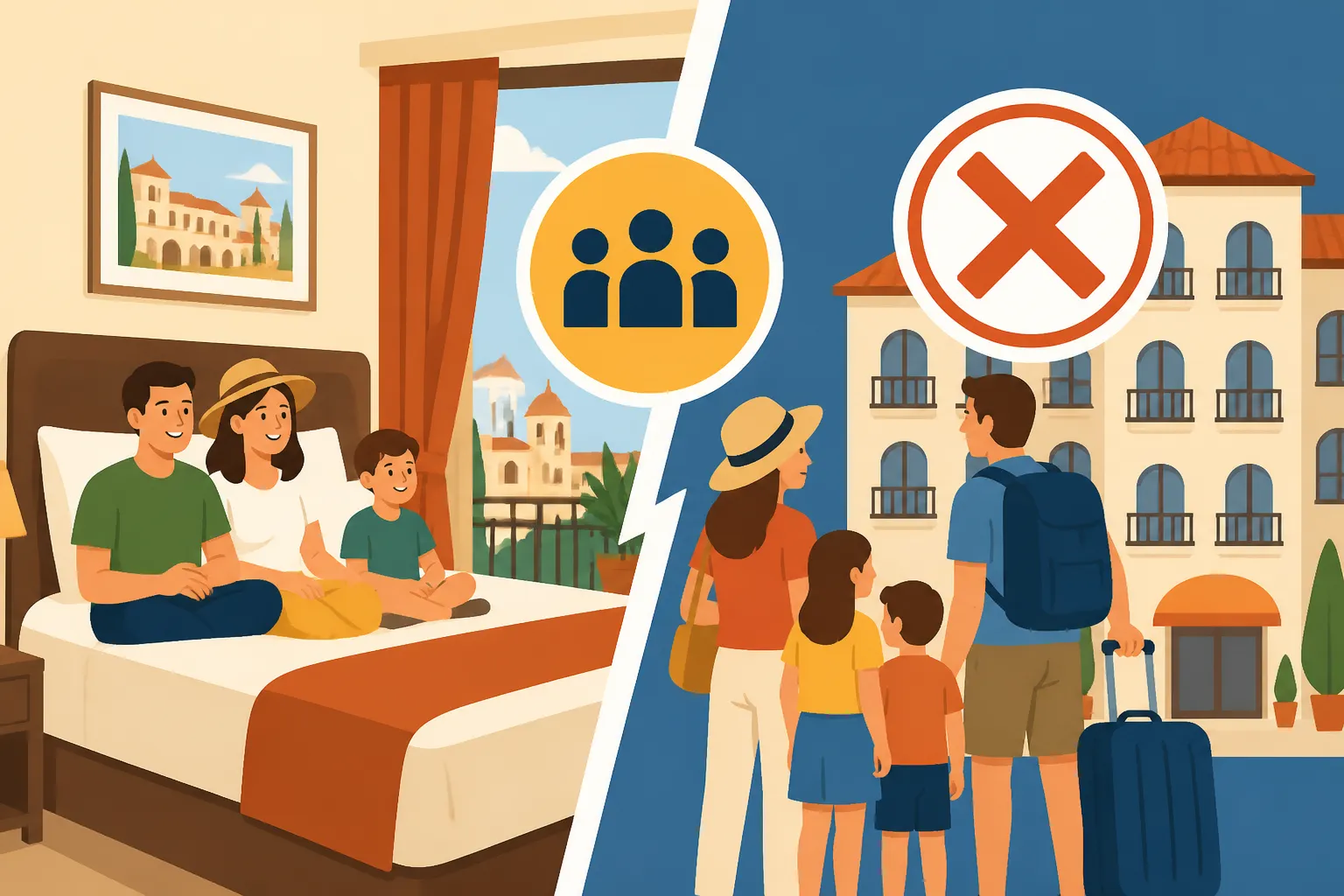
Why Spanish Hotels Cap Rooms at Three: Booking for Families of Four Plus
Oh, the perennial headache of trying to book a hotel in Spain when you’re traveling with more than just a couple! I know the drill: you excitedly punch in "4 guests" into the search bar, anticipating visions of sprawling family rooms or interconnected havens, only to be met with a frustrating chorus of "no availability" or a sudden leap in price for two separate rooms. It's a common stumbling block for expat families and tourists alike, and it often leaves you wondering if Spanish hotels are secretly campaigning for smaller families or if you're just doing something wrong. This guide is here to shed some light on why this happens and, more importantly, how you can navigate the system to find comfortable, family-friendly accommodation for your crew of four, five, or even more, with a keen eye on making your search on platforms like Booking.com a breeze.
Disclosure: This post may contain affiliate links. We may earn a commission at no extra cost to you if you make a purchase through these links. Read full disclosure.
Why Do Spanish Hotels Limit Room Occupancy? It’s Not Just About Space!
It might feel like a personal affront when you see a room with two double beds advertised, yet the booking system insists it can only host three people. You're thinking, "Surely two adults and two small children can fit in those beds!" But in Spain, especially with hotels, there's more to it than just the physical sleeping space.
Spanish Hotel Room Configurations and Classifications
The architecture and historical context of many Spanish buildings play a huge role in how hotel rooms are structured. Unlike some newer builds in other countries, older hotels, even renovated ones, often have rooms with specific, sometimes rigid, classifications.
When you look at hotel descriptions, you'll often encounter terms like habitación doble (double room), habitación matrimonial (room with a matrimonial bed, usually a queen or king), or habitación individual (single room). A habitación triple is usually a double bed with an added cama supletoria (extra bed) or three single beds, but these are far less common than you might think in standard hotel offerings. The core issue often lies in what the hotel is legally allowed to classify and sell as an occupancy. Even if a room physically has space for a rollaway bed or a child could theoretically share with parents, if the hotel isn't licensed or doesn't have the room type registered for that specific occupancy, it simply won't appear as an option. This is particularly true for independent hotels or charming boutique stays in historic city centers where room sizes and layouts are dictated by the original building structure.
Fire Safety and Occupancy Regulations
The biggest, often unseen, hand in this three-person cap is local and regional regulations, particularly concerning fire safety and building occupancy limits. These aren't arbitrary rules; they are put in place to ensure the safety of all guests. Each room has a maximum legal occupancy limit, which is strictly enforced by local authorities like the Ayuntamiento (city council) and tourism boards.
Imagine a charming hotel in the Gothic Quarter of Barcelona or a centuries-old building in Seville transformed into a boutique stay. These buildings often have narrow corridors, limited exits, and specific structural constraints that dictate how many people can safely occupy each room and, by extension, the entire building. Exceeding these limits could lead to severe fines for the hotel and, more importantly, could pose a real risk in an emergency. So, while it might seem counter-intuitive from a "bed space" perspective, the hotel isn't just being difficult; they are adhering to regulations that are sometimes stricter than what you might find in other countries. It’s a reality we often have to adapt to when living or traveling here, much like understanding other aspects of Spanish Customs, Etiquette, and Social Life.
The Frustration of Booking for Four or More
For families of four, five, or even more, this three-person cap can turn what should be an exciting travel planning session into a grueling exercise in frustration. It's not just about finding any place to sleep; it's about finding a place that works for your family's needs and budget.
The Search Engine Headache
You know the scenario: you jump onto a site like Booking.com, keen to find that perfect spot near the beach in Valencia or close to the Alhambra in Granada. You input "4 adults" (or 2 adults, 2 children), hit search, and watch as your options dwindle dramatically. Suddenly, you're left with only a handful of luxury suites at exorbitant prices, or perhaps places far out of the city center that require additional transport. Many excellent mid-range hotels that might have family rooms or connecting options simply don't show up in a generic search for "4 guests" because their standard rooms indeed cap at three.
This creates a significant hurdle. You end up spending hours tweaking search parameters, trying "3 guests" just to see what comes up, then trying to figure out if you could squeeze in the fourth, or if the hotel offers a paid extra bed not listed. It's a game of guesswork that adds unnecessary stress to what should be a straightforward task. This is where knowing the types of accommodation to look for, and how to specifically filter for them on platforms like Booking.com, becomes incredibly valuable.
Hidden Costs and Inconvenience of Multiple Rooms
Booking two separate standard rooms often seems like the only option, but it comes with its own set of problems. First and foremost, the cost can be significantly higher than a single, larger family room or apartment. You’re essentially paying for two separate accommodations, often with duplicated amenities you might not need.
Beyond the financial hit, there's the inconvenience, especially for families with young children. Will the two rooms be adjacent? Will they be on the same floor? Will they even be in the same section of the hotel? Leaving young kids in a separate room, even if it's next door, can be a major worry for parents. It can disrupt bedtime routines, make middle-of-the-night needs more complicated, and generally erode the feeling of being together as a family. Moreover, two separate rooms usually mean less communal space for unwinding, playing, or simply hanging out after a long day of sightseeing in a bustling city like Madrid or Barcelona. This is why many families prefer a single, cohesive living space, making solutions beyond traditional hotel rooms often more appealing. For general travel budgeting, it's good to keep in mind the overall Cost of Living in Spain: Realistic Budgets and Savings Tips.
Smart Strategies for Finding Family-Friendly Stays
Don't despair! While the three-person cap is real, there are plenty of ways around it. The key is to shift your mindset and your search strategy.
Understanding Room Types Beyond "Standard"
When you're searching, don't just look for "double" or "triple." Instead, actively seek out specific room types designed for families.
- Family Rooms (Habitaciones Familiares): These are purpose-built to accommodate more people, often featuring a larger main bed and additional single beds, bunk beds, or a sofa bed. They usually have a single occupancy limit that goes beyond three, often accommodating four or even five. The benefit here is that they are generally designed with families in mind, sometimes offering more space, child-friendly decor, or specific amenities.
- Connecting Rooms (Habitaciones Comunicadas): These are two separate rooms with an internal door connecting them, allowing for both privacy and easy access between family members. They are ideal for families with older children who appreciate their own space but still want to be close. You often need to request these specifically when booking, and they are not always guaranteed, so follow up with the hotel directly.
- Junior Suites / Suites: While often pricier, many suites come with separate sleeping areas (e.g., a bedroom and a living area with a sofa bed) that can comfortably house a family of four or more. These offer more space to spread out, which can be a godsend during longer stays. They often provide amenities like a small kitchenette or larger bathrooms.
When browsing on Booking.com, pay close attention to the room descriptions and layouts. Sometimes, a "Deluxe Double" might surprise you with a generous sofa bed perfect for two small children, even if the generic search results didn't highlight it for four guests. Always read the fine print under each room type.
Leveraging Search Filters and Direct Communication
This is where your detective skills come into play. Generic searches are fine to start, but then you need to get specific.
On platforms like Booking.com, you have powerful filters at your fingertips. After an initial search for your destination (e.g., Seville), look for options to filter by "Family rooms," "Apartments," or even "Aparthotels." This immediately narrows down the results to properties that are more likely to accommodate larger groups. Don't be afraid to specify the exact number of children and their ages, as some hotels have different policies for infants versus older kids. For instance, a baby in a crib might not count towards the "three-person" limit, whereas a 10-year-old would.
If you find a hotel that looks promising but its room descriptions are ambiguous, or if you're trying to secure connecting rooms, don't hesitate to contact the hotel directly. A quick email (even a Google-translated one if your Spanish isn't perfect) explaining your situation and asking about their family accommodation options, extra beds, or adjacent rooms can often yield a positive result. Many hotels are willing to be flexible or offer solutions not explicitly advertised online, especially if you book directly or mention you're looking on a platform like Booking.com and want to confirm details.
Considering Alternative Accommodation Types
Sometimes, the best solution isn't a traditional hotel room at all. Spain offers a fantastic array of alternative accommodation types that are often far better suited for families of four or more.
- Apartments (Apartamentos Turísticos): These are by far one of the best options. Fully furnished apartments, often with multiple bedrooms, a living area, and a fully equipped kitchen, provide ample space and the convenience of self-catering. You can find everything from cozy two-bedroom flats in cities to large villas near the coast. They offer more privacy, flexibility for meal times (especially if you have picky eaters), and can often be more cost-effective than two hotel rooms. Many apartments are available to book directly through Booking.com, which simplifies the search process immensely. You can even find platforms specifically for How to Find Family Rooms and Apartments in Spain.
- Aparthotels: These are a hybrid, offering the services of a hotel (reception, cleaning, sometimes breakfast) with the space and facilities of an apartment (kitchenette, living area). They are often ideal for families, striking a balance between convenience and independence. They are explicitly designed for longer stays and larger groups, often featuring dedicated family suites or multiple-bedroom units.
- Casas Rurales (Rural Houses): If you're venturing outside the major cities, a casa rural or cortijo (farmhouse) can be a phenomenal option. These are often charming, traditional homes in the countryside, mountains, or small villages, offering multiple bedrooms, large living spaces, and beautiful outdoor areas. They're perfect for larger families seeking a more authentic, tranquil experience and are generally very accommodating for children. This is a fantastic way to immerse your family in local culture and enjoy the natural beauty of Spain.
The Booking.com Advantage for Families
When it comes to finding that sweet spot for your family, Booking.com really shines as your go-to platform. Its robust filtering system and wide variety of listed properties, including apartments and aparthotels, give you a distinct advantage.
Specific Features for Family Searches
Booking.com isn't just for solo travelers or couples; it's designed with diverse travel needs in mind, and that absolutely includes families.
One of the most useful features on Booking.com is the ability to specify the number of children and their ages during your initial search. This is crucial because a hotel's policy on extra beds or occupancy limits often changes based on a child's age. For instance, a toddler might be able to stay for free in existing bedding or a crib, while an older child might require an additional charge or a dedicated bed that pushes the room over its standard occupancy. By inputting this information accurately upfront, Booking.com can filter results to show you properties and rooms that genuinely accommodate your family's specific makeup, rather than just generic "three-person" options.
Furthermore, Booking.com’s extensive inventory includes not only traditional hotels but also a vast selection of apartments, aparthotels, and holiday homes. This is incredibly beneficial for families facing the three-person cap, as these alternative accommodations are inherently designed for larger groups and offer more space. You can easily switch between viewing "Hotels" and "Apartments" in your search results, or apply filters to specifically look for "Family rooms" or properties with kitchen facilities. This single-platform convenience saves you from jumping between multiple websites, streamlining your search for the perfect family base, whether you're planning an urban adventure or a relaxing beach holiday. For example, if you're exploring Family Travel in Spain: Kid-Friendly Cities and Activities, Booking.com can help narrow down suitable stays in those regions.
Reading Reviews and Amenities Carefully
Don't underestimate the power of fellow travelers' insights! When you find a promising property on Booking.com, dive deep into the reviews. Other families who have stayed there will often share invaluable tips on room sizes, bed configurations, the friendliness of staff towards children, and available amenities like cribs, high chairs, or even small play areas. Look for mentions of "spacious family room," "connecting doors were perfect," or "loved having a kitchenette for breakfast."
Beyond reviews, thoroughly scrutinize the "Facilities" or "Amenities" section on each property's page on Booking.com. This is where you'll find details about:
- Bed configurations: Does the "family room" come with a double bed and two singles, or is it a double and a sofa bed? Understanding this helps you ensure everyone has a comfortable sleeping arrangement.
- Child-friendly services: Is there a crib available (often free or for a small charge)? Are there kids' clubs, playgrounds, or a children's pool? These can make a huge difference to your stay.
- Kitchen facilities: If you're staying in an apartment or aparthotel, note what kitchen equipment is provided. A microwave, fridge, and basic cooking utensils can be lifesavers for preparing simple meals or snacks, especially for little ones. This can also help you save money on dining out, making it easier to stick to your Cost of Living in Spain: Realistic Budgets and Savings Tips.
Booking.com consolidates all this information in one place, making it easier to compare options and make an informed decision for your family.
Exploring Practical Accommodation Solutions
Let’s dig deeper into the types of accommodations that truly cater to families of four or more, moving beyond the traditional hotel room limitations.
Aparthotels and Holiday Apartments
These are often the unsung heroes of family travel in Spain, providing the space and flexibility that conventional hotels struggle to offer.
- Aparthotels: Think of them as the best of both worlds. You get the benefits of a hotel—a reception desk, often daily cleaning, perhaps a communal pool or breakfast option—combined with the spaciousness and autonomy of an apartment. Most aparthotels feature units with separate living areas and often one or two bedrooms, plus a small kitchen or kitchenette. This means you can store snacks, prepare simple meals, and have a designated space for kids to play or for adults to relax after bedtime without disturbing sleeping children. Many are strategically located in city centers or popular tourist areas, making them incredibly convenient for exploring. They are also usually explicitly designed to accommodate more than three people, so you won't hit that frustrating cap. Booking.com offers a fantastic range of aparthotels across Spain, from the bustling streets of Madrid to the coastal towns of Andalusia.
- Holiday Apartments (Apartamentos Turísticos): This category offers even greater variety and often more space. From chic city flats to sprawling beachside residences, holiday apartments are perfect for families who want to live like locals. You’ll typically find multiple bedrooms, a full kitchen, a living/dining area, and often laundry facilities—a blessing for traveling families. This means less stress about meal times, more room for everyone to have their own space, and the ability to save money by cooking some meals in. When considering apartments, you might encounter different rental terms than hotels, so it’s always wise to understand details like deposits and check-in procedures, similar to navigating Renting in Spain: Contracts, Deposits, and Tenant Rights. Platforms like Booking.com excel in listing a vast selection of these apartments, allowing you to filter by the number of bedrooms, amenities, and location, ensuring you find a spot that perfectly fits your family's size and needs.
Rural Stays (Casas Rurales and Cortijos)
If your Spanish adventure extends beyond the big cities and you dream of serene landscapes, charming villages, and a slower pace, then a casa rural or cortijo (traditional farmhouse, especially in the south) might be your ideal family solution.
These properties are almost always large enough to comfortably accommodate families of four, five, or even larger groups. They are typically independent houses or guesthouses nestled in Spain's stunning countryside, from the green hills of Galicia to the olive groves of Andalucía. They offer:
- Abundant space: Multiple bedrooms, large living rooms, and often extensive outdoor areas like gardens, patios, or even private pools.
- Authentic experience: A chance to immerse yourselves in local culture, enjoy regional cuisine, and discover Spain's natural beauty away from the tourist crowds.
- Flexibility: The kitchen facilities are usually full-sized, allowing for complete self-catering. This can be fantastic for families, offering the freedom to eat on your own schedule and cater to specific dietary needs.
- Value: Especially for larger families, renting a casa rural can be surprisingly cost-effective compared to booking multiple hotel rooms, particularly during off-peak seasons.
Imagine waking up to birdsong in a tranquil village near Ronda, spending the day exploring olive groves, and returning to cook a delicious meal with local ingredients, a wonderful alternative to constant restaurant dining. For stocking up on supplies, you’ll find plenty of local markets and supermarkets to explore, helping you engage in Spanish Shopping: Supermarkets, Markets, and Budget Strategies. Booking.com often lists many of these charming rural properties, making it easy to discover unique stays that promise unforgettable family memories.
Connecting Rooms and Suites (with a caveat)
While apartments and aparthotels are often your best bet, sometimes a hotel experience is what you truly crave. In these cases, aim for connecting rooms or larger suites, but be prepared for potential trade-offs.
- Connecting Rooms: As mentioned, these are two adjacent rooms with an internal door. They offer the perfect balance of proximity and privacy, allowing parents to have their own space while children are just a door away. However, availability can be limited, and they often need to be specifically requested and confirmed with the hotel, even if you book through Booking.com. It's wise to contact the hotel directly after booking to reiterate your request. They might also come at a higher price than two standard rooms booked separately if offered as a package.
- Larger Suites: Many hotels, particularly higher-end establishments, offer spacious suites that can easily accommodate families. These often feature a main bedroom and a separate living area with a high-quality sofa bed, or sometimes even a second small bedroom. While pricier than standard rooms, the extra space and amenities can be worth it for comfort, especially for longer stays. Be sure to check the exact bedding configuration in the suite description on Booking.com to ensure it meets your family’s sleeping needs.
Both connecting rooms and suites provide the benefit of remaining within a traditional hotel environment, which might include access to hotel facilities like pools, restaurants, and concierge services. However, they might not offer kitchen facilities or the same level of independence as an apartment.
Essential Tips for a Smooth Family Stay in Spain
Beyond just booking the room, a few extra considerations can make all the difference for a family trip to Spain.
Confirming Bedding and Amenities in Advance
Once you’ve booked your family accommodation, especially if you’ve used a platform like Booking.com, it’s always a good idea to follow up directly with the property. This is your chance to confirm specific details that are critical for family comfort.
- Bedding Configuration: Reconfirm the exact sleeping arrangements. For instance, if you booked a family room, ask if it's two separate beds or a double bed with a sofa bed. If you need a baby crib (cuna), confirm it’s reserved and available in the room upon arrival. There's nothing worse than arriving tired with small children only to find a misunderstanding about where everyone will sleep.
- Extra Beds: If an extra bed (cama supletoria) was part of your booking or an arrangement made with the hotel, ensure it's noted in their system. Sometimes there's a small charge for these, so confirm that as well to avoid surprises.
- Specific Requests: If you have any specific needs, such as a room on a lower floor, near an elevator, or away from street noise, this is the time to politely ask. While not always guaranteed, hotels will often try to accommodate family requests where possible.
This proactive communication, even if just a polite email, can prevent many common travel woes and ensures that your family’s arrival is as smooth as possible.
Location, Location, Location
Choosing the right neighborhood can make or break a family trip. When looking at properties on Booking.com, don't just consider the accommodation itself, but also its surroundings.
- Proximity to Attractions: Are you near the historical center, a science museum, or a park that the kids will love? Minimizing travel time to activities is key for keeping young travelers happy.
- Public Transport Access: Even if you plan on walking, easy access to the metro, bus, or tram lines can be invaluable for tired legs. Being able to quickly hop on a bus back to your apartment after a long day exploring Seville's Alcázar or walking through Barcelona's Parc Güell is a huge relief. This is especially true for navigating Getting Around Spanish Cities: Metro, Bus, Tram, and Bikes.
- Amenities Nearby: Look for places close to supermarkets, pharmacies, and family-friendly restaurants. Having a supermercado within walking distance of your apartment is incredibly convenient for picking up snacks, drinks, and breakfast items, especially if you're self-catering. Access to a local park or playground can also be a lifesaver for burning off some energy before bedtime.
Booking.com’s map feature is excellent for this. You can see precisely where a property is located relative to key landmarks, public transport stops, and essential services, helping you make an informed decision about the best base for your family's Spanish adventure.
Booking in Advance and Flexibility
Family-sized accommodations are typically more limited in number than standard double rooms, and they get booked up quickly. This is especially true for popular destinations like the Balearic Islands or cities like Barcelona during peak travel seasons (summer, Easter, Christmas, or major fiestas).
- Book Early: For the best selection and prices, start your search and book your family-friendly accommodation well in advance. Six months to a year out isn't excessive for high season travel, particularly if you're looking for specific apartment types or connecting rooms.
- Be Flexible: If your travel dates are flexible, try searching for different weekdays or slightly off-peak weeks. Even shifting your arrival or departure by a day or two can sometimes open up more options for larger rooms or apartments. Similarly, consider slightly less-traveled destinations or neighborhoods. Instead of only looking at the absolute city center, expand your search to adjacent areas that might offer more space and better value, often with excellent public transport links.
- Consider Off-Season: Traveling during the shoulder seasons (spring and autumn) not only offers milder weather but also typically means fewer crowds and better availability for family rooms and apartments. This can result in a more relaxed and enjoyable trip for everyone. Keep an eye on the Spanish Holidays and Public Closures: Planning Errands to avoid unexpected closures or crowds, especially around major festivals like Semana Santa or Christmas.
By being strategic and planning ahead, you can significantly increase your chances of finding comfortable, convenient, and cost-effective accommodation for your family of four or more in beautiful Spain. So, dive into Booking.com with these tips in mind, and happy travels!
| Accommodation Type | Best For | Key Advantages | Booking.com Feature/Tip |
|---|---|---|---|
| Aparthotel | Families of 4+, longer stays, mix of service and space | Kitchenette, living area, hotel services (reception, cleaning) | Filter by "Aparthotel" or "Apartment" and "Family rooms" |
| Holiday Apartment | Larger families, self-catering, living like a local | Multiple bedrooms, full kitchen, laundry, privacy | Filter by "Apartment," specify number of bedrooms |
| Casa Rural | Rural escapes, authentic experience, large groups | Abundant space, natural surroundings, often multiple facilities | Filter by "Holiday homes" or "Country houses" and location |
| Hotel Family Room | Families wanting hotel amenities, specific design | Dedicated family space, pre-configured bedding for 4+ | Filter by "Family rooms," check room descriptions carefully |
| Hotel Connecting Rooms | Families with older kids, need for privacy & proximity | Internal door between two standard rooms | Request directly from hotel after booking a "Double" or "Twin" |
| Hotel Suite | Families seeking luxury and space, separate living area | Separate sleeping areas, more room to spread out, often kitchenette | Filter by "Suite," check occupancy & bedding in description |
Disclaimer
This article is for general informational purposes only and does not constitute professional advice. Laws, prices and regulations vary by location and change over time. Consult a qualified professional for guidance on your specific situation.