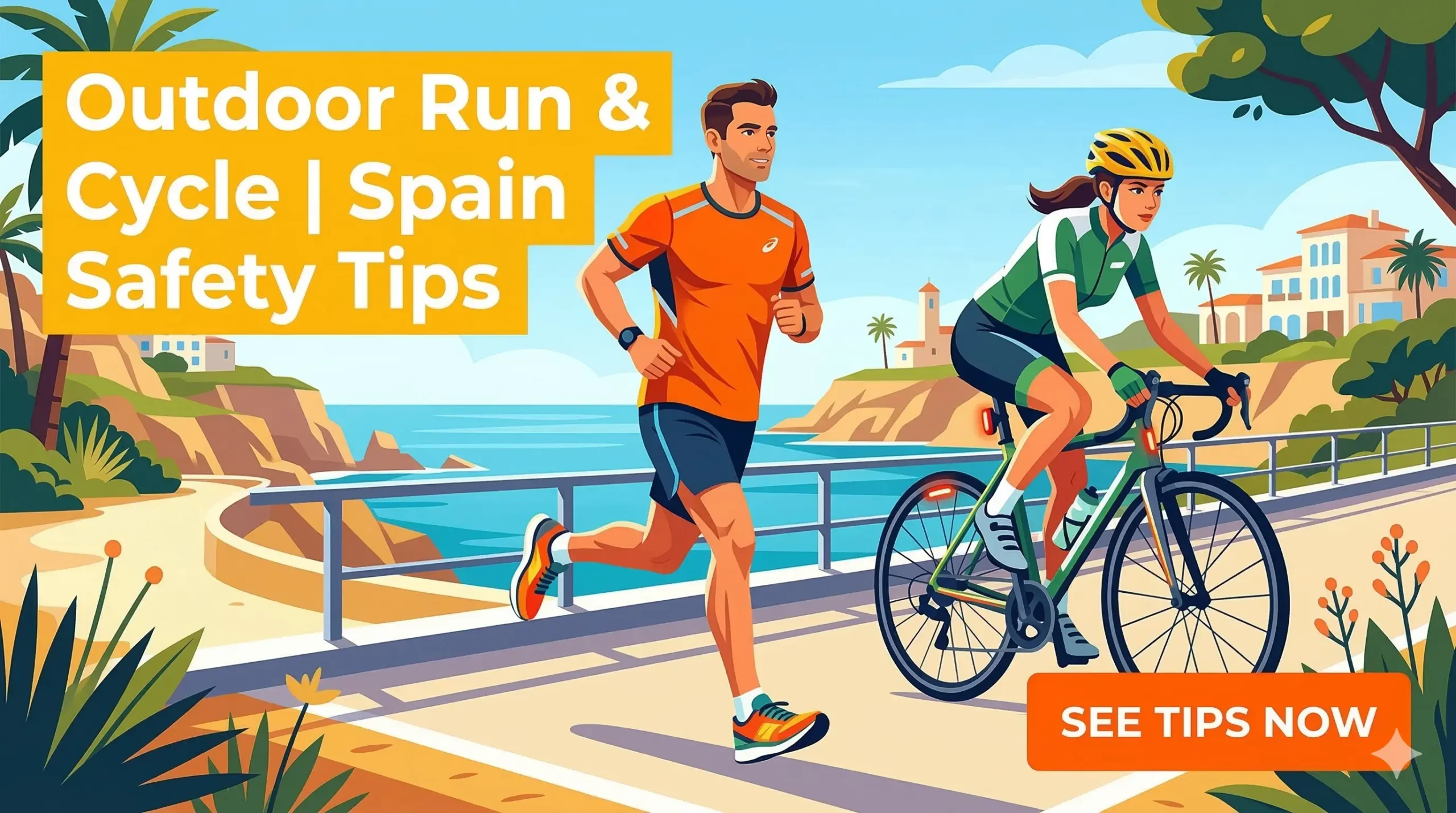
Outdoor Running and Cycling in Spain: Safety Tips for Newcomers
Hitting the open roads of Spain for a morning cycle or run sounds idyllic until a massive delivery truck buzzes past you with less than a meter to spare. I remember freezing in sheer panic during my first ride in Mallorca because I completely misunderstood the roundabout rules. This guide explains Spanish road etiquette, safety laws, and exactly how to protect yourself while training.
Disclosure: This post may contain affiliate links. We may earn a commission at no extra cost to you if you make a purchase through these links. Read full disclosure.
Decoding Spanish Cycling and Running Laws
The Dirección General de Tráfico (DGT) governs the roads in Spain, and their rules for vulnerable road users like cyclists and runners are incredibly specific and strictly enforced. Assuming you can simply jog or ride the exact same way you did back in your home country is a fast track to a hefty fine—or a highly dangerous accident.
Mandatory Helmets and Reflective Gear
For cyclists, Spain’s helmet laws are a frequent source of expat confusion because they change depending on exactly where you are riding. If you are cycling on interurban roads (highways or country roads outside of city limits), wearing a certified helmet is legally mandatory for everyone, regardless of age. The only legal exceptions are during periods of extreme heat, on steep uphill climbs, or for professional cyclists. However, within urban city centers, helmets are only legally mandatory for children under 16, though they are highly recommended for adults.
When it comes to visibility, the DGT is completely uncompromising. If you are cycling or running on interurban roads between sunset and sunrise, or during periods of low visibility (like dense morning fog), you are legally required to wear high-visibility reflective clothing that can be seen from at least 150 meters away. Cyclists must also have a white front light, a red rear light, and a rear red reflector installed on their bikes. Failing to have proper lighting or reflective gear carries a €200 fine.
Road Positioning and Pedestrian Rules
If you are a road cyclist, you must ride on the right side of the road and utilize the hard shoulder (arcén) if it is passable and clear of debris. Spain allows cyclists to ride two abreast (side-by-side) to improve visibility, but you must drop into single file on blind curves, narrow roads, or when traffic is heavily congested behind you. Cars are legally required to leave a minimum of 1.5 meters of space when overtaking a cyclist and must slow down by 20 km/h below the posted speed limit to do so safely.
If you are a runner navigating country roads without sidewalks, the rules flip entirely: you must run on the left side of the road, facing oncoming traffic. This allows you to see approaching vehicles and step safely onto the verge if necessary.
A massive cultural trap for expats is the strict ban on headphones. It is completely illegal to cycle or run on any public road in Spain while wearing headphones or earbuds—even if you only have one earbud in. The fine for this is an immediate €200. You must be able to hear ambient traffic. Additionally, cyclists must remember that they are considered vehicles; you must dismount and walk your bike across zebra crossings unless it is specifically painted as a continuous, dedicated bike lane.
| Rule / Requirement | Cyclists | Runners (on roads without sidewalks) |
| Road Positioning | Ride on the Right (with traffic) | Run on the Left (facing traffic) |
| Helmet Requirement | Mandatory on interurban roads | Not applicable |
| Headphones/Earbuds | Strictly Prohibited (€200 fine) | Strictly Prohibited on roads |
| Reflective Gear | Mandatory at night/low visibility | Mandatory at night/low visibility |
| Zebra Crossings | Must dismount and walk | Standard pedestrian right of way |
Navigating the Elements and Terrain
Spain’s geography is incredibly diverse, offering everything from flat coastal promenades to grueling alpine ascents. However, the environmental factors require careful planning to ensure you return from your workout safely.
The Brutal Spanish Sun and Heat
The most immediate danger to outdoor athletes in Spain is the climate. The Mediterranean summer heat is unforgiving, and running at noon in July is not just uncomfortable; it is a genuine medical hazard. To protect yourself, you must strictly time your workouts for the early morning (before 9:00 AM) or late evening. If you want to understand the biological toll of the midday sun and the difference between heat exhaustion and a true emergency, review our guide on Heatstroke vs Dehydration: Prevention Tips for Spain Summers.
Furthermore, the UV index in Spain can reach extreme levels even on breezy spring days. Relying on a simple baseball cap is not enough. You need high-grade sports sunscreen, polarized sunglasses, and breathable, UV-protective clothing. For a complete breakdown of how to read the local UV forecasts and protect your skin barrier, read Sun Safety in Spain: UV Index Basics and Habits.
Rural Routes vs. Urban Planning
If you want to avoid the stress of vehicular traffic entirely, Spain offers an incredible network known as the Vías Verdes (Greenways). These are thousands of kilometers of decommissioned railway lines that have been paved and repurposed exclusively for cyclists, runners, and walkers. They are flat, highly scenic, and entirely motor-vehicle-free, making them the absolute safest option for long weekend training sessions.
In major cities like Madrid, Barcelona, and Valencia, urban planning has heavily shifted to accommodate micro-mobility. You will find extensive carriles bici (dedicated bike lanes). If a bike lane is available, cyclists are strongly encouraged (and sometimes locally mandated) to use it rather than the main car lane. However, be highly vigilant of wandering pedestrians and tourists stepping into the bike lanes without looking.
Health, Nutrition, and Emergency Preparedness
Pushing your physical limits in a new country means you have to be fully prepared for the biological recovery phase, as well as the unfortunate possibility of a sports-related injury.
Sports Nutrition and Supplements
Training in the Spanish heat drains your body of critical electrolytes and trace minerals at an alarming rate. When you finish a grueling 50km ride or a long run, you cannot rely solely on tap water to recover. While you can walk into any local pharmacy to buy basic suero oral (rehydration salts)—a triage process we explain in Can a Pharmacist in Spain Help With Minor Illness? What to Expect—these local options are often packed with artificial sugars and heavy dyes.
Furthermore, Spanish pharmacies and local supermarkets frequently carry massive retail markups on specialized sports nutrition. Trying to find clean-ingredient whey protein isolate, high-grade BCAAs, or premium joint-support formulas locally is deeply frustrating and incredibly expensive. To better understand why the out-of-pocket costs for specialty health items are so severe locally, you can review our breakdown on Health Costs in Spain: Typical Co-Pays and Out-of-Pocket Fees.
To bypass this frustrating retail gap, the international athletic community in Spain relies heavily on iHerb. By ordering your specific electrolyte powders, post-workout protein, and inflammation-reducing supplements like turmeric or magnesium directly through iHerb, you gain access to the exact, trusted international wellness brands you used back home. Having a dedicated sports nutrition stash delivered directly to your Spanish door via iHerb ensures you are actively supporting your muscle recovery. Navigating a foreign retail landscape is exhausting; relying on iHerb to effortlessly restock your specific training supplements puts the control firmly back in your hands, allowing you to focus entirely on your athletic performance.
Dealing with Accidents and Insurance
No matter how carefully you signal or how brightly you dress, accidents happen. Slipping on a wet cobblestone or getting clipped by a distracted driver requires immediate administrative and medical action. If you suffer a minor crash, knowing exactly what paperwork to collect at the clinic is vital; read What to Do After a Minor Accident in Spain: Insurance and Care Steps so you do not leave without your necessary medical reports. If the accident is severe, such as a major collision or broken bones, you must know how to dispatch an ambulance quickly by reviewing How to Call 112 in Spain: What to Say and What Happens Next.
For non-emergency sports injuries—like a torn meniscus from running or severe IT band syndrome from cycling—the state-funded public health system is notoriously slow. You could easily wait months for a public physiotherapy appointment, completely derailing your training season. You can deeply explore these systemic delays in our overview of the Spain Healthcare System for Expats: Public vs Private.
Bypassing this agonizing public queue is precisely why using an expert, expat-focused broker like Innoinsure is an absolute necessity for active foreigners. A dedicated, bilingual agent from Innoinsure can seamlessly set up a premium private health policy that grants you immediate, unrestricted access to a vast network of top-tier, English-speaking sports medicine doctors and physiotherapists in your specific city.
With a policy secured through Innoinsure, you can skip the general practitioner referral completely, open your provider’s app, and book a private physio session for the very next day. To fully understand the financial structure of these premium networks before you sign a contract, read our breakdown on How to Compare Private Health Plans: Deductibles, Co-Pays, Networks. Furthermore, if you simply have a lingering joint ache and want a quick professional opinion without dragging yourself to a clinic, many premium policies through Innoinsure offer robust 24/7 digital doctor consultations. Discover how to safely leverage this digital perk in Telemedicine in Spain: When It’s Useful and What to Expect to keep your training on track safely. Finally, if you do end up in a clinic with an injury, knowing how to explain the pain is essential; brush up on your vocabulary with Spanish Emergency Phrases: How to Describe Symptoms Quickly.
References
Primary sources (official)
- Dirección General de Tráfico (DGT) – Normas para ciclistas: https://www.dgt.es/muevete-con-seguridad/viaja-seguro/en-bicicleta/
- Vías Verdes (Fundación de los Ferrocarriles Españoles): https://www.viasverdes.com/
Other helpful sources
- Expatica – Cycling in Spain: Rules and safety: https://www.expatica.com/es/lifestyle/sports-fitness/cycling-in-spain-106758/
- Real Federación Española de Ciclismo (RFEC): https://rfec.com/
Disclaimer
The information provided in this article is for educational and informational purposes only and does not constitute formal legal, medical, or insurance advice. Traffic laws, local municipal regulations, and private insurance coverage limits vary significantly across Spain’s autonomous communities. Always consult directly with the DGT for the most up-to-date road safety regulations, and speak with a licensed medical professional or certified insurance broker regarding specific sports injuries, nutritional requirements, and healthcare coverage. If you are involved in a severe road traffic accident, dial 112 immediately.