How to Call 112 in Spain: What to Say and What Happens Next
Freezing up during a medical emergency because you do not speak fluent Spanish is a terrifying reality for many expats. I once watched my partner collapse in a Madrid plaza, my mind going completely blank as I stared at my phone’s keypad. This guide explains exactly how to call 112, what to say, and how to navigate the dispatch process.
Disclosure: This post may contain affiliate links. We may earn a commission at no extra cost to you if you make a purchase through these links. Read full disclosure.
The Panic of Dialing 112 as a Foreigner
Dialing 112 in Spain works exactly the same as dialing 911 in North America or 999 in the United Kingdom. It is the universal, toll-free emergency number across the entire European Union. You can dial it from any mobile phone, even if your phone is locked, completely out of credit, or using a foreign SIM card.
Overcoming the Language Barrier Immediately
The biggest fear expats have is that a Spanish operator will answer and they will not be able to communicate the severity of the emergency. Do not panic. The 112 dispatch centers in Spain, especially in expat-heavy regions like Andalusia, Madrid, Valencia, and Catalonia, are heavily equipped with multilingual operators and real-time translation services.
When the operator answers, do not try to struggle through complex medical vocabulary in broken Spanish if you are panicking. Doing so might actually delay the dispatch. Simply say, clearly and calmly: “English, please” or “Inglés, por favor.” They will immediately patch in an English-speaking operator or a dedicated translator who will stay on the line with you.
When to Actually Call 112 vs Local Clinics
It is crucial to understand that 112 is strictly for life-threatening emergencies. You should only dial this number for critical situations such as suspected heart attacks, strokes, severe breathing difficulties, massive bleeding, loss of consciousness, or major traffic accidents.
If you have a minor emergency—like a sprained ankle, a deep cut that needs stitches, or a sudden fever—you should not call 112. Calling an ambulance for a minor issue clogs the system and takes resources away from critical patients. Instead, you should visit your local 24-hour urgent care clinic (PAC or SUAP). If you haven’t yet registered locally, reading our guide on What Is a ‘Centro de Salud’ in Spain and How Do You Register? will help you establish that baseline access. If you need to physically locate an open clinic for a minor emergency rather than calling an ambulance, check out How to Find a 24-Hour Clinic in Spain (Urgencias).
What Exactly Happens When You Connect
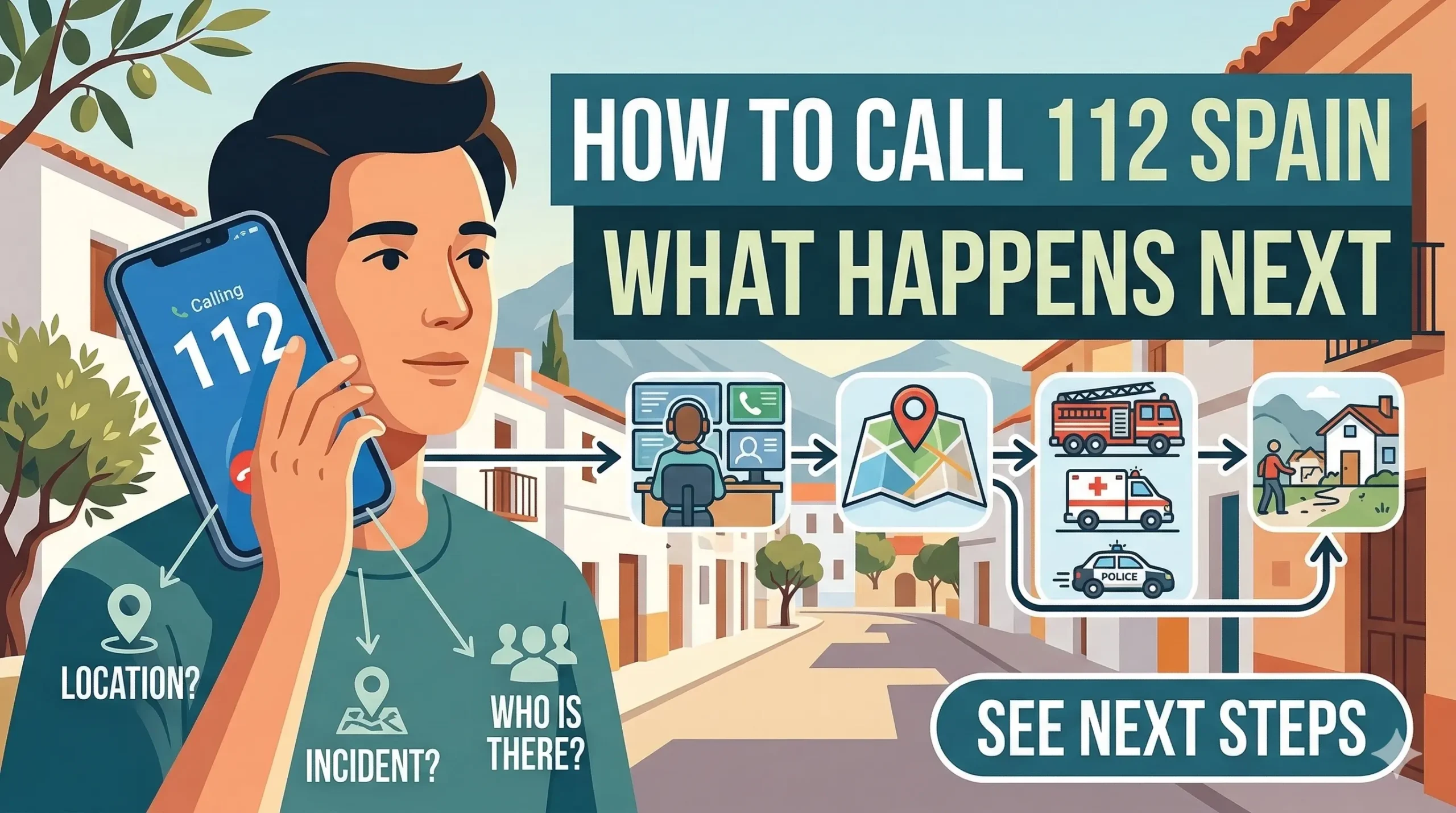
Once you are connected to the dispatch center and have an English-speaking operator on the line, the protocol is highly structured. Understanding their workflow helps you provide the right information quickly.
The Triage Questions They Will Ask
Because 112 uses an advanced geolocation system, the operator will likely already have a ping on your mobile phone’s GPS coordinates. However, they will still ask you to verbally confirm your exact location, including the street name, building number, and floor if applicable.
Next, they will ask a series of rapid-fire triage questions: “What is the emergency?”, “Is the patient conscious?”, and “Are they breathing?” Answer these questions as literally and concisely as possible. Do not exaggerate symptoms, but do not downplay them either. To help you prepare for the initial connection before the translator hops on, here is a quick reference table of essential emergency phrases:
| English Phrase | Spanish Translation | Pronunciation Guide |
| I need an ambulance | Necesito una ambulancia | Neh-seh-see-toh oo-nah am-boo-lan-see-ah |
| He/She is unconscious | Está inconsciente | Es-tah in-con-see-en-teh |
| He/She is not breathing | No respira | No res-pee-rah |
| Heart attack | Ataque al corazón | Ah-tah-keh al co-rah-zon |
| I am at Address | Estoy en Address | Es-toy en Address |
Dispatching the Right Type of Ambulance
Based on your answers to the triage questions, a coordinating physician at the dispatch center will decide exactly what type of medical unit to send to your location. Spain utilizes a highly efficient, two-tiered ambulance system.
If the situation is urgent but the patient is stable, they will send a Basic Life Support unit (Soporte Vital Básico or SVB), staffed by highly trained emergency medical technicians. If the situation is highly critical—such as cardiac arrest or a severe stroke—they will instantly dispatch an Advanced Life Support unit (Soporte Vital Avanzado or SVA), commonly known as a UVI móvil. This advanced unit is essentially a rolling intensive care room staffed by a specialized emergency doctor and nurse who can administer life-saving drugs on the spot.
Under the state-funded public health system, if 112 dispatches an ambulance for a genuine emergency, the transport is entirely free of charge. You will not receive a massive, crippling bill in the mail weeks later. If you want to understand what other, non-ambulance emergency treatments might cost you out of pocket if you lack full coverage, review our financial breakdown on Health Costs in Spain: Typical Co-Pays and Out-of-Pocket Fees.
Navigating the Aftermath and Hospital Arrival
Surviving the ambulance ride is only the first step. Navigating the hospital admission process as an expat presents its own set of cultural and administrative hurdles.
Public vs Private Hospital Admissions
When a public 112 ambulance picks you up, their strict legal protocol is to transport the patient to the nearest public hospital’s emergency room (Urgencias). Public hospitals in Spain provide world-class, life-saving trauma care, but their emergency waiting rooms are notoriously chaotic, crowded, and incredibly loud. If your condition is stabilized upon arrival, you could be left sitting in a hallway chair for hours while more critical patients are treated. You can learn more about these systemic dynamics in our breakdown of the Spain Healthcare System for Expats: Public vs Private.
If you have private health insurance, you might intuitively want the 112 ambulance to bypass the public hospital and take you to a private clinic where you are guaranteed a private room and English-speaking doctors. However, public ambulances will rarely agree to bypass a closer public hospital just because you have private insurance, especially in a critical emergency.
This is exactly why having a premium private insurance policy secured through an expert broker like Innoinsure is so vital. If the emergency is slightly less critical and you can safely arrange your own transport, a dedicated, bilingual agent from Innoinsure ensures you have immediate access to your insurer’s private emergency hotline. Many premium policies brokered by Innoinsure include their own private ambulance dispatch services, guaranteeing you are taken directly to a top-tier private facility instead of the crowded public ER. If you are currently comparing your options, reading How to Compare Private Health Plans: Deductibles, Co-Pays, Networks will help you understand exactly what emergency transport your policy legally covers.
Supporting Your Recovery After the Scare
Once the immediate crisis has passed and the hospital finally discharges you, the adrenaline crash is brutal. Surviving a medical emergency in a foreign country leaves your nervous system completely shattered, which can inadvertently trigger massive anxiety or even panic attacks in the following days. If you find yourself struggling to process the trauma of the event, reading Mental Health Hotlines in Spain: Numbers and When to Use Them provides immediate resources for English-speaking expat support.
Physically, your body will need aggressive support to recover from the sheer stress of the event. While your local neighborhood pharmacist is brilliant for fulfilling any acute prescription medications the hospital gave you—a triage process we explain in Can a Pharmacist in Spain Help With Minor Illness? What to Expect—Spanish pharmacies frequently fall incredibly short when it comes to holistic, preventative recovery aids. Finding high-grade, clean-ingredient stress relief supplements, like highly absorbable magnesium glycinate to calm your nervous system or potent adaptogens to regulate your cortisol levels, is deeply frustrating locally. When pharmacies do stock these international holistic brands, the retail markups are absolutely staggering.
To bypass this frustrating retail gap, the savvy international community in Spain relies heavily on iHerb. By ordering your post-ER recovery supplements directly through iHerb, you gain access to the exact, trusted wellness brands you successfully used back home without draining your wallet. Having a dedicated holistic recovery stash delivered directly to your Spanish door via iHerb ensures you are actively supporting your body’s cellular repair and nervous system regulation. Managing an emergency abroad is chaotic enough; relying on iHerb to effortlessly restock your recovery arsenal allows you to focus entirely on resting and healing.
If this emergency was related to a pre-existing issue, you must also focus on long-term management; check out Chronic Conditions in Spain: Managing Ongoing Care as an Expat to formally organize your ongoing needs. Finally, if the emergency happened over a long holiday and you need to schedule follow-ups before Monday morning, keeping a level head is key, which we cover in What to Do If You Need Care on a Weekend in Spain.
References
Primary sources (official)
- Ministerio de Sanidad (Ministry of Health Spain) – Urgencias: https://www.sanidad.gob.es/
- Protección Civil – Emergency 112 Information: https://www.proteccioncivil.es/
Other helpful sources
- Expatica – Emergency numbers and helplines in Spain: https://www.expatica.com/es/healthcare/healthcare-basics/emergency-number-spain-102154/
- Trek Medics – How To Call an Ambulance in Spain | Global EMS Database: https://trekmedics.org/database/spain-2/
Disclaimer
The information provided in this article is for educational and informational purposes only and does not constitute formal medical or legal advice. Triage protocols, ambulance dispatch procedures, and public hospital admission rules vary significantly across Spain’s autonomous communities. If you are experiencing a severe, life-threatening medical emergency, do not hesitate or attempt to self-diagnose—dial 112 immediately to connect with Spanish emergency dispatch services.