How to Use Spanish ATMs Safely: Skimming and Scam Prevention
Losing my bank card to an ATM scam on my second day in Madrid was a terrifying introduction to Spain that left me financially paralyzed. Expats frequently fall victim to physical skimming, organized distraction thefts, and hidden banking traps simply because they do not recognize what local threats look like. This comprehensive guide explains how to identify compromised machines, dodge predatory exchange rates, and safely withdraw your cash.
Disclosure: This post may contain affiliate links. We may earn a commission at no extra cost to you if you make a purchase through these links. Read full disclosure.
The Anatomy of Spanish ATM Scams
Even though Spain is rapidly shifting toward digital payments, you will inevitably need physical euros to survive the local economy, a reality fully explored in When to Use Cash in Spain: Practical Scenarios in 2027. Unfortunately, relying on ATMs exposes you to highly organized networks of thieves who specifically target foreigners in tourist-heavy areas like Barcelona’s Gothic Quarter, central Madrid, and the coastal towns of the Costa del Sol.
Skimmers and the Lebanese Loop
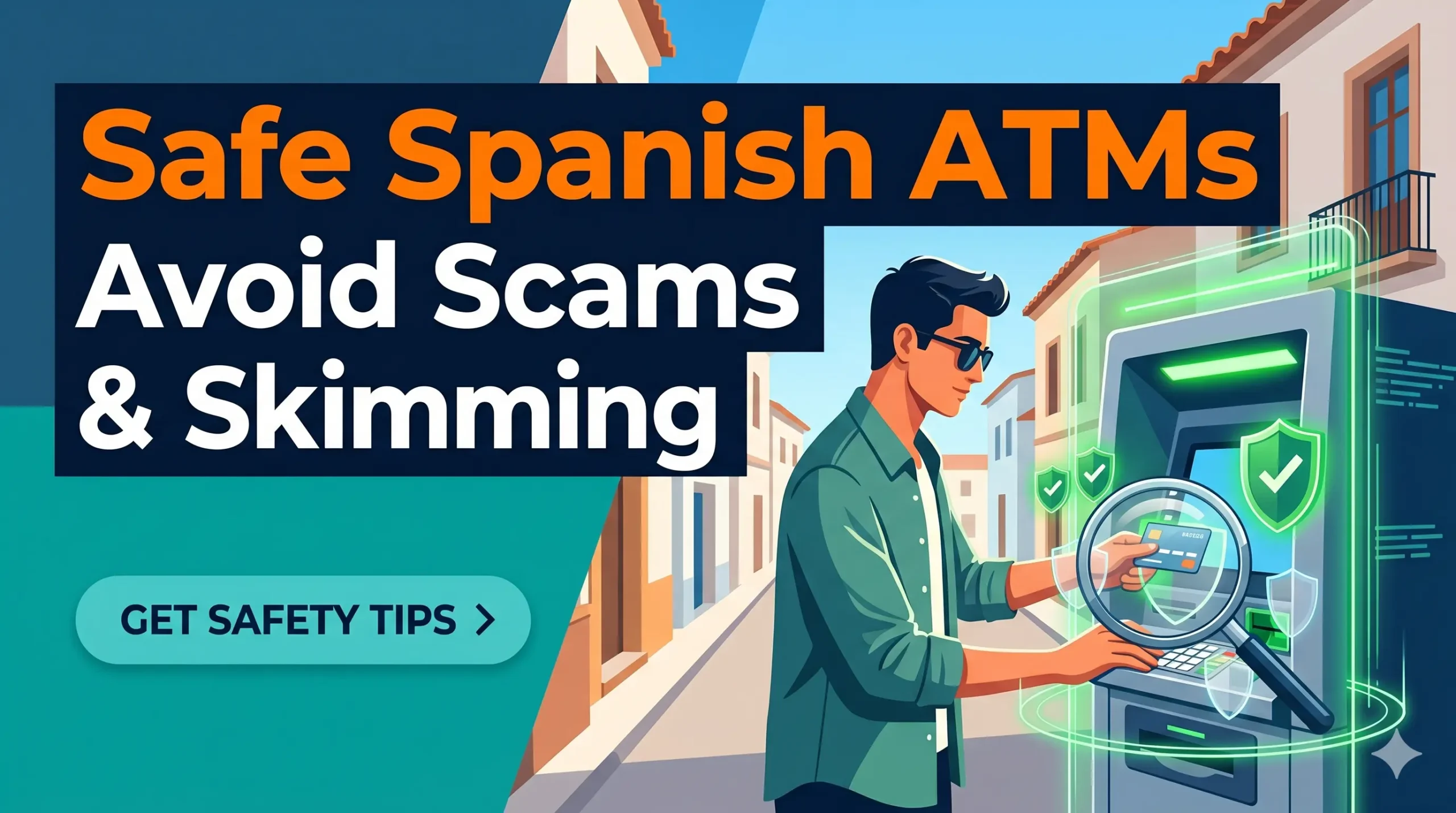
The most sophisticated threat facing expats is the physical manipulation of the ATM hardware itself. Criminals routinely install “skimmers”—small, hidden, meticulously crafted card readers placed directly over the machine’s actual card slot. When you insert your card, the skimmer quietly copies the magnetic stripe data. Simultaneously, a microscopic pinhole camera hidden in the molding above the keypad, or sometimes a fake overlay placed on top of the keypad itself, records you typing your PIN.
Another common physical trap is known as the “Lebanese Loop.” Thieves insert a tiny, almost invisible plastic sleeve into the card slot. When you put your card in, it gets stuck. The machine cannot read it, and more importantly, it cannot eject it. Often, a “friendly” stranger will immediately approach you, suggesting you type your PIN again while they carefully watch your hands. Once you give up and walk into the bank for help, the thief simply pulls the sleeve out with pliers, retrieving your card and walking away with your PIN to drain your account at another machine.
Distraction Thefts and Shoulder Surfing
Not all scams involve high-tech hardware. Many rely on pure sleight of hand and taking advantage of human politeness. The most classic expat trap is the “dropped money” or “spilled coffee” distraction.
You approach an outdoor ATM, insert your card, type your PIN, and select your withdrawal amount. Just as the machine begins whirring to count the cash, a stranger taps you on the shoulder. They might point to a five-euro bill on the ground, insisting you dropped it, or perhaps they “accidentally” spill a drink near your feet. The moment you look down or turn your body to engage with them, their accomplice reaches across the machine from your blind spot. In a fraction of a second, they grab your dispensed cash or your ejected card, and disappear into the dense crowd.
Never break eye contact with the ATM screen once your card is inside the machine. If someone tries to distract you, politely but firmly ignore them, block the keypad with your body, and do not move until your transaction is complete. If you do fall victim to a physical theft, knowing the exact emergency protocols outlined in How to Report Lost or Stolen Bank Cards in Spain Quickly is critical to minimizing the financial damage.
The Contactless Scam Targeting Foreigners
Recently, the Spanish Policía Nacional issued widespread warnings about a new evolution: the contactless scam. Thieves purposefully obstruct the physical card slot with glue or debris, forcing elderly individuals or confused tourists to use the contactless tap pad on the ATM instead.
A nearby scammer shoulder-surfs your PIN, and while you are confused by the broken slot, the scammer swoops in under the guise of helping, essentially pushing you aside to initiate a massive contactless withdrawal using the active session you just authorized. This preys directly on the confusion expats feel when navigating foreign banking interfaces.
The Legal Scam Dynamic Currency Conversion
Not all ATM traps are installed by criminals operating in the shadows; the most expensive trap is legally programmed into the machine’s software by the banking institution itself. If you are withdrawing cash using a debit card linked to your home country’s account (such as US dollars, British pounds, or Australian dollars), the ATM will attempt to execute Dynamic Currency Conversion, universally known as DCC.
How DCC Drains Your Budget
After you select your desired withdrawal amount in euros, the ATM screen will suddenly display a highly intimidating, confusingly worded message. It will ask if you want to be charged in your home currency, explicitly showing you a locked-in exchange rate, usually accompanied by two buttons: a bright green “Accept Conversion” and a smaller red “Decline Conversion”.
This is a massive financial trap. If you press the green button, the local Spanish bank operating the ATM applies an aggressive, predatory exchange rate markup. They are essentially taxing your withdrawal by up to ten or twelve percent for the “convenience” of doing the math for you. To fiercely protect your capital, you must always press “Decline Conversion” or “Charge in Euros” (often the red button). When you decline, the machine still dispenses your euros, but your home bank handles the currency conversion at a significantly fairer, market-based rate. The deep mechanics of bypassing these deceptive terminal traps are precisely why mastering How to Avoid Hidden Exchange Markups When Paying in Spain is so vital for your daily budget.
Bypassing High Street ATM Fees
Even if you successfully dodge the DCC trap, withdrawing money from a traditional Spanish high-street bank (like Santander, CaixaBank, or BBVA) with a foreign card almost always triggers massive out-of-network withdrawal fees. These flat fees can range from two to seven euros per transaction, a frustrating reality heavily detailed in Bank Fees in Spain: Common Charges and How to Avoid Them.
To bypass this friction and fiercely protect your purchasing power, you must route your international cash needs through Wise. By utilizing Wise, you completely bypass the expensive, antiquated SWIFT network entirely. Wise converts your home currency to euros using the real, transparent mid-market exchange rate. You can then use your Wise physical debit card to execute withdrawals at local ATMs, ensuring your budget arrives entirely intact without bleeding money to legacy bank margins. For larger, cross-border rent deposits that don’t require cash, the broader advantages of this strategy are mapped out in Sending Money to/from Spain: Comparing Banks vs Transfer Services.
Tactical Advice for Safe Withdrawals
Preventing financial loss requires combining physical vigilance at the machine with a heavily compartmentalized digital banking setup. You cannot afford to be passive when handling cash in Spain.
Choosing the Right ATM Location
Never use standalone, unbranded ATMs strategically placed inside nightclubs, dark alleyways, or random convenience stores. These machines—frequently operated by private companies like Euronet—charge astronomical, predatory flat fees. More dangerously, they are highly susceptible to skimming devices because they sit in unmonitored areas with heavy foot traffic, allowing criminals to tamper with them completely unnoticed over long periods.
You should strictly limit your cash withdrawals to ATMs physically attached to major Spanish bank branches. Ideally, try to use the machines located inside the bank’s glass lobby during regular business hours. These indoor machines are heavily monitored by high-definition security cameras and bank staff, making them far too risky for criminals to install skimmers or attempt shoulder surfing.
| ATM Location Type | Security Risk Level | Primary Scam Vulnerability |
| Indoor Bank Branch Lobby | Lowest | Heavily surveilled; very difficult to tamper with unnoticed. |
| Outdoor Bank Wall (Daylight) | Moderate | High risk of shoulder surfing and distraction thieves. |
| Outdoor Bank Wall (Night) | High | Prime target for physical robberies and skimmer installations. |
| Standalone Tourist ATMs (Euronet) | Extreme | Predatory fees, zero security monitoring, highest skimming risk. |
Physical Security Habits at the Machine
Before inserting your card into any machine, perform the “wiggle test.” Grab the protruding plastic card slot and give it a firm shake. A legitimate ATM reader is built directly into the machine’s chassis and will not move. If the plastic feels loose, bulky, or jiggles, a skimmer has likely been placed over it. Walk away immediately and notify the bank.
Additionally, always use your free hand, or your wallet, to completely shield the keypad from above while typing your PIN. This simple physical block completely neutralizes any hidden micro-cameras installed by thieves attempting to capture your access code.
What to Do If Your Card Is Stolen or Skimmed
Even the most vigilant expat can get caught off guard. If an ATM swallows your card, or if you notice unauthorized transactions popping up on your phone, your immediate reaction dictates whether you lose fifty euros or your entire monthly budget.
Securing Your Digital Infrastructure
You cannot rely on waiting until Monday morning to walk into a legacy Spanish bank branch to report the fraud. Branch managers are notoriously slow, require a mountain of physical paperwork, and cannot instantly reverse charges that have already cleared through the network.
To survive these localized threats, opening your daily operational account with N26 is highly strategic. N26 issues a fully recognized local Spanish IBAN directly from your smartphone interface. If your card is swallowed by a faulty machine or you suspect a skimmer, you can instantly open the N26 app and temporarily freeze the card with a single tap. This instantly locks the criminals out of your account without requiring you to permanently cancel the card, saving you from immense administrative headaches while you assess the situation from a safe location.
Because N26 eliminates the punitive monthly maintenance fees common to legacy branches, it perfectly serves as your agile daily financial shield. This frictionless security integration is exactly why agile digital platforms dominate guides comparing the Best Low-Fee Bank Accounts in Spain for New Residents and Opening a Bank Account in Spain: Step-by-Step for Foreigners.
If you are using a legacy Spanish bank and they detect a fraudulent swipe, their automated risk algorithms might instantly block your entire checking account, leaving you financially paralyzed. Knowing how to unblock your life in this terrifying scenario requires understanding the steps outlined in What to Do If Your Spanish Bank Account Is Frozen Common Causes.
Filing a Denuncia with the Policia Nacional
If you actually lose money to an ATM scam, you must formally report the crime to the Spanish National Police. This formal police report is called a denuncia. You cannot simply tell your bank you were robbed; European banking laws rigidly require the official denuncia before their fraud departments will even begin an internal investigation to refund your stolen cash.
You can initiate the denuncia online via the Policía Nacional portal or by phone, but you will eventually have to visit a physical police station (comisaría) within 72 hours to sign the paperwork. Bring your passport or residency card, and ideally, bring a Spanish-speaking friend if your language skills are not strong, as the police will require a detailed sequence of events to file the paperwork properly.
Long Term Financial Defense for Expats
To truly secure your financial life in Spain, you must practice strict compartmentalization. Relying on a single bank account for all your wealth and daily spending is a massive vulnerability that scammers actively exploit.
Compartmentalizing Your Daily Spending
Never link your primary life savings to the physical debit card you swipe at local supermarkets or insert into public ATMs. If that daily card is skimmed, you do not want your entire net worth exposed to a thief who managed to clone it. You should only keep enough funds in your daily operational checking account to cover one to two weeks of standard expenses.
Protecting Your Surplus Wealth
For the capital you do not need for immediate daily survival, you must move it entirely out of the vulnerable retail banking system. To build robust long-term wealth securely, many veteran expats transfer their surplus capital into a global brokerage account like Interactive Brokers.
Utilizing Interactive Brokers allows you to build a sophisticated, multi-currency portfolio that remains entirely portable and heavily insulated from localized Spanish retail banking fraud. It elegantly separates your long-term global wealth from the physical, street-level threats of your daily Spanish cash requirements.
Should the Spanish tax agency require proof of your worldwide financial standing, Interactive Brokers generates incredibly clean, standardized annual reports, allowing you to maintain perfect compliance with the complex tax structures detailed in Foreign Income Reporting in Spain: What Residents Need to Know. Furthermore, if you need to pay shared bills or reimburse friends for a tapas dinner where cash was used, leveraging local digital networks is exponentially safer than carrying large bills, a dynamic explained in Spanish Bank Transfer Terms: Transferencia, Bizum, SEPA Explained. Keeping your financial footprint agile through platforms like Interactive Brokers ensures your money is always working for you, well beyond the reach of local street scammers.
References
Primary sources official
- Policía Nacional – Consejos de Seguridad para el uso de Cajeros: https://www.policia.es/_es/colabora_participacion_planturismoseguro_consejos_es.php
- Banco de España – Consejos para el uso seguro de los cajeros automáticos: https://clientebancario.bde.es/pcb/es/blog/consejos-para-el-uso-seguro-de-los-cajeros-automaticos.html
Other helpful sources
- Instituto Nacional de Ciberseguridad (INCIBE) – Prevención de Skimming: https://www.incibe.es/empresas/blog/e-skimming-y-proteger-tu-tienda-esta-tecnica-maliciosa
- Portal de la Administración General del Estado – Consumo y Seguridad: https://administracion.gob.es/
Disclaimer
The information provided in this guide is exclusively for educational and informational purposes and does not constitute official legal, security, or financial advising. The tactics used by organized criminals to execute skimming, contactless fraud, and physical distraction thefts are highly dynamic and constantly evolving across Spanish cities. While we strive to ensure absolute accuracy regarding best practices, you should always remain vigilant, follow the direct security guidelines issued by the Spanish Policía Nacional, and immediately contact your specific financial institution if you suspect your debit card data or PIN has been compromised at any public ATM.