Issuing Invoices in Spain: Required Fields and Common Errors
Sending an invoice in Spain, only to have a massive corporate client reject it because you wrote “Receipt” instead of “Factura” or forgot to include your foreigner identity number, is an exhausting expat initiation. I once waited ninety days to get paid simply because my invoice lacked a single, mandatory tax line required by local law. This guide decodes the strict, uncompromising anatomy of Spanish invoicing so you get paid on time and avoid government audits.
Disclosure: This post may contain affiliate links. We may earn a commission at no extra cost to you if you make a purchase through these links. Read full disclosure.
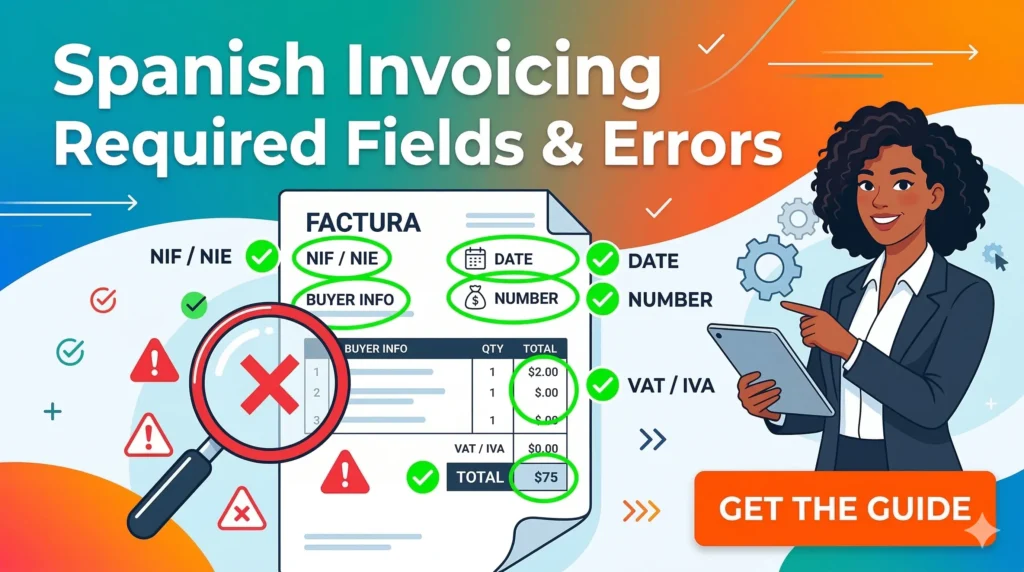
The Anatomy of a Spanish Invoice (Factura)
When you transition from freelancing in the United States, the UK, or Northern Europe to operating in Spain, you must unlearn everything you know about billing. In many Anglo-Saxon countries, an invoice is just a polite request for money; you can generate a simple Word document with a price and your bank details, and the client pays it. In Spain, a factura is a highly regulated, legally binding tax document. If it is missing even one mandatory field dictated by the Agencia Tributaria (Hacienda), it is legally void, and your client cannot legally pay it or deduct it as an expense.
Mandatory Identification Fields
The Spanish government approaches invoicing with an intense focus on anti-fraud tracking. Every single factura must clearly and completely identify both the person selling the service (the issuer) and the person buying it (the recipient).
As the issuer, you must include your full legal name exactly as it appears on your residency documents. A trading name or a catchy brand name (like “Madrid Digital Designs”) is not enough; your actual name must be present. Crucially, you must include your NIF (Número de Identificación Fiscal), which for expats is your NIE (Número de Identidad de Extranjero). You must also include your registered fiscal address (domicilio fiscal), which is the address you provided to Hacienda when you first registered as a freelancer.
You must gather the exact same information from your client. You cannot simply address an invoice to “John from Marketing.” You need the client’s full corporate name (razón social), their CIF (corporate tax ID) or NIF, and their official registered billing address. If you are dealing with a Spanish corporate accounting department, they will instantly bounce your invoice back to you if their CIF is missing, because without it, they cannot deduct the Value Added Tax on their own quarterly filings. If you are just starting out and need to ensure your baseline registration allows you to issue these documents, reviewing Autónomo Registration in Spain: RETA, Models, and Deadlines is a critical first step.
Invoice Numbering and Dates
The numbering system on your invoices is where Hacienda traps thousands of careless expats. By law, your invoice numbers must be strictly sequential, chronological, and without any gaps.
You cannot issue Invoice #001 on Monday, Invoice #005 on Wednesday, and Invoice #002 on Friday. The numbers must flow in order, and the dates must correspond to that flow (Invoice #002 cannot have an earlier issue date than Invoice #001). Expats who manually type their invoices in Excel frequently mess this up, leading to absolute chaos if they are ever audited. It is highly recommended to use the current year as a prefix to keep things organized (e.g., 2026-001, 2026-002).
Furthermore, the invoice must clearly state the fecha de expedición (date of issue). If the actual work was completed in a different month than the issue date—for example, you finished a project on March 28th but did not issue the invoice until April 2nd—you must also include the fecha de operación (date of supply) to clarify exactly when the economic activity took place. This distinction directly affects which quarterly tax cycle the invoice falls into.
Line Items, Base Price, and Tax Breakdowns
Hacienda despises ambiguity. If your invoice simply says “Consulting – €1,000,” it will raise immediate red flags. You must provide a specific, detailed description of the goods delivered or services rendered. “SEO Consulting Services for the month of March 2026 – 40 hours” is the level of detail expected.
The core of your invoice is the Base Imponible (the base price before any taxes are applied). Every single tax calculation—whether adding IVA or subtracting IRPF—is calculated strictly from this Base Imponible. If you try to reverse-engineer an invoice by taking the final cash amount you want to receive and indiscriminately applying tax percentages, your math will be wrong, and the Spanish accounting software of your corporate clients will reject it.
Navigating the IVA (VAT) Labyrinth
The Impuesto sobre el Valor Añadido (IVA) is Spain’s Value Added Tax. As an autónomo (freelancer) or business owner, you are legally deputized to collect this consumption tax from your clients and hold it in trust for the government. How you apply this tax on your invoices depends entirely on where your client lives and what you are selling.
Standard, Reduced, and Exempt IVA Rates
When you bill a client located inside Spanish territory, you must generally add IVA to your Base Imponible. The standard rate (tipo general) for almost all professional services, digital goods, and consulting is 21%. If your base rate is €1,000, you add €210 in IVA.
There are reduced rates of 10% and 4% for specific sectors like food, transport, and cultural events, but freelance professionals rarely use these. However, there are completely exempt sectors. If you provide official medical services, or if you teach standard educational curriculum subjects (like a licensed English tutor), your services might be fully exempt from IVA under Article 20 of the Spanish VAT Law. If you qualify for an exemption, you must state the exact legal clause on the bottom of your invoice (e.g., “Factura exenta de IVA en virtud del artículo 20 de la Ley 37/1992”). To understand how these consumption taxes alter broader pricing strategies, read VAT (IVA) in Spain: How It Affects Prices and Businesses.
The Reverse Charge Mechanism for EU Clients
If you are a digital nomad or consultant, your clients likely live beyond the Spanish borders. If you are billing a B2B (business-to-business) client located in another European Union country—such as a marketing agency in Berlin or a software firm in Paris—you do not charge them the Spanish 21% IVA.
However, to legally do this, both you and your European client must be formally registered in the VIES database (known in Spain as the ROI – Registro de Operadores Intracomunitarios). You must verify their European VAT number is active. Crucially, your invoice must explicitly include the legal text justifying the missing tax: “Inversión del Sujeto Pasivo (Reverse Charge) – Article 196 of the EU VAT Directive 2006/112/EC.” Without this text, a Spanish auditor will assume you simply forgot to charge 21% and will demand the money directly from your pocket.
Billing Clients Outside the EU
The rules are entirely different, and beautifully simple, when you export your professional services to clients located completely outside the European Union, such as the United States, Canada, or the post-Brexit United Kingdom.
When you provide professional B2B services to a company in New York, the transaction is legally considered outside the scope of European VAT. You issue your invoice with 0% IVA. You do not need to be registered in the ROI/VIES database to do this. You simply note on the bottom of the invoice that the transaction is exempt due to Spanish localization rules: “Operación no sujeta a IVA de acuerdo con las reglas de localización (Art. 69 Ley 37/1992).” This allows you to generate massive international revenue without artificially inflating your prices or acting as an unpaid tax collector for the Spanish state. To see how avoiding IVA changes your broader accounting strategy, review Starting a Business in Spain: Taxes and Accounting Basics.
Understanding IRPF Retentions on Invoices
While IVA is a tax added to your invoice, the Impuesto sobre la Renta de las Personas Físicas (IRPF) retention is a tax subtracted from your invoice. This mechanic confuses expats more than almost any other aspect of Spanish accounting.
When to Apply the Withholding
If you are officially registered as an autónomo profesional (a professional freelancer, such as a consultant, lawyer, designer, or architect, under the second and third sections of the IAE activity codes), you are legally required to apply an IRPF withholding to your invoices when billing other Spanish businesses or Spanish freelancers.
The standard retention rate is 15%. However, to help new entrepreneurs, the Spanish government allows newly registered freelancers to apply a reduced 7% retention rate for the year they register and the following two calendar years.
This retention is essentially an advance payment on your personal income tax. If your Base Imponible is €1,000, you subtract €150 (15%). Your Spanish corporate client keeps that €150 and is legally obligated to pay it directly to Hacienda under your name. Your final take-home cash is lower, but your client has already partially paid your annual income tax for you.
B2B vs. B2C Invoicing Dynamics
The IRPF withholding rule relies entirely on the status of your client. You only apply the 15% or 7% retention when billing a Spanish legal entity (a company or another registered freelancer). They have the administrative infrastructure to process the withholding and pass it to the government.
If you are billing a private individual (a B2C transaction, like designing a wedding invitation for a local couple), you do not apply an IRPF retention. Private citizens are not deputized tax collectors and cannot pay your retentions to Hacienda. Furthermore, if you are billing a foreign corporate client (like a company in the US or the UK), you do not apply Spanish IRPF retentions, because a foreign company cannot log into the Spanish tax portal to submit withholdings on your behalf.
| Invoice Element | B2B (Spanish Client) | B2C (Spanish Individual) | B2B (Non-EU Client) |
| Base Imponible | €1,000 | €1,000 | €1,000 |
| IVA (21%) | + €210 | + €210 | 0% (Not Subject) |
| IRPF Retention (15%) | – €150 | No Retention Applied | No Retention Applied |
| Total to be Paid | €1,060 | €1,210 | €1,000 |
How IRPF Withholdings Affect Your Quarterly Taxes
The presence or absence of these IRPF retentions on your invoices dictates your quarterly tax obligations. The Spanish tax calendar is relentless. Usually, freelancers must file Modelo 130 every three months to surrender 20% of their net profits to the government as an advance tax payment.
However, there is a massive legal exemption. If more than 70% of your total invoicing volume includes IRPF retentions (meaning your Spanish corporate clients are already paying your taxes for you), you are completely exempt from filing the dreaded Modelo 130. You bypass the administrative headache of quarter prepayments entirely. But if your clients are mostly foreign or private individuals, you will fail the 70% test and must manually file the prepayments. To understand these critical deadlines and models, read Quarterly Tax Filings in Spain: Model 130/303 Basics for Freelancers. For a comprehensive view of how this all balances out during the spring tax season, check out How to File a Tax Return in Spain: A Guide for Expats (IRPF).
Common Expat Invoicing Errors and Penalties
Because the Spanish system is so rigid, simple administrative errors can trigger devastating financial penalties. Hacienda algorithms actively scan for these specific expat mistakes.
The Ticket vs. Factura Completa Trap
A massive source of friction occurs when expats try to deduct their business expenses using the wrong type of document. In Spain, a factura simplificada (commonly known as a ticket or standard cash register receipt) is legally useless for deducting IVA.
If you buy a €2,000 laptop for your freelance business and the electronic store hands you a standard till receipt, you cannot use it for tax purposes because it does not bear your name, your address, or your NIE. You must explicitly demand a factura completa (full invoice) at the customer service desk. Similarly, when you generate invoices for your clients via foreign software like Stripe or PayPal, you must ensure the PDF templates are customized to include all Spanish mandatory fields, otherwise, your local clients will reject them.
Breaking Sequential Numbering Rules
Perhaps the most terrifying mistake a new freelancer can make is deleting an invoice. Imagine you issue Invoice #024, but the client cancels the contract and refuses to pay. Your instinct is to simply delete Invoice #024 from your computer and use that number for the next client.
In Spain, this is illegal. Deleting an invoice creates a gap in your sequential accounting, which instantly triggers an audit flag. If an invoice needs to be canceled or refunded, you must issue a factura rectificativa (a credit note or rectifying invoice). This is a completely separate document, with its own sequential numbering series (e.g., REC-2026-001), that legally neutralizes the original invoice.
Currency Conversion and Exchange Rate Mistakes
If you operate globally, you likely bill clients in US Dollars or British Pounds. While it is perfectly legal to issue a Spanish invoice denominated in a foreign currency, Hacienda requires you to report your taxes exclusively in euros.
You cannot simply use the exchange rate on the day you file your quarterly taxes. Legally, you must convert the foreign currency into euros using the official European Central Bank (ECB) exchange rate on the exact date the invoice was issued (or the date of supply). Your invoice should ideally display the total amount in USD, alongside a notation of the EUR equivalent on that specific day, to ensure your internal bookkeeping perfectly matches what you report to the government.
Financial Infrastructure for Painless Billing
Mastering the format of a Spanish invoice is only half the battle; you must also possess the correct financial infrastructure to receive the money and pay your subsequent taxes without bleeding capital.
Why You Need a Spanish IBAN
When you send a beautifully formatted, legally compliant invoice to a massive Spanish corporation, they will immediately look at the payment details. Spanish corporate accounting departments absolutely despise paying invoices to non-Spanish bank accounts. Even though European law mandates IBAN discrimination is illegal, many legacy Spanish payroll and accounting systems physically cannot process batch payments to a German or French IBAN.
Furthermore, when you need to pay your quarterly IVA to Hacienda, the tax portal practically demands a direct debit from a local account starting with the letters “ES”. To bypass the archaic paperwork and high fees of traditional Spanish banks, savvy expats immediately open a business account with N26. Because N26 is a fully licensed digital European bank, you instantly receive a recognized, official Spanish IBAN directly from your smartphone. Linking your N26 account to your invoices ensures your local clients pay you without friction, and ensures your tax debits process flawlessly. If you have previously struggled with local branch tellers, read Opening a Bank Account in Spain as a Non-Resident for context.
Receiving Foreign Currency Without Bleeding Fees
If you strategically decided to bill clients in the United States or the UK to legally avoid charging IVA, you face a massive hidden threat. If you invoice an American client for $10,000 and allow them to wire that money via SWIFT directly into a traditional Spanish bank account, you will be financially crushed.
Traditional Spanish banks hide massive profit margins in terrible currency exchange rates and charge exorbitant international receiving fees simply to process the wire. To protect your hard-earned corporate revenue, you must use a dedicated currency specialist like Wise. By opening a Wise business account, you can effortlessly provide your US clients with local ACH routing numbers and your UK clients with local sort codes directly on your invoices. Your clients pay you natively in their local currency with zero international friction. You can then use Wise to instantly convert those funds into euros at the true, mid-market exchange rate, saving you hundreds of euros per invoice.
Managing Retained Profits Effectively
Once your invoices are paid, your IVA is remitted, and your IRPF advance payments are settled, the remaining net profit belongs to you. Leaving this hard-earned surplus sitting in a standard Spanish checking account exposed to high European inflation is a terrible wealth-building strategy.
Furthermore, if you ask a local Spanish bank manager for corporate investment options, they will aggressively push their own proprietary mutual funds, which are universally notorious for abysmal performance and exorbitant management fees. To actually protect and grow your retained earnings, veteran expat freelancers utilize global brokerage platforms like Interactive Brokers. By transferring your post-tax profits into a dedicated account with Interactive Brokers, you gain direct access to low-cost, globally diversified ETFs and equities, completely bypassing the high-fee traps of the Spanish retail banking sector. Using Interactive Brokers allows you to build a highly portable, tax-efficient portfolio that compounds wealth globally, ensuring your hard work translates into permanent financial security.
References
Primary sources (official)
- Agencia Tributaria (AEAT) – Requisitos de las facturas: https://sede.agenciatributaria.gob.es/Sede/iva/facturacion-registro/facturacion-iva/requisitos-facturas.html
- Boletín Oficial del Estado (BOE) – Real Decreto 1619/2012 (Reglamento por el que se regulan las obligaciones de facturación): https://www.boe.es/buscar/act.php?id=BOE-A-2012-14696
- Agencia Tributaria (AEAT) – Inversión del sujeto pasivo (Reverse Charge): https://sede.agenciatributaria.gob.es/Sede/iva/facturacion-registro/facturacion-iva/inversion-sujeto-pasivo.html
Other helpful sources
- Expatica – Taxes for freelancers and the self-employed in Spain: https://www.expatica.com/es/finance/taxes/freelance-tax-spain-471615/
- Quipu – Requisitos y elementos obligatorios de una factura en España: https://getquipu.com/blog/requisitos-factura-electronica/
Disclaimer
The information provided in this article is for educational and informational purposes only and does not constitute formal financial, accounting, or legal advice. Spanish invoicing legislation, specific IRPF retention percentages, and cross-border VAT (IVA) reverse charge mechanisms are highly complex and subject to frequent legislative updates by the Agencia Tributaria. Always consult directly with a certified Spanish tax advisor (asesor fiscal) regarding your specific business model, international billing practices, and exact invoice formatting before sending legally binding tax documents to clients.