How to Avoid Hidden Exchange Markups When Paying in Spain
Arriving in Spain means dealing with a new currency, but the real shock comes when you review your home bank statement. I remember losing nearly ten percent of my budget during my first week simply because I pressed the wrong button at an ATM. This guide explains how to avoid hidden exchange markups and keep your hard-earned money.
Disclosure: This post may contain affiliate links. We may earn a commission at no extra cost to you if you make a purchase through these links. Read full disclosure.
The Dynamic Currency Conversion Trap
When you first land in Madrid or Barcelona, you probably need a little bit of physical cash. While Spain is increasingly becoming a cashless society, you still need a few euros in your pocket for small local bakeries, tipping, or emergencies. You walk up to an ATM from Santander, Euronet, or Caixabank, insert your foreign debit card, and are immediately hit with the most predatory financial trap in Europe.
How Spanish ATMs Trick You Into Paying More
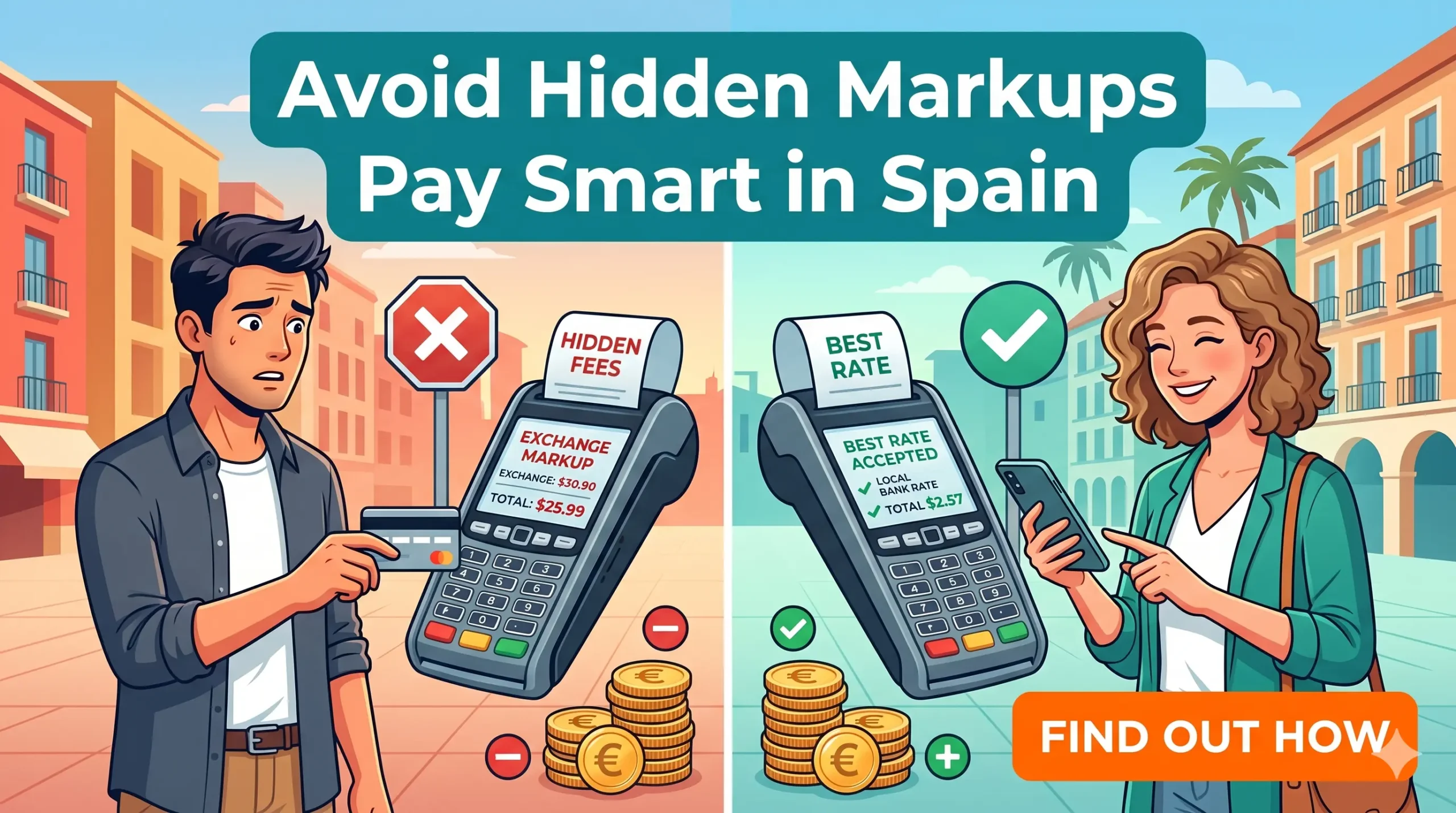
Dynamic Currency Conversion, commonly referred to as DCC, is a specialized “service” offered by foreign ATMs and merchant point-of-sale systems. When you try to withdraw 100 euros using a United States or United Kingdom bank card, the ATM screen will suddenly pause and offer to charge your home bank account directly in your home currency. It will display the exact withdrawal amount translated into dollars or pounds, proudly offering a “guaranteed” exchange rate so you know exactly what will be deducted from your checking account.
This is a massive psychological trap. The exchange rate the ATM is offering is universally terrible. The independent ATM operator bakes a massive profit markup—sometimes reaching up to 10 or 12 percent—directly into that “guaranteed” rate. Furthermore, the ATM interface often uses deceptive design tactics, turning the screen red or showing warning symbols if you attempt to reject their offer. If you accept the conversion, you are effectively handing the ATM provider a massive, unearned tip simply for doing the math for you.
The Golden Rule: Always Choose Euros
To avoid this extortionate markup, you must learn and strictly adhere to the golden rule of expat finances: always, without exception, decline the ATM’s conversion offer. When the screen prompts you to accept their guaranteed exchange rate, you must firmly hit the button that says “Decline Conversion,” “Without Conversion,” or “Continue in Euros.”
By actively declining their offer, you force the Spanish ATM to charge your card in euros. This kicks the currency conversion duty back to your home bank. While your legacy home bank might still charge a small foreign transaction fee depending on your specific account terms, their exchange rate will be significantly closer to the real mid-market rate than whatever the localized Spanish ATM was attempting to charge. Understanding this fundamental rule is just as critical to your financial survival as the initial steps covered in Opening a Bank Account in Spain: Step-by-Step for Foreigners.
Card Payments at Restaurants and Retailers
The Dynamic Currency Conversion trap is not limited to cash withdrawals at standalone machines. You will face the exact same confusing digital prompts every single time you go out for dinner, buy groceries at Mercadona, or purchase train tickets at the station.
Point of Sale Terminals and the Euro Question
In Spain, the standard practice for dining out is that waiters will bring a portable, wireless card machine (known locally as a datáfono) directly to your table when it is time to settle the bill. If you insert or tap a foreign credit or debit card, the terminal software will instantly recognize that your card’s origin is not denominated in euros.
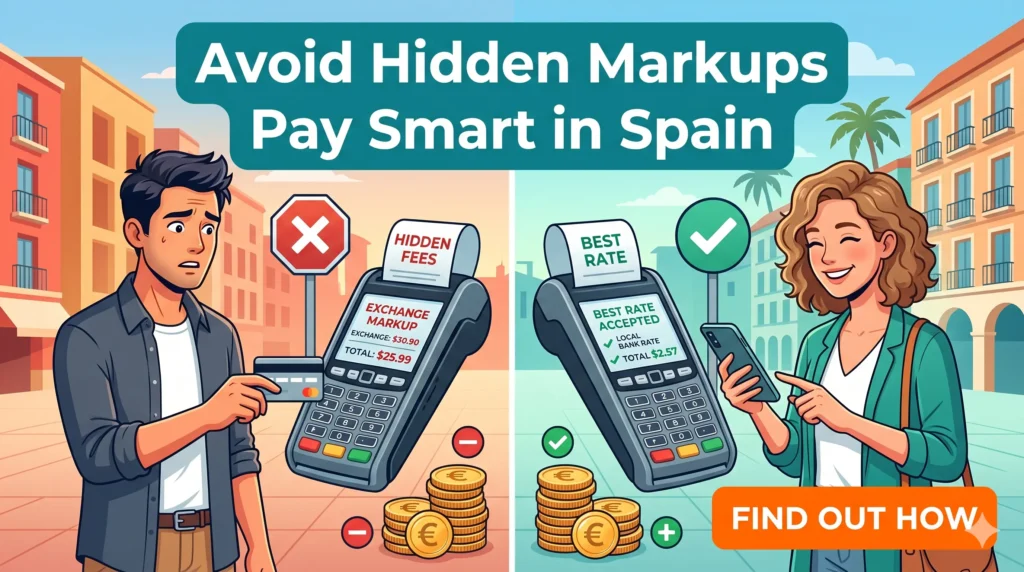
Before the transaction finally processes, the small digital screen will prompt you to choose between paying in EUR or paying in your home currency. Sometimes the waiter, trying to be helpful and expedite the process, will simply press the button for your home currency, assuming you want to see the final bill in familiar numbers. You must preempt this by politely but firmly asking them to let you select euros. Just like at the ATM, if you or the waiter select your home currency, the merchant’s payment processor applies the exact same dynamic currency conversion markup, skimming a silent, hefty percentage directly off the top of your monthly budget. If you are regularly splitting tapas bills with flatmates, mastering this terminal interaction—alongside understanding How to Split Household Bills in Spain: Fair Methods for Flatmates and knowing exactly What Is Bizum in Spain and How Do Expats Use It?—will save you hundreds of euros over your first year abroad.
Why Your Legacy Bank is Secretly Skimming Your Budget
Even if you successfully navigate the terminal and correctly choose to pay in euros, you are still not entirely safe if you are relying on an old-school legacy bank card from your home country. Traditional banks frequently penalize their customers for traveling by charging a “foreign transaction fee” of anywhere from 1 to 3 percent on every single purchase made abroad.
Every time you tap your card for a morning coffee, buy a metro ticket, or pay for your weekly groceries, your home bank is quietly taking a percentage cut in the background. You can stop this financial bleeding by migrating your daily spending to modern, expat-friendly financial tools. If you are exhausted from checking your monthly statements only to find missing funds and confusing line items, comparing your options in Sending Money to/from Spain: Comparing Banks vs Transfer Services will help you map out a significantly cheaper, more agile strategy.
| Payment or Transfer Method | Who Determines the Exchange Rate? | Hidden Exchange Markup | Best Practical Use Case |
| Dynamic Currency Conversion (DCC) | The ATM operator or local merchant’s bank | Very High (Often up to 10% – 12%) | Never use this under any circumstances |
| Traditional Foreign Credit Card | Your home country legacy bank | Moderate (1% – 3% plus transaction fees) | Emergency backup only when local cards fail |
| SWIFT International Wire Transfer | Intermediary banks and receiving Spanish bank | High (3% – 5% plus hefty flat wire fees) | Avoid unless legally mandated for a transaction |
| Mid-Market Transfer Service | The real-time global forex market | None (You pay a transparent upfront fee) | Moving rent, savings, and large relocation funds |
Sending Large Sums: Rent and Relocation Costs
Buying a coffee with a hidden foreign transaction fee is annoying, but paying a hidden exchange markup on a massive international transfer can literally cost you your rental deposit. When you are moving large sums of money across international borders, the financial stakes are significantly higher.
The Reality of International Wire Transfers
When you secure your first long-term Spanish apartment, your landlord or real estate agency will demand the first month’s rent plus a security deposit—often totaling thousands of euros upfront. If you log into your home country’s banking portal and initiate a standard international wire transfer to Spain, you are stepping blindly into the incredibly expensive SWIFT network.
SWIFT relies on a chain of correspondent banks to manually pass your money across the globe, with each bank in the chain taking a flat fee for the privilege. Worse, either your home bank or the receiving Spanish bank will apply their own internal exchange rate to convert your funds, keeping the difference as pure corporate profit. You can dive much deeper into this archaic, expensive process by reviewing Spanish IBAN, SEPA, and SWIFT: Sending and Receiving Money Explained.
Bypassing SWIFT with Specialized Services
To completely avoid the predatory SWIFT fees and terrible exchange rate markups charged by legacy banks, you must bypass their international wire portals entirely. When you need to send your initial relocation savings into Spain, using Wise is the absolute smartest financial strategy you can deploy.
By initiating the large transfer through Wise, your home currency is converted to euros using the real, real-time mid-market exchange rate—the exact same rate you see when you search on Google. You pay a clear, transparent upfront fee that is a fraction of what a traditional high-street bank charges. Wise then utilizes its own localized bank accounts in Spain to deliver the funds domestically via the standard SEPA network. This ensures your landlord or agency receives the exact euro amount requested without any surprise deductions arriving short. If you need a checklist on the exact data points required to execute these larger cross-border moves safely, read How to Send International Wire Transfers From Spain: What You Need to ensure you don’t face administrative delays.
Setting Up Your Expat Financial Ecosystem
Relying on foreign cards and international transfer tools is an excellent temporary survival tactic, but it is not a permanent solution. To truly eradicate hidden exchange markups from your daily life, you must establish a local, optimized financial base.
Securing a Local Bank Account
The ultimate, permanent solution to foreign transaction fees and ATM markups is to stop using foreign accounts for your daily Spanish life. You need a local IBAN. However, traditional Spanish high-street banks are notorious for charging expats heavy quarterly maintenance fees simply for the privilege of keeping their money in a checking account.
To bypass these legacy costs, opening your operational daily account with N26 is highly strategic. Because N26 issues a fully recognized local Spanish IBAN directly from your smartphone, you can use their debit card to pay for everything in euros effortlessly, completely avoiding DCC prompts and foreign transaction fees in your daily life. Setting up an account with N26 allows you to integrate seamlessly into the local economy, a core reason digital alternatives absolutely dominate lists comparing the Best Low-Fee Bank Accounts in Spain for New Residents. Once you have this local IBAN secured, you can smoothly establish domestic mandates for your internet, water, and electricity, a bureaucratic process clearly outlined in How Direct Debits (Domiciliación) Work in Spain: Setup and Cancellations.
Furthermore, if you are a freelancer, linking your clean N26 account to the tax portals ensures you can pay your quarterly obligations without worrying about cross-border transfer failures, keeping you compliant with the complex timelines detailed in What Is the Difference Between IRPF and IVA in Spain?.
Managing Your Global Wealth Efficiently
As you settle completely into your Spanish life and start earning a comfortable local salary, you will likely want to invest your surplus euros for the future. However, buying United States or global stocks through a legacy Spanish high-street bank means you will be hit with hefty currency conversion markups every single time you execute a trade. They essentially apply the exact same predatory exchange rates to your long-term investments as they do to their international wire transfers.
To grow your money efficiently without bleeding capital, many veteran expats route their surplus euros into a global brokerage account like Interactive Brokers. Utilizing Interactive Brokers allows you to convert your locally earned euros to dollars, pounds, or yen at near-institutional exchange rates with incredibly low commissions. You can maintain a multi-currency portfolio and access global stock markets without losing a percentage of your profit to retail bank margins.
Because Interactive Brokers generates clean, standardized annual tax reports, managing your ongoing tax obligations in Spain becomes significantly less stressful. This reporting is a strict reality that is thoroughly explained in Foreign Income Reporting in Spain: What Residents Need to Know, and it ties directly into your annual obligations detailed in Spanish Income Tax (IRPF) 101: Who Pays and When. By keeping your daily Spanish spending agile and your global investments insulated from local bank markups, you build a resilient financial structure that protects every single euro you earn.
References
Primary sources (official)
- Banco de España – What are exchange rates?: https://www.bde.es/wbe/en/areas-actuacion/politica-monetaria/preguntas-frecuentes/tipos-cambio/que-son-los-tipos-de-cambio.html
- European Central Bank – Enhancing cross-border payments: https://www.ecb.europa.eu/press/key/date/2025/html/ecb.sp250627~de084f5b69.en.html
Other helpful sources
- Fondo de Garantía de Depósitos de Entidades de Crédito: https://www.fgd.es/
- Portal de la Administración General del Estado: https://administracion.gob.es/
Disclaimer
The information provided in this guide is exclusively for educational and informational purposes and does not constitute official financial, banking, or tax advice. Banking fee structures, exchange rate policies, Dynamic Currency Conversion merchant practices, and international transfer compliance rules are subject to frequent changes by the Banco de España and international financial networks. While we strive to ensure absolute accuracy, you should always verify the latest fee disclosures, exchange rates, and transaction limits directly with your chosen financial institution before initiating any large cross-border transfers or investments.