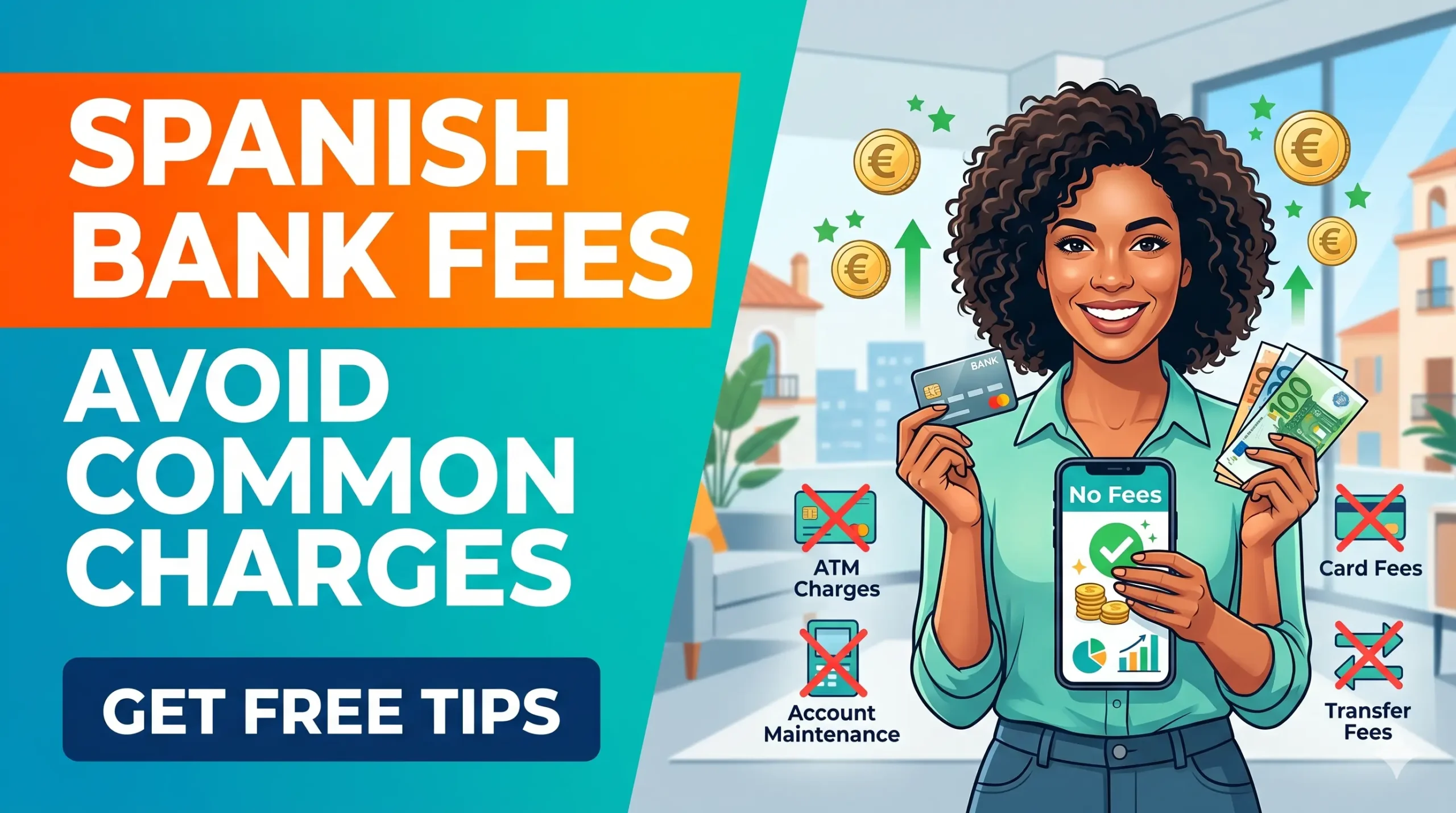
Bank Fees in Spain: Common Charges and How to Avoid Them
Opening a Spanish bank account feels like a massive administrative victory until you check your balance and see your money quietly draining away each month. I once lost sixty euros in a single quarter to a “maintenance fee” I did not even know existed, simply because my foreign paycheck arrived a day late. This guide breaks down the hidden fees legacy banks charge expats and exactly how to bypass them entirely.
Disclosure: This post may contain affiliate links. We may earn a commission at no extra cost to you if you make a purchase through these links. Read full disclosure.
The Reality of Traditional Spanish Banking
When expats arrive in Spain, they naturally gravitate toward the massive, glowing logos of traditional high-street banks. We incorrectly assume these financial giants operate like the free checking accounts we left behind in the United States or the United Kingdom. In Spain, legacy banks view a checking account not as a basic consumer right, but as a premium service.
The Maintenance Fee Trap
If you walk into a traditional branch and open a standard checking account without reading the microscopic fine print, you will inevitably be hit with a comisión de mantenimiento (maintenance fee).
These fees are not negligible. Legacy banks routinely charge between 120 and 240 euros a year simply for the privilege of holding your money. They deduct this amount quarterly or monthly directly from your available balance, often without sending you a push notification or email warning. For many expats, the first sign of trouble is having their card declined at a grocery store because an unexpected 60-euro quarterly fee pushed their account balance below zero.
The Illusion of Fee-Free Accounts
Traditional banks will aggressively advertise “fee-free” accounts, but these are heavily conditional. To qualify, you must achieve bonificado (bonused) status.
To unlock this status, the bank will strictly demand that you domiciliar la nómina (direct deposit your salary). However, if your salary comes from a foreign company in US dollars or British pounds, or if you are living on a foreign pension, the bank’s localized software will not recognize it as an official Spanish nómina, and they will immediately revoke your fee-free status.
Furthermore, they will often require you to set up at least three local direct debits. Figuring out how to navigate these local mandates is a massive headache, which you can anticipate by reviewing Typical Utility Bills in Spain: Electricity, Gas, Water (Examples). Even if you meet the conditions, I remember walking out of a branch in Valencia completely defeated because the teller refused to give me the free account unless I also purchased the bank’s overpriced home insurance.
By European Union law, Spanish banks are actually required to offer a Cuenta de Pago Básica (Basic Payment Account) capped at 3 euros a month, but branch managers actively hide this product because it is unprofitable. They will push the premium 20-euro-a-month product on unexpecting foreigners instead.
Common Hidden Charges That Drain Your Budget
Beyond the basic cost of holding the account, legacy banks aggressively monetize every single movement you make. Understanding the taxonomy of these charges is the only way to avoid bleeding cash.
Transfer and Administration Penalties
If you attempt to send a standard SEPA transfer to pay your rent, a traditional bank will usually process it for free within 48 hours. However, if you need the money to arrive instantly—which landlords frequently demand on the first of the month—they will suddenly tack on a 1.50 to 3.00 euro surcharge for an immediate transfer.
Even worse is the comisión de administración (administration fee). This is an archaic charge where the bank literally charges you a few cents for every single transaction you make over a predetermined monthly limit. If you use your debit card to buy a coffee, pay for the metro, and grab daily groceries, you might be charged a fee for each swipe. Understanding how local money movement works is why mastering Spanish Bank Transfer Terms: Transferencia, Bizum, SEPA Explained is absolutely mandatory.
Non-Resident Account Surcharges
If you open an account when you first arrive with just a passport, before you have your physical residency card (TIE), the bank will classify you as a non-resident. Non-resident accounts carry significantly higher maintenance fees.
More frustratingly, Spanish banks are legally required to verify your non-resident status every two years. They will quietly charge you a “verification fee” of around 30 euros to pull a certificate from the police database on your behalf. If you successfully upgrade to a resident card but fail to physically walk into your branch and inform your specific manager, you will continue bleeding these non-resident fees. Sometimes, failing to update your paperwork results in abrupt automated freezes, a terrifying reality deeply explored in What to Do If Your Spanish Bank Account Is Frozen (Common Causes).
Out-of-Network ATM Withdrawals
The Spanish ATM network is highly fragmented, and loyalty to your specific bank’s physical machines is strictly enforced. If you use a CaixaBank debit card at a Santander ATM, you will be hit with a painful 2 to 3 euro withdrawal fee.
If you attempt to withdraw physical euros using a foreign bank card from your home country, the situation is drastically worse. The local ATM will detect the foreign card and apply an aggressive exchange rate markup, essentially taxing your withdrawal. Knowing how to actively decline these terminal traps is precisely why reading How to Avoid Hidden Exchange Markups When Paying in Spain is critical for your first few months.
How to Build a Fee-Free Financial Setup
You do not have to accept this financial extortion. By abandoning legacy branch managers and utilizing agile digital financial tools, you can build a completely fee-free expat infrastructure.
Securing a Free Local IBAN
You cannot live in Spain without a local “ES” IBAN. Landlords demand it, and utility companies require it to set up direct debits. However, you do not need to walk into a legacy high-street bank to get one.
Opening your daily operational account with N26 is highly strategic. N26 issues a fully recognized local Spanish IBAN directly from your smartphone interface. You simply scan your passport or residency card, take a selfie, and your account is active within minutes.
Crucially, N26 completely eliminates the punitive quarterly maintenance fees and administration charges common to traditional banks. Because they have no physical branches or legacy software to subsidize, they pass those savings directly to you, providing free basic accounts and fee-free ATM withdrawals within the Eurozone. This frictionless integration is exactly why digital alternatives dominate lists comparing the Best Low-Fee Bank Accounts in Spain for New Residents and guides covering Opening a Bank Account in Spain: Step-by-Step for Foreigners.
Moving Money Across Borders
If your primary savings or income originates in your home country, you have to move those funds into your Spanish account to pay your rent and daily expenses.
If you initiate a standard international wire transfer from your legacy home bank, they will crush your budget with hidden SWIFT network fees and terrible exchange rate markups. You could easily lose 50 euros just trying to move your monthly rent. To fiercely protect your capital, you must route your international transfers through Wise.
Utilizing Wise allows you to completely bypass the expensive, antiquated SWIFT network entirely. Wise converts your home currency to euros using the real, transparent mid-market exchange rate. You can instantly transfer those cleanly converted euros directly to your local Spanish account. The deep mathematical advantages of these cross-border savings are heavily mapped out in Sending Money to/from Spain: Comparing Banks vs Transfer Services.
Protecting Your Surplus Wealth
Once you have successfully stopped bleeding money to local maintenance fees and international wire markups, managing your surplus savings is your final hurdle.
Leaving large sums of your life savings sitting idle in a localized Spanish checking account is a massive strategic error. It unnecessarily exposes your wealth to local retail inflation and subjects your broader assets to potential local administrative scrutiny.
To build robust long-term wealth securely, many veteran expats transfer their surplus capital into a global brokerage account like Interactive Brokers. Utilizing Interactive Brokers allows you to build a sophisticated, multi-currency portfolio that remains entirely portable and heavily insulated from the high fees of localized Spanish retail investment products. It elegantly separates your long-term global wealth from the administrative chaos of your daily Spanish living expenses.
Keeping your financial footprint agile through platforms like Interactive Brokers ensures your money is always working for you, while keeping your capital highly organized for the mandatory tax compliance structures detailed in Foreign Income Reporting in Spain: What Residents Need to Know.
| Feature | Traditional Spanish High-Street Bank | Digital Expat Financial Setup |
| Maintenance Fees | €120 – €240 annually (unless strict nómina conditions met). | €0 annually (Standard basic accounts). |
| International Transfers | High SWIFT fees + 3-5% exchange markups. | Real mid-market rate + transparent low fee. |
| Account Opening | Requires branch visit, physical paperwork, and Spanish fluency. | 100% digital, English support, requires only smartphone. |
| Administration Fees | Often charges a few cents per transaction/swipe. | €0 per transaction. |
| Best Solution For… | Securing a heavy local mortgage. | Daily agile expat life and avoiding hidden overhead. |
References
Primary sources (official)
- Banco de España – Qué son las comisiones bancarias: https://clientebancario.bde.es/pcb/es/menu-horizontal/productosservici/relacionados/comisiones/que-son-las-comi/
- Banco de España – Cuenta de pago básica: https://clientebancario.bde.es/pcb/es/menu-horizontal/actualidadeducac/educacion-financiera/cuenta-de-pago-basica/
Other helpful sources
- Organización de Consumidores y Usuarios (OCU) – Comisiones bancarias al descubierto: https://www.ocu.org/dinero/cuenta-bancaria/noticias/comisiones-bancarias
- Portal de la Administración General del Estado – Trámites Financieros: https://administracion.gob.es/
Disclaimer
The information provided in this guide is exclusively for educational and informational purposes and does not constitute official financial or legal advice. Spanish banking regulations, specific maintenance fees (comisiones de mantenimiento), and the terms and conditions for basic payment accounts (cuenta de pago básica) are highly dynamic and subject to frequent updates by individual banking institutions and the Banco de España. While we strive to ensure absolute accuracy, you should always thoroughly read the fine print of any banking contract, verify exact transfer fees, and consult an independent financial advisor before making significant cross-border transfers or investing capital while residing in Spain.