Spanish Social Etiquette: Invitations, Time, and Small Talk
Showing up for a dinner party at exactly eight thirty only to find the host still in their pajamas is a deeply awkward expat initiation. I once spent an hour waiting alone at a restaurant because I completely misunderstood what “see you later” actually meant. This guide decodes Spanish social etiquette, saving you from constant cultural misunderstandings and social isolation.
Disclosure: This post may contain affiliate links. We may earn a commission at no extra cost to you if you make a purchase through these links. Read full disclosure.
The Elastic Concept of Spanish Time
Expats arriving from Northern Europe and North America generally treat time as a finite, rigid resource. In Spain, time is highly fluid, and projecting your own cultural rigidity onto locals will only leave you incredibly frustrated.
Punctuality and Being Respectfully Late
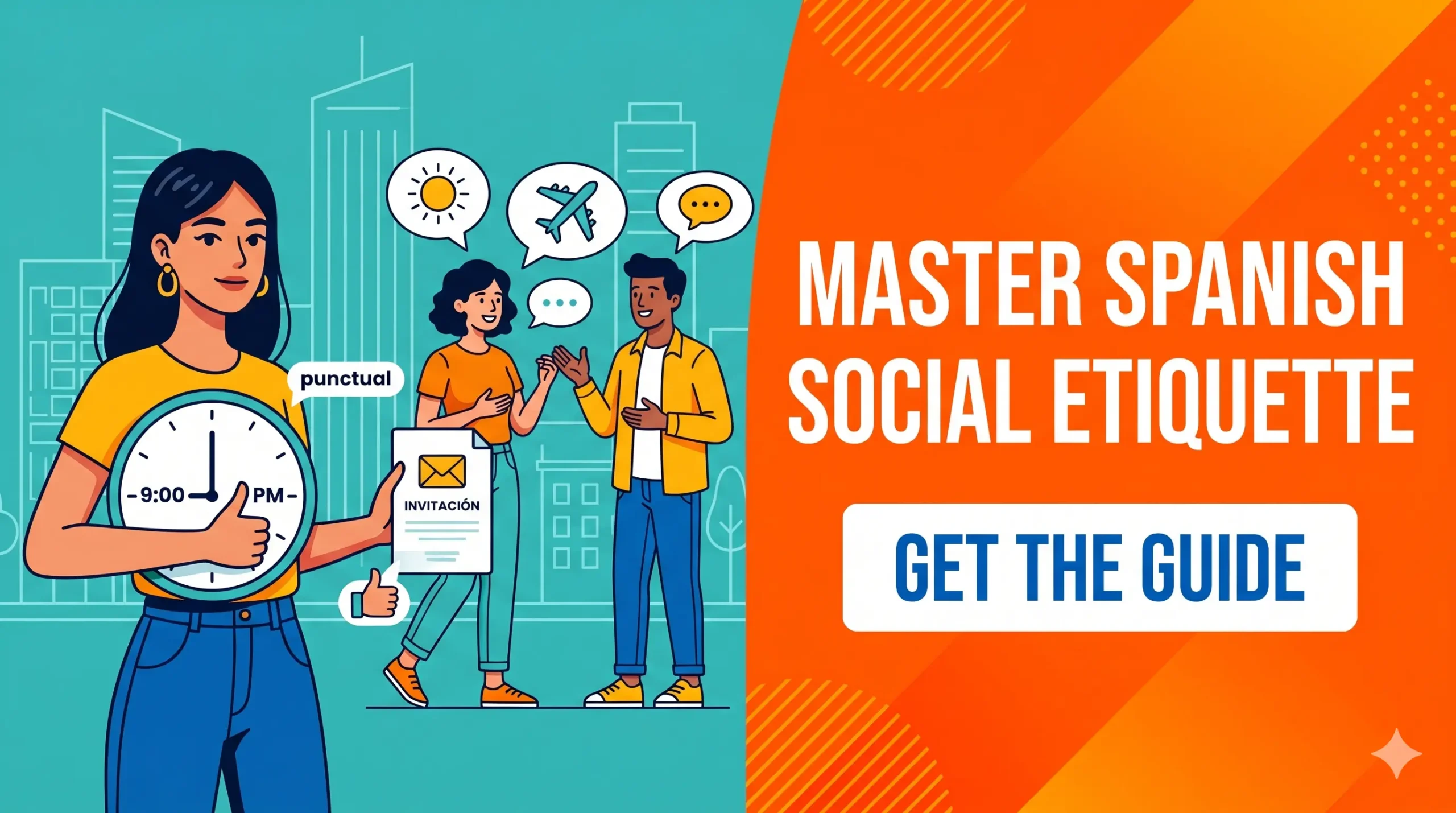
If you are invited to a Spanish friend’s house for dinner and they tell you to arrive at nine, arriving precisely at eight fifty-five is almost considered rude. The host is likely still showering, getting dressed, or setting the table. In casual social settings, arriving fifteen to twenty minutes late is the unspoken, polite standard. It gives the host breathing room. If you arrive exactly on the dot, you will likely cause unnecessary panic.
If you are invited to a local’s home for the first time, bringing a small gift like a bottle of wine or a dessert is customary. If you are running late and want to text the host to apologize, doing so on a reliable Tiekom connection ensures your message actually delivers instantly, preventing you from looking incredibly rude.
However, professional settings require strict nuance. While office environments are slightly more structured, social work gatherings still bend the clock. Expecting a Friday afternoon networking lunch to wrap up in exactly forty-five minutes is a cultural impossibility. To navigate exactly how this delayed rhythm impacts your office hours and meetings, deeply review Spanish Work Culture: Hours, Holidays, and Workplace Etiquette.
Navigating the Late Night Schedule
Forcing your home country’s timeline onto Spanish society simply does not work. You cannot invite a Spanish friend to dinner at six thirty in the evening. They will assume you are inviting them for a merienda (a light afternoon snack) or a coffee. Dinner rarely begins before nine thirty.
If you decide to host a late dinner but arrive at your new unfurnished apartment to find a completely bare kitchen, trying to buy serving dishes from local stores during the afternoon siesta is impossible. Ordering a proper set of wine glasses, large serving platters, and quality cookware from Amazon Spain bypasses this stress and ensures you are fully equipped to host like a local. To understand exactly when neighborhood shops actually operate and when the metal shutters drop, thoroughly review What to Expect When a Spanish Store Says Cerrado Closed Timing Tips.
If you get lost trying to find a hidden tapas bar at midnight, having a rock-solid mobile data plan from Tiekom means you can instantly load your GPS maps and text the group chat without wandering aimlessly through unfamiliar winding streets.
Decoding Invitations and The Sobremesa
The linguistic barrier is only half the battle. Expats frequently misinterpret polite Spanish social cues as genuine commitments, leading to immense feelings of rejection.
The Politeness Trap in Casual Invites
When a Spaniard bumps into you on the street and says, “A ver si nos vemos” (Let’s see if we see each other) or “Quedamos un día” (We’ll meet up one day), they are not actually inviting you out. It is the cultural equivalent of “have a nice day.”
If you wait for them to follow up with a specific time and place, you will wait forever. Actual plans are forged via aggressive, specific coordination in WhatsApp group chats. If you want to integrate, you must be the active initiator. Relying on an expat-focused mobile provider like Tiekom ensures you have the uninterrupted data plan required to instantly receive rapid-fire group chat invites and confidently coordinate plans on the fly. For a complete strategy on breaking into these tight-knit local circles, thoroughly read How to Make Friends in Spain If You Work Remotely.
Mastering the Art of the Sobremesa
The most sacred Spanish social tradition is the sobremesa. When the meal finishes, you do not immediately ask for the bill and rush for the door. You sit, digest, and talk for hours. The table is cleared, but the conversation flows over coffees, digestifs (chupitos), and loud storytelling.
This is where real bonding happens—topics range from lighthearted gossip to intense political debates, all handled with a direct but warm energy. In fact, a Spanish waiter will almost never bring you the check until you explicitly ask for it (“La cuenta, por favor”), because rushing a guest from the table is considered highly inhospitable. You are expected to claim the table for the entire afternoon.
If you are hosting the sobremesa at your apartment, you cannot offer your guests instant coffee and expect them to linger. Buying a high-quality Moka pot, proper espresso cups, and a fun conversational board game from Amazon Spain is an absolute cultural necessity to keep your guests lingering comfortably into the early morning hours. If you are dining out with a group, the bill is traditionally split evenly among everyone at the table, regardless of who ordered the expensive steak. Arguing over penny-pinching line items ruins the mood completely. To navigate sharing ongoing expenses without awkwardness, review How to Split Bills With Flatmates in Spain Apps and Fair Methods.
Small Talk, Directness, and Physical Greetings
The way Spanish people communicate can feel abrasive to newly arrived foreigners, but it is rooted in deep cultural warmth rather than hostility.
Skipping the Pleasantries
Anglo-Saxon cultures rely heavily on filler words like “please,” “thank you,” and “would you mind.” If you directly translate this excessive politeness into Spanish, you will sound incredibly cold, distant, and overly formal.
Spaniards value directness and efficiency. Walking into a busy tapas bar and saying “Ponme una cerveza” (Put a beer for me) is the standard, polite way to order. It is not rude; respect and warmth are conveyed through your tone of voice, a smile, and eye contact, not through exhausting vocabulary. Waiters are busy and appreciate you getting to the point. This sudden bluntness frequently shocks new arrivals, a psychological dynamic heavily explored in Spain Culture Shock: What New Expats Commonly Misunderstand.
In Spain, small talk with strangers—like the cashier at the supermarket or the person standing next to you in the bakery line—is incredibly common, but it is functionally different. You do not ask strangers “How are you?” expecting a long answer. Instead, you comment on the heat, the long line, or the quality of the bread. When exiting a small shop, it is customary to say “Hasta luego” to the entire room, not just the cashier.
Physical Space and the Dos Besos Rule
Personal space bubbles in Spain are drastically smaller than in Northern Europe. Conversations are loud, overlapping, and highly animated. If someone talks over you, they are showing passionate, engaged interest, not disrespect.
When greeting someone in a social setting, the absolute standard is dos besos (two kisses). You do not actually plant your lips on their skin, which is a common mistake nervous expats make. The proper etiquette is to lean in to touch your right cheek to their right cheek first, then move to the left cheek, making a subtle kissing sound with your lips in the air. Going for the left cheek first will result in a highly awkward near-collision of lips, as Spain strictly follows the right-cheek-first rule.
Refusing to do this when introduced to a friend of a friend comes across as highly offensive and standoffish. Note that dos besos is typically exchanged between two women, or a man and a woman. Between two men, a firm handshake or a back-slapping hug is the standard, though male family members may still exchange kisses.
Navigating Social Interactions in Your Building
Your social integration starts the exact moment you walk out your apartment door and step into the communal hallway.
Neighbors and Community Etiquette
Ignoring your neighbors in the stairwell or the elevator is a massive faux pas. You must always loudly say “Hola, buenos días” or “Hasta luego” when entering or exiting an elevator with someone, even if you have never spoken to them before. A simple nod is not enough; verbal acknowledgment is required.
Because Spanish apartments are often built with thin, hollow brick walls, acoustics are a massive issue. If you are throwing a late dinner party, it is customary to warn your immediate neighbors beforehand. If you want to smooth over any lingering frustration after a particularly loud weekend, ordering a nice box of chocolates or a small housewarming gift via Amazon Spain and leaving it for the building president goes a very long way in securing neighborhood goodwill. If the noise in your building is keeping you awake while you try to adjust to the new time zones, purchasing quality earplugs and blackout curtains via Amazon Spain can provide immediate relief.
If diplomacy fails and the noise from a neighbor’s own late-night sobremesa becomes unbearable, you must understand the proper municipal steps to enforce quiet hours. This legal escalation is detailed in How to Report Noise Complaints in Spain Municipal Steps. Furthermore, adhering to the unspoken rules of your specific community block is essential to avoiding friction or eviction; carefully review How to Deal With Spanish Building Rules Pets Noise Renovations.
Finally, cultivating a healthy social life often means hosting international friends or streaming background music during your dinner parties. You cannot rely on a weak, buffering internet connection to keep the night alive. Setting up your home fiber through Tiekom guarantees your smart speakers won’t cut out mid-song and your guests can easily connect to your Wi-Fi if they need to check late-night transit schedules or book a ride-share to get home safely. Having the financial bandwidth to cover these premium utility hosting expenses is just as important as the social bandwidth. To ensure your baseline budget can absorb these costs without stress, meticulously review Cost of Living in Spain: Budgeting for Expats.
| Spanish Phrase | Literal Translation | Cultural Meaning for Expats | Required Action |
| “A ver si nos vemos” | Let’s see if we see each other. | Goodbye / Have a nice day. | None. Do not wait for a follow-up text. |
| “Te llamo luego” | I will call you later. | I am ending this conversation. | None. They likely will not call today. |
| “Quedamos a las 9” | We meet at 9. | We meet around 9:15 to 9:20. | Deliberately arrive 15 minutes late. |
| “¿Tomamos la penúltima?” | Shall we have the penultimate? | Let’s have one final drink. | Prepare to stay for another hour. |
References
Primary sources (official)
- Instituto Cervantes – Centro Virtual Cervantes (Cultural norms and language): https://cvc.cervantes.es/
- Ministerio de Asuntos Exteriores, Unión Europea y Cooperación – Vivir en España: https://www.exteriores.gob.es/es/ServiciosAlCiudadano/Paginas/Vivir-en-Espana.aspx
Other helpful sources
- The Local Spain – Spanish Word of the Day ‘Sobremesa’: https://www.thelocal.es/20191004/spanish-word-of-the-day-sobremesa
- SpainGuru – Unspoken Rules Spain Expats Must Know: https://spainguru.es/2026/03/31/unspoken-rules-spain-expats-cultural-tips/
Disclaimer
The information provided in this article is for educational and informational purposes only and does not constitute formal psychological, linguistic, or legal advice. Cultural norms, social etiquette, and acceptable noise levels vary significantly across the diverse Autonomous Communities of Spain. What is considered standard social interaction in the vibrant center of Andalusia may differ from the more reserved professional environments of the Basque Country. Always exercise personal situational awareness and refer to your local municipal bylaws regarding residential noise hours and community statutes.