How to Order at a Bar in Spanish Without Stress
Stepping into a bustling Spanish bar for the first time can be an exhilarating, yet utterly nerve-wracking experience when you're not a native speaker. The quick-fire Spanish, the lively atmosphere, the lack of a clear queue – it can all feel like a whirlwind, leaving you struggling to get your order in. But don't you worry, my friend, because this guide is here to arm you with all the essential phrases and cultural insights you'll need to confidently order your caña or tapa without breaking a sweat.
Disclosure: This post may contain affiliate links. We may earn a commission at no extra cost to you if you make a purchase through these links. Read full disclosure.
Decoding the Spanish Bar Experience
Alright, let's pull back the curtain on the magic of Spanish bars, because understanding how they work is half the battle won. It's not just about the words; it's about the rhythm, the flow, and the unspoken rules.
The Social Rhythm of Spanish Bars
Unlike some countries where ordering is a very formal, one-on-one transaction, Spanish bars, especially the popular ones, operate on a different frequency. You'll often find people standing, chatting loudly, and ordering directly from the barman or waitress who seems to have an uncanny ability to know who's next, even in a throng. Don't expect a neat queue! You just need to catch their eye, be ready, and speak clearly. It can feel chaotic, but there's a method to the madness, a dance that locals have perfected over years. Embrace the energy, even if it feels a bit overwhelming at first. Just try to appear ready to order, make eye contact, and maybe a slight nod or raised hand will do the trick to signal you’re next.
The pace can be incredibly fast, particularly in peak hours, like aperitivo time (before lunch) or in the early evening before dinner. Locals pop in for a quick drink and a bite, so the turnover is high. Trying to overthink your Spanish too much in these moments will only make you miss your window. Get your core phrases down, and don't be afraid to be concise. For a deeper dive into the cultural nuances, check out our guide on Spanish Social Customs: Greetings, Kisses, and Personal Space.
Understanding the Menu: Tapas, Raciones, and Drinks
Before you even open your mouth, knowing what you can order is a huge help. Spain’s bar food culture is incredibly rich, and the terminology can be a bit confusing for newcomers.
- Tapas: This is probably the most famous, and often misunderstood, concept. A tapa is a small portion, usually just a bite or two, often served free with a drink in some regions (like Granada, parts of Castilla y León) but ordered separately and paid for in others (like Madrid, Barcelona). Think of it as a small plate meant to be shared or enjoyed solo.
- Pinchos (or Pintxos in Basque Country): These are small snacks, often served on a slice of bread, and usually displayed on the bar counter. You often grab them yourself and pay based on the number of toothpicks you have at the end, or you ask the bartender for hot ones. It's a fantastic, interactive way to eat.
- Media Ración / Ración: If a tapa isn't quite enough, a media ración is a half-portion, and a ración is a full portion, designed for sharing among a few people. This is your go-to when you want a proper plate of something delicious to share, like patatas bravas, jamón, or calamares.
- Drinks: This is where things get interesting. Ordering "beer" will often get you a blank stare. You need to know the specifics.
- Caña: This is a small glass of draft beer, the most common way to drink beer in Spain. It's usually about 200-250ml, ensuring it stays cold.
- Doble: A larger draft beer, roughly double the size of a caña.
- Tubo: A tall, slender glass of draft beer, typically around 300-330ml.
- Clara: Beer mixed with lemon soda (like Casera or Sprite), very refreshing in summer.
- Vino tinto / blanco / rosado: Red, white, or rosé wine. If you just say "un vino," you'll likely get a small glass of house red.
- Refresco: Any soft drink (cola, Fanta, etc.).
- Agua: Water. Specify con gas (sparkling) or sin gas (still).
- Café: Oh, the coffee culture! This deserves its own deep dive, but for a quick order, you might want "un café solo" (espresso), "un cortado" (espresso with a splash of milk), "un café con leche" (latte), or "un descafeinado" (decaf, often served from a sachet). Our guide How to Order Coffee in Spain Like a Local covers this in glorious detail.
Knowing this vocabulary helps immensely, as it prepares you for what you might see or hear. For general dining experiences, you might also find our guide on Spanish Meal Times and Dining Etiquette Explained quite useful.
Essential Phrases for Ordering Drinks and Food
Now, let's get down to brass tacks: the actual words you'll use. Keep it simple, clear, and don't be afraid to make mistakes. Spaniards appreciate the effort!
Getting a Drink: From Coffee to Cañas
When you're ready to order, catch the server's eye and use one of these simple starting phrases:
- "Hola, una caña, por favor." (Hello, a small draft beer, please.) – The ultimate classic.
- "Quisiera un café con leche, por favor." (I would like a coffee with milk, please.) – A polite way to ask.
- "Para mí, un vino tinto, gracias." (For me, a red wine, thanks.) – Another polite option.
- "¿Me pones un refresco?" (Could you get me a soft drink?) – Informal, but common and perfectly acceptable.
- "¿Tienes cerveza sin alcohol?" (Do you have non-alcoholic beer?) – Good to know if you're not drinking.
If you're ordering for multiple people, you can list them:
- "Dos cañas y un agua sin gas, por favor." (Two small beers and a still water, please.)
- "Una clara y un zumo de naranja, por favor." (A shandy and an orange juice, please.) – Freshly squeezed orange juice is very common and delicious here!
The key is to sound confident, even if you're not. Your pronunciation doesn't have to be perfect; clarity is more important. Remember, a smile and a "por favor" go a long way. If you find yourself in a tapas bar known for its particular regional offerings, a great starting point for culinary adventures can be found through platforms like GetYourGuide, which often offer food tours that demystify local ordering.
Ordering Food: Tapas and Beyond
Once the drinks are sorted, or if you're ready for food right away, here's how to tackle it. Many bars, especially those focused on tapas, will have a display counter. You can point if needed!
- "¿Qué tapas tienes?" (What tapas do you have?) – A good opener if you're unsure.
- "Dame una ración de patatas bravas, por favor." (Give me a portion of bravas potatoes, please.)
- "Una de calamares a la romana, por favor." (One portion of Roman-style squid, please.) – Notice the "una de…" which implies "a portion of…"
- "¿Tienes alguna opción vegetariana?" (Do you have any vegetarian options?) – Crucial for many expats.
- "Para compartir, una media ración de jamón." (To share, a half-portion of ham.)
If you see something on the counter you like:
- "Quisiera este pincho, por favor." (I'd like this pintxo, please.) – Point clearly!
- "¿Me pones uno de esos?" (Could you get me one of those?) – Again, point.
Don't be shy about asking for recommendations either. "Cuál me recomiendas?" (Which one do you recommend me?) is a fantastic phrase to have in your back pocket. Our guide to Spanish Tapas Culture: How to Order and Where to Go has even more specific tips for navigating this delicious world.
Asking for the Bill and Other Essentials
When you've finished enjoying your drinks and food, don't wait for the bill to arrive automatically, especially in a busy place. You'll need to ask for it.
- "La cuenta, por favor." (The bill, please.) – The most common and direct way.
- "¿Me cobras, por favor?" (Could you charge me, please?) – Slightly more informal, but also widely used.
They'll often bring the bill to your table or tell you the amount directly. If you're paying with card:
- "¿Se puede pagar con tarjeta?" (Can one pay with card?)
- "Con tarjeta, por favor." (With card, please.)
A little note on tipping: Tipping in Spain isn't the same as in North America. It's appreciated but not obligatory, especially for just a coffee or a quick drink. For a full meal with good service, leaving a few euros or rounding up is common. Our detailed guide on Tipping in Spain: When, Where, and How Much will give you the full lowdown.
Here's a handy table summarizing some key phrases:
| English Phrase | Spanish Phrase | Usage Context |
|---|---|---|
| Hello / Good morning / Good evening | Hola / Buenos días / Buenas tardes | Always start with a greeting! |
| A small draft beer, please | Una caña, por favor. | Standard beer order. |
| A coffee with milk, please | Un café con leche, por favor. | Common coffee order. |
| A red wine, please | Un vino tinto, por favor. | For a glass of red. |
| Still water, please | Agua sin gas, por favor. | Essential for hydration. |
| What tapas do you have? | ¿Qué tapas tienes? | When exploring food options. |
| A portion of patatas bravas, please | Una ración de patatas bravas, por favor. | Ordering a larger dish to share. |
| I'd like this (pointing), please | Quisiera esto, por favor. | When pointing at items on the counter. |
| The bill, please | La cuenta, por favor. | When you're ready to pay. |
| Can I pay by card? | ¿Se puede pagar con tarjeta? | Before handing over your card. |
| Thank you | Gracias | Essential for politeness. |
| You're welcome | De nada | Common response. |
Navigating Common Scenarios and Avoiding Pitfalls
Even with all the phrases down, real-life situations can throw curveballs. Here’s how to handle some common challenges you might encounter.
Dealing with Fast-Paced Service and Crowds
Spanish servers are often incredibly efficient, but also incredibly busy. If you're used to waiting to be acknowledged, you might find yourself overlooked.
- Be Ready: Have your order clear in your head. When you make eye contact, be ready to speak. Hesitation can mean they move on to the next person.
- Project Your Voice: In a noisy environment, you might need to speak a little louder than you're comfortable with. Don't shout, but be assertive.
- A Gentle "¡Perdona!" or "¡Oiga!": If you've been waiting for a while and can't get attention, a polite "¡Perdona!" (Excuse me!) or "¡Oiga!" (Listen! – often used to call a server) can work wonders. Use it respectfully, not demandingly.
- Don't Take it Personally: If service feels brisk or even a bit gruff, it’s almost never personal. It’s just the pace of the place. They're focused on getting orders out, not on charming every customer. This is part of the charm (and occasional frustration) of the bustling Spanish bar scene.
Understanding the culture of quick service can really ease the stress. Sometimes, you just need to jump in. If you're looking for bars in specific cities, platforms like Booking.com can sometimes help you find accommodations near vibrant nightlife or tapas areas, making it easier to explore.
Handling Dietary Needs and Allergies
This can be a genuine source of anxiety for expats, especially with severe allergies. While awareness is growing, it's not as universally understood as in some other countries.
- Learn Key Allergy Phrases:
- "Soy alérgico/a a…" (I am allergic to…)
- "…el gluten." (…gluten.)
- "…los frutos secos." (…nuts.)
- "…la lactosa." (…lactose.)
- "…el marisco." (…shellfish.)
- "¿Contiene…?" (Does it contain…?)
- Be Specific: Instead of just "I'm allergic," try to specify what cannot be in your food. For example, "Soy alérgico al gluten. ¿Qué platos no contienen gluten?" (I am allergic to gluten. Which dishes do not contain gluten?).
- Use a Translation App (If Needed): Don't be ashamed to pull out your phone and show a translated message, especially for complex allergies. This is where tools mentioned in our guide Using Translation Apps in Spain: What Works Best come in handy.
- Research Ahead: For serious allergies, it can be helpful to research restaurants or bars online beforehand. Many places now list ingredients or have allergy menus, especially in larger cities. You can find authentic restaurants and reviews to help you plan your visits in our guide How to Find Authentic Restaurants in Spain (Not Tourist Traps).
It's better to be overly cautious than risk your health. Most servers will try to help, but their knowledge might be limited, particularly in smaller, more traditional establishments.
When All Else Fails: Embrace the Gesture
Sometimes, despite your best efforts, your Spanish might fail you, or the server might be too busy to fully grasp what you're trying to say. This is where non-verbal communication becomes your best friend.
- Pointing: Don't underestimate the power of a clear, polite point, especially at items on display or on a physical menu.
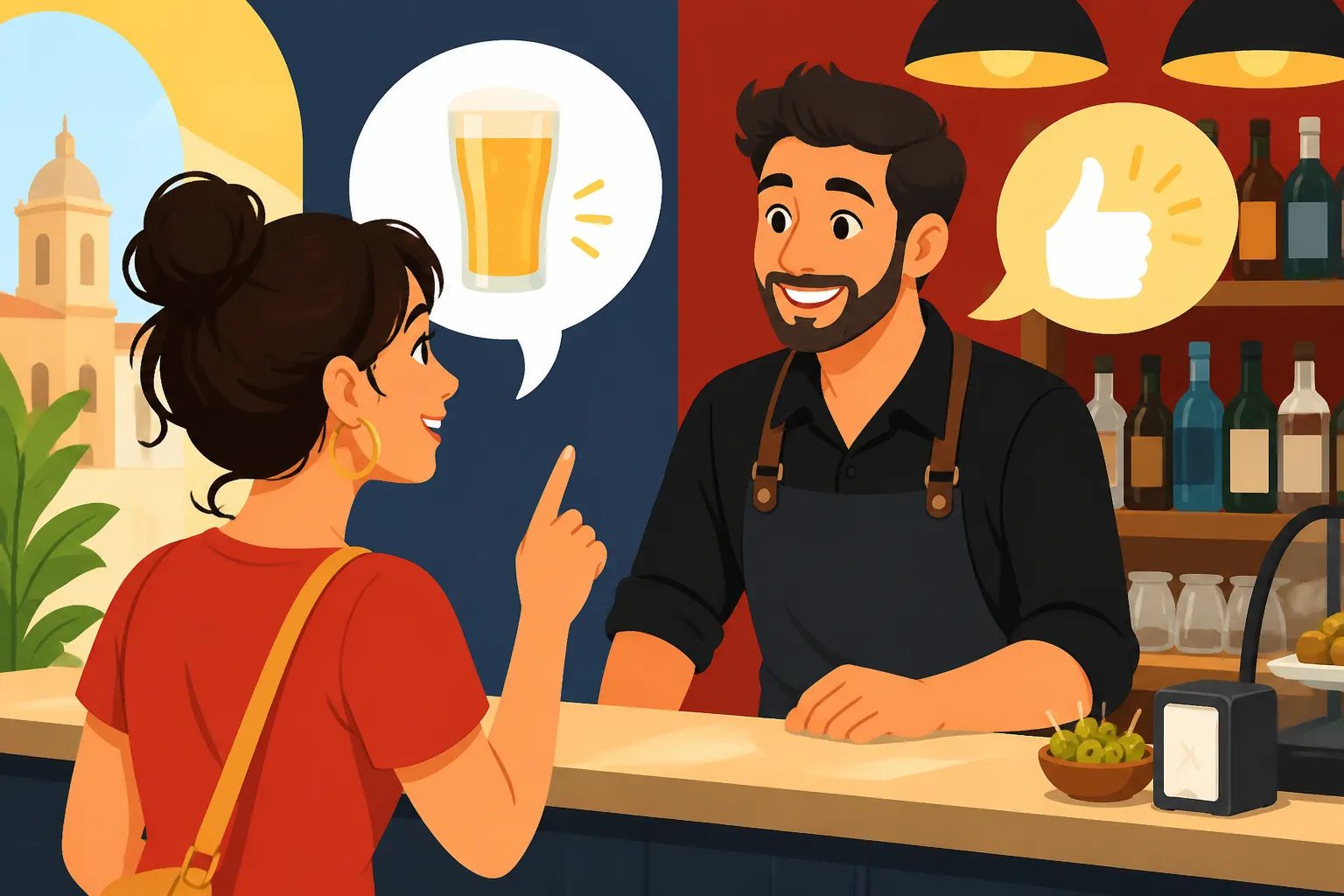
- Mimicking: Need a caña? Mimic holding a small glass. Ordering two? Hold up two fingers. This might feel silly, but it's universally understood and can quickly resolve misunderstandings.
- A Confident Smile: A friendly demeanor can smooth over many language barriers. It shows you're trying and are open to communication.
- The "¡Por favor!" and "¡Gracias!" Lifelines: No matter what, always pepper your interactions with "please" and "thank you." Politeness transcends language.
Remember, the goal is to get what you want, not to win a grammar award. Most Spaniards are very understanding and patient with language learners.
Practice Makes Perfect: Beyond the Bar Counter
Conquering the bar ordering experience is a huge step, but it's just one piece of the linguistic puzzle. The more you immerse yourself, the easier it becomes.
Practicing Your Spanish in Everyday Life
Don't let the bar be your only testing ground. The more you speak Spanish, the more natural it will feel, and the less stressed you'll be in any public interaction.
- Daily Errands: Use Spanish at the grocery store, at the market, when buying a metro ticket. Every small interaction builds confidence.
- Small Talk: Try to engage in basic pleasantries. "Hace buen día, ¿verdad?" (It's a nice day, isn't it?) or "¿Qué tal?" (How are you?) can open up small conversations.
- Language Exchange Meetups: Many cities have groups where you can meet native speakers looking to practice English in exchange for helping you with Spanish. Websites and apps can help you find these.
- Watch Spanish TV/Movies: Immersion is key. Even if you don't understand everything, your ear will get accustomed to the sounds and rhythm of the language.
For more comprehensive advice on navigating daily conversations, check out our Spanish Language and Everyday Communication for Visitors guide, or if you're just starting, Survival Spanish for Travelers: Key Phrases to Learn First is an excellent resource.
Resources for Language Learning
If you're serious about reducing stress at the bar (and everywhere else!), investing a little time in formal language learning can make a world of difference.
- Language Schools: Spain has countless excellent language schools, especially in cities popular with expats. Immersive courses can fast-track your progress.
- Online Apps: Duolingo, Babbel, Pimsleur – these can be great for building foundational vocabulary and grammar in a low-pressure environment. They're fantastic for practicing on the go.
- Private Tutors: For personalized attention and to focus on specific needs (like ordering confidently), a private tutor can be invaluable.
- Immersion Travel: Consider visiting different regions of Spain. Sometimes a change of scenery, like traveling with Omio to a different city, can expose you to new accents and vocabulary, further solidifying your language skills. This is where you really put your knowledge to the test.
The journey of learning a new language is continuous, and every successful interaction, no matter how small, is a victory. So next time you walk into a Spanish bar, take a deep breath, flash a smile, and confidently order your drink. ¡Que aproveche! (Enjoy your meal/drink!)
Disclaimer
The information provided in this guide is for general informational purposes only and does not constitute professional advice. While we strive to provide accurate and up-to-date information, local customs, regulations, and prices can change. Always verify critical information, especially regarding allergies or legal matters, with official sources or local professionals.