How to Find a ‘Farmacia de Guardia’ Near You in Spain
Falling ill outside of standard business hours in Spain does not mean you are without medical options. This guide explains how to easily locate an on-duty farmacia de guardia, navigate late-night prescription rules, and understand emergency dispensing fees.
Disclosure: This post may contain affiliate links. We may earn a commission at no extra cost to you if you make a purchase through these links. Read full disclosure.
Understanding the Farmacia de Guardia System
If you wake up with a severe fever in the middle of the night or realize you desperately need infant pain relief on a Sunday afternoon, you will quickly notice that standard Spanish shops and medical clinics are closed. To ensure public health and safety, Spain utilizes a highly organized, legally mandated system of on-duty pharmacies universally known as the farmacia de guardia.
The Twenty Four Hour Roster Explained
In Spain, pharmacies are heavily regulated by the government and the regional College of Pharmacists. By law, every single municipality must guarantee that its residents have continuous, uninterrupted access to essential medications twenty-four hours a day, 365 days a year.
To achieve this without forcing every pharmacy to remain open overnight, towns and city districts implement a rotating roster. While your neighborhood pharmacy might normally close at 8:30 PM, it will periodically be assigned the guardia shift. This shift requires the pharmacy to remain open—or have a licensed pharmacist actively on call and sleeping on the premises—through the night, on Sundays, and during national public holidays. This rotating system is a core component of the Spain Healthcare System for Expats: Public vs Private, ensuring that whether you rely on state healthcare or private doctors, you can always fill a vital, urgent prescription.
What You Can and Cannot Buy After Hours
It is crucial to understand that a farmacia de guardia is primarily designed to dispense urgent, essential medications. While the pharmacist will not actively turn you away if you want to buy a luxury face cream or a toothbrush at 3:00 AM, utilizing the late-night service for non-emergencies is generally frowned upon and can sometimes incur additional administrative fees.
If you are simply looking to maintain your daily wellness routine with non-urgent vitamins, specialized organic supplements, or holistic remedies, it is much more polite and cost-effective to wait for regular business hours. For these daily wellness needs, the expat community frequently relies on global online retailers like iHerb. Sourcing your routine health supplements through iHerb and having them shipped directly to your Spanish address allows you to build up a robust home first-aid kit, reserving your late-night pharmacy trips for true medical necessities.
How to Locate an On Duty Pharmacy
Finding the designated on-duty pharmacy in your specific neighborhood requires knowing exactly where to look, as the location shifts daily or weekly depending on your municipality’s size.
Checking Local Pharmacy Windows
The most traditional, foolproof method of finding an on-duty pharmacy does not require an internet connection or a smartphone. By strict regulatory law, every single pharmacy in Spain—even when completely closed and shuttered with heavy metal grates for the weekend—must physically display a printed list of the current on-duty pharmacies in their immediate vicinity.
If you walk up to your closed local pharmacy, look closely at the glass door or the illuminated display case mounted on the exterior wall. You will find a clear, printed calendar indicating exactly which pharmacy holds the guardia shift that day and night, complete with its street address and often a small, simplified map. If you live in a small rural village, there may only be one pharmacy on duty for the entire municipality. In large metropolitan areas like Madrid or Barcelona, the printed list will show the closest options specifically within your district.
Using Regional Health Apps and Websites
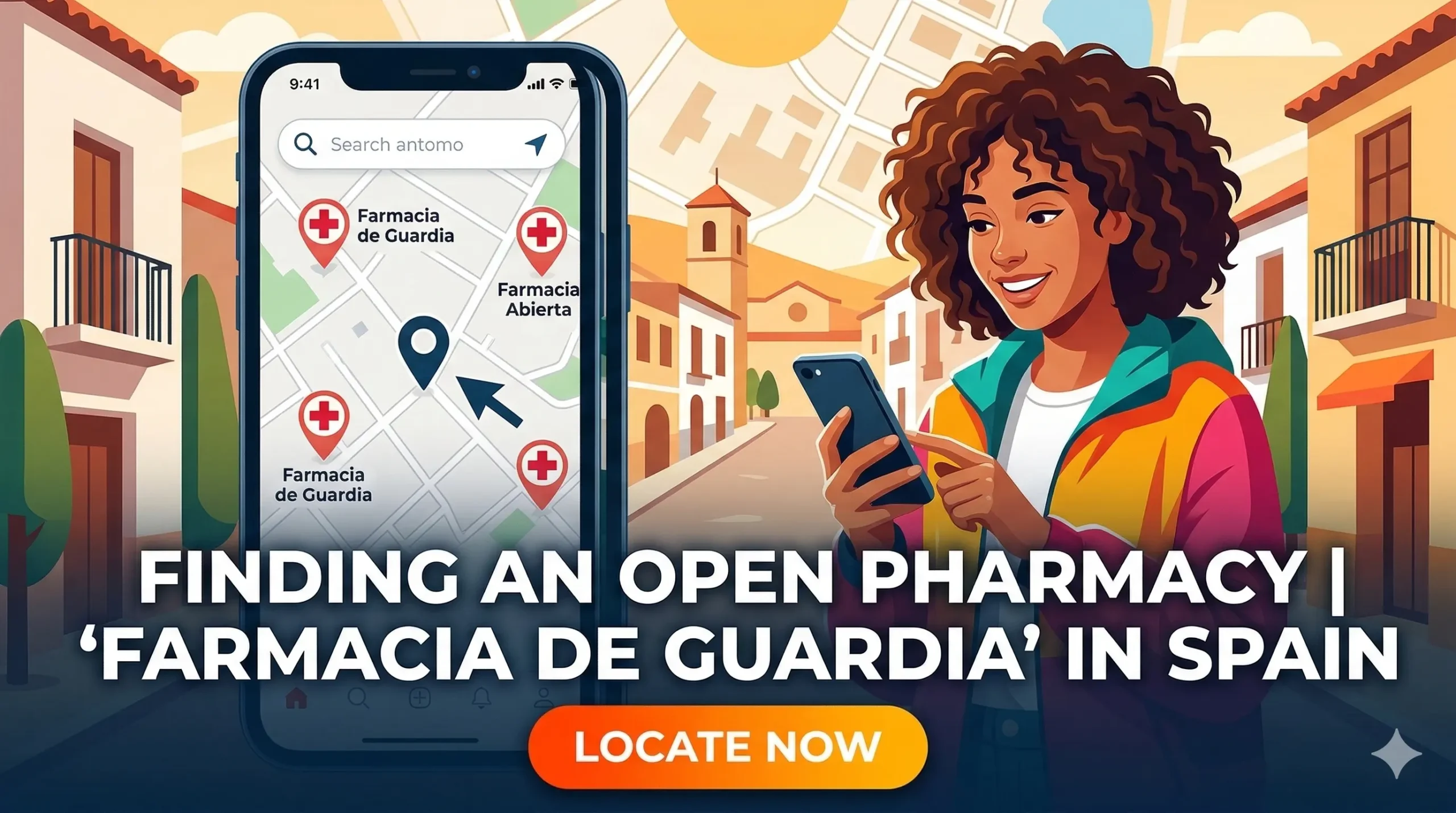
For a more modern approach, you can easily locate an on-duty pharmacy using digital tools. A simple web search for “farmacia de guardia cerca de mi” (on-duty pharmacy near me) will usually yield accurate, location-based results.
However, the most reliable digital method is to check the official website of your province’s College of Pharmacists. These official regulatory websites feature dedicated, real-time search engines where you input your zip code, and the system outputs the exact pharmacies holding the shift that night. Furthermore, if you are registered in the public system, you can often find this locator tool directly within your autonomous community’s digital health application. To learn how to download and utilize these highly efficient digital tools, review our comprehensive guide on Health Apps in Spain: Booking, Records, and Telemedicine Options.
Calling Official Assistance Numbers
If you are traveling, lack a stable internet connection, and cannot find a printed list, you can always utilize telephone assistance. While you should never dial the 112 emergency line solely to ask for pharmacy directions (unless it is a life-threatening medical crisis), you can call municipal citizen assistance numbers.
In many Spanish regions, dialing 012 connects you to local government information services, and the operators can quickly look up the nearest open pharmacy based on your current location. If you are a tourist navigating these logistics and realize you left your essential daily medication in your home country, discovering where to go late at night is vital. You can find more tips on preparing your medical travel kit in Traveling With Medication in Spain: Practical Carry-On Tips. If you have to hail a late-night taxi to reach a pharmacy on the other side of town, using a multi-currency card like Wise allows you to tap and pay the driver in Euros without incurring high international transaction fees from your home bank.
Rules Surcharges and Late Night Prescriptions
Visiting a pharmacy at 3:00 AM is a slightly different experience than walking in during a sunny Tuesday afternoon. Knowing what to expect regarding security, surcharges, and prescription laws will make your visit entirely stress-free.
Security Measures and After Hours Fees
When you arrive at the farmacia de guardia late at night, the main front doors will likely be locked. Do not assume they are closed. For security reasons, most late-night pharmacies operate through a small, reinforced glass hatch or a metal drawer built directly into the front door or wall, known as a guardillón. You ring the illuminated doorbell, and the pharmacist will assist you through this secure window.
You should also be prepared for a minor financial difference. Pharmacies are legally permitted to apply a small after-hours surcharge to items purchased late at night or on holidays. However, this surcharge is almost always waived if you present an official, urgent prescription issued that same day by a doctor from a public hospital or your local What Is a ‘Centro de Salud’ in Spain and How Do You Register?.
If you are purchasing over-the-counter medications without a fresh prescription, the surcharge will apply. To manage these small, unexpected out-of-pocket costs without getting hit by poor international bank exchange rates, using a borderless account like Wise is highly recommended. Tapping your Wise debit card at the pharmacy window ensures you are paying the true Euro cost without hidden banking fees padding your emergency health expenses.
Handling Emergency Prescriptions
A critical rule of Spanish pharmacies is that they strictly adhere to prescription laws, regardless of what time it is. If you arrive at an on-duty pharmacy at midnight with a severe urinary tract infection, the pharmacist will not sell you antibiotics over the counter without a valid prescription. They can only provide palliative pain relief, like ibuprofen or paracetamol, and advise you to see a doctor immediately.
If you hold a comprehensive private expat health insurance policy, 24/7 video consultations are usually included in your premium. Securing a robust policy through a specialized broker like Innoinsure ensures you always have immediate digital access to an English-speaking doctor, preventing you from having to endure agonizing hours in a physical waiting room. You can learn more about how these virtual appointments function in our article on Telemedicine in Spain: When It’s Useful and What to Expect. Additionally, it is wise to check the terms of your Innoinsure policy to see if late-night pharmacy surcharges are reimbursable under your outpatient benefits.
Managing Chronic Refills vs Emergencies
The farmacia de guardia is brilliant for sudden illnesses, but it should not be your primary strategy for managing chronic medications. If you realize on a Sunday night that you have run out of your daily blood pressure pills, a late-night pharmacist might advance you a small blister pack to tide you over until Monday morning, provided you can prove you are officially registered in the regional health database.
However, relying on the goodwill of an after-hours pharmacist for chronic refills is a risky strategy. It is essential to understand the digital renewal process. Public primary care doctors can program your electronic health card to automatically authorize your medication refills for months in advance, allowing you to pick them up seamlessly during normal business hours. For a comprehensive look at how this automated system works and how to avoid running out, read Medication Refills in Spain: How Renewals Work.
Furthermore, if your late-night emergency involves severe, radiating tooth pain rather than a general medical illness, an on-duty pharmacist can only provide temporary numbing gels and painkillers. They cannot fix the root cause. For these specific, highly painful scenarios, you will need to locate a specialized 24-hour dental clinic, which operates entirely separately from standard pharmacies. We cover how to handle these specific crises in Emergency Dental Care in Spain: Where to Go.
Pharmacy Service Comparison
To clarify the differences, here is a quick breakdown of what you can expect when visiting a standard pharmacy during the day versus an on-duty pharmacy at night:
| Feature | Standard Pharmacy | Farmacia de Guardia |
| Typical Hours | Mon-Fri: 9:30 AM – 8:30 PM (often closed for siesta) | 24/7 (or specific overnight/holiday shifts) |
| Access Method | Walk-in, open doors | Often via a secure window or hatch after dark |
| Out of Hours Surcharge | No | Yes (usually waived with an urgent, same-day Rx) |
| Primary Purpose | Routine prescriptions, cosmetics, health advice | Urgent medical needs and emergency prescriptions |
| Item Availability | Full inventory | Limited to essential medications late at night |
Whether you are dealing with an unexpected cold, a minor injury, or stocking up your home first-aid kit via iHerb to avoid midnight runs, understanding the pharmacy system guarantees that you are never left without essential medical support. By combining this local knowledge with comprehensive coverage from providers like Innoinsure and paying for out-of-pocket urgent care with your Wise card, you can build an incredibly robust health safety net abroad. To understand exactly how much you might pay for standard prescriptions once the sun comes up, be sure to review Health Costs in Spain: Typical Co-Pays and Out-of-Pocket Fees.
References
Primary sources (official)
- Consejo General de Colegios Farmacéuticos – Pharmacy Locator and Regulations: https://www.farmaceuticos.com/
- Ministerio de Sanidad (Ministry of Health) – Farmacia y Prestaciones: https://www.sanidad.gob.es/
Other helpful sources
- Expatica – Pharmacies in Spain: https://www.expatica.com/es/healthcare/healthcare-services/pharmacies-in-spain-106770/
- Citizens Advice Bureau Spain – Accessing Pharmacies and Medication: https://www.citizensadvice.org.es/
Disclaimer
The information provided in this article is for educational and informational purposes only and does not constitute formal medical or legal advice. Pharmacy operating hours, out-of-hours surcharges, and prescription regulations vary by autonomous community and are subject to change by local Spanish authorities. Always consult a licensed healthcare professional for medical diagnoses and dial 112 in the event of a severe, life-threatening medical emergency.