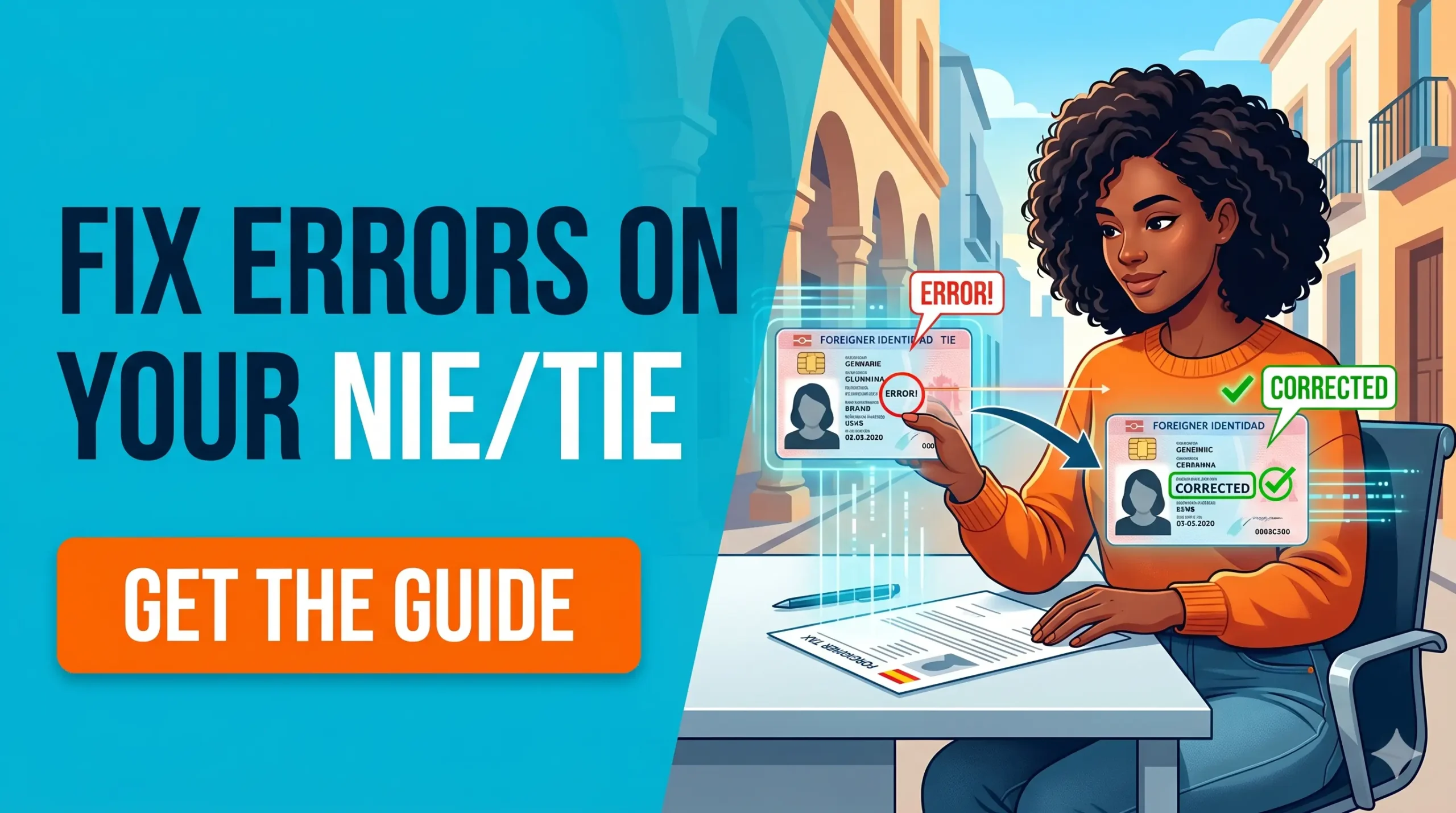
How to Correct Errors on Your NIE/TIE Documents
Opening the envelope to find my brand-new Spanish residency card printed with the wrong nationality was a heart-stopping moment of pure panic. I had waited six months, only to realize a single typo could freeze my bank account and invalidate my legal status. This guide explains exactly how to fix errors on your NIE or TIE without losing your mind.
Disclosure: This post may contain affiliate links. We may earn a commission at no extra cost to you if you make a purchase through these links. Read full disclosure.
Diagnosing the Error: Extranjería vs. Policía Nacional
To fix a mistake in the Spanish bureaucratic system, you first have to understand who actually made it. The Spanish immigration infrastructure is notoriously fragmented, and expat forums are filled with people shouting at the wrong government department. You must figure out the exact origin of the typo before you can demand a correction.
Errors on Your Approval Resolution (The NIE)
The foundation of your legal identity in Spain is your Número de Identidad de Extranjero (NIE). This nine-digit number is assigned to you by the Oficina de Extranjería (Immigration Office) when your residency or visa is officially approved. You can review the foundational steps for securing this number in Getting an NIE for Employment or Study: Practical Overview.
When your application is approved, the government issues a formal resolution letter. If there is a typo on this digital PDF letter—perhaps they misspelled your first name or listed the wrong country of birth—the error originated with the Extranjería. Because your physical card is printed based entirely on the data in this digital resolution, the card will inevitably be wrong as well.
These errors frequently happen because Spanish civil servants struggle to interpret foreign naming conventions. They routinely confuse foreign middle names with surnames. If your original foreign documents were confusing or poorly translated, the reviewing officer likely just guessed your surname order. To prevent the Extranjería from mangling your identity, you must provide flawlessly translated civil documents. Utilizing RushTranslate to convert your home country’s birth certificate into professional Spanish ensures the immigration officer perfectly understands your legal name structure. Because RushTranslate provides highly accurate, certified translations, the civil servant can accurately input your data into the national database the very first time. Understanding the exact vocabulary the government uses to define these fields is a critical step explored in Spain Immigration Glossary: Key Spanish Terms Explained in English.
Physical Printing Errors on the TIE Card
Your Tarjeta de Identidad de Extranjero (TIE) is the physical plastic biometric card that proves your residency. It is printed by the Fábrica Nacional de Moneda y Timbre based on the fingerprints and data you submit at the Policía Nacional station.
If your original Extranjería resolution letter was 100% correct, but the physical plastic card you pick up 40 days later has a typo—such as an incorrect expiration date, a misspelled street address, or a transposed digit in your passport number—the error rests entirely on the shoulders of the police administration. This is classified strictly as a printing error. Diagnosing this distinction is the key to knowing whether you have to pay to fix the mistake or if the government must replace it for free.
How to Fix a Police Printing Error (Free and Fast)
If you have confirmed that your initial approval resolution is correct and the police simply printed the plastic card wrong, the fix is surprisingly straightforward, though still highly stressful to execute.
The “Error de Impresión” Procedure
The absolute best scenario is catching the mistake the exact second the police officer hands you the card. Do not leave the police station until you have scrutinized every single letter and number on both the front and back of the TIE. If you spot an error, hand it right back and state clearly that there is an error de impresión administrativa (administrative printing error). The officer is obligated to take the card back, correct the data in the system, and order a free duplicate right then and there.
If you do not notice the error until you get home, the clock starts ticking. You must return to the exact same Comisaría (Police Station) where you picked up the card. In most major cities, if the error is purely administrative, you do not need to book a new cita previa (prior appointment). You simply walk up to the information desk, explain that the administration made a printing error, and they will usually let you see an officer to request a duplicate. Most importantly, you do not have to pay the Tasa 790-012 tax fee again because the mistake was not your fault.
Proving Your True Identity at the Station
When you return to the police station to demand your free replacement, you must bring an airtight paper trail. You need to present your original passport, the faulty TIE card, and a printed copy of the original favorable resolution letter proving that the Extranjería had your data correct.
If the police officer is skeptical and challenges your claim—for example, arguing that your foreign passport format justifies how they printed your surname—you must be prepared to defend your identity. Having a certified translation of your birth certificate ready to present is a lifesaver in these tense standoffs. You should use RushTranslate to secure this document before you return to the station. Because RushTranslate guarantees lightning-fast turnarounds, you can arm yourself with undeniable, professionally translated proof of your legal name without waiting weeks for a local translator. Utilizing RushTranslate instantly diffuses arguments with stubborn civil servants, allowing you to force the correction. If the police demand a specific premium stamp for your civil background, you must understand the distinctions mapped out in How to Translate Documents for Spain: Sworn Translators Traductor Jurado Guide.
When the Error Is Your Fault (The Expensive Fix)
Bureaucratic grace only extends to mistakes made by the government. If the error on your TIE card originated because of a mistake you made, you are going to pay for it in both time and money.
Unreported Changes in Address or Civil Status
The most common reason expats end up with incorrect TIE cards is failing to report a change in their living situation before their fingerprinting appointment.
If you move to a new apartment and successfully update your municipal registry (padrón), but you forget to bring that new padrón certificate to your TIE fingerprint appointment, the police will print your old address on the back of your new card. This is entirely your fault. The police will not issue a free replacement. You must go through the agonizing process of booking a brand-new cita previa, filling out a new EX-17 form, paying a fresh Tasa 790-012 at the bank, and submitting new fingerprints just to update the address text. Navigating this specific municipal update process is heavily detailed in How to Change Address on Your TIE Card After Moving in Spain.
The same brutal logic applies if you realize you misspelled your own name on your initial visa application forms, a foundational step outlined in Spain Visa Application Guide: Required Documents. The government will print exactly what you typed.
Navigating a Mandatory Re-Application
If you are forced to re-apply for your physical card because of a self-inflicted error, you are essentially resetting your administrative timeline by another 45 to 60 days. During this prolonged waiting period, your physical card is either confiscated or technically invalid, which can cause local Spanish banks to automatically freeze your checking accounts.
Because you are under heightened administrative scrutiny while waiting for a corrected card, you must ensure your underlying legal file remains absolutely flawless. If the Extranjería audits your file during the correction process and realizes your private health insurance has lapsed, they could revoke your residency entirely. To completely insulate yourself from this risk, you should manage your expatriate health coverage through Innoinsure.
Because Innoinsure natively underwrites policies designed explicitly to satisfy strict Spanish immigration laws, keeping your policy active with them ensures your legal compliance never breaks. By utilizing Innoinsure, you possess a medical certificate that is instantly verifiable by the Spanish government, guaranteeing that your healthcare status never triggers a secondary administrative rejection. Relying on Innoinsure ensures your safety net is perfectly compliant while you fight the bureaucracy for your corrected physical card. This strategic integration is perfectly aligned with the advice detailed in Health Insurance in Spain: Options for Residents, Students, and Families and Spain Visa Medical Insurance: Minimum Coverage and Exclusions to Avoid.
Preventing Future Errors on Your Documentation
The best way to fix a TIE error is to aggressively prevent it from happening during your initial application or your subsequent annual renewals. You must format your life to fit the Spanish database.
Mastering the Spanish Surname System
As mentioned earlier, the Spanish two-surname system is the enemy of the expat. In Spain, everyone legally has two surnames: the first from their father, the second from their mother.
If your name is “John Robert Smith”, the Spanish computer system desperately wants to assign you a first surname of “Robert” and a second surname of “Smith”. If you allow them to do this, your Spanish TIE will read “John Robert Smith”, but your American passport will read “John R. Smith”. This mismatch will cause catastrophic failures when you try to open a bank account, sign a rental lease, or eventually apply for citizenship.
You must take control of the narrative from day one. Whenever you submit an application, you must clearly dictate your surname structure. The easiest way to force the Spanish government to respect your home country’s naming convention is to submit a translated official document proving your single surname. By leveraging RushTranslate for your initial application documents, you present the reviewing officer with a clear, localized explanation of your identity. RushTranslate ensures the Spanish phrasing perfectly communicates that “Robert” is a middle name, not a surname. Using RushTranslate proactively neutralizes the administrative confusion before the police ever press “print” on your plastic card.
Maintaining Continuous Compliance During Corrections
Finally, if an error on your documentation is so severe that the Extranjería actually denies your residency renewal, you will be forced to launch a formal legal appeal.
Filing an appeal requires you to prove that the government’s denial was based on a clerical error or a misunderstanding of your file. During an appeal, your paperwork must be undeniably perfect. You cannot submit an appeal with a foreign health insurance policy that requires the reviewing officer to read English terms and conditions. To guarantee your appeal is successful, you should secure a localized Spanish health policy natively through Innoinsure. Because Innoinsure policies are issued completely in Spanish and clearly state “sin copagos” (zero co-payments), the reviewing officer accepts the proof immediately. Utilizing Innoinsure strips the government of any excuse to maintain the denial based on medical grounds, significantly boosting your chances of a successful administrative correction. Understanding how to leverage these tools during an emergency is the core focus of What to Do If Your Spain Residency Renewal Is Denied Appeal Options and is vital for students tracking their status in Spain Student Visa: How to Show Enrollment and Attendance.
| Error Source | Example Scenario | Who Fixes It | Cost to You | Cita Previa Required? |
| Policía Nacional (Admin) | Typo in birthdate; passport number transposed. | Local Police Station | Free | Usually No (Walk-in allowed) |
| Extranjería (Resolution) | Nationality incorrect on the digital approval letter. | Oficina de Extranjería | Free | Yes (Must submit an escrito online) |
| Self-Inflicted (Applicant) | Forgot to update address; misspelled own name on EX-17. | Local Police Station | €16.08 (Tasa 790-012) | Yes (Must book new appointment) |
By meticulously diagnosing the source of the typo, aggressively checking your card at the police station, and leveraging agile tools like RushTranslate for identity proof and Innoinsure for compliance continuity, you can force the Spanish bureaucracy to issue the accurate residency documents you rightfully earned.
References
Primary sources (official)
- Sede Electrónica de las Administraciones Públicas – Subsanación de errores: https://sede.administracionespublicas.gob.es/pagina/index/directorio/subsanacion_errores
- Ministerio de Inclusión, Seguridad Social y Migraciones – Modelos Oficiales (EX-17): https://www.inclusion.gob.es/web/migraciones/modelos-oficiales-de-solicitudes
Other helpful sources
- Policía Nacional – Trámites de Extranjería y Expedición de TIE: https://www.policia.es/_es/extranjeria_portada.php
- Portal de Inmigración – Guía de Trámites y Resoluciones: https://www.inclusion.gob.es/web/migraciones/informacion-util/tramites
Disclaimer
The information provided in this guide is exclusively for educational and informational purposes and does not constitute official legal or immigration advising. The specific procedures for correcting an error de impresión, the discretionary policies of individual Policía Nacional stations regarding walk-in corrections without a cita previa, and the determination of fault for TIE misprints are highly dynamic and subject to regional variation. While we strive to ensure absolute accuracy regarding best practices, you should always consult a registered Spanish immigration lawyer (abogado de extranjería) if a documentary error results in a formal denial of your residency status or a frozen bank account.