Spain Student Visa: Can You Bring Dependents?
Applying for a Spanish student visa is stressful enough, but trying to drag your spouse and kids through the system feels like a bureaucratic nightmare designed to make you quit. I nearly gave up when the consulate demanded a mountain of freshly translated marriage and birth certificates I didn’t even know I needed. This guide breaks down exactly how to successfully bring your family to Spain without losing your mind or your savings.
Disclosure: This post may contain affiliate links. We may earn a commission at no extra cost to you if you make a purchase through these links. Read full disclosure.
The Legal Reality of Bringing Family on a Student Visa
The short answer is yes, you can bring your family. The long, highly frustrating answer is that the Spanish government places the entire burden of proof—both financial and administrative—on your shoulders. Consular officers approach family applications with deep skepticism, assuming dependents are secretly planning to enter the local labor market.
Who Qualifies as a Legitimate Dependent
The Spanish immigration system is incredibly rigid regarding family units. You cannot bring your parents, your siblings, or your extended family as dependents on a student visa.
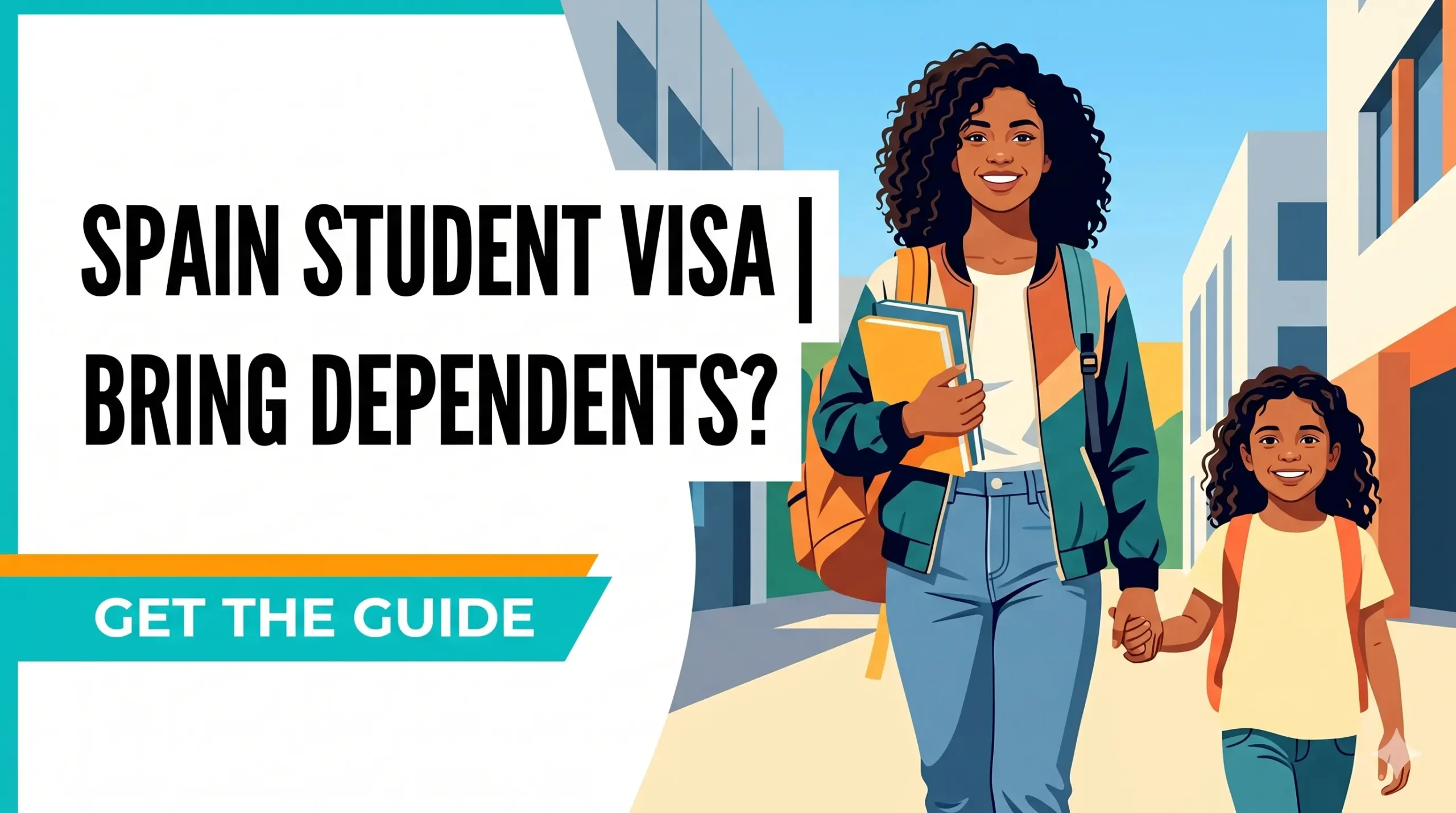
The only individuals who legally qualify as dependents are your legal spouse, your officially registered domestic partner (pareja de hecho), and your unmarried children under the age of 18. The only exception made for adult children is if they suffer from a severe disability that renders them objectively incapable of providing for their own needs due to their health status. If you are bringing a domestic partner, be warned that the consulate will heavily scrutinize the registration; a casual, unregistered cohabitation will not survive the visa desk. Navigating these strict eligibility requirements is the foundational step of the Spain Student Visa Application.
The Duration and Working Rights Traps
Before you pack your bags, you must understand two brutal legal realities that constantly catch expat families off guard.
First, dependents can only accompany you if your academic program is longer than 90 days. In practical terms, to actually secure physical residency cards (the TIE) for your family, your studies should be longer than six months. If you are doing a short-term, three-month summer immersion course, your family cannot officially piggyback on your visa; they would have to enter as standard tourists.
Second, and most importantly, dependents of a student visa are strictly prohibited from working in Spain. While the main student applicant might be granted automatic permission to work up to 30 hours a week if enrolled in higher education, that permission does not extend to the spouse. Your spouse cannot take a job at a local café, nor can they legally register as a freelancer to service local clients. This means your household must survive entirely on foreign savings or remote passive income, making your financial preparation critical before you even look into Getting an NIE for Employment or Study: Practical Overview.
Financial and Administrative Hurdles for Dependents
Because your dependents cannot legally earn a local salary, the Spanish consulate demands overwhelming, undeniable proof that your family will not become a burden on the state’s social services.
Proving Maximum Financial Solvency (The IPREM Calculation)
Spain calculates financial solvency based on an economic indicator called the IPREM (Indicador Público de Renta de Efectos Múltiples). When applying alone, the main student must prove they have 100% of the monthly IPREM for the duration of their studies.
When you add family members, the math scales aggressively. For your first dependent (usually your spouse), you must add 75% of the IPREM to your monthly requirement. For every additional dependent (like your children), you must add another 50% of the IPREM per child. If the baseline IPREM is €600, a student with a spouse and one child must show a combined monthly solvency of €1,350 (€600 + €450 + €300). If you are studying for a year, that means holding over €16,000 in liquid, immediately accessible cash.
You must prove this via six months of stamped, official bank statements. Consulates rarely accept volatile assets or locked retirement accounts. Because gathering these massive sums is a huge hurdle, mapping out your daily burn rate is why referencing a Spain Budget Template for New Expats (Downloadable Categories) is mandatory. If your funds are sitting in a foreign currency, you will also need an agile way to transfer those massive sums into euros once you arrive, a dynamic mapped out in Opening a Bank Account in Spain: Step-by-Step for Foreigners.
| Family Member | IPREM Percentage Required | Monthly Solvency Estimate (Based on ~€600 IPREM) |
| Main Student Applicant | 100% | €600 |
| First Dependent (Spouse/Partner) | 75% | + €450 |
| Second Dependent (Child) | 50% | + €300 |
| Third Dependent (Child) | 50% | + €300 |
| Total for Family of Four | 275% | €1,650 per month |
Securing Zero Copay Medical Insurance
The single most common reason family student visas are rejected is flawed medical insurance. The consulate absolutely will not accept generic travel insurance or basic catastrophic coverage for your spouse and children.
Every single member of your family must hold a comprehensive private medical insurance policy that matches the Spanish public health system. This policy must explicitly state that it has zero co-payments (sin copagos) and no waiting periods (sin carencias) for the entire family unit.
If you attempt to purchase a massive international policy from your home country to cover your family, the consulate will demand that the fifty-page foreign policy booklet be completely translated into Spanish, which will cost you hundreds of euros in premium translation fees. To completely avoid this bureaucratic nightmare, you should secure a localized family policy natively through Innoinsure. Because Innoinsure issues the comprehensive family policy and the required visa certificates natively in Spanish, there is absolutely zero need for a translation. The consulate accepts the paperwork immediately. Furthermore, relying on Innoinsure guarantees your dependents hit the strict zero-copayment requirements, deeply insulating your family from arbitrary consular rejections. This strategic integration is heavily aligned with the advice detailed in Health Insurance in Spain: Options for Residents, Students, and Families and Spain Visa Medical Insurance: Minimum Coverage and Exclusions to Avoid.
Formatting the Family Application Packet
The logistics of managing a multi-person application packet are a nightmare of timing and authentication. Every piece of paper tying your family together must be validated by multiple international governments before Spain will accept it.
Translating and Authenticating Vital Records
You cannot just hand a consular officer an American or British marriage certificate and expect them to approve your spouse. Any foreign public document proving family ties—specifically marriage certificates and the birth certificates of your children—must go through a rigid two-step authentication process.
First, the original vital records must be authenticated with a Hague Apostille from the issuing government. You can review the exact, frustrating sequence of securing this international authentication in Apostille for Spain: Which Documents Need It and How to Get One.
Second, because Spain operates strictly in Spanish, the Apostilled marriage and birth certificates must be translated by a recognized professional. You cannot translate these yourself. While background checks and medical certificates often require a premium MAEC-stamped Traductor Jurado—a strict requirement explored in How to Translate Documents for Spain: Sworn Translators (Traductor Jurado) Guide—you will also need agile services for your massive stacks of financial proof and supporting civil documents.
Using RushTranslate to process your family’s bank statements, tax returns, and standard civil records is a lifesaver. RushTranslate provides lightning-fast, highly accurate certified translations with a 24-hour turnaround, allowing you to bridge the language gap safely without delaying your visa appointment. Utilizing RushTranslate allows you to quickly decipher complex local forms and provide English-to-Spanish documentation safely, keeping your massive family application packet moving forward without spending a fortune on premium government-mandated translators for every single piece of paper.
Sequencing the Application Submission
You have two choices when submitting the paperwork: you can submit the dependent applications simultaneously with the main student application at your local consulate, or the dependents can apply at a later date, provided the main student still has at least six months of valid residency remaining on their visa.
Veteran expats heavily recommend applying simultaneously. If you try to bring your spouse over six months later, you have to completely refresh your financial proofs, secure new bank statements, and often deal with a different, skeptical consular officer who will question why the family didn’t travel together. Consolidating the paperwork from day one reduces the chance of bureaucratic errors. Preparing for this massive, simultaneous submission is the core focus of the Spanish Visa Application Guide: Required Documents.
If you meticulously calculate your IPREM solvency, leverage localized native services like Innoinsure to bulletproof your family’s medical requirements, and ensure your vital records are perfectly translated via RushTranslate, you can defeat the notorious administrative hurdles of the Spanish consulate. Once approved, your entire family can finally focus on the incredible reality of actually living and studying in Spain.
References
Primary sources (official)
- Ministerio de Inclusión, Seguridad Social y Migraciones – Estancia por estudios y familiares: https://www.inclusion.gob.es/web/migraciones/w/estancia-por-estudios
- Ministerio de Asuntos Exteriores, Unión Europea y Cooperación (MAEC) – Visado de estudios: https://www.exteriores.gob.es/Consulados/bogota/es/ServiciosConsulares/Paginas/index.aspx?scca=Visados&scco=Colombia&scd=31&scs=Visados+Nacionales+-+Visado+de+estudios
Other helpful sources
- Portal de la Administración General del Estado – Trámites y Extranjería: https://administracion.gob.es/
Disclaimer
The information provided in this guide is exclusively for educational and informational purposes and does not constitute official legal, immigration, or financial advising. The specific IPREM financial thresholds for dependents, the exact working rights restrictions applied to accompanying family members, and the translation and Apostille mandates enforced by the Spanish consulates are highly dynamic and subject to the discretionary enforcement of individual consular officers. While we strive to ensure absolute accuracy, you should always consult a registered Spanish immigration lawyer (abogado de extranjería) and verify the exact documentary requirements with the specific consulate handling your jurisdiction before applying for multi-person visas.