How to Apply to Spanish Universities: Timeline and Document Checklist
Missing an arbitrary mid-July deadline because a single high school transcript was not stamped by a sworn translator is the ultimate expat nightmare. I lost an entire academic year because I misunderstood the agonizingly slow Spanish validation process. This guide provides a bulletproof timeline and document checklist to ensure your university application survives the brutal Spanish bureaucracy.
Disclosure: This post may contain affiliate links. We may earn a commission at no extra cost to you if you make a purchase through these links. Read full disclosure.
The Public vs Private University Application Divide
Before you begin gathering paperwork, you must decide whether you are targeting a Spanish public university or a private institution. This single decision alters your entire application timeline, your documentation requirements, and your stress levels. The administrative friction between these two routes is staggering.
Demystifying Public University Requirements
Spain’s public universities are incredibly prestigious and highly subsidized, but their admissions departments operate with unbending rigidity. They do not care about your extracurricular activities, your letters of recommendation, or your personal essay. Public university admissions are a pure numbers game based on a strict, mathematically rigid 14-point grading scale.
Because you are applying with a foreign high school diploma, the Spanish government legally does not recognize your grades until they are mathematically converted into the Spanish system. You cannot simply email a PDF of your American or British transcripts to the University of Valencia and expect them to evaluate it. You must go through a centralized governmental clearinghouse called UNEDasiss, which acts as the official middleman between international students and Spanish public universities.
Navigating the UNEDasiss portal is a notoriously frustrating experience. Making a mistake on your UNEDasiss application can completely disqualify you from the public university admission cycle. To understand how navigating this initial friction fits into your broader academic strategy and visa prerequisites, you must deeply review Choosing a University in Spain: Admission Requirements for International Students.
The Streamlined Private University Route
If you possess a higher budget and absolutely despise dealing with government bureaucracy, private universities in Spain offer a highly pragmatic, customer-service-oriented alternative. Institutions like IE University, ESADE, or Universidad de Navarra operate much more like traditional American or British universities.
Private universities generally bypass the UNEDasiss centralized system. They maintain their own internal international admissions departments that are accustomed to evaluating foreign transcripts directly. They frequently accept standard international standardized tests like the SAT or the IB Diploma in lieu of the Spanish national exams. Their application portals are modern, and you will usually be assigned an English-speaking admissions counselor to guide you through the process.
While the private route saves you months of administrative headaches, it comes with a massive financial premium. You are trading bureaucratic stress for exorbitant tuition fees. Before committing to this route, you must rigorously assess your financial capacity and understand the long-term budget implications by reviewing Tuition Fees in Spain: Public vs Private Universities.
How Your Choice Affects Your Legal Timeline
The timeline for public universities is terrifyingly short and inflexible. The primary admissions window, known as the Fase Ordinaria (Ordinary Phase), typically occurs over a few frantic weeks in June and early July. If your paperwork is not perfectly validated by UNEDasiss before this window opens, you are locked out of the system for an entire year.
Private universities operate on a rolling admissions basis, often accepting applications as early as November of your final year of high school for the following September intake. This flexibility is a massive advantage for expats. Securing an acceptance letter in January from a private university means you can apply for your Spanish student visa months before the summer consulate rush.
If you choose the public route, you often will not receive your official acceptance letter until late July. This leaves you with an agonizingly tight window to secure your student visa before classes begin in September. Understanding how this timeline impacts your legal entry into the country is a vital concept explored deeply in Spain Student Visa: What Study Programs Qualify?.
Essential Document Checklist for International Students
Gathering the required documents for a Spanish university application is a global logistical puzzle. You cannot execute this checklist in a single week. You must initiate these steps months in advance, as you are relying on multiple government agencies across different countries.
The Apostille of The Hague and Legalization
Your original, beautiful high school diploma and your official academic transcripts are legally worthless to the Spanish government unless they bear the Apostille of The Hague. The Apostille is an international certification that verifies the absolute authenticity of the signature on your academic documents, proving to Spain that your degree is not a forgery.
You cannot get an Apostille in Spain. It must be issued by the competent governmental authority in the exact country where the degree was issued. If you studied in the United States, you must send your notarized transcripts to the specific Secretary of State where your high school is located. If you studied in the UK, you must route it through the Foreign, Commonwealth and Development Office.
Sworn Translations Traductores Jurados
Once your original diploma and full academic transcripts are properly apostilled, they must be translated into formal Spanish. You cannot translate these documents yourself, and you cannot use a cheap, standard online translation agency.
The Spanish Ministry of Education and UNEDasiss strictly mandate that all foreign language documents must be translated by a Traductor Jurado (Sworn Translator) who is officially licensed and registered with the Spanish Ministry of Foreign Affairs. These translators possess a specific, legally binding stamp and signature that validates the accuracy of the translation under penalty of perjury.
Sworn translations are expensive, often costing hundreds of euros for a full academic dossier. When you are paying these specialized Spanish translators from your home country before you officially relocate, you face terrible international bank wire fees. To fiercely protect your educational budget, veteran international students completely bypass legacy banks and utilize dedicated currency specialists like Wise. By routing your payments to the translator through a Wise account, you lock in the true mid-market exchange rate, avoiding the massive hidden markups that traditional banks charge.
The UNEDasiss Credential Explained
If you are applying to a public university, your apostilled and translated documents must be uploaded to the UNEDasiss portal to generate your official accreditation. UNEDasiss calculates your Calificación de Admisión (Admission Score), scaling your foreign high school grades up to a maximum baseline of 10 points.
However, the Spanish public university system famously operates on a 14-point scale. Highly competitive degrees like medicine, engineering, or international business often have a cut-off grade (Nota de Corte) of 12 or 13 points. To bridge this mathematical gap, international students must sit for the Pruebas de Competencias Específicas (PCE).
The PCE are specific competency exams, roughly equivalent to the American SAT Subject Tests. You test in specific subjects related to your desired major, and each exam you pass adds crucial decimal points to your final UNEDasiss score. You must register for these exams through the UNEDasiss portal months in advance, and you must travel to an authorized UNED testing center (often located in Spanish embassies or major global cities) to sit for the physical exams in May or June.
| Application Requirement | Public University (UNEDasiss) | Private University |
| Apostille of The Hague | Mandatory for all foreign documents | Usually required (sometimes allowed later) |
| Sworn Translation | Mandatory (Traductor Jurado) | Mandatory (Sometimes English accepted) |
| PCE Exams (Selectividad) | Required to reach the 14-point scale | Rarely required (Internal exams used) |
| Application Deadline | Rigid (Usually June/July) | Rolling (November to August) |
| Language Proof (B2/C1) | Strictly enforced via official certificates | Required, but internal testing permitted |
The Month by Month Application Timeline
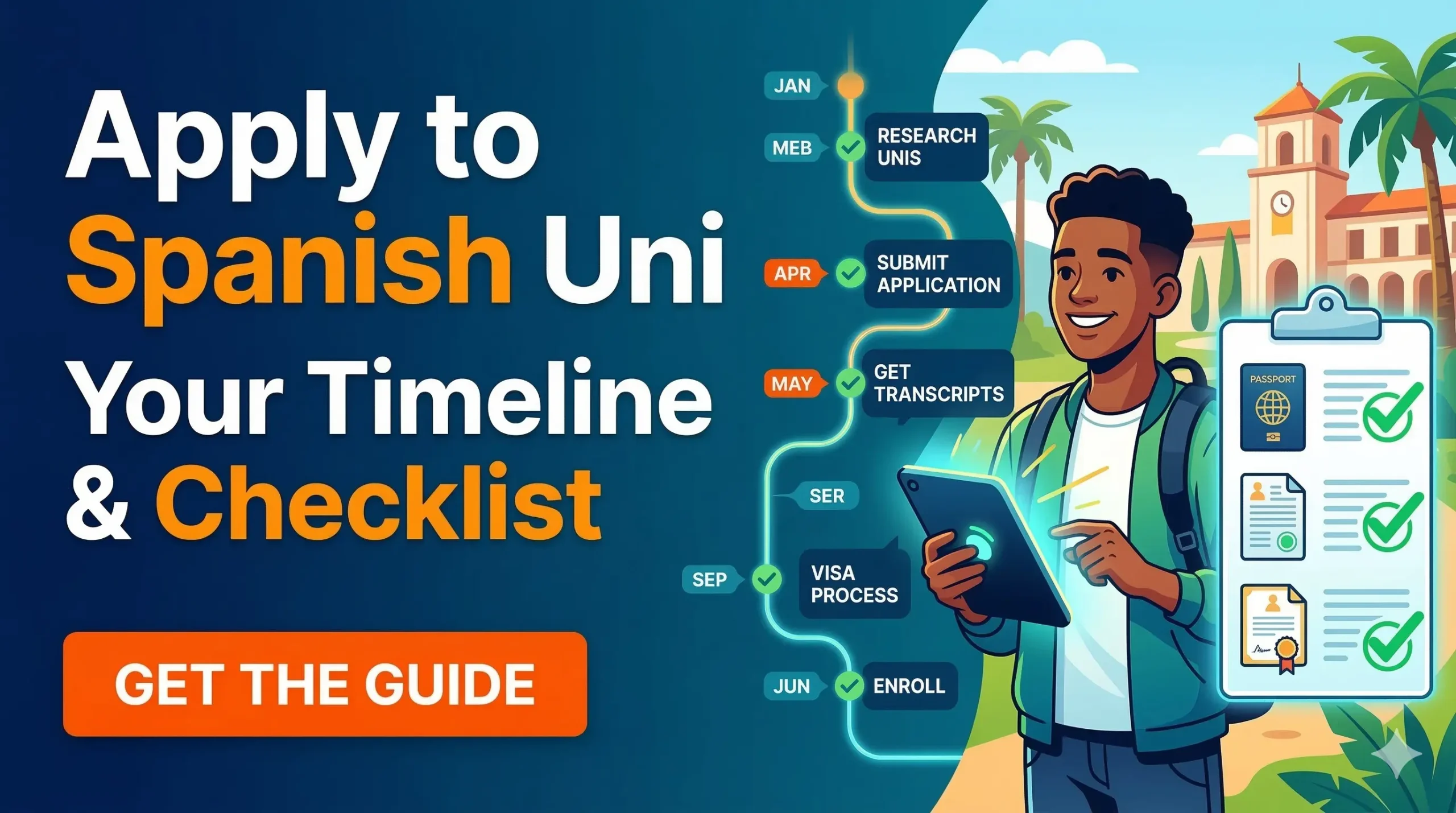
To survive this bureaucratic marathon, you must build a master calendar. Assuming you intend to begin university in Spain in September, this is the realistic timeline you must follow during your final year of high school or prior university studies.
January to March Document Preparation and UNED Registration
Your application journey begins in the dead of winter. By January, you must request official, sealed interim transcripts from your high school. You must immediately send these documents to your local government authority to secure the Apostille of The Hague. Do not wait until you graduate in June; by then, it is mathematically too late to apply for Spanish public universities for the fall semester.
In late February or early March, the UNEDasiss portal officially opens for the upcoming academic year. You must create your digital profile, upload your apostilled and translated interim transcripts, and formally register for the specific PCE exams you intend to take. You will be required to pay an administrative fee to UNEDasiss to process your file and secure your exam seat. When paying this fee from a foreign account, utilizing Wise ensures your payment clears seamlessly without being rejected by archaic Spanish institutional banking gateways.
April to June PCE Exams and Pre Inscription
April is dedicated entirely to intense academic preparation for the PCE exams. These exams are based entirely on the Spanish national high school curriculum, and they are administered in formal, academic Spanish. This is an incredibly stressful period for non-native speakers.
To survive these exams, you must be able to comprehend complex questions regarding Spanish history, advanced biology, or mathematics without relying on a dictionary. Engaging with rigorous, curriculum-based platforms is essential. Dedicating an hour a day to the advanced learning pathways on SpanishPod101 is a highly effective strategy to build the precise grammatical foundation and reading comprehension skills required to pass the PCE exams on your first attempt.
In late May or early June, you will physically sit for the PCE exams at your designated testing center. Simultaneously, the Pre-inscripción (Pre-enrollment) window for Spanish public universities opens. You must log into the regional university portals (such as the portal for Andalusia, Madrid, or Catalonia) and list your desired degree programs in order of preference.
July to September Acceptance Letters and Visas
July is the month of truth. UNEDasiss will release your final PCE exam scores and generate your final 14-point accreditation certificate. The regional public university portals will then run their algorithms, comparing your UNEDasiss score against their specific cut-off grades.
In mid-to-late July, the universities will publish the lists of accepted students. If you made the cut, you will receive an official digital acceptance letter. The moment you receive this letter, you must instantly pivot to securing your Spanish student visa. Because you only have roughly six weeks before classes begin in September, you must already have your visa paperwork completely prepared and waiting in a folder on your desk.
Overcoming the Language and Financial Barriers
The Spanish consulate and the university admissions departments will place two massive, undeniable hurdles in your path: you must prove you can speak the language, and you must prove you have the money to survive.
Proving Language Proficiency with DELE or SIELE
If you are applying for a degree program taught in Spanish, the university will not simply take your word that you are fluent. You must provide undeniable, official proof of your language proficiency. Almost all Spanish public universities mandate a minimum verified level of B2 on the Common European Framework of Reference for Languages (CEFR).
You must pass either the DELE (Diplomas de Español como Lengua Extranjera) or the SIELE (Servicio Internacional de Evaluación de la Lengua Española). The DELE is a traditional, paper-based exam offered on rigid dates, while the SIELE is a highly flexible, computer-based exam that provides your results in a matter of weeks. Without one of these official certificates attached to your UNEDasiss profile, your application will be instantly rejected.
Achieving a B2 level requires far more than basic conversational skills; you must be able to comprehend complex academic texts and write structured essays. Utilizing the advanced conversational and reading modules on SpanishPod101 will dramatically accelerate your grasp of the complex academic vocabulary required to survive the DELE or SIELE. For a deeper dive into mastering the language quickly for institutional purposes, read Learning Spanish for Work and Study: Fast-Track Strategy.
Surviving the Financial Proof Requirements
To secure your long-term student visa, you must mathematically prove to the Spanish government that you will not become a financial burden on the state. The consulate uses a specific economic index called the IPREM to calculate your required survival funds.
For current academic cycles, the IPREM is set at roughly 600 euros per month. To secure your visa, you must show the consulate that you have 100% of the IPREM for every single month of your intended stay. If your degree program lasts for a standard ten-month academic year, you must provide bank statements showing a highly liquid, easily accessible cash balance of at least 6,000 euros.
This 6,000 euro survival fund must be completely separate from the money you have already spent on your university tuition and your mandatory private health insurance policy. The consulate will not accept screenshots of volatile stock portfolios; they demand clean, verifiable bank statements. To understand exactly how far 600 euros a month actually goes in a major city, you must meticulously review Student Finances in Spain: Bank Accounts and Budgeting Tips and Cost of Living in Spain: Budgeting for Expats.
Transferring Tuition Safely Across Borders
Before the consulate even looks at your visa application, you must prove that you have officially enrolled in the university. This requires paying your initial tuition fees via international wire transfer before the school will issue your final carta de admisión (letter of admission).
If you attempt to execute a massive international wire transfer from your local bank in your home country directly to the Spanish university’s bank account, you will be financially crushed by the legacy banking system. Traditional banks secretly pad the currency exchange rate with a massive hidden markup, easily stealing hundreds of euros from your educational budget simply to execute the digital conversion.
To fiercely protect your tuition funds, veteran international students completely bypass legacy banks and utilize dedicated currency specialists like Wise. By routing your massive tuition payments through a Wise account, you lock in the true, transparent mid-market exchange rate. This guarantees that your hard-earned capital actually goes toward your education. Furthermore, utilizing Wise to transfer your monthly living allowance once you arrive in Spain ensures you are not bleeding capital on international wire fees every single month.
The Final Hurdle From Acceptance to Arrival
Securing the acceptance letter and passing your language exams is an incredible achievement, but the administrative nightmare does not end when you board the plane. Arriving in Spain triggers a final wave of localized bureaucracy.
Securing the Spanish Student Visa
Your physical appointment at the Spanish consulate in your home country is the climax of your application journey. You must arrive with a perfectly organized binder containing your official university acceptance letter, your proof of financial means (the IPREM requirement), a comprehensive private health insurance policy with zero copays, a recent criminal background check bearing the Apostille of The Hague, and a medical certificate proving you do not suffer from any internationally quarantinable diseases.
If a single document is missing a stamp or a translation, the consulate official will reject your application and send you to the back of the line. Because consulate appointments are incredibly difficult to secure during the late summer rush, a rejection in August often means you will miss the first three weeks of your university classes. Treat the visa appointment with the same intensity as a final exam.
The TIE Card and Local Registration
When you finally land in Spain, your visa sticker in your passport is only valid for your first ninety days. To secure your legal right to remain in the country for the entire academic year, you must immediately begin the process of acquiring your Foreigner Identity Card (TIE).
To get the TIE, you must first secure a Certificado de Empadronamiento (municipal census registration) from the local town hall. This requires proving you actually live in the city by presenting a legally binding apartment lease. If you rent a room under the table from a landlord who refuses to let you register, your entire residency process collapses. To safely navigate the chaos of the Spanish rental market, you absolutely must read Renting in Spain: How to Budget for Deposits, Fees, and Utilities.
Finally, to manage your daily life, pay your local rent, and set up your Spanish mobile phone contract, you must establish a localized digital bank account immediately upon arrival. Legacy Spanish bank branches are notoriously hostile to non-residents, so you must rely on agile, digital-first banking solutions. For a comprehensive guide on establishing this vital local infrastructure, read Opening a Bank Account in Spain as a Non-Resident.
References
Primary sources (official)
- UNEDasiss (Universidad Nacional de Educación a Distancia) – International Student Accreditation: https://unedasiss.uned.es/home&idioma=en
- Ministerio de Asuntos Exteriores – Visado de Estudios: https://www.exteriores.gob.es/Consulados/londres/es/ServiciosConsulares/Paginas/Consulares/Visado-de-estudios.aspx
Other helpful sources
- SEPIE (Servicio Español para la Internacionalización de la Educación) – Study in Spain: http://sepie.es/internacionalizacion/what-to-study-in-spain.html
- Expatica – Higher Education and Studying in Spain: https://www.expatica.com/es/education/higher-education/study-in-spain-106757/
Disclaimer
The information provided in this article is for educational and informational purposes only and does not constitute formal legal, financial, or immigration advice. Spanish university admission protocols, the exact scoring algorithms of the UNEDasiss accreditation system, and the specific requirements for securing the Apostille of The Hague are highly complex and subject to frequent legislative updates by the Ministerio de Universidades and international governing bodies. Always verify exact application deadlines, PCE exam requirements, and visa prerequisites directly with your target university’s international admissions office and the Spanish consulate in your home jurisdiction before committing capital or moving abroad.