Spanish Academic Calendar: Terms, Exams, and Holidays
I missed a crucial midterm during my first semester in Madrid because a localized bank holiday unexpectedly shut down the entire university, pushing the exam schedule back two days without me realizing. The Spanish academic calendar operates on a deeply localized rhythm filled with sudden long weekends and terrifyingly compressed exam periods. This guide decodes the semester structures, exam seasons, and holiday culture so you can plan your year effectively.
Disclosure: This post may contain affiliate links. We may earn a commission at no extra cost to you if you make a purchase through these links. Read full disclosure.
Demystifying the Spanish Semester System
When you attempt to align a standard Anglo-Saxon academic mindset with the Spanish higher education system, you immediately encounter massive structural friction. The Spanish university calendar is not rigidly uniform across the country; it bends to regional laws, traditional holidays, and highly specific university statutes. Understanding the fundamental architecture of the academic year prevents you from showing up to an empty campus or missing critical enrollment deadlines.
The Elusive Start Dates and the Primer Cuatrimestre
In the United States, the United Kingdom, or Canada, the fall semester typically begins with sharp precision in the first week of September. In Spain, the start of the academic year is notoriously fluid. While international orientations might begin in early September, actual lectures for domestic students frequently do not commence until mid-September or even the first week of October, depending heavily on the specific faculty and the university’s administrative backlog.
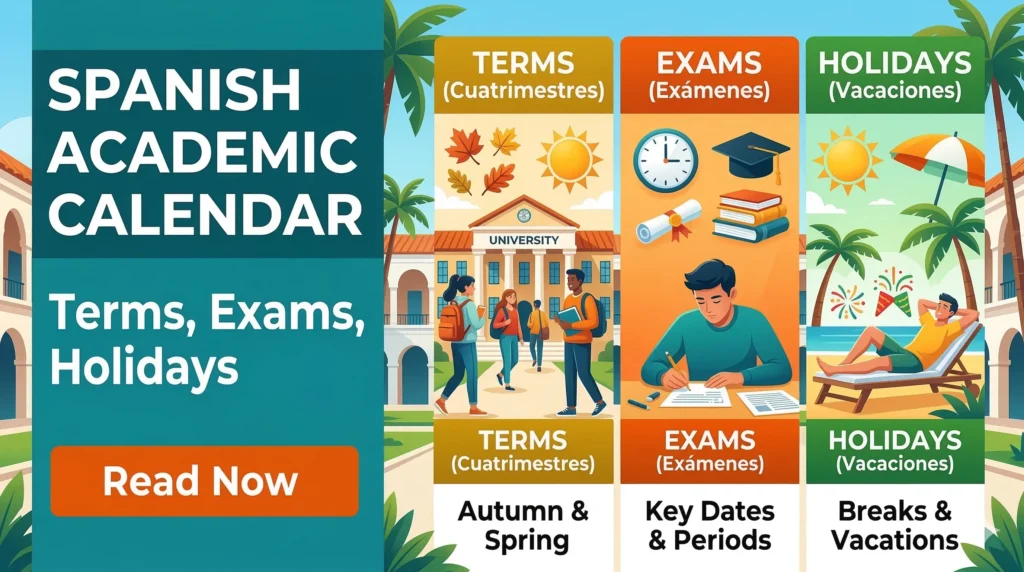
This first term is officially known as the Primer Cuatrimestre (First Four-Month Period). The most jarring cultural difference for international students is how this term interacts with the winter holidays. The Primer Cuatrimestre does not end before Christmas. Instead, the term pauses for an extended winter break in late December, and students return in January not to start a new semester, but to immediately face the terrifying final exams for the classes they began in September.
This structure creates a massive psychological burden for expats. Rather than returning home to relax with family during the holidays, you will spend your entire Christmas and New Year break aggressively studying and reviewing material from October. If you fail to anticipate this delayed semester schedule, your winter travel plans will collide disastrously with your academic survival. To understand how these delayed timelines affect your ability to secure housing before classes start, review Renting in Spain: How to Budget for Deposits, Fees, and Utilities.
The Segundo Cuatrimestre and Spring Transitions
Once you survive the brutal January exam block, the university transitions immediately into the Segundo Cuatrimestre (Second Four-Month Period). This spring semester typically launches in late January or the first week of February and stretches all the way into late May or early June.
The rhythm of the spring semester is heavily dictated by Semana Santa (Easter Holy Week). Depending on the lunar calendar, Easter can fall anywhere from late March to late April. This creates a massive, floating ten-day holiday that violently interrupts the momentum of the semester. Before Semana Santa, professors are relatively relaxed; the moment you return from the Easter break, the university shifts into an aggressive panic mode as the looming summer exam block approaches.
For expats, the Segundo Cuatrimestre is generally much more enjoyable simply because the weather improves, but it is academically treacherous. The long stretch of uninterrupted classes in February and March often lulls international students into a false sense of security.
Quarter vs Semester Systems in Spain
While the overwhelming majority of traditional Spanish public universities—such as the Complutense of Madrid or the University of Barcelona—operate strictly on the Cuatrimestre (semester) system, expats targeting private business schools will likely encounter an entirely different framework.
Elite private institutions, which actively cater to international students, frequently operate on a trimester or quarter system. In these institutions, the academic year is sliced into three distinct, highly compressed ten-week blocks, mirroring the aggressive pacing of a modern corporate environment. The exams are held immediately at the end of each short block, entirely removing the dreaded post-Christmas exam trap found in public universities.
| System Feature | Cuatrimestre (Public Universities) | Trimester (Private Business Schools) |
| Duration of Term | ~15 weeks of classes | ~10 weeks of classes |
| Exam Placement | January and May/June | December, March, and June |
| Assessment Style | Heavily weighted final exams (70-100%) | Continuous assessment, frequent quizzes |
| Pacing | Slow build, intense finish | Rapid, relentless momentum |
| Best Expat Fit | Students seeking traditional immersion | Expats requiring structured, continuous feedback |
If you are currently trying to decide which of these academic environments best suits your personal learning style and budget, you must deeply analyze the differences outlined in Tuition Fees in Spain: Public vs Private Universities.
Surviving the High Stakes Exam Seasons Época de Exámenes
The most intense culture shock you will experience in a Spanish university does not happen in a tapas bar; it happens in the examination hall. The Spanish grading system relies heavily on the Época de Exámenes (Exam Season), a high-stress, deeply intimidating period that dictates your entire academic future.
The Brutal January Exam Block
As previously noted, the month of January in a Spanish public university is entirely dedicated to testing. Regular classes completely cease, and the university transforms into a silent, high-anxiety testing center. The library will be packed to absolute capacity by 8:00 AM, and you will quickly realize that the relaxed Spanish students you met in October are now fiercely competitive.
In the Spanish academic system, it is incredibly common for your entire grade in a specific module to be based entirely on one single, massive final exam. You will not have midterms to pad your grade, nor will you receive participation points simply for attending lectures. If you have a bad day and fail the three-hour written exam in January, you fail the entire course.
This lack of continuous assessment means you must possess immense self-discipline. No professor will email you to remind you to study. To aggressively build the academic vocabulary required to read dense Spanish exam prompts without panicking, dedicating daily time to the advanced reading comprehension modules on SpanishPod101 is an absolute necessity. You cannot fake your way through a Spanish university exam.
May and June The Testing Marathon
The second massive exam block hits at the end of the spring semester, typically spanning from late May through the first three weeks of June. This testing marathon is physically and mentally grueling. As the Spanish heat sets in, you will be trapped in un-air-conditioned lecture halls handwriting lengthy essay responses in a foreign language.
During this period, the university administration releases a highly complex, matrix-style exam schedule. Exams are frequently grouped tightly together, meaning you might have a devastating macroeconomics final on a Tuesday morning and an equally brutal corporate law final on Wednesday afternoon.
Expats frequently make the fatal error of booking their flights home for early June, assuming the semester ends when the actual classes stop. You must never book your return flights until the official calendario de exámenes (exam calendar) is definitively published by your specific faculty. Professors in Spain frequently reschedule exams at the absolute last minute due to administrative conflicts or localized strikes, and if you miss your scheduled testing window because you are on a flight to New York, the university will show you absolutely zero mercy.
The Lifeline of Convocatoria Extraordinaria Resits
If you do fail a final exam in January or June—and as an expat studying in a second language, the statistical likelihood is high—the Spanish academic system offers a legally protected lifeline known as the Convocatoria Extraordinaria (Extraordinary Call), commonly referred to as the resits.
This is a secondary exam period, typically held in late June or early July (though some traditional universities still hold them in September). It allows you to retake the final exam and attempt to pass the course a second time. This system is a massive pro because it prevents you from instantly failing out of the university and triggering the punitive, highly expensive segunda matrícula (second enrollment) tuition fees for the following year.
However, the major con is that relying on the resits completely destroys your summer. While your friends are traveling or starting lucrative summer internships, you will be chained to your desk in July studying for an exam you already failed once. When managing this sudden, unexpected liquidity drain across borders, using Wise to transfer your emergency survival funds from your home country directly to your Spanish landlord protects you from the predatory wire fees charged by legacy banks.
Navigating Spanish Holidays and the Puente Culture
Spain boasts one of the most generous and fiercely protected systems of public holidays in the entire world. However, the system is intensely decentralized, and understanding how these holidays disrupt the academic calendar is vital for your sanity.
National Holidays and Regional Variations
The Spanish academic calendar is frequently interrupted by festivos (bank holidays). However, the system is split into multiple tiers. There are national holidays that the entire country observes simultaneously, such as Hispanic Day on October 12th, All Saints’ Day on November 1st, and Constitution Day on December 6th. On these days, every university in the country shuts down.
The confusion for international students stems from the regional and municipal holidays. Every single autonomous community, and every specific city, has its own unique set of local holidays. If you study in Madrid, the entire city—including your university—shuts down on May 15th for San Isidro. If you study in Valencia, the university will completely close for a full week in March to celebrate Las Fallas. If you study in Seville, the academic calendar halts for the Feria de Abril.
You cannot rely on a generic, nationwide Google search to tell you when you have class. You must meticulously check the specific calendario laboral (labor calendar) published by your local town hall, alongside your specific university’s portal, to avoid showing up to a locked campus. To understand how deeply these localized breaks dictate the broader professional world beyond the university, review Spanish Work Culture: Hours, Holidays, and Workplace Etiquette.
The Puente Long Weekend Phenomenon
The absolute greatest cultural invention of the Spanish calendar is the concept of the puente (the bridge). Because Spanish holidays are tied to exact numerical dates rather than floating days (like “the third Monday of the month” in the US), holidays frequently fall on a Tuesday or a Thursday.
When a localized or national holiday falls on a Thursday, the entire Spanish university system will collectively agree to take Friday off as well, creating a massive four-day weekend. This act of bridging the holiday to the weekend is taking a puente. If the holiday falls on a Wednesday, some faculties will boldly shut down for the entire remainder of the week, a phenomenon colloquially known as an acueducto (aqueduct).
Christmas Navidad and Easter Semana Santa Breaks
The two massive pillars of the Spanish holiday calendar are Christmas (Navidad) and Easter (Semana Santa).
The Christmas break in Spain is exceptionally long, but for a highly specific cultural reason. The primary gift-giving holiday in Spain is not December 25th; it is the arrival of the Three Kings (Los Reyes Magos) on January 6th. Therefore, the university winter break typically stretches from December 22nd all the way past January 6th.
Semana Santa (Easter) generally grants students a full week to ten days of holiday. This is the primary travel window for international students, creating a massive surge in local airport traffic. However, you must remember that returning from the Easter break signifies the immediate launch of the spring exam panic. If you spend your entire Semana Santa partying in Ibiza, you will almost certainly fail your exams in May.
Bureaucracy and Deadlines Throughout the Year
The Spanish academic calendar is not just a schedule of classes and holidays; it is a rigid framework of unbending bureaucratic deadlines. Missing these administrative windows can instantly jeopardize your legal right to remain in the country.
Enrollment and Matriculation Windows
If you are accustomed to the Anglo-Saxon model where you carefully select your classes for the fall semester in the preceding April, the Spanish enrollment process will give you severe anxiety.
In the Spanish public university system, the official enrollment and class selection window (período de matriculación) rarely opens until late July or even early September, mere weeks before the actual classes begin. This deeply delayed timeline is tied to the release of the national high school exam scores.
During the frantic enrollment window, the university’s digital portal (Secretaría Virtual) will inevitably crash under the weight of thousands of students trying to secure their modules simultaneously. You must be digitally vigilant. If you miss your assigned, highly specific 48-hour enrollment window, you will be locked out of your mandatory classes, delaying your graduation by an entire year. To grasp exactly how this enrollment friction fits into the broader admissions timeline, you must thoroughly review Choosing a University in Spain: Admission Requirements for International Students.
Sorting Out Visas and NIE Renewals During Breaks
Your physical presence in Spain is dictated by your Foreigner Identity Card (TIE), which contains your NIE number. If you are enrolled in a multi-year degree program, your TIE card will inevitably expire at the end of the academic year, typically in July or August.
You must legally initiate the renewal of your residency permit (prórroga de estancia por estudios) within the 60 days before it expires, or up to 90 days after it expires. This creates a massive logistical nightmare for expats who wish to travel home for the summer.
If your TIE is expired and you leave the European Schengen zone to visit your family in the United States or the UK, border control will not let you back into Spain in September to finish your degree. To legally travel while your renewal is processing over the summer break, you must fight the local immigration office to secure a highly elusive Autorización de Regreso (Return Authorization). Understanding how these critical visa deadlines overlap with your academic timeline is a survival skill explored deeply in Spain Student Visa: What Study Programs Qualify?.
Managing Your Money Across Academic Terms
The rhythm of your academic calendar dictates the rhythm of your localized cash flow. Most Spanish landlords sign 10-month or 11-month “seasonal” leases explicitly designed to mirror the September-to-June academic term.
When your lease ends in June, but you are forced to remain in the city until late July to take the Convocatoria Extraordinaria resit exams, you suddenly face a terrifying liquidity crisis. You will likely be forced into expensive short-term Airbnb rentals just to survive the testing period.
Furthermore, if your university allows you to pay your massive tuition invoice in installments (pago fraccionado), those direct debits will hit your checking account in strict alignment with the calendar, often in October, December, and March. For a deep comparative look at how much capital this strategy preserves during a multi-year degree, carefully read Sending Money to/from Spain: Comparing Banks vs Transfer Services.
Strategic Planning for International Students
Surviving the chaos of the Spanish academic calendar requires foresight. You cannot simply react to the deadlines; you must anticipate them months in advance to protect your budget and your academic standing.
Booking Travel and Avoiding Peak Prices
Because the Spanish academic calendar operates on highly predictable national holidays, the domestic travel industry dynamically prices their flights and high-speed AVE trains to extract maximum wealth from students trying to go home.
If you attempt to book a train ticket from Madrid to Barcelona the day before a massive December puente, you will pay triple the standard rate, or find the trains entirely sold out. To survive the localized travel economy, you must download the official academic calendar from your specific university faculty the exact moment it is published in September.
Mastering the Language Before Exam Season
The ultimate bottleneck in the Spanish academic calendar is the high-stakes exam season. If your language skills are deficient, no amount of late-night studying in May will save you from failing a rigorous three-hour written exam.
Many Spanish professors also utilize aggressive, unscripted oral exams (exámenes orales) to test their students at the end of the semester. Sitting in a professor’s tiny office, defending your knowledge verbally in a foreign language while they aggressively cross-examine you, is an utterly terrifying experience. You cannot fake fluency in this environment.
To survive these high-stakes oral defenses, you must actively train your ear and your tongue long before the exam calendar is published. Relying purely on the academic Spanish taught in your lecture hall is insufficient, as professors often speak rapidly, using heavy regional dialects and complex professional jargon. Integrating SpanishPod101 into your daily routine allows you to aggressively build the advanced, highly structured vocabulary necessary to articulate complex academic arguments under immense pressure. For a comprehensive strategy on bridging this linguistic gap, read Learning Spanish for Work and Study: Fast‑Track Strategy. To fully grasp how these localized institutional challenges compare to your home university experience, review Erasmus and Exchange Programs in Spain: What Non‑EU Students Should Know.
References
Primary sources (official)
- Ministerio de Inclusión, Seguridad Social y Migraciones – Calendarios laborales: https://www.mites.gob.es/es/informacion/calendarios/index.htm
- Boletín Oficial del Estado (BOE) – Calendario Laboral 2024/2025: https://www.boe.es/diario_boe/txt.php?id=BOE-A-2024-21316
- Ministerio de Ciencia, Innovación y Universidades – Sistema Universitario Español: https://www.ciencia.gob.es/
Other helpful sources
- SEPIE (Servicio Español para la Internacionalización de la Educación) – Study in Spain: http://sepie.es/internacionalizacion/what-to-study-in-spain.html
- Eurydice (European Commission) – The organisation of the academic year in Europe: https://eurydice.eacea.ec.europa.eu/publications/organisation-academic-year-europe-20222023
Disclaimer
The information provided in this article is for educational and informational purposes only and does not constitute formal academic, financial, or immigration advice. Spanish public university academic calendars, specific regional holiday schedules (calendario laboral), and the exact administrative deadlines for TIE visa renewals are highly complex, heavily decentralized, and subject to frequent updates by the 17 individual Autonomous Communities and individual university faculties. Always verify the exact, up-to-date semester dates, exam blocks, and holiday closures directly with your specific university’s registrar office (Secretaría) before committing to legally binding travel plans or housing contracts.