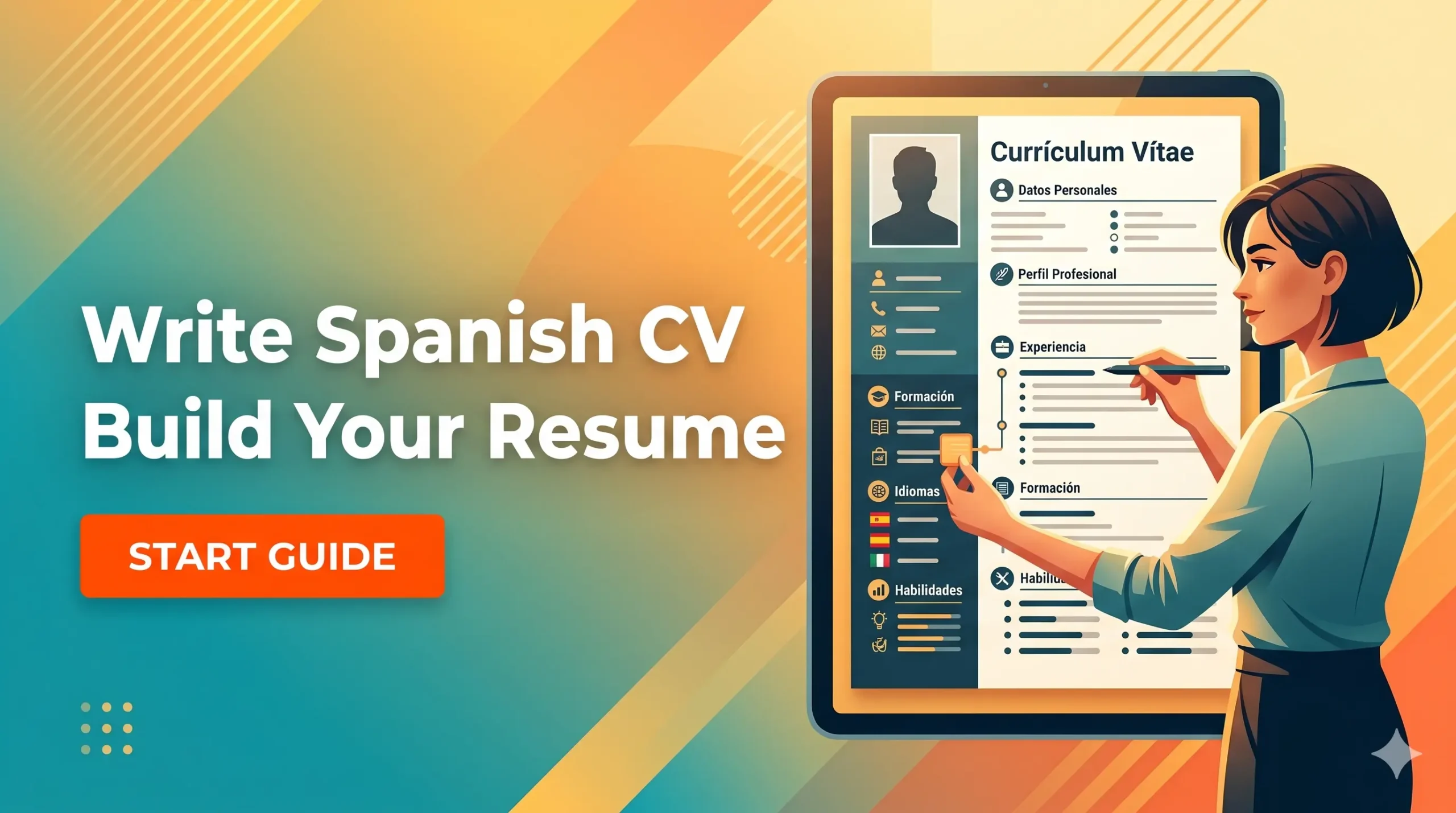
How to Build a Spanish Style CV From Scratch Template Guide
Sending out fifty perfectly translated American resumes and hearing absolutely nothing back is a soul-crushing way to start your Spanish job hunt. I spent two months wondering why I wasn’t getting interviews before I realized my document completely lacked the mandatory photo and personal details local recruiters expect. This guide shows you exactly how to format a Spanish CV that lands interviews.
Disclosure: This post may contain affiliate links. We may earn a commission at no extra cost to you if you make a purchase through these links. Read full disclosure.
The Culture Shock of the Spanish CV Format
When you apply for a job in the US, UK, or Canada, anti-discrimination laws strictly forbid employers from asking for your age, nationality, or a photograph. In Spain, an anonymous, text-only resume is often immediately discarded by Human Resources because it looks suspicious or incomplete.
The Mandatory Headshot Rule
The most jarring adjustment for North American and British expats is the absolute requirement of a professional headshot on your CV. In Spain, recruiters expect to see who they are hiring. This is not the place for a cropped selfie from a beach in Ibiza or a blurry photo from a graduation ceremony.
You must include a high-quality, front-facing headshot with a neutral background, placed in the top right or top left corner of your document. Dress as you would for an interview in your specific industry—a suit and tie for corporate finance, or smart-casual for a tech startup. Because local photography studios often charge a premium for corporate portraits, using Wise to pay a freelance photographer in your home country to retouch a professional digital photo you take yourself can save you from losing money to terrible foreign exchange rates before you even secure your first local paycheck.
Personal Details You Might Find Intrusive
Right next to your photograph, your Spanish CV must feature a block of Datos Personales (Personal Data). Expats often feel intensely uncomfortable providing this level of data, but omitting it screams “foreigner who doesn’t understand local norms.”
A standard Spanish CV includes your full legal name, your date of birth (Fecha de nacimiento), your nationality, and your exact physical address. If you move flats during your job hunt, you must update your address immediately, a logistical process similar to the bureaucratic hurdle of How to Change Address on Your TIE Card After Moving in Spain. You must also clearly list your DNI or NIE number. Placing your identification number front and center proves to the employer that you are legally registered in the system, a foundational step we decode in Getting an NIE for Employment or Study: Practical Overview. It is also highly recommended to include whether you have a driver’s license (Carnet de conducir) and your own vehicle, as many Spanish industrial parks (polígonos) are impossible to reach via public transit.
Structuring Your Experience and Education
In Spain, the CV is generally kept to a strict one-to-two-page limit. Recruiters spend an average of seven seconds glancing at a CV before deciding whether to read further. Brevity and structural clarity are your best weapons.
Chronological Order and Formatting
Your professional experience (Experiencia Profesional) should always be listed in reverse chronological order, starting with your most recent role. For each position, list the dates of employment, the job title, the company name, and the city.
Because Spanish recruiters may not be familiar with the corporate landscape of your home country, you should include a brief, one-sentence description of what your former company actually does. Follow this with three to four bullet points detailing your specific achievements. When translating your daily responsibilities, avoid directly translating English corporate jargon word-for-word, as it often sounds absurd in Spanish. Instead, utilizing the advanced business vocabulary modules on SpanishPod101 ensures you are using the precise, native-sounding corporate terminology that Spanish HR managers actually use in their daily operations.
Translating Your Academic Credentials
The Formación Académica (Education) section is another massive trap for expats. Direct translations of academic degrees are often completely wrong and can accidentally downgrade your qualifications.
For example, do not translate a “Bachelor’s Degree” to Bachillerato. In Spain, Bachillerato refers to high school. A university Bachelor’s Degree is a Grado (e.g., Grado en Administración de Empresas). A Master’s is a Máster, and a PhD is a Doctorado. If you studied at a prestigious university in your home country, mention it, but understand that Spanish recruiters value local recognition. If you are currently studying at a Spanish university while looking for work, you must clearly outline this, as student employment is governed by a highly specific set of rules explained in How to Find a Legal Part-Time Job as a Student in Spain. If your degree required a mandatory internship, list it separately; understanding how corporate training works is vital, a dynamic we explore in How to Get a Spanish Internship Contract as a Foreigner.
| English / Anglo-Saxon Resume | Spanish CV Equivalent | Formatting Differences |
| Photograph | Strictly Forbidden | Absolutely Mandatory |
| Personal Details | Phone and Email only | Age, Nationality, NIE, Address required |
| Bachelor’s Degree | Bachelor of Arts / Science | Grado (Do not use Bachillerato) |
| References | “References available upon request” | Completely omitted unless specifically asked |
Mastering the Language and Skills Sections
Spain has one of the lowest rates of English fluency in Western Europe. If you are applying for a job outside of a localized expat bubble, your Spanish language skills will be heavily scrutinized.
Honestly Assessing Your Spanish Level
Never list your Spanish skills as simply “Beginner,” “Intermediate,” or “Fluent.” Spanish recruiters rely exclusively on the Common European Framework of Reference for Languages (CEFR). You must grade your language skills on the A1 to C2 scale.
If you list your Spanish as B2 or C1, the recruiter will instantly switch to Spanish during the phone interview to test you. If you freeze, you will lose the job offer. To genuinely prepare for this exact scenario, dedicating time to the targeted HR dialogue exercises on SpanishPod101 will drastically improve your listening comprehension, ensuring you can confidently answer rapid-fire behavioral questions without needing a translator. Consistently practicing with SpanishPod101 guarantees that the language level you print on your CV matches the reality of your conversational fluency when you are put on the spot.
Technical Skills and Formatting Tools
Create a dedicated section for Habilidades (Skills) or Informática (IT Skills). List your software proficiencies clearly.
When it comes to the actual visual design of your CV, avoid the infamous “Europass” template. While the European Union heavily promotes the Europass CV builder for cross-border mobility, most modern Spanish recruiters find it visually repulsive, unnecessarily long, and outdated. Instead, use modern, clean templates from platforms like Canva. Make sure the template highlights your photo and leaves plenty of white space. A clean, visually appealing format shows that you understand modern professional presentation.
Overcoming Expat Specific Hiring Hurdles
Your CV must proactively answer the two biggest doubts every Spanish employer has about a foreign applicant: Are they legal, and do they understand how the local payroll works?
Addressing Visa and Work Permit Status
Do not make the recruiter guess if you are legally allowed to work in Spain. If they have to guess, they will assume you need visa sponsorship and will immediately trash your CV.
Right under your Datos Personales, or explicitly next to your NIE number, you should write: Permiso de trabajo y residencia en vigor (Valid work and residence permit). If you are a non-EU citizen trying to bridge the gap between finishing your studies and entering the corporate world, you must ensure your timeline is pristine, an administrative tightrope detailed in How to Extend a Spanish Student Visa: Renewal Checklist. Putting your legal work status front and center completely removes the HR department’s fear of dealing with the immigration office.
Salary Expectations and Financial Realities
While you should never list your salary expectations directly on the CV, you must prepare your financial infrastructure for when the job offer finally arrives. Spanish salaries are structurally different; they are often divided into 12 or 14 payments (pagas) throughout the year. You must factor this reality into your budgeting, a process mapped out heavily in Cost of Living in Spain.
When HR asks for your banking details to set up your first nómina (payroll), they will need a local Spanish IBAN. Setting this up as a newcomer is a bureaucratic necessity we decode in Opening a Bank Account in Spain: Step-by-Step for Foreigners. However, transitioning into your new professional life often means paying a massive deposit on a new apartment, a challenge explained in Renting an Apartment in Spain: A Guide for Expats. To cover these heavy upfront relocation costs before your first Spanish paycheck clears, using Wise allows you to instantly transfer your foreign savings into Euros at the real mid-market rate. Relying on Wise during your job hunt ensures you aren’t bleeding your limited startup funds dry through predatory international banking fees, allowing you to focus your energy entirely on acing the interview.
References
Primary sources (official)
- Servicio Público de Empleo Estatal (SEPE) – Orientación para el Currículum Vitae: https://www.sepe.es/HomeSepe/
- Europass – Working in Spain and European CV Standards: https://europass.europa.eu/en/country/work-spain
Other helpful sources
- InfoJobs – Consejos para hacer un buen currículum: https://orientacion-laboral.infojobs.net/como-hacer-un-curriculum-vitae
- Universidad Complutense de Madrid – Oficina de Prácticas y Empleo (OPE): https://www.ucm.es/ope
Disclaimer
The information provided in this guide is exclusively for educational and informational purposes and does not constitute official career, legal, or immigration advising. The expectations for CV formatting, including the inclusion of a photograph and personal identification details (such as the DNI or NIE), reflect standard corporate cultural practices in Spain but may vary depending on the specific multinational corporation, tech startup, or industry. You should always ensure that your stated immigration status accurately reflects the legal allowances of your specific visa, and consult with a registered Spanish immigration lawyer (abogado de extranjería) to confirm your legal right to work before submitting employment applications.