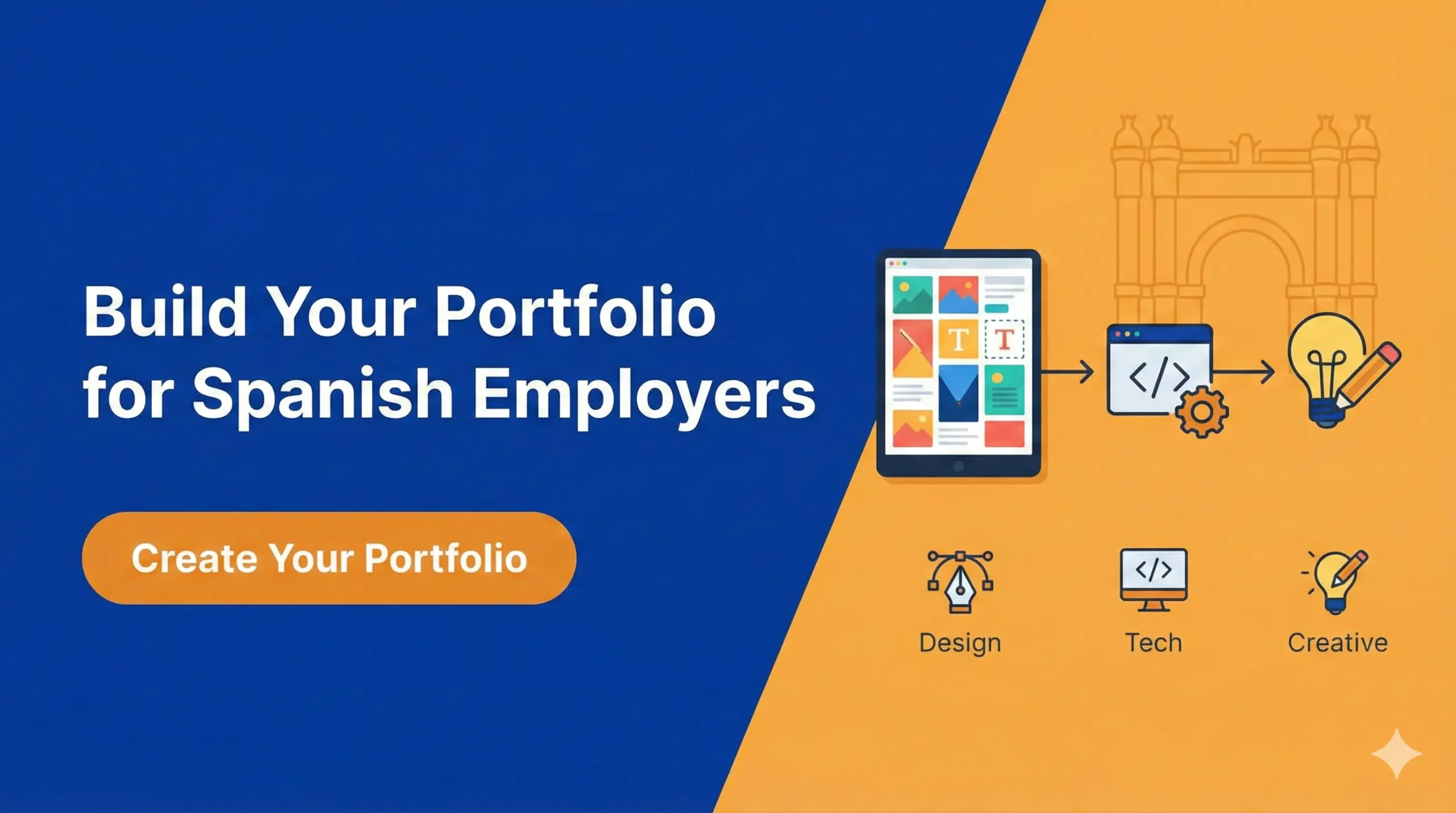
Building a Portfolio for Spanish Employers (Design, Tech, Creative)
In Spain’s competitive creative and tech sectors, a standard portfolio is insufficient. This guide details how to tailor your body of work to Spanish recruiters by emphasizing process over polish, navigating the English-Spanish language dilemma, and leveraging “confianza” to prove your reliability in a risk-averse market.
Disclosure: This post may contain affiliate links. We may earn a commission at no extra cost to you if you make a purchase through these links. Read full disclosure.
The Cultural Context: What Spanish Recruiters Want
To build the right tool, you must understand the user. Spanish recruiters and hiring managers operate under specific cultural pressures that influence how they review portfolios.
1. Risk Aversion and “Titulos”
Historically, Spain has suffered from “titulitis”—an obsession with university degrees and certificates. While the tech and creative industries are the most meritocratic sectors, a lingering risk aversion remains.
- The Implication: Your portfolio must prove stability. Flashy, experimental work is good, but it must be grounded in solid fundamentals. They need to see that you can deliver boring, functional work just as well as award-winning campaigns.
- The Fix: Include at least one “bread and butter” project that shows you can work within strict corporate guidelines, as this reduces the perceived risk of hiring a “wild card” foreigner.
2. Process Over Polish
In a culture that values conversation and storytelling, the narrative of how you solved a problem is often more important than the final pixel-perfect image. Spanish creative directors want to see the sketches, the failed attempts, and the pivot points.
- The Implication: A portfolio of just images (Dribbble-style) will be seen as superficial.
- The Fix: Adopt a “Case Study” format that tells a story.
3. The Human Element
Spain is relational. We have discussed how Office Politics in Spain: Practical, Culture‑Aware Tips relies on personal connection. Your portfolio cannot be a cold, anonymous repository of files. It must have personality.
- The Implication: Your “About Me” page is statistically more important in Spain than in the US or UK.
- The Fix: Include a professional but approachable photo. Mention non-work interests that humanize you.
The Language Dilemma: English, Spanish, or Both?
This is the most common question: “Should my portfolio be in Spanish?”
The answer depends entirely on your target audience.
Scenario A: The International Startup / Multinational
- Target: Glovo, Cabify, Typeform, Mango, Inditex.
- Language: English.
- Why: These companies operate globally. Their internal working language is often English. Submitting a portfolio in Spanish might actually hurt you if they are looking for international talent.
Scenario B: The Local Studio / SME (Pyme)
- Target: A boutique design agency in Valencia, a marketing firm in Seville, or a local software house.
- Language: Spanish.
- Why: Even if they want you to speak English, the person reviewing your portfolio (the HR manager or the owner) might feel more comfortable reading in Spanish. Making them work to understand your case studies is a barrier to entry.
Scenario C: The “Bilingual” Hybrid (The Safe Bet)
If you are casting a wide net, a hybrid approach is best.
- Navigation: Keep navigation in English (Projects, About, Contact).
- Headlines: English.
- Body Text: English, but with a “Descargar Versión en Español” (Download Spanish Version) button for your CV or specific case studies.
Tip: Never use Google Translate for your portfolio. A bad translation is worse than no translation. It signals laziness and a lack of respect for the culture. If your Spanish isn’t C2 level, hire a native proofreader. This attention to detail is your first step in building confianza.
Format: The Website vs. The PDF “Dossier”
In the Anglo world, the personal website is king. In Spain, the “Dossier” (a curated PDF) still holds surprising power, especially in traditional advertising and architecture.
The Personal Website
Essential for: UX/UI Designers, Web Developers, Digital Marketers.
- Pros: Shows you are digitally literate. SEO benefits.
- Cons: Passive. You have to hope they click through.
The PDF Dossier
Essential for: Graphic Designers, Illustrators, Architects, Branding Specialists.
- Why: Spanish agencies often save candidate files to a shared server. A well-named PDF (
Nombre_Apellido_Portfolio_2026.pdf) stays in their system. A link to a website might get lost in an email chain. - Strategy: Have a website as your “archive,” but send a tailored PDF Dossier attached to your email. Select only the 5 projects most relevant to that specific company.
Anatomy of a Spanish Case Study
Whether you are a developer or a designer, your project pages need structure. Spanish employers appreciate logical flow.
1. El Contexto (The Context)
- Client: Who was it for? (If it’s a Spanish brand, highlight it).
- Role: What did you do? Be honest. If you were part of a team, define your specific contribution. Spaniards value humility; claiming credit for a whole team’s work is a red flag.
- Timeline: How long did it take?
2. El Reto (The Challenge)
What was the problem? Keep this concise.
- Example: “The client needed to increase conversion on their booking flow for the Spanish market.”
3. El Proceso (The Process) – Crucial Section
This is where you win the job. Show your work.
- Designers: Show sketches, wireframes, mood boards. Show the “ugly” phase.
- Devs: Link to the specific commit history or explain the architectural decision to use React over Vue.
- Marketers: Show the A/B testing data or the audience segmentation strategy.
4. La Solución (The Solution)
High-resolution images or live links to the code.
5. Los Resultados (The Results)
Spaniards are pragmatic. Did it work?
- Use metrics: “Increased sales by 20%.”
- Use testimonials: A quote from the client is powerful social proof.
Discipline-Specific Advice
For Designers (UX/UI, Graphic, Product)
Spanish design culture has a specific aesthetic. It tends to be clean, modern, and vibrant (think Barcelona style), but heavily influenced by Swiss typography.
- Localization Matters: If you have a project with dummy text, do not use “Lorem Ipsum.” Use real Spanish copy. Seeing “Lorem Ipsum” implies you didn’t care enough to write content. Seeing correct Spanish copy shows you understand the rhythm of the language (which takes up more space than English).
- Typography: Spain uses the Euro sign (€). Ensure your typefaces support it correctly. It seems minor, but it matters.
For Developers (Frontend, Backend, Full Stack)
- GitHub is your Portfolio: Ensure your ReadMe files are impeccable. A ReadMe in English is standard, but adding a Spanish summary is a nice touch.
- Clean Code: Spanish tech leads value maintainability. Show that you write code that others can read.
- The “Technician” Bias: In Spain, devs are sometimes viewed as “technicians” rather than “creatives.” Fight this by including a “Business Logic” section in your portfolio, explaining why your code helped the business make money.
For Creatives (Copywriters, Social Media, Marketing)
- Transcreation: If you are an English native copywriter, do not just show English work. Show how you would adapt a global campaign for Spain.
- Cultural Knowledge: Create a spec project for a Spanish brand (e.g., Mahou, Zara, Seat). Show you understand the local humor and references.
- Metrics: Spanish marketing directors are under budget pressure. Show ROI (Return on Investment).
The “About Me” Page: Your Secret Weapon
In the US, an “About” page might be a list of achievements. In Spain, it is a handshake.
The Photo
Include a photo. It is standard on CVs in Spain (as detailed in Finding a Job in Spain: CV, Interviews, and Networking), and it is expected on portfolios.
- Style: Professional but friendly. Smile. Look approachable.
The Bio
- The Hook: “I am a [Role] based in [City].”
- The Story: Why Spain? Recruiters are terrified you will get homesick and leave. Address this. “After falling in love with the vibrant culture of Valencia, I moved here to establish my long-term career.”
- The Personal: Mention hobbies. “When I’m not coding, I’m hiking in the Sierra Nevada or trying to cook the perfect tortilla.” This provides a “hook” for small talk in the interview.
Contact Info: The WhatsApp Factor
Email is standard. LinkedIn is mandatory. But in Spain, WhatsApp is a business tool.
- The Move: Include your phone number with the WhatsApp icon in your footer.
- The Signal: It says, “I am accessible, I am local, and I am ready to chat.” It removes friction. (See Spanish Business Etiquette: Gifts, Greetings, and WhatsApp Norms for why this is professional, not intrusive).
Navigating the “Autónomo” (Freelance) Portfolio
If you are freelancing, your portfolio serves a double purpose: it must win clients, not just employers.
Tax & Legal Transparency
If you are pitching to B2B clients in Spain, they need to know you are legal.
- The Footer: Add a small line: “Freelance professional registered in Spain (Autónomo). Available for invoicing.”
- Why: Spanish companies are terrified of hiring “fake freelancers” (falsos autónomos) or people who cannot issue valid invoices. Stating this upfront resolves a major anxiety.
- Context: Understanding your legal status is key. If you are unsure about your registration, review Getting a Spanish Social Security Number for Work: Steps.
Rate Cards
Do not put your prices on your public portfolio. Spanish negotiation culture requires a conversation.
- Call to Action: Instead of “Buy Now,” use “Consultar Presupuesto” (Request a Quote).
Social Proof: Testimonials and “El Enchufe”
In a low-trust market, someone else’s word is worth more than your own.
The Power of Logos
If you have worked with any recognizable Spanish brand, put their logo at the very top. If you haven’t, have you worked with a global brand recognized in Spain (Coca-Cola, Google, Ford)? Use those.
- Unknown Brands: If your experience is with unknown US startups, add a descriptor: “TechCrunch-featured Startup” or “Market Leader in Ohio.” Give them context.
LinkedIn Recommendations
Embed your LinkedIn recommendations directly into your portfolio.
- Why: LinkedIn is verified. A text quote on a website could be faked. A widget showing a real person’s LinkedIn profile is verifiable proof.
Common Mistakes to Avoid
1. The “Gringo” Pricing
If you are a freelancer, do not list London or New York rates if you are competing for local Spanish clients.
- Reality Check: Salaries and budgets in Spain are lower. You can charge a premium for being a native English speaker, but if you charge $150/hour for graphic design, you will price yourself out of 90% of the market.
- Research: Understand the cost of living and local rates. Check Cost of Living in Spain: Monthly Budget Guide for Expats to align your expectations.
2. Over-Confidence / Arrogance
American-style “selling yourself” (e.g., “I am a rockstar ninja developer who crushes code”) reads as arrogance and immaturity in Spain.
- Tone: Be confident but humble. Focus on collaboration and learning. “I had the privilege of leading a team…” is better than “I single-handedly saved the project.”
3. Broken Links and Slow Loading
Spain has excellent internet speeds (see Internet in Spain: Choosing Fiber, Mobile, and Bundles), so there is no excuse for a slow site. However, ensure your site is mobile-optimized. Many recruiters review portfolios on their phones during their commute.
Checklist: Is Your Portfolio Ready for Spain?
Before you hit send on that application, run your portfolio through this “Hispanicizing” checklist:
| Element | Standard Portfolio | “Spanish-Ready” Portfolio |
| Language | English only | English with Spanish download option |
| Photo | Often omitted | Professional, friendly photo included |
| Contact | Contact Form | Email + LinkedIn + WhatsApp |
| Tone | “I am the best” | “I am reliable and collaborative” |
| Context | Assuming user knows the brands | Explaining the brands/market context |
| Legal | No mention of status | “Available to work (EU Citizen/Visa Holder)” |
| Format | Link only | Link + PDF Dossier available |
Conclusion
Building a portfolio for Spanish employers is an exercise in empathy. You are trying to bridge a cultural gap, reassuring a risk-averse hiring manager that you are not just talented, but also a safe, reliable, and pleasant addition to their team.
By shifting your focus from “look at how cool this is” to “look at how I solve problems,” and by sprinkling in the necessary cultural signals—from the photo on your About page to the WhatsApp icon in your footer—you transform your portfolio from a gallery into a handshake. And in Spain, the handshake is where the deal begins.
Once your portfolio secures you that interview, you need to be ready to navigate the conversation. Ensure you are prepared for the next step by mastering the interview dynamics outlined in Finding a Job in Spain: CV, Interviews, and Networking.
References
Primary sources (official)
- SEPE (Servicio Público de Empleo Estatal): https://www.sepe.es/
- Ministry of Labour and Social Economy: https://www.mites.gob.es/
- ICEX (Invest in Spain – Talent Attraction): https://www.investinspain.org/
Other helpful sources
- Domestika (Creative Community & Portfolio examples): https://www.domestika.org/
- Behance Spain (Regional Trends): https://www.behance.net/
- Manfred (Tech Recruiting Insights Spain): https://getmanfred.com/
- Malt Spain (Freelance Rates & Trends): https://www.malt.es/
Disclaimer
The information provided in this article is for educational and informational purposes only and does not constitute career counseling or legal advice. Hiring practices vary by industry and region within Spain. We recommend researching the specific company culture before submitting your portfolio.