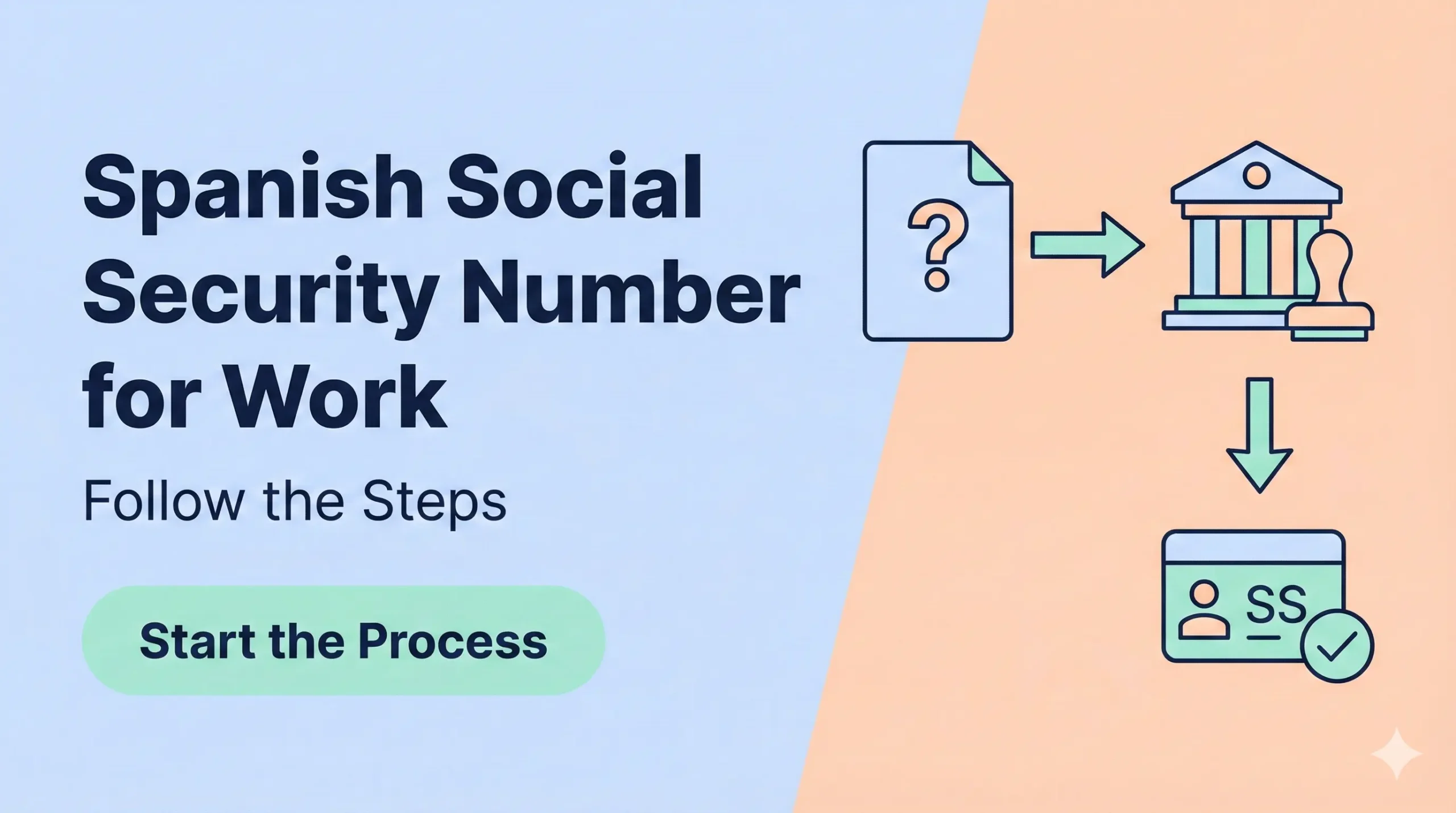
Getting a Spanish Social Security Number for Work: Steps
Obtaining a Spanish Social Security Number (NUSS) is a mandatory step for anyone planning to work, study, or access public healthcare in Spain. This comprehensive guide covers the application methods via the online Importass portal, the TA.1 form, and the critical documents required for both EU and non-EU citizens.
Disclosure: This post may contain affiliate links. We may earn a commission at no extra cost to you if you make a purchase through these links. Read full disclosure.
Understanding the Spanish Social Security Number
The Spanish Social Security system is a robust safety net funded by contributions from workers and employers. The NUSS identifies you within this system.
What is the NUSS?
The Número de la Seguridad Social is a unique nine-digit number assigned to every citizen and resident who engages in paid work or requires social protection.
- It is for life: Once you have a NUSS, it never changes. Even if you leave Spain for ten years and return, you will reactivate the same number.
- It is personal: It is linked to you, not your employer. If you switch jobs, you take the number with you.
- It transforms: Technically, when you first get the number but aren’t working yet, it is just an administrative number. The moment you start working (and contributing), it becomes an NAF (Número de Afiliación). In practice, people use the terms NUSS and NAF interchangeably because the number itself stays the same.
Why You Cannot Live Without It
While you can technically live in Spain with just a passport and money, you cannot integrate without a NUSS.
- Employment: It is illegal for a company to hire you without one. They need it to pay social security taxes on your behalf.
- Freelancing: To register as an Autónomo, this is the first requirement.
- Healthcare: The NUSS is the prerequisite for obtaining your Tarjeta Sanitaria (public health card). Without it, you cannot access the public health system free of charge.
- Benefits: It tracks your eligibility for maternity/paternity leave, sick pay, and unemployment benefits (el paro).
Who Needs to Apply?
The responsibility for obtaining the NUSS depends on your situation.
- Employees (Contracted Workers): Theoretically, your employer can apply for this on your behalf. However, many companies now expect you to have it already to speed up the onboarding process. Having it ready makes you a more attractive candidate.
- Self-Employed (Autónomos): You must apply for it yourself before you register with the tax agency (Hacienda).
- Students: If you have a student visa and plan to do an internship (prácticas) or work part-time (up to 30 hours), you need a NUSS. Increasingly, universities require it even for unpaid internships to cover insurance liability.
If you are currently looking for work, you do not need to wait for a contract to get this number. You can request it proactively. For strategies on securing that first role, refer to our guide on Finding a Job in Spain: CV, Interviews, and Networking.
The Requirements: What You Need Before You Start
Before you open the government website or walk into an office, ensure you have your documentation package ready. Spanish bureaucracy is intolerant of missing papers.
The Essential Documents
- Identity Document:
- EU Citizens: Valid Passport or National ID card from your home country.
- Non-EU Citizens: Valid Passport and your TIE (Foreigner Identity Card) if you already have one. If you only have a visa stamp in your passport, that is usually sufficient for the initial application.
- NIE Number: While it is sometimes possible to apply with just a passport, having your NIE (Número de Identidad de Extranjero) assigned simplifies the process immensely. If you have not secured this yet, read How to Get a Spanish NIE Number: In Spain vs Abroad first.
- Form TA.1: The official application form for “Affiliation and Assignment of Social Security Number.”
- Proof of Address: Usually not strictly mandatory for the NUSS itself if you have a TIE, but highly recommended to have your Certificado de Empadronamiento handy just in case the official wants to verify your residence.
- Employment Proof (Optional but Helpful): A pre-contract or internship offer letter can smooth the process if the official questions why you need the number, though “intention to work” is a valid legal reason.
Method 1: The Online Application (Recommended)
In 2026, the Spanish Social Security administration (Tesorería General de la Seguridad Social or TGSS) strongly prefers digital interactions. The online portal, known as Importass, is user-friendly and often instant.
Step 1: Digital Identification
To use the online system effectively, you need a way to prove who you are digitally. You cannot just create a username and password. You need one of the following:
- Digital Certificate: A software file installed in your browser.
- Cl@ve PIN / Cl@ve Permanente: A government ID system that sends codes to your phone.
If you do not have these yet, stop and get them. They are the keys to the kingdom of Spanish bureaucracy. We detail the installation process in our article on Spanish Bureaucracy for Daily Life: Padrón, IDs, and Local Services.
Step 2: Accessing Importass
- Go to the official Importass portal (Social Security Treasury).
- Look for the section labeled “Solicitar el Número de la Seguridad Social”.
- Click “Solicitar” and choose your login method (Certificate or Cl@ve).
Step 3: The Form
The system will pull most of your data (Name, NIE) automatically from your digital ID.
- Contact Info: Verify your email and Spanish mobile number.
- Address: Ensure this matches your current residence in Spain.
- Reason: You may be asked why you want the number. Select “Work” or “Internship.”
Step 4: Submission and Resolution
Once you submit the request, the system often generates the NUSS instantly. You will receive a PDF resolution containing your name and your new 9-digit Social Security Number. Save this PDF immediately.
Note: If the system cannot validate your data automatically (common for newcomers with irregular naming conventions in their passports), it will ask you to upload scans of your passport/NIE and submit the request for manual review. This typically takes 1 to 10 days.
Method 2: The In-Person Application
If you lack a digital certificate or prefer human interaction, you can apply in person at a TGSS office. However, you cannot just walk in.
Step 1: Cita Previa (Appointment)
You must book an appointment online or by calling the designated phone line.
- Go to the Social Security Sede Electrónica.
- Select “Cita previa para pensiones y otras prestaciones”.
- Choose “Afiliación, Inscripción y Modificaciones”.
- Enter your details and choose the office nearest to your home.
Warning: Appointments in major cities like Madrid or Barcelona can be scarce. You might find availability in smaller nearby towns if the main city is booked out.
Step 2: The Visit
On the day of the appointment:
- Arrive 10 minutes early.
- Bring your printed confirmation code.
- Bring originals and photocopies of all your documents (Passport, NIE, TIE).
- Bring the Form TA.1 filled out and signed (though they can print it there, it is better to be prepared).
The official will review your documents and, usually, issue the paper document with your NUSS right there at the desk.
Decoding the TA.1 Form
Whether you apply online (via manual upload) or in person, the Modelo TA.1 is the standard form. It is available in Spanish, but here is how to navigate it in English.
Section 1: Datos del Solicitante (Applicant Details)
- Nombre / Apellidos: First Name / Surnames. (Match your passport exactly).
- Sexo: Male (H) / Female (M).
- Tipo de documento: Check Passport or NIE and write the number.
- Domicilio: Your street address in Spain.
- Datos telemáticos: Email and Mobile number. Crucial: Check the box allowing them to send you notifications via SMS/Email.
Section 2: Datos Relativos a la Solicitud (Request Details)
This section asks what you want.
- Check the box “Asignación de Número de Seguridad Social”.
- Leave the “Variación de datos” section blank unless you are correcting an error on an existing number.
Section 3: Cause (Motivo)
Sometimes there is a free text field or checkbox. Write “Inicio de actividad laboral” (Start of work activity).
Signature
Sign and date the bottom. If you are submitting online, you do not need to physically sign the PDF if you are using your digital certificate to upload it, as the certificate acts as a signature.
Comparison: NIE, TIE, and NUSS
Newcomers often confuse these three acronyms. They are distinct, and you generally need all three to function in Spain.
| Acronym | Full Name | Purpose | Validity | Physical Form |
| NIE | Número de Identidad de Extranjero | General administrative ID for tax and legal acts. | Permanent Number (Never changes). | A number on a white A4 paper (or on your TIE/Green Card). |
| TIE | Tarjeta de Identidad de Extranjero | Residency card proving your right to live in Spain. | Expires (needs renewal). | A hard plastic photo ID card. |
| NUSS | Número de la Seguridad Social | Tracks work history, pension, and healthcare. | Permanent Number (Lifelong). | A PDF resolution or card (rarely issued now). |
Understanding the distinction is vital, especially when dealing with contracts. For a deeper dive on the residency card aspect, review How to Get the TIE Card in Spain: Fingerprints, Fees, and Pickup.
Special Cases: Students and Dependents
Students and Interns
Previously, unpaid internships did not require Social Security registration. This changed recently. Now, all students undertaking external academic placements (prácticas) must be registered with Social Security.
- University’s Role: The university typically handles the bulk registration, but they need you to have the NUSS first.
- Work Hours: If you get a part-time job, your employer will activate your NUSS as a worker.
To ensure your student status allows for this, check the regulations in Working Part-Time on a Spain Student Visa: Hours and Requirements.
Dependents (Beneficiaries)
If you are moving with a spouse or children who will not work, they still need access to healthcare. They do not get their own independent NUSS for work; instead, they are registered as beneficiaries of the main worker.
- The Process: You must obtain a document proving the family relationship (marriage certificate/birth certificate, translated and apostilled) and present it to the Social Security office to link them to your number.
After You Receive the Number
Congratulations! You have the PDF. What now?
1. Give it to your Employer
Email the PDF resolution to your HR department or your future boss immediately. They need this code to register your employment contract (Dar de alta) in the system.
2. Register as Autonomo
If you are freelancing, you take this number to the Tax Office (Hacienda) and then back to Social Security (RETA) to set up your monthly contributions.
3. Apply for the Health Card
Once your employer registers your contract and the first contribution is made, you are “active.” You can then go to your local health center (Centro de Salud) with your NUSS, your residency card, and your Padrón to apply for the Tarjeta Sanitaria.
- Important: You cannot get the health card before you are employed/paying in, even if you have the NUSS. The NUSS is just the bucket; the job puts the water in it.
For a full explanation of how to navigate the public health system once you are registered, see Spain Healthcare System for Expats: Public vs Private.
Troubleshooting Common Issues
Even with a streamlined system, things go wrong.
“The system says my NIE does not exist.”
This is common if you recently obtained your NIE. The police database (DGP) and the Social Security database (TGSS) do not always sync instantly.
- Solution: You must make an appointment or use the “Submit documentation” feature on Importass to manually send a scan of your NIE paper so they can merge the records.
“My name is spelled wrong on the NUSS.”
Spain often struggles with middle names or double surnames from other cultures.
- Solution: If the error is minor (one letter), it usually doesn’t affect work. If it is significant, file a “Variación de datos” form (TA.1) immediately to correct it. If it doesn’t match your passport exactly, you might have trouble claiming a pension 30 years from now.
“I lost my number.”
Since physical cards are no longer issued, you might forget the number.
- Solution: Log into Importass with your digital certificate. You can download a “Duplicate of Affiliation Document” instantly at any time.
Conclusion
Obtaining your Spanish Social Security Number is a milestone. It signifies that you are no longer just a visitor or a resident on paper; you are an active participant in the Spanish economy. You are contributing to the system and, in return, the system protects you.
While the forms and appointments might seem tedious, remember that this number is the key to free healthcare and future financial security. By utilizing the digital tools available and preparing your documents meticulously, you can secure your NUSS in a matter of days, clearing the path for your professional success in Spain.
Once your paperwork is sorted, the real work begins: managing your income. To ensure you have the right financial infrastructure, make sure to read Opening a Bank Account in Spain: Step-by-Step for Foreigners.
References
Primary sources (official)
- Seguridad Social (Importass Portal): https://portal.seg-social.gob.es/
- Sede Electrónica de la Seguridad Social (Appointments): https://sede.seg-social.gob.es/
- Modelo TA.1 Download: https://www.seg-social.es/wps/portal/wss/internet/Trabajadores/Afiliacion/Servicios/ModelosSolicitud/
Other helpful sources
- European Commission (Social Security Rights in Spain): https://ec.europa.eu/social/main.jsp?catId=1129&langId=en
- Citizens Advice Bureau Spain (Bureaucracy Help): https://www.citizensadvice.org.es/
Disclaimer
The information provided in this article is for educational and informational purposes only and does not constitute legal or administrative advice. Procedures for obtaining a Social Security Number in Spain are subject to change by the Tesorería General de la Seguridad Social. We recommend consulting with a qualified ‘gestor’ or the official Social Security website for the most up-to-date requirements.