Noise Rules in Spain: Quiet Hours and What to Do About Complaints
While Spain is famous for its vibrant street life, strictly enforced laws protect residents’ right to rest. This guide details the legal decibel limits, the specific “horario de descanso” for renovations and parties, and the step-by-step process for filing a “denuncia” against noisy neighbors.
Disclosure: This post may contain affiliate links. We may earn a commission at no extra cost to you if you make a purchase through these links. Read full disclosure.
The Legal Framework: It Is Not Just Culture
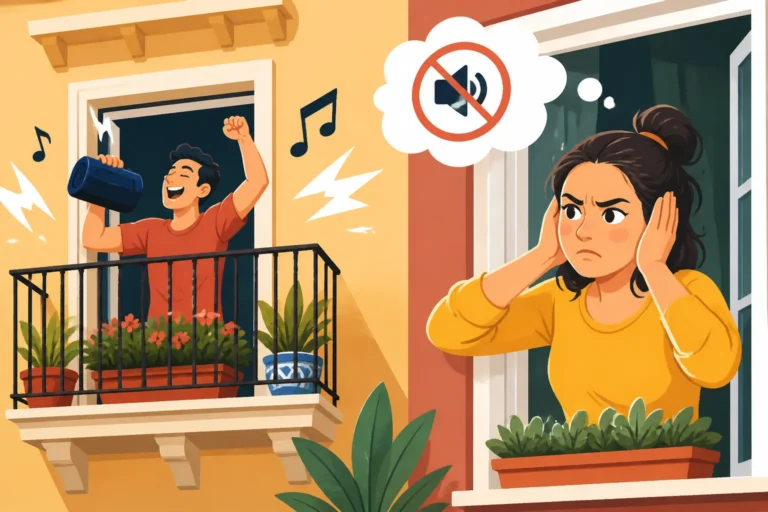
Many foreigners hesitate to complain about noise because they fear being seen as the “grumpy expat” who doesn’t understand the local culture. While tolerance is necessary in a dense urban environment, you should know that the law is on the side of the sleeper.
National Law vs. Local Ordinances
The regulation of noise operates on three levels:
- National Level (Ley 37/2003 del Ruido): This sets the baseline. It defines noise as a pollutant and establishes the right to health and a suitable environment.
- Regional Level: Autonomous communities may have stricter environmental laws.
- Municipal Level (Ordenanzas Municipales): This is where the rubber meets the road. Every Town Hall (Ayuntamiento) has specific bylaws detailing exact hours and decibel limits. Madrid’s rules differ slightly from Barcelona’s or Valencia’s.
The Horizontal Property Act
For those living in apartment blocks—which is the vast majority of the population—the Horizontal Property Act (Ley de Propiedad Horizontal) is your most powerful tool. It governs the Comunidad de Propietarios (Community of Owners) and explicitly forbids “annoying, unhealthy, harmful, dangerous, or illicit activities.”
If a neighbor is persistently noisy, the Community can vote to take legal action. This is not just a fine; a judge can order the cessation of the use of the property for up to three years. This means the owner is evicted from their own house. While rare, the threat of this is often enough to silence a problem neighbor. To understand how these communities function and how to leverage the President’s authority, reviewing How Spanish Building Communities Work (Comunidad): Fees and Rules is essential context.
Quiet Hours: The Horario de Descanso
The most frequent question is: “When does the music have to stop?” The answer depends on the day of the week and the type of noise.
General Nighttime Quiet Hours
In most Spanish municipalities, the protected nighttime period (Horario Nocturno) generally runs:
- Sunday to Thursday: 22:00 or 23:00 to 07:00 or 08:00.
- Friday, Saturday, and Holidays: 23:00 or 00:00 to 08:00 or 09:30.
During these hours, noise must be kept to a minimum. This means no loud music, no shouting, no moving heavy furniture, and no washing machines (unless they are silent models).
The Siesta: Myth vs. Law
Is it illegal to make noise during siesta time (15:00 – 17:00)?
Generally, no. There is rarely a specific law forbidding noise in the afternoon. Construction work, for example, is usually permitted during these hours. However, community statutes (Estatutos) often include a clause prohibiting noise during the post-lunch relaxation period. While the police might not fine a driller at 4:00 PM, the Community President certainly can issue a warning if the internal rules forbid it.
Adapting to these rhythms is part of the cultural adjustment. For a broader look at how the daily schedule in Spain impacts lifestyle, see Work‑Life Balance in Spain: What Changes for Expats.
Construction and Renovation Works (Obras)
Renovations are the bane of apartment living. The law is strict here because the noise is unavoidable and intense.
- Weekdays (Mon-Fri): Usually allowed from 08:00 to 21:00.
- Saturdays: Usually allowed from 09:30 to 21:00 (varies by city; some ban it starting at 14:00).
- Sundays and Holidays: Strictly Forbidden.
If your neighbor starts hammering at 7:00 AM on a Sunday, they are breaking the law. You can call the police immediately.
Decibel Limits: How Loud is Too Loud?
“Loud” is subjective. Decibels (dB) are objective. Spanish law relies on measurements to issue fines.
Residential Limits
While exact numbers vary by municipality, these are the standard thresholds for residential zones.
Daytime (08:00 – 22:00):
- Living Areas: Max 35 – 45 dB.
- Bedrooms: Max 30 – 40 dB.
- Comparison: 40 dB is a quiet conversation or a humming refrigerator. 60 dB is a normal conversation.
Nighttime (22:00 – 08:00):
- Living Areas: Max 30 – 35 dB.
- Bedrooms: Max 25 – 30 dB.
- Comparison: 30 dB is a whisper.
The Vibrations:
Noise isn’t just sound; it is impact. Heavy footsteps, dragging chairs, or a washing machine on spin cycle create structural vibrations. If these transmit into your bedroom at night exceeding the limits, it is actionable, even if the “volume” seems low.
Commercial Premises (Bars and Gyms)
If you live above a bar or a gym, the insulation requirements are much higher for them. They cannot transmit more than 25-30 dB into your home at night. If you can hear the lyrics of the songs playing downstairs, they are almost certainly violating their license.
Specific Noise Sources and Regulations
Different sources of noise trigger different regulations.
1. Domestic Appliances
Running a washing machine or dishwasher at 1:00 AM to save on electricity bills (during off-peak hours) used to be common advice. However, most machines spin at 50-70 dB. In older buildings with thin walls and lightwells (patios de luces), this noise travels.
- Rule: If your machine disturbs a neighbor’s sleep (exceeds 30 dB in their bedroom), you can be fined, regardless of electricity prices.
2. Pets (Barking Dogs)
Continuous barking is considered “avoidable noise.”
- Responsibility: The owner is liable. Leaving a dog alone on a balcony for hours where it barks at passersby is a violation of municipal ordinances and potentially the new Animal Welfare Law.
- Action: Police can measure the noise and fine the owner for failing to control the animal.
3. Musical Instruments
Piano practice is a frequent source of lawsuits.
- Rule: Practice is allowed during the day, but often restricted to specific hours (e.g., not during siesta).
- Soundproofing: If a professional musician practices hours a day, they are often legally required to soundproof the room to prevent transmission.
4. Street Noise (Botellón)
The botellón (street drinking parties) is illegal in almost all of Spain.
- Action: This is a public order issue. Call the Policía Local. They are usually quick to disperse street drinking in residential areas because it carries heavy fines for the drinkers.
How to Handle a Noise Complaint: A Step-by-Step Guide
If you are suffering from noise, do not suffer in silence. However, escalating too quickly can create a hostile living environment. Follow this escalation ladder.
Step 1: The Friendly Approach
Never start with the police. The Spanish value personal relationships.
- Action: Knock on the neighbor’s door the next day (not at 2 AM when tempers are high).
- Script: “Hola, disculpa. I don’t know if you realize, but the walls are very thin. Last night the music was quite loud in my bedroom. Could you please lower it a bit after 11 PM?”
- Tone: Apologetic and polite. Assume they didn’t know. Most people will apologize and stop.
Step 2: Involve the Community President
If the noise continues, make it official within the building.
- Action: Contact the President or the Property Administrator.
- The Power: The President has a legal duty to mediate. They can send a formal warning to the noisy neighbor reminding them of the Community Statutes. This puts the neighbor on notice that the “building” is watching, not just “the annoying foreigner.”
Step 3: Call the Local Police (Policía Local)
If there is a loud party at 2:00 AM and they refuse to stop:
- Call 092 (Local Police). Do not call the National Police (091) or Civil Guard (062) for noise; this is a municipal competency.
- The Request: Ask them to come and measure the noise (medición acústica).
- The Outcome: The police will come to your house to measure the noise level coming through the wall. If it exceeds the limit, they will go next door and issue a denuncia (fine). The police report (atestado) is crucial evidence if you need to go to court later.
Step 4: The Official Denuncia (Municipality)
If the noise is chronic (e.g., a bar downstairs or a dog that barks every day), filing a one-time police report isn’t enough. You need to file a complaint with the Town Hall (Ayuntamiento).
- The Process: Go to the Town Hall registry or use their online portal. Submit a formal complaint citing the noise ordinance.
- The Result: The Town Hall sends technicians to verify. If the business or neighbor is non-compliant, the Council can seal the premises or issue escalating fines.
Administrative procedures like this require you to be correctly registered in the city. Ensure your census registration is active by checking How to Register Your Address (Empadronamiento) as a Renter in Spain.
Step 5: The Burofax
Before suing, you must prove you tried to solve it amicably. Send a Burofax (certified letter with content proof) to the neighbor.
- Content: State the dates/times of noise, the police interventions, and a final warning that legal action will follow.
- Why: This is essential proof for the judge that the defendant acted in “bad faith” by ignoring warnings.
Step 6: Civil Court (Demand)
If all else fails, you sue under Article 7.2 of the Horizontal Property Act (Acción de Cesación).
- The Goal: You ask the judge to order the noise to stop, to pay damages for “moral suffering” (lack of sleep), and potentially to ban the owner from the home for up to 3 years.
- Success Rate: High, if you have the police measurements and the Burofax proof.
Fines and Penalties: What Is the Cost of Noise?
Spanish law categorizes noise offenses into three tiers. The fines can be eye-watering, which is why the threat of a denuncia is effective.
| Severity | Type of Infraction | Fine Amount (Approx) | Examples |
| Minor | Leve | €600 – €3,000 | Exceeding limit by <6 dB, loud music at night, moving furniture, shouting. |
| Serious | Grave | €3,001 – €15,000 | Exceeding limit by >6 dB, obstructing inspection, recidivism (doing it again). |
| Very Serious | Muy Grave | €15,001 – €300,000 | Exceeding limit by >15 dB, causing serious structural harm or health danger. |
Note: Fines vary by region. These are indicative ranges based on the National Noise Law.
Renters vs. Homeowners: Who Has the Power?
Your legal standing changes depending on whether you own the property or rent it.
If You Are a Tenant (Renter)
You are the victim, but you are not a member of the Community of Owners.
- Action: You must notify your Landlord. The landlord is responsible for ensuring the property is “habitable.” Chronic noise renders it uninhabitable.
- Leverage: If the landlord does not act to stop the noisy neighbors (e.g., by speaking to the President), you may have grounds to terminate the rental contract without penalty.
- Shared Flats: If the noise is coming from your own flatmates (e.g., in a Piso Compartido), this is an internal contract dispute. Review Room Rentals (Piso Compartido) in Spain: Contracts and Safety Tips to understand house rules clauses.
If You Are the Landlord
If your tenant is the one making the noise:
- Risk: The Community can sue you for the actions of your tenant.
- Solution: Ensure your rental contract has a specific clause stating that violation of Community Noise Rules is grounds for immediate eviction. See Renting in Spain: Contracts, Deposits, and Tenant Rights for how to draft watertight contracts.
Soundproofing: The Practical Solution
Sometimes, the neighbor isn’t being loud; the building is just old. Spanish construction prior to the 2006 Building Code (Código Técnico de la Edificación) often lacks acoustic insulation.
If the problem is “structural” (hearing footsteps or voices at normal volume), legal action will fail because the neighbor isn’t exceeding decibel limits; the wall is just thin.
Solutions for Tenants:
- Rug Rule: Ask the upstairs neighbor if they would mind putting down rugs. It dampens impact noise significantly.
- Furniture Placement: Move wardrobes against the shared wall to act as a buffer.
- White Noise: Use fans or white noise machines to mask the sudden spikes of sound.
Solutions for Owners:
- Drywall Cladding: Installing a false wall (trasdosado) with acoustic wool can reduce transmission by 10-15 dB. It costs money and loses you 10cm of room space, but it guarantees sleep.
Handling Street Noise: Bars and Terraces
Spain has more bars per capita than almost any other country. Living above one is a calculated risk.
- Closing Times: Bars must close at specific times (e.g., 2:00 AM on weekends). Terraces often must close earlier (e.g., 12:00 AM or 1:00 AM).
- The License: Every bar has a license limiting its noise. If they have a terrace, they are responsible for the noise their patrons make, even outside.
- ZAS (Zona Acústicamente Saturada): If a street is declared a “Saturated Acoustic Zone” due to too many bars, the Council imposes stricter limits: no new licenses, earlier closing times, and suspension of terraces.
If you are looking for a flat, check if the street is a ZAS. It sounds bureaucratic, but it means “You will not sleep here.”
Conclusion
Spain is loud, but it is not lawless. The idea that you must simply endure sleepless nights as the price of living in the sun is a myth. The Ley del Ruido provides you with strong armor, and the local police are the enforcement arm.
However, the key to success is cultural calibration. Do not be the person who calls the police at 11:05 PM because of a dinner party. Be the neighbor who knocks on the door with a smile first. Use the Community President. Build a consensus. But if the noise persists and affects your health, know that the law is unequivocal: your home is your sanctuary, and you have the right to silence.
Before you engage in any formal complaint process, ensure your own administrative house is in order. From your ID card to your local registration, having your papers ready makes the police and the Town Hall take you seriously. Check Spanish Bureaucracy for Daily Life: Padrón, IDs, and Local Services to ensure you are fully compliant before you start a battle.
References
Primary sources (official)
- Boletín Oficial del Estado (Ley 37/2003 del Ruido): https://www.boe.es/buscar/act.php?id=BOE-A-2003-20976
- Boletín Oficial del Estado (Ley de Propiedad Horizontal – Art. 7.2): https://www.boe.es/buscar/act.php?id=BOE-A-1960-10906
- Ministry for Ecological Transition (Noise Pollution Maps): https://sicaweb.cedex.es/
- Ayuntamiento de Madrid (Noise Ordinance Example): https://www.madrid.es/
Other helpful sources
- OCU (Organization of Consumers and Users – Noise Guide): https://www.ocu.org/vivienda-y-energia/comunidad-de-propietarios
- Idealista News (Legal Steps for Noise): https://www.idealista.com/news/inmobiliario/vivienda
- Citizens Advice Bureau Spain (Nuisance Neighbors): https://www.citizensadvice.org.es/
Disclaimer
The information provided in this article is for educational and informational purposes only and does not constitute legal advice. Noise ordinances (decibel limits and hours) vary significantly by municipality. We recommend consulting your local Town Hall regulations or a lawyer specializing in Horizontal Property law for specific disputes.