Understanding Spanish Payslips: IRPF and Social Security Lines Explained
Staring at your first Spanish paycheck and realizing nearly thirty percent of your negotiated salary vanished before hitting your bank account is a brutal expat initiation. I once spent three days arguing with my Madrid HR department, entirely convinced they had stolen my money due to an incomprehensible tax line. This guide breaks down exactly how to read a Spanish payslip, decode IRPF retentions, and understand your social security deductions so you never feel shortchanged.
Disclosure: This post may contain affiliate links. We may earn a commission at no extra cost to you if you make a purchase through these links. Read full disclosure.
The Structure of a Spanish Nomina
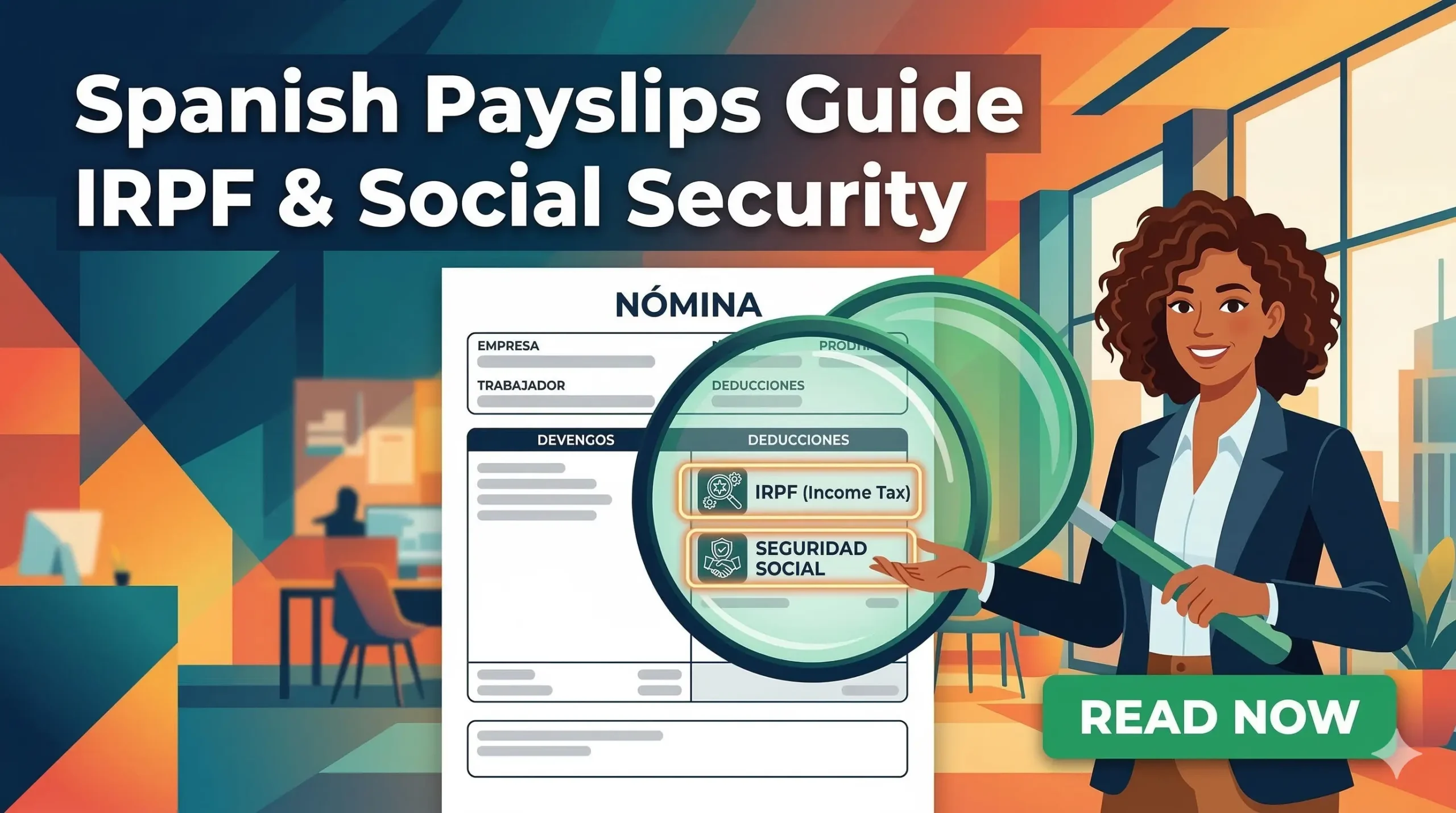
When you successfully land a job in Spain, you quickly realize that the local administrative machinery loves paperwork. The document that governs your monthly livelihood is the nómina (payslip). Unlike the simplified, single-page digital summaries common in the US or UK, a Spanish payslip is a dense, highly regulated legal document filled with acronyms, percentages, and complex accounting categories.
Header and Company Information
The very top section of your nómina is the Encabezamiento (Header). While it is tempting to skip past this to look at the money, this section is an absolute minefield for administrative errors that can derail your legal residency. It contains the official data of the company—their registered legal name, corporate address, and CIF (tax identification number). Next to the company data, you will find your personal identification data.
Your personal section will list your full legal name, your NIE or DNI (identity number), your official Categoría Profesional (Professional Category as defined by your industry’s collective bargaining agreement), and your Número de Afiliación a la Seguridad Social (NAF). As a newly arrived expat, you must scrutinize this section obsessively. Spanish administrative systems are notoriously unforgiving of typos. If your HR department transposes two numbers in your NIE, your income tax withholdings will not sync correctly with the national tax agency, creating an absolute nightmare when tax season arrives. If you are struggling to understand how this identification number connects to your physical residency card, reviewing our Guide to NIE Numbers and TIE Cards in Spain is crucial.
Devengos Accruals and Gross Pay
Directly below the header lies the Devengos section. This is the positive side of the ledger, detailing your Salario Bruto (Gross Salary) and exactly how much money you accrued during the 30-day working period before the government touched it. However, your gross salary is rarely listed as a single, clean number. It is mathematically fractured into several highly specific sub-categories based on Spanish labor law.
The foundation is your Salario Base (Base Salary). This is the minimum guaranteed remuneration dictated by your industry’s convenio colectivo (collective bargaining agreement). On top of the base salary, you will likely see Complementos Salariales (Salary Supplements). These are extra, taxable amounts paid for specific conditions, such as a language bonus for speaking native English, a seniority bonus (antigüedad) for your years at the company, or a hazard bonus if your job involves physical risk. Understanding these components is vital when negotiating a job offer, a topic we cover deeply in Employment Contract in Spain.
Finally, you might see Percepciones No Salariales (Non-Salary Accruals). These are reimbursements for expenses you incurred while doing your job, such as transport allowances, relocation stipends, or daily meal vouchers (dietas or Tickets Restaurant). Identifying these lines is crucial because non-salary accruals are often legally exempt from certain social security deductions and income taxes. Structuring a compensation package heavily reliant on non-taxable allowances is a massive tactical advantage that keeps more cash in your pocket, though it does not contribute to your future pension calculations.
The 12 Versus 14 Payment System
Perhaps the most confusing cultural nuance of the Spanish payroll system is the distribution of your annual salary. In most of the English-speaking world, your annual gross salary is simply divided by twelve, yielding twelve equal monthly paychecks. In Spain, the legal default rooted in mid-20th-century labor law is a fourteen-payment system (14 pagas).
Many expats despise the fourteen-payment system because it means their standard monthly take-home pay from January to June is artificially low. When you are trying to cover steep rental deposits and initial relocation costs, having your own money withheld is incredibly frustrating. Fortunately, most modern, international companies operating in Spain allow you to request your salary prorrateada (prorated). You must proactively clarify which payment structure your company uses during the negotiation phase to ensure you can afford your local lifestyle; reviewing the Cost of Living in Spain: Budgeting for Expats will help you calculate your monthly needs.

Demystifying Social Security Deductions
Once you pass the accruals, you hit the Deducciones section. This is the painful half of the document where your gross pay is aggressively slashed. The first major category of deductions is your mandatory contribution to the Seguridad Social (Social Security).
Contingencias Comunes Explained
The Spanish social security system is a massive, heavily subsidized welfare state that provides comprehensive public healthcare, state pensions, and robust sick leave. However, it is entirely funded by the active workforce. The largest deduction on your payslip is labeled Contingencias Comunes (Common Contingencies).
For standard employees, the government mandates a strict 4.70% deduction from your gross taxable base for Contingencias Comunes. This money goes directly into the national pot. It is the insurance premium you pay to ensure that if you are hospitalized with a severe illness, you will never receive a medical bill. It funds your maternity or paternity leave, and it builds your timeline toward a Spanish retirement pension. Recently, the government also added a new, smaller line item called the Mecanismo de Equidad Intergeneracional (MEI), pulling an additional 0.12% to 0.13% to help fund the looming baby boomer pension crisis.
For many expats, paying nearly 5% of their gross salary for public healthcare is frustrating if their visa status legally requires them to also hold a comprehensive private health insurance policy. You end up paying twice for medical coverage. However, the peace of mind the public safety net provides during catastrophic, long-term illnesses is unparalleled. To deeply explore the systemic differences between these parallel medical routes, review our overview of the Spain Healthcare System for Expats: Public vs Private.
Unemployment and Vocational Training Lines
Directly below the common contingencies, you will find two smaller, hyper-specific deductions. The first is Desempleo (Unemployment). If you are on a permanent employment contract, you will pay exactly 1.55% of your gross salary into the national unemployment fund. If you are on a temporary contract, the rate is slightly higher at 1.60%, reflecting the higher risk of you utilizing the system.
This 1.55% is the premium you pay to access el paro—the famous Spanish unemployment benefit. The final, smallest bucket in the social security section is for Formación Profesional (Vocational Training). This deduction takes a mere 0.10% of your gross pay. This microscopic fraction is pooled nationally to fund state-sponsored re-skilling programs and free training courses for the unemployed workforce across the country.
What Your Employer Pays Behind the Scenes
Expats relocating from high-wage economies often look at Spanish gross salaries and assume that local companies are simply cheap. In reality, the Spanish government places a massive, invisible tax burden directly on the employer. The social security deductions you see on your nómina only represent the “worker’s share.”
Behind the scenes, your employer pays an incredibly high premium to the government just for the privilege of keeping you on the payroll—typically around 30% to 32% on top of your gross salary. If your negotiated gross salary is €40,000 a year, you actually cost the company roughly €52,000. The employer pays 23.60% for their share of your Contingencias Comunes, plus additional percentages for unemployment, training, and occupational accident insurance.
| Social Security Deduction | Employee Share (%) | Employer Share (%) | Total Contribution |
| Contingencias Comunes | 4.70% | 23.60% | 28.30% |
| Desempleo (Permanent Contract) | 1.55% | 5.50% | 7.05% |
| Formación Profesional | 0.10% | 0.60% | 0.70% |
| Mecanismo de Equidad (MEI) ~2024/2025 | 0.12% – 0.13% | 0.58% – 0.67% | 0.70% – 0.80% |
Navigating IRPF Income Tax Retentions
While social security is a fixed, predictable percentage, the second major deduction on your payslip operates on a complex, sliding scale. This is the IRPF (Impuesto sobre la Renta de las Personas Físicas), and it is responsible for the largest chunk of your missing money.
How the Progressive Tax System Works
The Spanish income tax system is highly progressive. The more money you earn, the higher the percentage of tax you pay on your upper income brackets. The national IRPF rates scale aggressively, starting around 19% for lower-income earners and scaling up to 45% or 47% for top earners, depending on your autonomous community’s specific regional tax laws.
However, the amount deducted from your monthly nómina is not your final, official tax bill. It is an estimated retención (withholding). Your employer uses an algorithm provided by the tax authority (Hacienda) to estimate what your total tax liability will be at the end of the year, and they withhold a percentage of your salary each month to slowly pay that estimated bill.
This progressive system causes immense frustration when you receive a bonus. If you earn a €1,000 performance bonus, it might push your annualized income projection into a higher tax bracket for that specific month. You might see your IRPF retention spike from 18% to 26% on that single paycheck, meaning the government swallows a massive portion of your reward. If your company calculates this estimated retention correctly throughout the year, you will owe nothing when you file your annual tax return in the spring. If you want a deep dive into the actual filing mechanics and deadlines, you must read How to File a Spanish Tax Return (Renta) as a New Resident.
The Crucial Role of Modelo 145
The accuracy of your monthly IRPF retention depends entirely on a specific bureaucratic form called the Modelo 145. On your very first day of work, your HR department will hand you this form. It is your official, legally binding declaration of your personal and family situation to the payer.
If your life circumstances change—for example, if you have a baby in October—you must submit a newly updated Modelo 145 to HR immediately so they can lower your retention rate for the rest of the year. Filling this form out incorrectly is dangerous. If you claim dependents you do not have to artificially inflate your monthly take-home pay, Hacienda will inevitably catch the discrepancy during tax season and hit you with a massive, lump-sum tax bill and potential penalties.
The Beckham Law Exemption for Expats
If you are a high-earning expat relocating to Spain specifically for a corporate job, you might be eligible to completely bypass the brutal, progressive IRPF tax brackets. Spain offers a special tax regime for impatriates, colloquially known as the Beckham Law.
If you apply for and are granted Beckham Law status, you do not pay progressive taxes scaling up to 47%. Instead, you pay a flat, highly advantageous tax rate of 24% on all Spanish-sourced income up to €600,000. Furthermore, under this regime, Spain will not tax your foreign-earned investment income, foreign capital gains, or foreign real estate holdings.
If you qualify for this regime, your HR department must be notified immediately and presented with your official approval document from Hacienda. Instead of calculating a complex progressive retention based on the Modelo 145, your nómina will simply show a flat, predictable 24% IRPF deduction every single month. Because securing this tax status can save you tens of thousands of euros over a five-year period, understanding the application process is absolutely critical; read Beckham Law Explained: Tax Benefits for Expats to determine if your specific relocation timeline makes you eligible.
Managing Your Net Salary and Bank Transfers
At the very bottom of the nómina, usually bolded and boxed in, lies the Líquido a Percibir (Net to Receive). This is your actual salario neto—the exact, final amount that the company owes you. Navigating the transfer of this money into your control requires setting up your local financial infrastructure correctly.
Why You Need a Spanish IBAN
When you sign your employment contract, your HR department will ask for a bank account number to deposit your monthly net salary. While European law technically dictates that Spanish employers must accept any European IBAN (such as a German or French account number) without discrimination, the reality of Spanish HR departments is incredibly frustrating.
Many legacy payroll systems in Spain are outdated and physically cannot process a batch salary transfer to a non-Spanish IBAN. The HR department will often stubbornly demand a local account number starting with the letters “ES”. Walking into a traditional high-street bank like Santander or BBVA to open an account is an exhausting ordeal filled with massive physical paperwork, long queues, and severe language barriers.
To completely bypass this localized stress, savvy expats immediately open an account with N26. Because N26 operates as a fully licensed, digital-first European bank, you can open a Spanish-branch account directly from your smartphone in minutes. N26 provides you with a fully recognized, official Spanish IBAN that your HR department will accept without question. You get your salary deposited seamlessly, enjoy an intuitive English-language app, and completely avoid the predatory maintenance fees that traditional Spanish banks use to trap foreign workers. To understand the broader challenges of getting set up in the traditional banking system, review Opening a Bank Account in Spain as a Non-Resident. Furthermore, building a consistent transaction history with a reliable bank is the first step toward future financial credibility; check out Getting a Credit Card in Spain as a Foreigner: Approval Tips for next steps.
Sending Money Back Home Efficiently
Once your net salary hits your Spanish account, you will likely need to move a portion of it back to your home country. Expats frequently need to pay outstanding student loans in the United States, maintain a property mortgage in the UK, or send financial support to aging family members abroad.
To protect your net salary, you must use a dedicated currency specialist like Wise. By linking your Spanish account to Wise, you can move your euros across international borders at the true, mid-market exchange rate. Wise offers total transparency, allowing you to see exactly how much money will land in your foreign account down to the cent before you hit send. Bringing Wise into your monthly financial routine ensures that the net salary you fought so hard for in Spain retains its maximum purchasing power internationally.
Protecting Your Wealth from Inflation
Seeing how much of your gross salary is consumed by the Spanish tax and social security systems is a sobering experience. It makes preserving and aggressively growing your remaining net income an absolute priority. However, keeping your savings in a traditional Spanish bank account is a terrible financial strategy, as local inflation will slowly erode its purchasing power.
To actually build wealth, veteran expats utilize global brokerage platforms like Interactive Brokers. By transferring a portion of your monthly net salary into Interactive Brokers, you gain direct access to low-cost, globally diversified ETFs, index funds, and equities. You completely bypass the high-fee traps of the Spanish retail banking sector. Furthermore, Interactive Brokers allows you to maintain a highly portable, tax-efficient investment portfolio that travels with you, regardless of whether your expat journey keeps you in Spain forever or takes you to a new country next year.
Troubleshooting Common Payslip Errors
Spanish payroll departments are managed by humans, and humans make mistakes. As an expat, you must audit your payslip every single month. If you spot an error, you must approach HR strategically, as local administrative cultures can be highly defensive.
Spotting Incorrect Retention Rates
One of the most dangerous traps for expats on short-term or temporary contracts is an artificially low IRPF retention rate. By law, the absolute minimum an employer can withhold for income tax on a temporary contract is 2%. Sometimes, an employer will apply this 2% flat rate to an expat’s salary for the entire year.
While taking home 98% of your gross pay feels amazing in October, it is a ticking time bomb. When you file your taxes the following spring, Hacienda will calculate your actual tax liability (which might be 24%). You will suddenly owe the Spanish government thousands of euros in a lump sum. If you look at your nómina and see an IRPF rate of 2%, you must march into HR immediately. Request that they voluntarily increase your retention rate (subir la retención voluntariamente) to match your true annualized tax bracket, ensuring you are not hit with a massive, unpayable bill later.
Missing Allowances and Bonuses
If your negotiated contract included monthly transport stipends or Tickets Restaurant (meal vouchers), you must verify that they are correctly displayed in the Devengos section but properly excluded from the IRPF base calculation.
Meal vouchers are legally exempt from income tax up to €11 per working day. If HR mistakenly codes these vouchers as standard salary supplements, you will be unjustly taxed on money meant for your daily lunch. If you spot this discrepancy, do not accuse HR of theft; approach them politely, point to the specific line item, and ask for a revisión de la nómina (payroll review). In Spain, a calm, bureaucratic approach will get your money refunded significantly faster than an angry confrontation.
References
Primary sources (official)
- Seguridad Social – Bases y tipos de cotización 2024/2025: https://www.seg-social.es/wps/portal/wss/internet/Trabajadores/CotizacionRecaudacionTrabajadores/36537
- Agencia Tributaria – Retenciones IRPF y Modelo 145: https://sede.agenciatributaria.gob.es/Sede/irpf/retenciones-ingresos-cuenta-pagos-fraccionados/retenciones-ingresos-cuenta/gestiones-retenciones-irpf.html
- Ministerio de Trabajo y Economía Social – El Recibo de Salarios: https://www.mites.gob.es/es/Guia/texto/guia_6/contenidos/guia_6_14_1.htm
Other helpful sources
- Expatica – Taxes in Spain: https://www.expatica.com/es/finance/taxes/taxes-in-spain-471614/
Disclaimer
The information provided in this article is for educational and informational purposes only and does not constitute formal financial, tax, or legal advice. Spanish social security contribution percentages (including the MEI), progressive IRPF tax brackets, and specific labor laws regarding payroll formatting are subject to frequent legislative updates by the Spanish government. Always consult directly with a certified Spanish tax advisor (asesor fiscal) or a registered employment lawyer (abogado laboralista) regarding your specific payroll deductions, tax liabilities, and employment contract terms.