Are Bank Cheques Still Used in Spain? What Expats Need to Know
Trying to pay a Spanish plumber with a personal cheque is a fast track to sheer confusion. Expats often assume their trusty chequebooks work globally, but this guide explains why Spanish cheques are virtually extinct and what modern alternatives you actually need to survive.
Disclosure: This post may contain affiliate links. We may earn a commission at no extra cost to you if you make a purchase through these links. Read full disclosure.
The Extinction of the Personal Chequebook
If you are moving to Spain from the United States, the United Kingdom, or France, you are likely accustomed to writing personal cheques for your monthly rent, paying independent contractors, or sending cash gifts in birthday cards. You need to entirely erase this habit from your financial mindset the moment you cross the Spanish border.
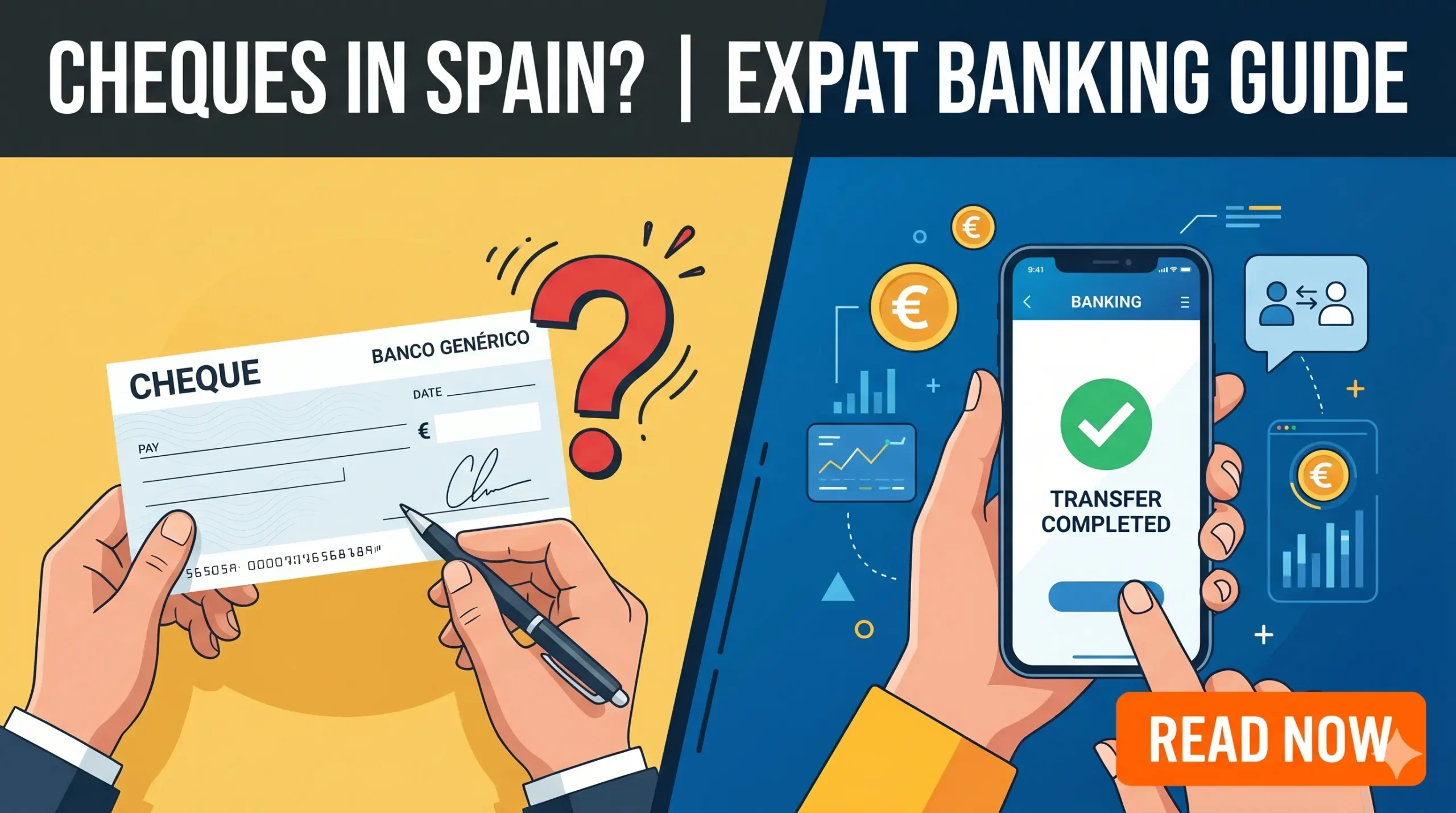
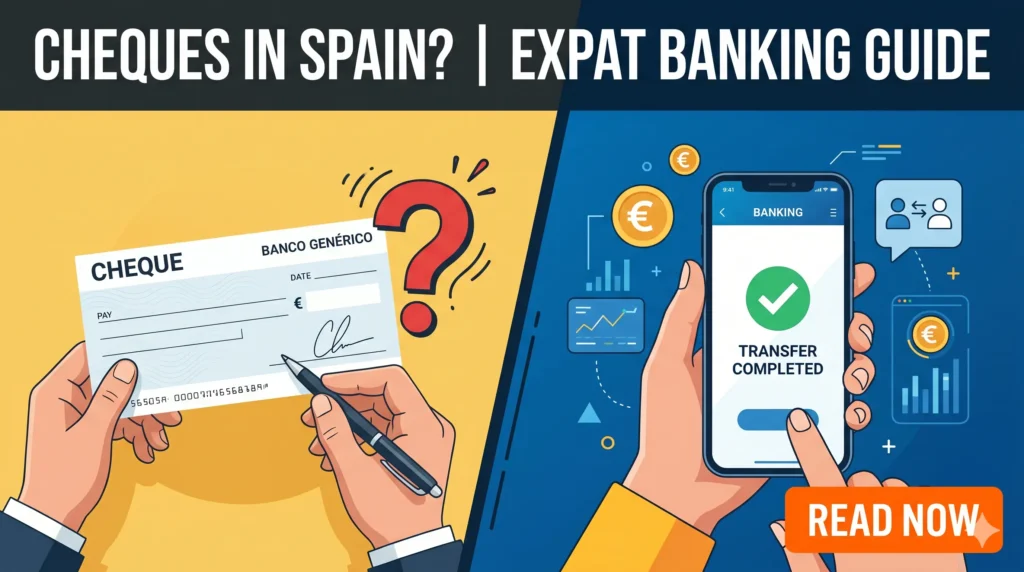
In Spain, the personal chequebook—known locally as a talonario—is functionally dead for everyday consumer transactions. No supermarket will process them, no local plumber will accept them, and handing one to a new landlord will immediately flag you as a highly suspicious, problematic tenant.
Why Nobody Wants Your Personal Cheque
The Spanish financial system transitioned to digital, instantaneous electronic transfers much faster and more aggressively than the North American banking sector. To a Spanish merchant or landlord, a personal cheque represents an unacceptable level of financial risk and an exhausting administrative burden.
When you hand someone a personal cheque, there is zero guarantee that your account actually holds the funds to clear it. In Spain, bounced cheques (cheques sin fondos) carry massive headaches for the recipient, who must physically go to their bank branch, wait in endless lines, deposit the paper, and then wait several business days for the funds to clear the national system. If the cheque bounces, the recipient is often charged a penalty fee by their own bank simply for attempting to deposit a bad piece of paper.
Because the European SEPA network makes sending money digitally completely free and virtually instantaneous, local residents view the use of a personal cheque as archaic and inherently risky. If you try to pay your rent with paper, your landlord will instantly demand you establish a digital connection, which is why securing a local IBAN via the steps in Opening a Bank Account in Spain: Step-by-Step for Foreigners is so critical during your first week. Once you have a local account, you will rely exclusively on the digital transfer methods deeply explained in Spanish Bank Transfer Terms: Transferencia, Bizum, SEPA Explained.
The Exception: When You Actually Need a Banker Draft
While the personal chequebook is obsolete for daily life, there is one specific scenario where a physical piece of paper remains the absolute king of the Spanish economy: massive, high-value asset purchases.
Buying Spanish Property or Vehicles
If you are finalizing the purchase of a Spanish villa at a notary’s office, or if you are buying a high-end vehicle directly from a private seller, you cannot simply log into your banking app and swipe to send 300,000 euros. Spanish notaries and private sellers require absolute, ironclad proof of immediate funds before signing over a property deed (escritura).
This is where you must use a cheque bancario (a banker’s draft) or a cheque conformado (a certified cheque).
Unlike a personal cheque, a cheque bancario is issued directly by the bank itself. The bank physically removes the funds from your personal checking account, holds them in their own secure central ledger, and prints a specialized cheque guaranteeing the money. When you hand this piece of paper to the seller at the notary table, they know with absolute certainty that the money exists and cannot bounce. This highly formalized process is a standard hurdle you must budget for, a reality explored deeply in Buying a Used Car in Spain: Total Cost Breakdown.
The Outrageous Fees of Legacy Banks
This guarantee comes at a horrific price. Traditional Spanish high-street banks view the issuance of a cheque bancario as a premium service, and their fee structures are notoriously predatory.
Legacy banks rarely charge a flat fee for printing this piece of paper. Instead, they charge a percentage of the cheque’s total value, usually ranging between 0.2 percent and 0.5 percent. If you are buying a 400,000-euro apartment, your bank could legally charge you 1,600 euros simply to print the cheque required to close the deal.
To avoid this extortion, you must aggressively negotiate with your bank branch manager weeks before your closing date. Often, you can convince them to waive or cap the cheque issuance fee if you agree to route your home insurance or payroll through their branch. If the bank refuses to budge, you can request an OMF Transfer (Orden de Movimiento de Fondos), which is an urgent transfer routed directly through the Banco de España that clears in hours. It still carries a fee, but it is often significantly cheaper than the percentage-based cheque commission.
| Payment Method | Acceptance in Spain | Typical Fees | Primary Use Case |
| Personal Cheque | Virtually Zero | High penalties if bounced | Obsolete; do not use in Spain |
| Cheque Bancario | Very High | 0.2% to 0.5% of total value | Buying a house or a vehicle |
| SEPA Transfer | Universal | Usually Free | Paying rent, paying contractors |
| Bizum | Universal | Free | Splitting tapas, small peer-to-peer debts |
Cashing Foreign Cheques: A Bureaucratic Nightmare
As an expat, your biggest interaction with physical cheques will likely happen when money arrives from your home country. Perhaps your grandmother mails you a 100-dollar birthday cheque, or the IRS finally mails your physical tax refund cheque.
The Clearing Process and Processing Times
Do not attempt to walk into a Spanish bank branch and hand a foreign, non-euro cheque to the teller. Many local branches will simply refuse to accept it, stating their systems are not equipped for foreign paper clearing. If you do find a branch manager willing to process it, you are stepping into a bureaucratic nightmare known as gestión de cobro.
Because the Spanish bank cannot instantly verify the funds in an American or British account, they must physically mail the paper cheque back to a clearinghouse in the issuing country. This international validation process is agonizingly slow. It is entirely common to wait four to eight weeks before the funds finally clear and become available in your Spanish checking account.
Losing Your Money to Hidden Markups
The waiting period is only half the pain; the financial fees will decimate the value of the cheque. Spanish banks charge a massive flat fee for international cheque processing—often minimums of 30 to 50 euros per cheque—regardless of the cheque’s actual value. If you attempt to cash a 100-dollar birthday cheque, the processing fee might consume half the gift.
Furthermore, the bank will apply an incredibly poor internal exchange rate when converting those dollars or pounds into euros, skimming a massive hidden profit margin off the top.
The Digital Solution for Foreign Cheques
To bypass this archaic, expensive system, you must digitize your cross-border money. If you receive a physical cheque from your home country, use your home country’s mobile banking app to remotely deposit the cheque into your US or UK account using your smartphone camera.
Once the money clears in your home account, you should route your funds through Wise. By utilizing Wise, you convert your home currency to euros at the real, transparent mid-market exchange rate, paying only a tiny upfront fee. You can then send those cleanly converted euros via Wise directly into your local Spanish account via a standard, instant SEPA transfer. You entirely avoid the Spanish cheque-clearing desk, a strategy that saves expats thousands of euros and is thoroughly mapped out in Sending Money to/from Spain: Comparing Banks vs Transfer Services.
Modern Payment Solutions for Daily Expat Life
Since you are throwing your personal chequebook in the trash, you must establish a modern, localized financial ecosystem to survive your daily Spanish overhead.
Automating the Essentials
In Spain, nobody writes a cheque for the water or electric bill. Every single utility provider requires you to establish a domiciliación bancaria (direct debit). You provide the company with your Spanish IBAN, and they automatically pull the funds from your account every billing cycle. Understanding how to set up these mandates—and your legal right to instantly reverse them if a company overcharges you—is critical for your financial security, a topic deeply explored in How Direct Debits Domiciliacion Work in Spain: Setup and Cancellations.
For your monthly rent, you simply log into your banking app and set up a recurring SEPA transferencia. It automatically pushes the exact rent amount to your landlord on the first of every month, leaving a flawless digital paper trail that eliminates any disputes over whether a cheque was “lost in the mail.”
Navigating the Banking Infrastructure
To set up these automatic debits and SEPA transfers seamlessly, opening your daily operational account with N26 is highly strategic. Traditional Spanish high-street banks are notorious for demanding endless paperwork and charging expats heavy quarterly maintenance fees simply to keep a basic checking account open.
Conversely, N26 instantly issues a fully recognized local Spanish IBAN directly from your smartphone interface. You can use your N26 app to send SEPA transfers, authorize direct debits, and integrate into the local economy without ever visiting a physical branch. Because N26 eliminates legacy maintenance fees, it perfectly replaces the old-school checking account, leaving you entirely in control of your digital cash flow.
Furthermore, your local account grants you access to Bizum, the instant peer-to-peer payment network built directly into Spanish banking apps. When you go out for dinner with friends, nobody throws down cash or writes a split-cheque. You simply ping their phone number with a Bizum transfer. Mastering this tool is culturally mandatory, as explained in What Is Bizum in Spain and How Do Expats Use It? and How to Split Household Bills in Spain: Fair Methods for Flatmates.
Managing Your Global Wealth Digitally
Finally, many expats receive paper cheques from foreign brokerages or companies paying out quarterly stock dividends. Trying to cash these dividend cheques in Spain triggers the exact same expensive, cross-border delays mentioned earlier.
To eliminate this friction, many veteran expats route their surplus income into a global brokerage account like Interactive Brokers. Utilizing Interactive Brokers allows you to digitally reinvest global dividends directly within a multi-currency portfolio, entirely bypassing the need for physical paper cheques. It elegantly separates your long-term wealth building from your daily Spanish living expenses, ensuring your global assets remain strictly organized and optimized. Keeping your global portfolio purely digital is also the best defense during tax season, a reality outlined in Foreign Income Reporting in Spain: What Residents Need to Know.
References
Primary sources (official)
- Banco de España – Tipos de cheques: https://clientebancario.bde.es/pcb/es/menu-horizontal/productosservici/efectivocheques/cheques/guia-textual/tipos-de-cheques/
- Banco de España – ¿Cheque o transferencia? Cómo se hace el pago de la vivienda: https://clientebancario.bde.es/pcb/es/blog/compra-de-vivienda-cheque-o-transferencia.html
Other helpful sources
- Portal de la Administración General del Estado – Obligaciones financieras: https://administracion.gob.es/
Disclaimer
The information provided in this guide is exclusively for educational and informational purposes and does not constitute official financial or legal advice. Spanish banking regulations, cheque clearing timelines, and the specific fee structures for issuing banker’s drafts (cheques bancarios) are highly complex and subject to frequent updates by the Banco de España and individual retail banking institutions. While we strive to ensure absolute accuracy, you should always verify the exact issuance fees, international clearing costs, and required real estate payment methods directly with your specific Spanish bank manager and designated Notary before executing large capital transactions.