Booking Platforms vs Direct Booking in Spain: When Calling the Hotel Wins
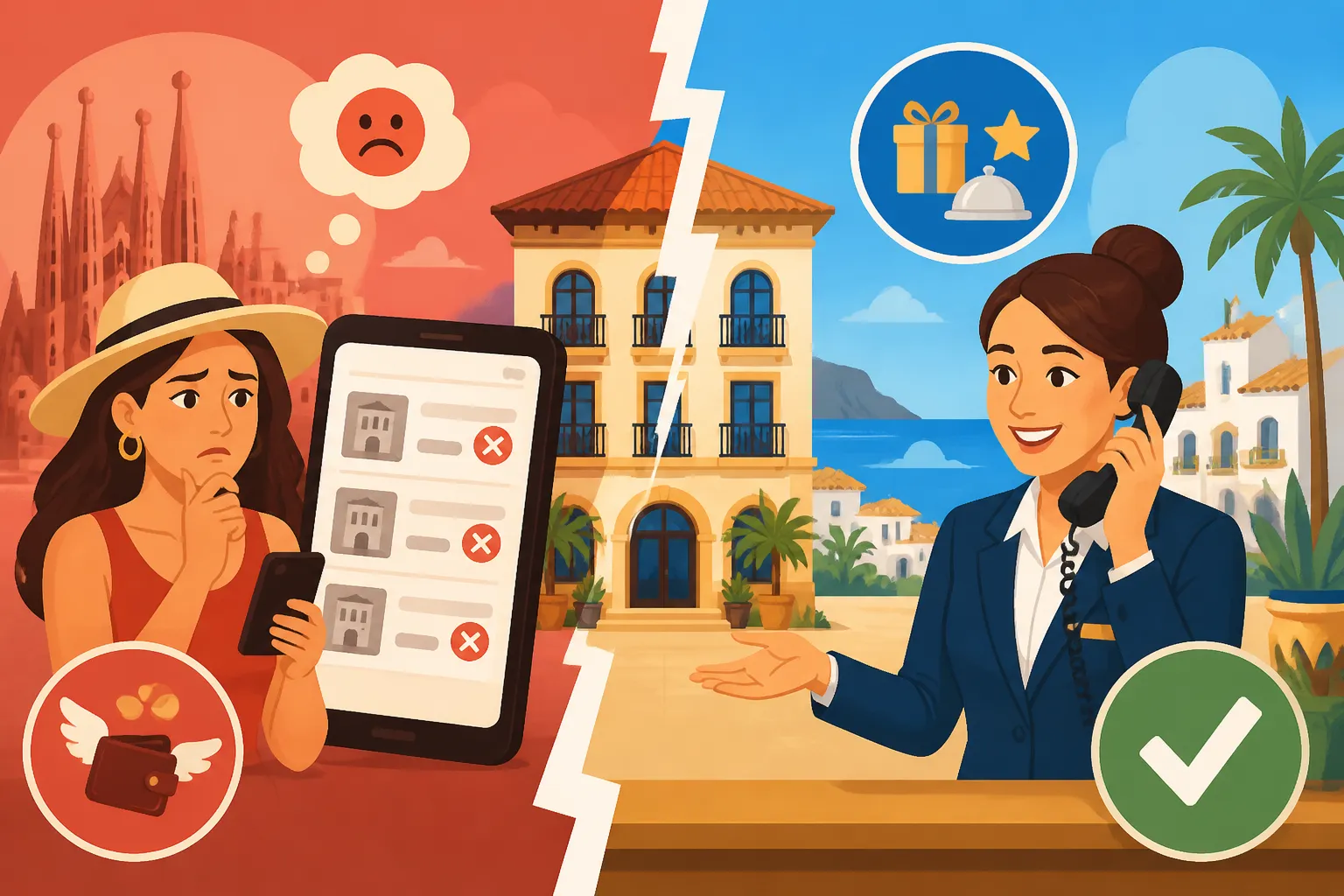
Picture this: you’ve found a lovely hostal in Seville’s Santa Cruz quarter on a booking app, then you spot a phone number on its website and wonder whether ringing them would get you a better room or a better deal. This guide explains when Booking.com is the smarter route, when calling the hotel wins, and how to use both together.
Disclosure: This post may contain affiliate links. We may earn a commission at no extra cost to you if you make a purchase through these links. Read full disclosure.
How Booking.com and Direct Booking Actually Work in Spain
Before deciding which route to take, it helps to know what is happening behind the screen. I’ve been booking accommodation in Spain for years, from tiny pensiones in Madrid’s Lavapiés to paradores in the hills of Castile. The biggest lesson is that the two methods are not rivals so much as two different tools. Each one shifts responsibility, flexibility and negotiating power in a different direction.
What You Get When You Book Through Booking.com
When you reserve through Booking.com, you are entering a standardised system. The property lists its rooms, sets its rates and cancellation conditions, and pays the platform a commission for each confirmed booking. You see the same layout whether you’re looking at a beachfront aparthotel in Málaga or a rural guesthouse in Asturias. You get a confirmation number, a written record of the price and policy, and a customer service channel that sits outside the hotel itself.
That neutral middle layer matters more in Spain than many visitors expect. Spanish hospitality runs from slick international chains to family operations where the owner’s nephew answers the phone between serving cafés con leche. When something goes wrong, such as an overbooking during a long weekend or a room that bears no resemblance to its photos, you have a documented reservation and a third party you can contact. With a casual phone booking, it’s your word against theirs.
The platform also translates the jargon. Listings show bed types, whether breakfast is included, and the cancellation deadline in your own language. If Spanish hotel descriptions confuse you, see Reading Spanish Hotel Listings: Room Types, Bed Sizes, and Terms Decoded, which covers terms like habitación doble versus habitación de matrimonio.
What Changes When You Call or Email the Hotel Directly
Booking direct means dealing with the property on its own terms. You might call reception, send an email through the hotel’s website, or use its own booking engine. Because no commission goes to a platform, some hotels have room to be more generous with direct guests. That can mean a slightly better rate, a free breakfast, a room upgrade or a relaxed approach to check-in times. It is not guaranteed, though, and many smaller Spanish properties simply quote you the same price they show everywhere else.
The trade-off is that you lose the standardised safety net. Cancellation terms might be agreed verbally or written in a quick email that never mentions what happens if you need to cancel. Some small hostales still ask for a bank transfer as a deposit, which is hard to recover if plans fall apart. You also have to manage the conversation yourself, often partly in Spanish, and keep track of the confirmation without one central app.
In practice, direct booking rewards travellers who know exactly what they want, are comfortable negotiating and have a specific reason to talk to a human. Platform booking rewards everyone else, which is most of us, most of the time.
Why Booking.com Wins for Most Trips to Spain
I’ll be honest about my own habits. For the majority of my trips around Spain, whether a quick weekend in Valencia or a week moving between Granada, Córdoba and Seville, I book through Booking.com. Calling hotels is not a bad idea, but the platform solves the problems that trip up visitors here most often.
Comparing Dozens of Properties in One Search
Spanish cities have a very dense accommodation mix. In Madrid’s centre alone, you’ll find historic hostales on the upper floors of old buildings, boutique hotels in renovated palacios, apartamentos turísticos and big chain properties all within a few streets of Puerta del Sol. Calling each one to compare availability and rates would take an entire afternoon, and you’d be doing it around Spanish reception hours and siesta-time staffing gaps.
A single search on Booking.com shows you what is actually available on your dates, filtered by neighbourhood, price, review score and features such as air conditioning or a lift. That last point is not trivial. Plenty of charming buildings in Barcelona’s Gòtic or Cádiz’s old town have no lift and four flights of stairs. A filter saves you from discovering this while hauling a suitcase up a marble staircase at midnight.
Imagine you are planning three nights in San Sebastián in July. Direct calls might find you two or three options with space. A platform search might show forty, including a pensión in Gros you’d never have heard of, which has excellent reviews and is a short walk from Zurriola beach. That breadth is the main reason the platform is the default.
Flexible Cancellation and One Place for Every Reservation
Spain is a country where plans shift. Trains get rescheduled, strikes happen, the weather turns a beach day into a city day, and an invitation to a friend’s pueblo for the local fiesta can upend a carefully built itinerary. Being able to cancel or change a booking from your phone without making an international call is enormously useful.
Many listings on Booking.com offer free cancellation up to a set deadline, clearly displayed before you pay. Always read the exact cutoff, because it varies by property and some deadlines fall several days before arrival. For a detailed look at how these terms work in practice, see Free Cancellation in Spain: What the Policy Really Allows. If you’re weighing a cheaper locked-in rate against a flexible one, Refundable vs Non-Refundable Rates in Spain: When the Discount Is Worth It walks through the decision.
Having every reservation in one app is a quieter benefit, but it adds up on multi-city trips. When I did a rail loop from Madrid through Toledo, Córdoba and Málaga, each booking, confirmation and address sat in the same place. At each hotel I just showed the confirmation on my phone. No digging through email threads half in Spanish, no wondering whether the receptionist I spoke to had actually written my name down.
Reviews That Reflect Spanish Realities
Guest reviews on a large platform are a practical goldmine for Spain-specific issues that a hotel’s own website will never mention. Reviewers will tell you whether street noise in Malasaña keeps you up until four in the morning, whether the air conditioning actually copes with an August night in Seville, or whether the “sea view” in Benidorm means a sliver of blue between two towers.
Because reviews are tied to verified stays, they tend to be more reliable than scattered comments elsewhere. I look for patterns rather than single complaints. One person grumbling about a slow breakfast is noise. Five people in a row mentioning that the reception closes at 10 pm and you must collect keys from a lockbox is information you need before you book a late flight into Bilbao.
Loyal users may also unlock member pricing through the Genius programme, which can tip the value comparison back towards the platform even against a direct quote. The details are covered in Booking.com Genius Levels in Spain: What the Discounts Are Actually Worth.
When Calling the Hotel Wins
Now for the situations the title promises. There are real cases where picking up the phone gets you a better outcome. The key is knowing which ones they are, rather than assuming direct is always cheaper.
Small Family-Run Hostales and Casas Rurales
The smaller and more personal the property, the more a direct conversation tends to pay off. A family-run casa rural in La Alpujarra or a stone farmhouse in the Picos de Europa may only have four or five rooms. The owners often value a direct relationship, and they may be able to offer extras like a home-cooked dinner, a packed lunch for hiking or advice on which footpath is passable after rain.
Some rural properties also list only part of their inventory online, keeping the remaining rooms for regulars and phone enquiries. If a platform shows a place as fully booked for a weekend in the Sierra de Grazalema, a polite call can sometimes reveal a room that was never listed. For more on booking countryside stays, see Casas Rurales and Agroturismo: Booking Spain’s Countryside.
Here’s a realistic scenario. You want to stay in a small village near Ronda during a local romería. The online listing is sold out. You ring the owner, explain you’re flexible about room type, and she offers you the small attic room she doesn’t usually advertise. That’s a win you’d never get through a search engine. My own approach is still to find the property through the platform first, read its reviews, then call if availability looks tight.
Long Stays and Group Bookings
If you’re staying for several weeks, a direct conversation can unlock a monthly rate the property never advertises publicly. This is common with aparthotels and apartment-style properties in places like Valencia, Alicante or Las Palmas de Gran Canaria, which host a lot of winter-sun visitors and remote workers. Owners prefer one guest for a month over the turnover of a dozen short stays, and they’ll often negotiate to secure it. See Long-Stay Discounts in Spain: Negotiating Weekly and Monthly Rates for tactics that work.
Groups are the other big one. If you’re organising rooms for a wedding in a Catalan masia, or a family reunion of ten people in Granada, a direct call to the hotel’s reservations team usually gives you better control. You can negotiate a block of rooms, agree on a shared check-in time and coordinate dietary requests for breakfast. Platforms often cap how many rooms you can book in one transaction, and group terms tend to differ. The specifics are covered in Group and Multi-Room Bookings in Spain: What Changes Above Six People.
Even here, the platform is useful for benchmarking. Check the per-night rate on Booking.com before you call, so you know whether the “special group price” the hotel quotes is actually special.
Special Requests Like Parking, Accessibility and Late Arrivals
Some needs are simply easier to sort out with a human being. Parking is the classic Spanish example. A listing might say parking is available, but in an old town like Toledo or Santiago de Compostela, that might mean a public garage several streets away, a limited number of spaces that must be reserved, or a paid service. Calling lets you confirm exactly what happens when you arrive with a car. For more, see Parking at Spanish Hotels: Why ‘Parking Available’ Often Means Paid.
Accessibility is another area where a direct conversation helps. If you or a travelling companion uses a wheelchair, you’ll want to know about step-free access to the building, the width of the lift door and the layout of the bathroom. A phone call or email with specific questions gets clearer answers than a generic “accessible” tag.
Late arrivals and early departures also benefit from a heads-up. Many small Spanish properties don’t staff reception overnight. If your flight lands in Palma close to midnight, you need to know whether someone will be there, whether there’s a key code, or whether you’ll be locked out on the pavement. You can send messages through the platform’s chat, but for anything complicated, I phone. If you’re hoping to arrive early or leave late, Early Check-In and Late Check-Out in Spain: Who Actually Offers It explains what’s realistic.
Platform vs Direct Booking: A Side-by-Side Comparison
Here is how the two approaches stack up across the factors that matter most when booking in Spain.
| Factor | Booking.com | Calling or Booking Direct |
|---|---|---|
| Comparing many options | Excellent, with filters for area, price, lift, air conditioning | Slow, one property at a time |
| Cancellation clarity | Deadline and terms shown before payment | Depends on what the hotel writes down |
| Language barrier | Listings and support in your language | Often partly in Spanish |
| Dispute support | Third-party customer service and written record | You deal only with the hotel |
| Verified reviews | Large volume tied to real stays | Not available from the hotel itself |
| Hidden or unlisted rooms | Only what is listed | Sometimes available on request |
| Long-stay negotiation | Fixed displayed rates | Often flexible |
| Group room blocks | Limited per transaction | Easier to negotiate |
| Special requests | Possible via messaging | Easier to discuss in detail |
| Managing several bookings | All in one app | Spread across emails and calls |
The pattern is clear. For standard stays of a few nights, the platform wins on almost every practical measure. Direct booking pulls ahead mainly for small rural properties, long stays, groups and complex requests.
The Hybrid Method: Search on Booking.com, Then Decide
The approach I use, and the one I recommend to friends visiting Spain, combines both. It takes a few extra minutes and almost always produces the best result.
- Search your destination and dates on Booking.com and filter by the features you actually need, such as neighbourhood, lift, air conditioning or parking.
- Shortlist three to five properties and read recent reviews closely, paying attention to noise, reception hours and how accurate the photos are.
- Note the price and cancellation deadline for each shortlisted option so you have a clear baseline.
- If you have a reason to talk to the hotel, such as a long stay, a group, accessibility needs or a car, call or email your top choice and ask your specific questions.
- Compare what the hotel offers against your baseline, including any extras, and weigh the protection you’d give up by booking outside the platform.
- If the direct offer isn’t clearly better, book through the platform and keep the reservation in one place.
- If you book direct, ask the hotel to confirm the price, dates, cancellation terms and any extras in writing by email before you pay anything.
Most of the time, step six is where you’ll land. But the few occasions when step seven wins are worth the phone call.
How to Phone a Spanish Hotel Without Fluent Spanish
Many reception staff in tourist areas speak good English, but in smaller towns and rural spots you may be working in Spanish. A few prepared phrases make the call far less stressful. I keep these written on my phone.
- “Hola, buenos días. ¿Habla inglés?” means “Hello, good morning. Do you speak English?”
- “Quería saber si tienen habitación libre para el (date).” means “I wanted to know if you have a room available for the (date).”
- “Somos (number) personas, para (number) noches.” means “We are (number) people, for (number) nights.”
- “¿Cuál es el precio por noche?” means “What is the price per night?”
- “¿Está incluido el desayuno?” means “Is breakfast included?”
- “¿Tienen aparcamiento?” means “Do you have parking?”
- “Llegaremos tarde, sobre las (time). ¿Hay alguien en recepción?” means “We’ll arrive late, around (time). Is anyone at reception?”
- “¿Me lo puede confirmar por correo electrónico?” means “Can you confirm it by email?”
Time your call sensibly. Mid-morning works well. Avoid the long lunch window in the middle of the afternoon at small family places, when the person who handles bookings may be eating with the family or serving guests in the restaurant. And always end by asking for that email confirmation, because a friendly phone chat is not a booking record.
Peak Dates, Fiestas and Avoiding Traps
The choice between platform and direct booking matters most when demand is highest. Spain’s festival calendar can turn a quiet city into a sold-out one almost overnight, and that changes the calculation.
Semana Santa, Feria and San Fermín
During Holy Week in Seville or Málaga, the April Feria in Seville, San Fermín in Pamplona or Las Fallas in Valencia, rooms disappear early. In these weeks, the platform’s breadth is your best friend. You can see every remaining room in one search instead of calling hotel after hotel to hear “lo siento, estamos completos” over and over.
Peak dates also bring stricter conditions, such as minimum stays, prepayment and non-refundable rates. The platform shows these up front, which is an advantage over a phone call where the minimum-stay rule may only come up at the end of the conversation. For timing advice, see Semana Santa Bookings in Spain: Which Cities Sell Out and When.
There is one exception worth knowing about. In Pamplona during San Fermín, some small hostales and private-room hosts work largely through word of mouth and repeat guests. If you’ve stayed somewhere before and got on well with the owner, a direct call months ahead can secure you a room the internet never sees. For a first-timer, though, the platform remains the more reliable route.
Red Flags With Either Method
No method is immune to problems, so stay alert. When booking direct, be wary of any small property that asks for a large deposit by bank transfer and refuses card payment, especially if the listing appears only on social media. Genuine family businesses sometimes do request transfers, but you lose the ability to dispute a charge, so I only agree to this with places I already know or that have a long, verified review history.
When booking through any platform, check that apartments display a tourist licence number, which is required for holiday lets in many Spanish regions. The comparison in Booking.com vs Airbnb in Spain: Registration Numbers, Fees, and Cancellation explains what to look for. Be equally wary of anyone who messages you after booking and asks you to pay outside the platform’s own system for a “discount”. That is a common scam pattern, and paying off-platform strips away the protection you booked for.
Whichever way you book, expect two Spanish formalities at check-in. Hotels must register guests’ identity documents with the authorities, so have your passport or national ID ready; see Check-In Documents in Spain: Why Hotels Register Your Passport. Some regions, including Catalonia and the Balearic Islands, also charge a tourist tax that is often paid at the property rather than included in your online price. The regional details are in Spain’s Tourist Tax by Region: Catalonia, the Balearics, and What You Pay.
Making Your Choice for Your Next Spanish Stay
After all the comparisons, the decision usually comes down to a few questions about your trip. Answer them honestly and the right method becomes obvious.
Quick Decision Guide for Common Trip Types
| Trip Type | Best Route | Why |
|---|---|---|
| City break of two to four nights | Booking.com | Breadth, reviews and clear cancellation |
| Multi-city rail trip | Booking.com | Every reservation in one app |
| Festival or holiday week | Booking.com | Fastest way to see what’s left |
| Rural casa or tiny family hostal | Search online, then call | Owners may have unlisted rooms or extras |
| Stay of several weeks | Search online, then call | Monthly rates are often negotiable |
| Group of many rooms | Call the hotel | Room blocks and coordinated terms |
| Arriving by car to an old town | Book either way, then call about parking | Parking details are rarely clear online |
| Accessibility needs | Search online, then call | Specific questions need specific answers |
You’ll notice that the platform appears in almost every row, either as the booking route or as the research step. That’s not an accident. Even when calling the hotel wins, you’ll call with more confidence once you’ve seen the reviews, photos and baseline price.
My Honest Recommendation
If you only remember one thing from this guide, make it this: start every search on Booking.com. For the typical visitor planning a few nights in Madrid, a weekend in Barcelona or a loop through Andalusia, it’s the simplest, safest and most transparent way to book. You get verified reviews, clear cancellation rules, support in your own language, and a written record if anything goes wrong.
Then keep the phone in your back pocket for the situations where a human conversation adds real value, such as a cosy rural retreat, a month-long winter stay, a family wedding or an arrival that needs special arrangements. Paradores are a good example of the hybrid approach in action; see Paradores in Spain: What They Cost and Which Ones Are Worth It for whether a stay in one suits your trip.
Spain rewards travellers who plan a little and stay flexible. Open Booking.com, shortlist your favourites for your next trip, and decide from there whether a quick call might sweeten the deal. Either way, you’ll arrive knowing exactly what you’ve paid for and where you’re sleeping. That peace of mind is worth more than any small discount.
Disclaimer
This article is for general informational purposes only and does not constitute professional advice. Laws, prices and regulations vary by location and change over time. Consult a qualified professional for guidance on your specific situation.