How to Use Spanish Medication Instructions (Dosage Terms) — Quick Guide
Disclosure: This article contains affiliate links. If you buy through them, we may earn a commission at no extra cost to you. Read our full disclosure.
Navigating a Spanish pharmacy can be daunting if you do not understand the local language. This quick guide breaks down essential Spanish medication instructions, common dosage terms, and crucial safety abbreviations so expats and tourists can safely manage their prescriptions with absolute confidence.
Understanding Your Spanish Prescription
When you visit a doctor in Spain or pick up a medication from the local pharmacy, the instructions you receive will be entirely in Spanish. While the active ingredients of medications are standardized globally, the local terminology used for dosages, frequencies, and administration routes is entirely unique to the Spanish healthcare system.
Decoding the Medication Packaging
The first step in taking any medication safely is understanding what is written on the external box, known in Spain as the caja. The most important piece of information is the principio activo, which means the active ingredient. This is usually printed in slightly larger letters directly below the commercial brand name. For example, if you are looking for an over-the-counter pain reliever like Tylenol, you will not find that exact brand in Spain; instead, you need to look for the principio activo, which is paracetamol. Understanding the active ingredient prevents dangerous accidental double-dosing.
You should also look for specific symbols printed on the upper right corner of the box. A small, empty circle printed on the packaging indicates that the medication legally requires a medical prescription, known as a receta médica. If there is no circle, the medication is available over the counter. If you are ever confused about whether a specific box requires a doctor’s note to purchase, you can read our comprehensive guide on Can a Pharmacist in Spain Help With Minor Illness? What to Expect to understand exactly what a pharmacist is legally allowed to dispense.
Reading the Patient Information Leaflet
Inside every box of medication dispensed in Spain, you will find a folded, densely printed paper document known as the prospecto. This is the legally required patient information leaflet. While it features tiny print and complex medical jargon, understanding a few key Spanish headings will help you quickly find the safety information you need without having to translate the entire document word for word.
Look for the section titled Indicaciones, which explicitly tells you what the medication is used to treat. The Posología section outlines the standard dosage guidelines based on age and weight. Arguably the most critical section to review is Contraindicaciones, which lists the exact medical circumstances under which you should absolutely not take the medication. This might include warnings if you are currently pregnant, have high blood pressure, or suffer from kidney disease.
If you experience unexpected physical symptoms after taking a new pill, immediately refer to the Efectos adversos or Efectos secundarios section, which meticulously details all known side effects. If you strongly suspect you are having an adverse allergic reaction and need to see a doctor quickly, having a premium private insurance policy through a trusted broker like Innoinsure allows you to bypass public hospital queues. With a policy secured through Innoinsure, you can instantly book a same-day specialist appointment or launch a digital consultation to assess your reaction safely and rapidly.
Common Spanish Dosage Terms and Abbreviations
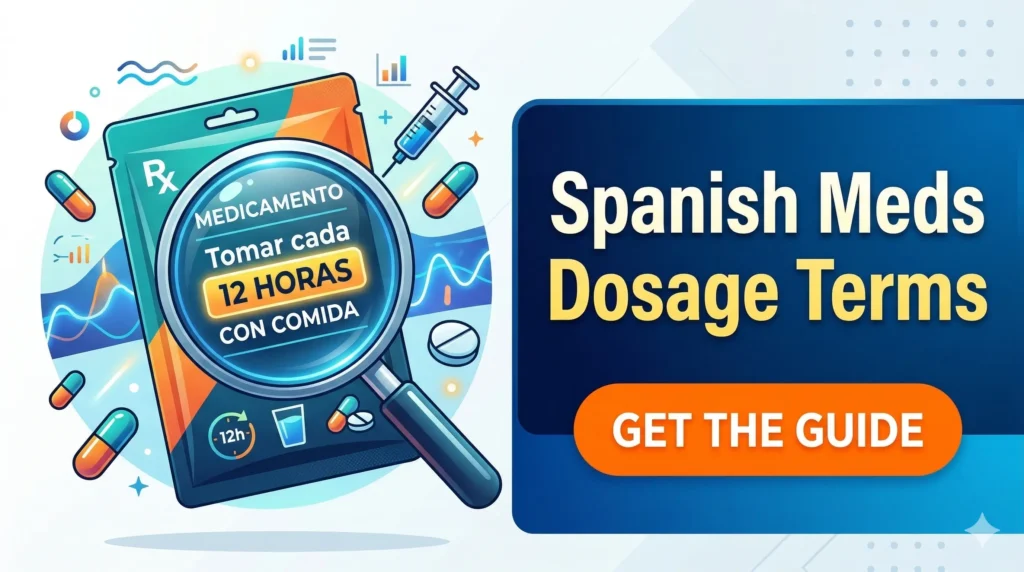
To safely manage your health, you must meticulously follow the dosage instructions provided by your doctor or pharmacist. The following terms are the most frequently used vocabulary in Spanish healthcare regarding how, when, and how much of your medication to take.
Frequency and Timing Vocabulary
The timing of your medication is crucial for its clinical efficacy and your personal safety. Spanish doctors use specific phrases to dictate the intervals at which you should consume your pills. If you visit a public doctor, these instructions are often printed on a small paper receipt that accompanies your electronic health card. If you are navigating the public system for the first time, our guide on What Is a ‘Centro de Salud’ in Spain and How Do You Register? will help you set up your initial consultations and secure your health card.
Understanding whether a pill should be taken with food or on an empty stomach can drastically affect how the active ingredient is absorbed into your bloodstream. Below is a helpful translation table of the most common Spanish timing instructions you will encounter on your prescription sheet:
| Spanish Term | English Translation | Practical Meaning |
| Cada 8 horas | Every 8 hours | Take three times a day at evenly spaced intervals. |
| Una vez al día | Once a day | Take one dose every 24 hours. |
| En ayunas | On an empty stomach | Take at least 1 hour before eating or 2 hours after. |
| Con las comidas | With meals | Take while eating to prevent severe stomach upset. |
| Antes de acostarse | Before bed | Take right before going to sleep. |
| Si hay dolor | If there is pain | Take only as needed for acute symptom relief. |
| Masticable | Chewable | The tablet must be chewed entirely, not swallowed whole. |
Measurement and Administration Terms
The physical format of Spanish medication sometimes surprises newly arrived expats. While pastillas or comprimidos (pills and tablets) are incredibly common, Spain heavily favors the use of sobres (sachets) for standard painkillers like ibuprofen, paracetamol, and anti-inflammatory drugs.
Other common administration terms include jarabe (syrup), which is typically measured using an included plastic dosing spoon or syringe, and gotas (drops), which are frequently used for eye (vía oftálmica) and ear (vía ótica) infections. You will also see route instructions such as vía oral (to be taken by mouth) or vía tópica (to be applied directly to the skin as a cream or ointment). If you require specialized instruction on how to administer a complex medication properly, consulting a digital doctor via video call is highly convenient. You can learn more about these digital services in our guide: Telemedicine in Spain: When It’s Useful and What to Expect.
Purchasing and Paying for Medications in Spain
Once you understand the dosage instructions, the next step is actually navigating the pharmacy counter. Spain’s pharmacy system is highly regulated, and understanding how to effectively pay for your medications will save you significant time and money.
Over the Counter versus Prescription Drugs
The distinction between over the counter (sin receta) and prescription (con receta) medications is heavily enforced by Spanish law. You cannot buy simple pain relievers, cold medicine, or allergy tablets at a local supermarket; they are sold exclusively behind the counter at licensed pharmacies.
A common surprise for tourists is that certain high dosages of common drugs are heavily restricted. For instance, while you can buy 400mg ibuprofen over the counter for a mild headache, 600mg ibuprofen strictly requires a doctor’s prescription. Antibiotics are universally restricted across the European Union and cannot be purchased under any circumstances without a valid prescription. If you are traveling and suddenly realize you left your essential maintenance medication at home, you will need to see a local doctor for an urgent refill. We detail exactly how to manage this stressful situation in our guide on How to Get a Prescription Renewed in Spain If You’re Traveling.
If you are a resident managing a long-term chronic condition, your general practitioner will likely set up a rolling prescription on your public health card to automate the process. To understand how to manage these long-term refills without visiting the clinic every single month, review our breakdown on Medication Refills in Spain: How Renewals Work.
Managing Pharmacy Costs
If you are a legally registered resident utilizing the public healthcare system, your prescription medications are heavily subsidized by the Spanish government. Your exact co-pay amount depends on your annual income bracket, but you generally pay a very small fraction of the retail price. However, if you are a tourist, a digital nomad without social security access, or if you present a private paper prescription from an independent clinic, you must pay the full, unsubsidized retail price of the drug out of pocket. For a detailed look at expected prices and income tiers, read our article on Health Costs in Spain: Typical Co‑Pays and Out‑of‑Pocket Fees.
When paying for expensive, unsubsidized medications at the pharmacy counter, you must be financially strategic. Swiping a foreign debit or credit card often triggers terrible dynamic currency conversion rates and hidden international transaction fees applied by your home bank. Savvy expats and tourists completely bypass these extra charges by using a borderless multi-currency account like Wise. By tapping your Wise card at the pharmacy, you guarantee that you are paying the exact Euro amount at the true, transparent mid-market exchange rate, keeping your healthcare budget fully intact.
If you find yourself needing acute medication late at night or on a Sunday when regular shops are closed, you will need to locate an on-duty emergency pharmacy. Our specialized guide on How to Find a ‘Farmacia de Guardia’ Near You in Spain explains exactly how to find these 24-hour lifelines in your specific neighborhood.
Safety Tips for Expats Taking Spanish Medicine
Managing your health in a foreign country requires an extra layer of diligence. When you are dealing with unfamiliar brands and foreign-language leaflets, biological safety must always be your primary concern.
Dealing with Side Effects and Interactions
Whenever you start a new Spanish medication, closely monitor your body for the first forty-eight hours. Because commercial brand names differ wildly across Europe and North America, you must always double-check the active ingredient to ensure you are not accidentally double-dosing on a medication you are already taking under a completely different name. Mixing multiple medications that contain paracetamol, for example, can cause severe liver damage.
For non-emergency concerns regarding potential drug interactions, having access to a private, English-speaking doctor is invaluable. By securing a premium health insurance policy through an expat-focused broker like Innoinsure, you can easily launch a digital consultation from your smartphone to verify that your new Spanish prescription does not interact negatively with your existing home-country medications. Understanding the stark differences between public wait times and rapid private access is crucial; read more in Spain Healthcare System for Expats: Public vs Private.
Alternative and Preventative Options
Many expats rely heavily on specific preventative health routines involving high-quality vitamins, specialized probiotics, and herbal supplements that they are accustomed to buying in their home countries. When you relocate to Spain, you may find that local pharmacies have a surprisingly limited selection of holistic wellness products, and the ones they do successfully stock are often subjected to massive retail markups.
If your Spanish doctor recommends a specific dietary supplement to take alongside your medication, or if you simply want to aggressively maintain your daily immune-support routine, sourcing these products locally can be frustrating. To bridge this gap, the expat community heavily relies on global health platforms like iHerb.
By utilizing iHerb, you can confidently order premium, international wellness brands, highly specific vitamin complexes, and natural remedies that may not be available in a traditional Spanish farmacia. Having these trusted preventative products delivered directly to your Spanish residence ensures that your baseline health remains strong, actively reducing your overall reliance on pharmaceutical interventions. For those managing a strict budget, paying for these online orders using a Wise virtual card adds an extra layer of financial security. Furthermore, if you plan to fly back to your home country with a large, multi-month supply of Spanish medications, understanding airport security rules is crucial; review our expert advice on Traveling With Medication in Spain: Practical Carry-On Tips before packing your bags.
References
Primary sources (official)
- Agencia Española de Medicamentos y Productos Sanitarios (AEMPS): https://www.aemps.gob.es/
- Ministerio de Sanidad (Ministry of Health Spain): https://www.sanidad.gob.es/
- European Medicines Agency (EMA) – Medicine Information: https://www.ema.europa.eu/en
Other helpful sources
- Expatica – Pharmacies in Spain: https://www.expatica.com/es/healthcare/healthcare-services/pharmacies-in-spain-106770/
Disclaimer
The information provided in this article is for educational and informational purposes only and does not constitute formal medical or pharmaceutical advice. Medication guidelines, availability, and active ingredients vary significantly by country and are subject to change. Always consult directly with a licensed Spanish pharmacist or a registered medical doctor before starting, stopping, or altering the dosage of any medication, and immediately dial 112 in the event of a severe allergic reaction or life-threatening medical emergency.