Medical Records in Spain: Accessing and Sharing Your History
You moved from Valencia to Madrid, your new family doctor asks about the blood test results from last spring, and you have no idea how to get them. Or you are going home for a few months and need your Spanish reports in a form your old doctor can read. This guide explains how medical records work in Spain, how to access your own history and how to share it safely.
Disclosure: This post may contain affiliate links. We may earn a commission at no extra cost to you if you make a purchase through these links. Read full disclosure.
How Medical Records Work in Spain
Before you can request or share anything, it helps to know where your information actually lives. When I first tried to get a copy of an X-ray report, I learned the hard way that “the Spanish health system” is not a single organisation with a single database.
What Your Medical Record Contains
In Spain, your medical record is called the historia clínica. It is the collection of documents and data produced every time you are treated, and it usually includes:
- Your personal and contact details and your health card number
- Your medical history, allergies and chronic conditions
- Notes from consultations with your family doctor, nurse and specialists
- Results of laboratory tests and imaging, such as X-rays, ultrasound scans and MRI reports
- Hospital discharge reports (informes de alta) and emergency department reports (informes de urgencias)
- Records of operations, anaesthesia and informed consent forms
- Prescriptions and your current medication plan
- Vaccination records
Not every document is stored in the same place. Your family doctor’s notes may be in one system, your hospital reports in another, and images from a private clinic somewhere else entirely.
Who Keeps Your Records
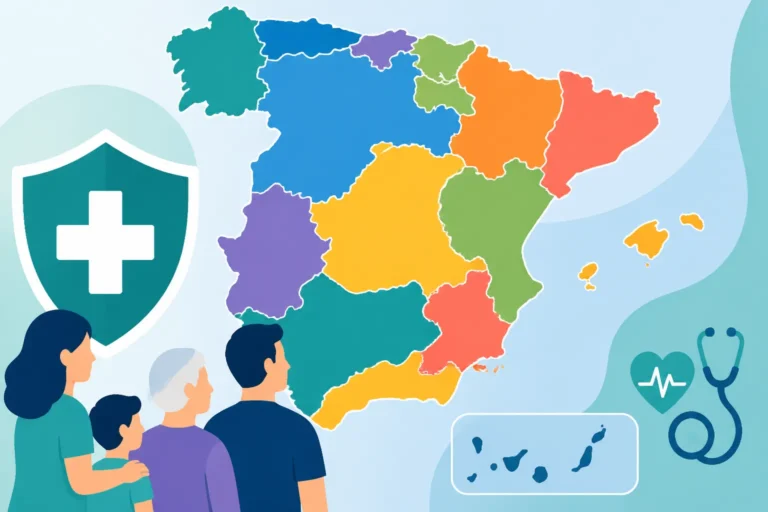
Public healthcare in Spain is run by the autonomous communities. Each region has its own health service, for example the Servicio Madrileño de Salud in Madrid, the Catalan Health Service (CatSalut) in Catalonia, the Andalusian Health Service (SAS) in Andalusia, Osakidetza in the Basque Country and the Valencian health department in the Valencian Community. Each one keeps the records of the patients it treats, in its own electronic system.
Private clinics and hospitals keep their own records too, separately from the public system. If you see a private specialist through your insurance, that report will not appear in your public record unless you bring a copy to your public doctor.
That regional structure is the key to everything else in this article. It explains why you access your records through a regional portal, why moving between regions needs a national link between systems, and why private records need a little extra effort.
Your Legal Rights
Spanish law gives you strong rights over your own health information. The national patient autonomy law (Ley de Autonomía del Paciente) recognises your right to access your medical record and to obtain copies of the documents in it. The European data protection rules add rights of access and correction, and require that health data is kept confidential and used only by people who need it to treat you.
In practice, this means:
| Right | What it means for you |
|---|---|
| Access | You can see and get copies of your medical record |
| Confidentiality | Only professionals involved in your care should access your data |
| Information about access | Many regional portals show which professionals have viewed your shared records |
| Correction | You can ask for wrong personal data to be corrected |
| Third-party access | Others, including relatives, need your authorisation, except in specific legal situations |
There are some limits. Personal notes that a doctor has written for their own use, and information about third parties, may be excluded from copies. Access to the records of a person who has died is possible for relatives under conditions, unless the person had forbidden it.
The Regional Patient Portals
Every regional health service offers a patient portal and usually an app where you can see part of your record online. The names differ, and they change from time to time, but examples include the virtual health card and personal health folder services in Madrid, La Meva Salut in Catalonia, ClicSalud+ in Andalusia and the GVA +Salut app in the Valencian Community.
Although each portal looks different, most offer a similar core set of functions:
- Booking and cancelling appointments with your family doctor or nurse
- Viewing your prescriptions and medication plan
- Seeing laboratory results and some reports, such as hospital discharge reports
- Downloading your vaccination certificate
- Checking your health card details and assigned health centre
- In some regions, sending messages to your health centre or doing video consultations
To log in, you usually need your health card number and a mobile phone number registered with the health service, or a digital identity such as a digital certificate or the Cl@ve system. If you have not set up Cl@ve yet, Cl@ve System Explained: Accessing Spain Government Services Online walks you through it. Foreign residents without a Spanish DNI can still get a digital certificate, as explained in How to Get a Digital Certificate in Spain Without a Spanish ID.
These portals are the starting point for accessing your public records. They do not usually show your entire historia clínica, but they show the parts you will need most often.
Interoperability Between Regions
Because each region keeps its own records, the Spanish Ministry of Health built a system that links them: the Digital Medical Record of the National Health System (Historia Clínica Digital del Sistema Nacional de Salud, usually shortened to HCDSNS). This is what “interoperability” means in Spanish healthcare: the ability of one region’s system to read key documents from another region’s system.
The HCDSNS does not copy your entire record into a national database. Instead, it makes a defined set of documents available across regions, such as:
- A summary medical record (historia clínica resumida) with your main diagnoses, allergies and medication
- Hospital discharge reports
- Emergency department reports
- Specialist consultation reports
- Laboratory and imaging test results
- Nursing care reports
When you are treated in another region, an authorised doctor there can consult these documents. You, as a patient, can usually view your own shared documents through your regional portal, see which professionals have accessed them, and in many regions hide specific reports from being shared, although doctors are told that something has been hidden.
Electronic prescriptions work in a similar way. The national e-prescription interoperability system lets you collect medication prescribed in one region at a pharmacy in another, as described in Prescription System in Spain: How ePrescriptions Work.
Interoperability is not perfect. Not every type of document is shared, coverage can depend on the region and private records are not included. But it means that if you move or travel within Spain, the most important parts of your history can follow you.
How to Access Your Medical Records
Now that you know where your records are kept, here is how to get them.
Through Your Regional Portal
For lab results, reports and prescriptions, the regional portal is the quickest route.
- Make sure you have a valid health card and are registered with a health centre. How to Get a Spanish Health Card Tarjeta Sanitaria Step-by-Step covers this.
- Download your region’s official health app or open its patient portal.
- Register using your health card number and mobile phone, or log in with Cl@ve or a digital certificate.
- Go to the section usually called “Mi historia”, “Informes”, “Resultados” or similar.
- View or download the reports you need as PDF files.
- Check the section on shared records to see your documents in the national system and who has accessed them.
By Formal Request
If you need your full record or documents that are not available online, such as complete images on a disc, you can make a formal request.
- Identify where the record is held. For family doctor records, that is your health centre. For hospital records, it is the hospital’s patient services office (Servicio de Atención al Paciente) or its medical records department (Admisión y Documentación Clínica).
- Get the request form. Many health services publish a form for requesting access to the historia clínica online, and you can also ask at reception.
- Specify what you need. Be precise: the dates, the department and the type of document, for example “discharge report and MRI images from the trauma department”.
- Attach your identification. Bring or send your NIE, TIE or passport. If you are requesting someone else’s records, include their signed authorisation and a copy of their ID.
- Submit the request. You can usually do this in person, by post or through the region’s electronic registry with a digital identity.
- Collect or receive the documents. The health service will tell you how and when they will be delivered. Images may be provided on a disc or through a download link.
Keep a copy of your request and the registration stamp or receipt. If you do not receive an answer within a reasonable time, you can file a complaint, as explained in How to Make a Complaint About Healthcare in Spain: Patient Rights.
Records From Private Healthcare
If you use private healthcare, either through an insurer or by paying directly, the clinic or hospital that treated you holds your record. Most private hospital groups have their own patient apps where you can see appointments, reports and test results. For anything not available in the app, ask the clinic’s reception or patient services department, using the same steps as for a formal public request.
Your private health insurer may also have a member app or portal. International insurers such as Cigna Global typically offer one for managing claims and finding providers, but these apps are mainly about your insurance, not a full medical record. Keep copies of the reports the clinic gives you, because the insurer may not store them.
Records of Children and Family Members
Parents can usually access the records of their young children through the regional portal, often by adding the child to their own account or by logging in with the child’s health card details. As children grow older, their right to confidentiality grows too, and teenagers may be able to see a doctor and keep certain information private. Ask your health centre how your region handles access for minors.
For adult family members, such as an elderly parent who lives with you in Spain, you need their written authorisation to request records on their behalf, unless a court has appointed you as their legal representative. Some regional portals let a patient authorise a relative or carer to manage appointments and see certain documents. It is worth setting this up while your relative is well, rather than in the middle of a hospital stay.
Correcting Mistakes in Your Record
Mistakes happen, especially for foreigners whose names do not fit the Spanish pattern of two surnames. Medical records have been found records with first and last names swapped, with a wrong date of birth and with an allergy recorded against the wrong patient’s medication. If you spot an error:
- Note exactly what is wrong and where you saw it, ideally with a screenshot or a copy of the document.
- For personal data such as your name, address or date of birth, ask the reception team at your health centre to correct it, bringing your identification.
- For clinical information, such as a missing allergy or an outdated diagnosis, raise it with your family doctor at your next appointment. Doctors cannot simply delete clinical notes, but they can add corrections and update your summary.
- If the error is not corrected, submit a written request to the patient services office of your health service, citing your right to correction under data protection rules.
- Keep copies of all correspondence.
Allergies and current medication are the most important items to get right, because they are the details an emergency doctor in another region will see first in your shared summary.
How to Share Your Medical History
Accessing your records is one thing; getting them to the right doctor at the right time is another. Here are the most common situations.
Moving to Another Region
If you move within Spain, register with your new region’s health service and a new health centre. Thanks to the interoperability system described above, your new family doctor can usually see your summary record, discharge reports and test results from your previous region. Still, it is wise to bring PDF copies of important reports to your first appointment, because not every document is shared and some systems are slow to connect.
Getting Treated While Travelling Within Spain
If you fall ill while visiting another region, go to a health centre or the emergency department there with your health card. The doctor can usually consult your shared summary and recent reports through the national system, which is particularly helpful if you have a chronic condition or take several medications. Afterwards, ask for the emergency or consultation report, and check that it appears in your own region’s portal; if it does not, bring the paper copy to your family doctor.
Seeing a Private Doctor
Private doctors do not have access to your public record through the national system. If you see a private specialist, bring printed or digital copies of relevant reports and test results from your regional portal. Likewise, bring private reports to your public doctor so they can add them to your record.
Comparing Public Portals and Private Apps
Now that both have been described, here is how the regional public portals compare with the apps of private hospitals and insurers.
| Feature | Regional public portals | Private hospital and insurer apps |
|---|---|---|
| Records available | Public primary care and hospital reports, lab results, prescriptions | Reports and tests from that hospital group or provider network |
| Link to other regions | Yes, through the national system for shared documents | No |
| Prescriptions | Electronic public prescriptions | Private prescriptions, which vary by provider |
| Access method | Health card and phone, Cl@ve or digital certificate | Provider account |
| Booking appointments | Family doctor and nurse, some specialists | Specialists and tests within the network |
| Cost | Included in public healthcare | Included with private care or insurance |
Many expats use both: the public portal for their family doctor and prescriptions, and a private app for specialists. The important thing is to be the bridge between them by keeping your own copies. For an overview of other apps, see Health Apps in Spain: Booking, Records, and Telemedicine Options.
Sharing Records With Doctors Abroad
When you return home or move to another country, take your records with you. Download the reports you need from your regional portal, request anything missing through the formal process, and ask for imaging on a disc or by download. How to Request Medical Records in Spain for a New Doctor Abroad goes into more detail.
Within the European Union, a cross-border system for sharing patient summaries and electronic prescriptions exists between some countries, but it does not cover every country or every type of document. Do not rely on it; bring your own copies.
Language is the other hurdle. Reports from Spain are written in Spanish, and in some regions partly in a co-official language such as Catalan, Galician or Basque. For routine use, a doctor abroad may accept a plain translation or simply read the key values, but for insurance claims, legal matters or official use you may need a sworn translation. How to Translate Medical Documents in Spain (Sworn Translators) explains the options.
Sharing Records With Your Insurer
If you have private health insurance, your insurer may ask for medical reports to approve a treatment or to settle a claim. Send only what is requested, and keep a record of what you sent. If you are choosing a policy and want an advisor to explain how claims and documentation work in practice, a broker such as Innoinsure, which works with expats in Spain, can help you compare options; Choosing a Private Health Insurer in Spain: What to Compare covers the main questions.
Travellers and digital nomads often rely on travel medical insurance instead, such as SafetyWing, during short stays. If you are treated in Spain under that kind of policy, ask the clinic for a full report and an itemised invoice before you leave, because your claim will depend on those documents and you may not be able to obtain them easily once you are back home.
Keeping Your Own Health File
The single best habit I have developed in Spain is keeping my own medical file. The public and private systems do not always talk to each other, and you are the only person who sees the whole picture.
What to Keep
| Document | Why you need it |
|---|---|
| Hospital discharge reports | Summarise diagnoses, treatments and recommendations |
| Specialist reports | Explain diagnoses and follow-up plans |
| Lab results | Allow comparison over time |
| Imaging reports and discs | Avoid unnecessary repeat scans |
| Medication plan | Prevents mistakes with doses and interactions |
| Vaccination certificate | Needed for travel, work and school |
| Records from your home country | Gives your Spanish doctors your full history |
| Insurance documents | Needed for claims and approvals |
How to Organise It
- Create a folder on your computer or a secure cloud service, with subfolders by year or by type of document.
- Download new reports from your regional portal after each appointment.
- Scan paper reports from private clinics.
- Keep a one-page summary in Spanish and English with your diagnoses, allergies, medication and blood type.
- Keep printed copies of the most important documents for emergencies.
- Protect the folder with a strong password, because health data is sensitive.
Records From Your Home Country
Bring the most important records from home when you move to Spain, ideally with a summary translated into Spanish. Your new family doctor can add the relevant information to your Spanish record, which will then be shared through the national system if you move within Spain. What to Bring to Your First Doctor Visit in Spain (Documents Checklist) has a list.
If you have a long-term condition, such as diabetes, a heart condition or a history of cancer, ask your doctor at home for a recent specialist letter that summarises the diagnosis, treatment so far and the follow-up plan. A single clear letter is often more useful to a Spanish doctor than a thick folder of untranslated test results, and it is far cheaper to translate.
Privacy Tips
- Use only the official app of your regional health service; check that it is published by the health service itself.
- Do not send medical records by unencrypted email to people you do not know.
- Review the access log in your regional portal from time to time.
- If you believe someone accessed your records without reason, contact the patient services office of your health service.
Final Thoughts
Medical records in Spain are kept by regional health services and private providers, not by one central system. You can access your public records through your region’s patient portal or by formal request, and private records through the clinic that treated you. The national interoperability system shares key documents between regions, so your history can follow you within Spain, but it does not include private records and does not reach every country abroad. The safest approach is to combine the official tools with your own well-organised file, so that every doctor, public or private, in Spain or abroad, can see the history they need.
For a broader overview of how the two sectors fit together, see Spain Healthcare System for Expats: Public vs Private.
Disclaimer
This article is for general informational purposes only and does not constitute professional advice. Laws, prices and regulations vary by location and change over time. Consult a qualified professional for guidance on your specific situation.