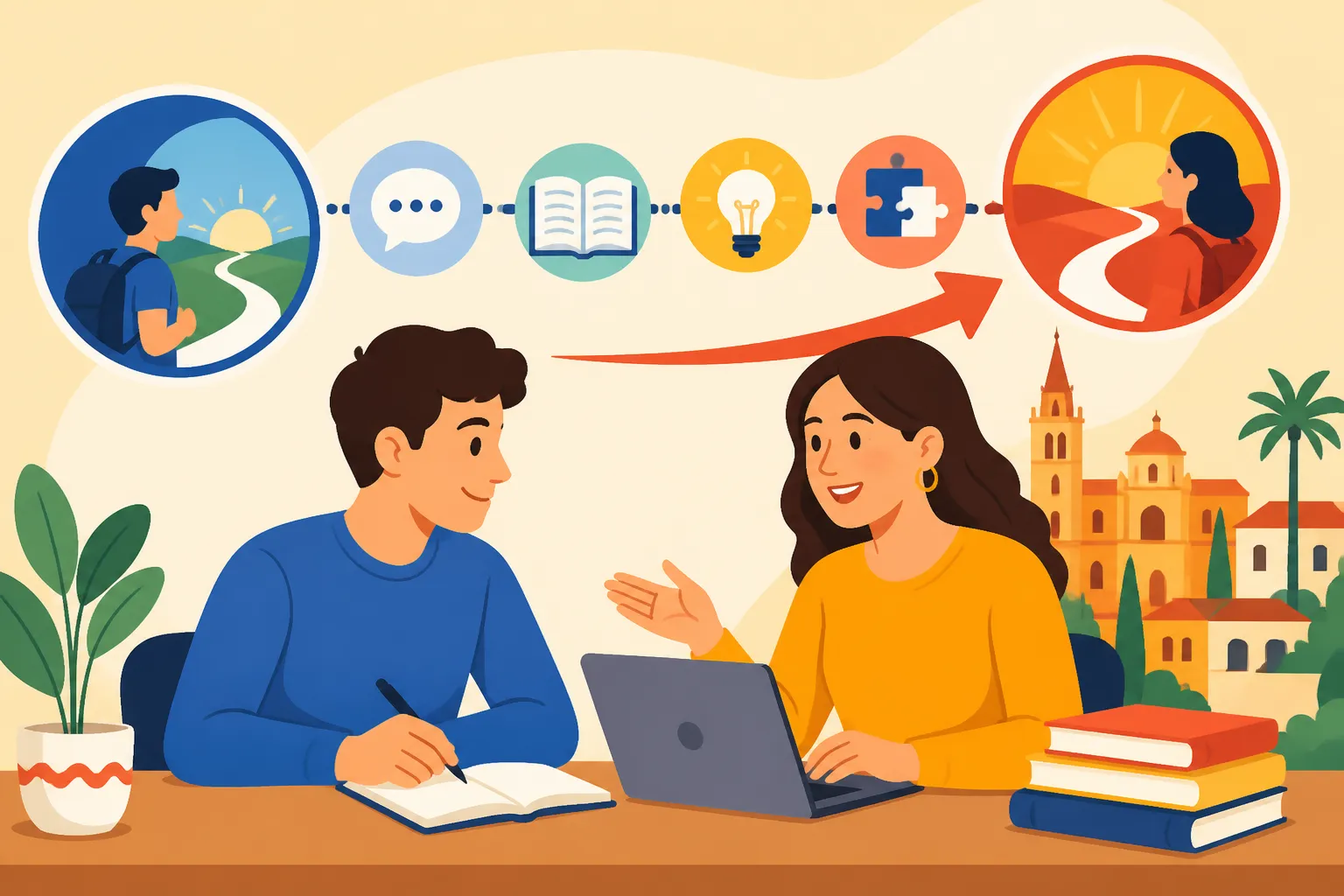
From A1 to A2 With a Tutor: What to Cover in 20 Lessons
Stepping into life in Spain is exhilarating, but let's be honest, the moment you try to move beyond "Hola, ¿qué tal?" and actually understand what the panadero is telling you, that A1 Spanish can suddenly feel like a concrete wall. It's frustrating to know basic words but be utterly lost in a simple conversation. This guide is all about helping you break through that initial language barrier, taking you from A1 to a confident A2 level, specifically with a structured plan for 20 personalized lessons with a tutor, opening up a whole new world of communication and connection here in Spain.
Disclosure: This post may contain affiliate links. We may earn a commission at no extra cost to you if you make a purchase through these links. Read full disclosure.
The A1-A2 Jump: Beyond Tourist Phrases
Many of us arrive in Spain with a grab-bag of survival Spanish. We can order a café con leche, ask for directions to the playa, and maybe even muddle through a greeting. This is your A1 level – understanding and using very basic, common expressions for immediate needs. It’s fantastic for getting by, but it leaves you feeling pretty isolated when the conversation moves beyond the absolute essentials. You can introduce yourself, but explaining why you moved to Spain, or sharing a brief anecdote about your day, feels impossible.
The leap to A2 isn't about becoming fluent overnight; it's about gaining real independence in everyday situations. Think of it as moving from being a polite guest to being a fully functioning resident who can genuinely participate. At A2, you can understand sentences and frequently used expressions related to areas of most immediate relevance: simple information about yourself and your family, shopping, local geography, and employment. You can communicate in simple and routine tasks requiring a direct exchange of information on familiar and routine matters. This is where you start to feel like you're truly living in Spain, not just visiting. You can navigate bureaucracy a bit better, make small talk with your neighbors, and even understand a simple joke. It’s a game-changer for daily life.
What A2 Competence Actually Means for Daily Life
Reaching A2 means you can do a lot more than just ask for things. You can describe your background, talk about your hobbies, express simple opinions, and handle routine transactions with a greater sense of ease. Imagine being able to:
- Handle Basic Shopping Independently: Not just pointing, but asking about prices, materials, or sizes. "Excuse me, do you have this in a larger size?" or "Is this local produce?"
- Make and Understand Simple Appointments: Booking a haircut, scheduling a doctor's visit, or understanding the specifics of a delivery. How to Book GP Appointments in Spain: Apps, Phones, and Walk‑ins will feel less daunting.
- Engage in Small Talk: Discuss the weather, weekend plans, or a recent event with your barista or a parent at your child's school.
- Describe Past Events: Share what you did last weekend, recount a memorable trip, or explain a minor problem you encountered. This opens up social interaction immensely.
- Express Simple Preferences and Dislikes: "I prefer the red wine," or "I don't like spicy food." It’s about more than just saying "yes" or "no."
- Navigate Public Transport with More Confidence: Understanding announcements, asking for clarification on routes or schedules.
These are the practical, empowering milestones that 20 focused lessons with a good tutor can help you achieve. It’s about transforming passive understanding into active communication, allowing you to immerse yourself more fully in the vibrant Spanish culture.
Your 20-Lesson Roadmap: Core Grammar & Vocabulary for the A2 Leap
Twenty lessons might sound like a lot, or not enough, depending on your perspective. But with a dedicated tutor, especially one found on a platform like iTalki, you can tailor these sessions to be incredibly efficient and effective. The key is to focus on the high-impact grammar and vocabulary that will unlock everyday communication. This isn't about memorizing every single verb conjugation, but mastering the most common ones that allow you to express yourself meaningfully in the present, past, and future.
Here's a suggested roadmap, broken down into manageable blocks, assuming each lesson is about an hour and includes a mix of new material, practice, and conversation. Your iTalki tutor can adjust this based on your learning style and current strengths.
Lessons 1-5: Solidifying Present & Building Blocks
These first five lessons are crucial for ensuring your foundation is rock solid. You'll move beyond just knowing the 'yo' form of a verb and start confidently conjugating for different subjects, while expanding your immediate use vocabulary.
- Review and Master Regular Present Tense Verbs: Go beyond the basics. Practice -AR, -ER, -IR verbs in all forms (yo, tú, él/ella/usted, nosotros/as, vosotros/as, ellos/ellas/ustedes). Focus on high-frequency verbs related to daily routines, work, and free time.
- Introduce Irregular Present Tense Verbs (High Frequency): Start with the heavy hitters like ser, estar, tener, ir, venir, hacer, decir, poder, querer, saber. These are non-negotiable for basic communication.
- Basic Adjectives and Adverbs: Learn to describe things and actions. Focus on common pairs (grande/pequeño, rápido/lento, bueno/malo).
- Everyday Vocabulary: Expand on family members, common professions, daily activities (desayunar, trabajar, estudiar, pasear), and household items.
- Simple Question Words: Master qué, quién, dónde, cuándo, cómo, cuánto, por qué. Being able to ask questions is just as important as answering. This will boost your confidence significantly when trying to understand Spanish Medical Terminology: Common Words Expats Should Know or Spanish Emergency Phrases: How to Describe Symptoms Quickly.
Lessons 6-10: Stepping into the Past
This is often where A1 learners get stuck. The past tenses. Suddenly, you can talk about what happened, which opens up a huge conversational door.
- Pretérito Perfecto (Present Perfect): This is often the easiest past tense for English speakers, as it uses "haber" (to have) and a past participle. It's great for recent past actions. "He comido" (I have eaten).
- Pretérito Indefinido (Simple Past/Preterite): Essential for narrating completed actions in the past. Your iTalki tutor will guide you through regular conjugations and common irregulars (ir, ser, hacer, tener). This is vital for telling stories or explaining events.
- Past Tense Vocabulary: Words like ayer, la semana pasada, el año pasado, hace dos días.
- Connecting Phrases: Introduce simple conjunctions like y, o, pero, porque, después.
- Expressing Opinions and Preferences: Learn basic phrases to share your thoughts, using vocabulary related to likes and dislikes. This allows for more engaging conversations than simply stating facts.
Lessons 11-15: Describing & Comparing
Now that you can discuss the present and past, it’s time to add more nuance and descriptive power to your Spanish.
- Pretérito Imperfecto (Imperfect Past): This past tense describes ongoing actions, habits, or descriptions in the past ("I used to play," "It was raining"). It contrasts perfectly with the Pretérito Indefinido, and a good tutor can clarify when to use each.
- Comparatives and Superlatives: Learn to say "bigger than," "more interesting than," "the best," "the worst." Más… que, menos… que, el/la más…
- Object Pronouns (Direct and Indirect): These simplify sentences and make you sound much more natural. Lo, la, los, las, le, les. "Lo quiero" (I want it).
- Essential Prepositions: Delve deeper than en and a. Explore por, para, con, sin, de, desde, hasta. Mastering these can be tricky, but an iTalki tutor can provide targeted practice.
- More Complex Question Structures: Learn to ask more detailed questions, combining tenses and descriptive elements.
Lessons 16-20: Looking to the Future & Practical Application
The final stretch focuses on future plans and bringing all the pieces together for fluent, practical communication at an A2 level.
- Future Tense (Simple Future): Learn to talk about what will happen. "Voy a ir" (I am going to go) is a common workaround, but the actual future tense is elegant and useful.
- Conditional (Simple Conditional): How to say "I would like," "I would go." This is incredibly useful for polite requests and expressing desires. "Me gustaría…"
- Command Forms (Imperative): Basic commands for tú and usted forms. Crucial for understanding instructions or giving simple directions.
- Review and Integrate: These lessons are about putting everything together through extensive conversation practice. Your iTalki tutor can set up role-playing scenarios: making travel plans, discussing current events, talking about health, or describing your city. This is also where you practice your Spanish Social Etiquette: Invitations, Time, and Small Talk.
- Vocabulary for Specific Situations: Focus on topics relevant to your life in Spain, whether it's Ordering Food and Drinks in Spanish: A Practical Phrasebook, discussing your work, or chatting about local fiestas. Your tutor can adapt to your immediate needs.
This roadmap is a guide, not a rigid prison. The beauty of learning with a personalized tutor on iTalki is that they can adapt the pace and content to your individual progress and interests. They’re there to identify your weaknesses and reinforce your strengths, ensuring you get the most out of every single lesson.
| Skill/Topic Area | A1 Level (Starting Point) | A2 Goal (After 20 Lessons) |
|---|---|---|
| Verb Tenses | Present tense (yo/tú forms), ser/estar/tener basics | Present (all forms), Pretérito Perfecto, Pretérito Indefinido, Imperfecto, Future (simple), Conditional (simple), Basic Commands |
| Vocabulary | Greetings, numbers, basic food, family, immediate needs | Daily routines, hobbies, work, local geography, feelings, travel, shopping, health, simple opinions, connecting words |
| Sentence Structure | Simple sentences, declarative statements, basic questions | Compound sentences with conjunctions, direct/indirect object pronouns, comparatives/superlatives, expressing preferences/dislikes |
| Conversation | Very short, direct exchanges, relies on gestures, answering yes/no | Participating in short conversations, asking clarifying questions, describing past/future events, expressing simple opinions, handling routine situations |
| Listening Comprehension | Understanding isolated words and very slow, clear phrases | Understanding frequently used expressions in familiar contexts, simple questions/answers in normal speed conversations |
| Reading Comprehension | Understanding single words, short signs | Understanding short, simple texts (e.g., public notices, basic emails, simple ads) |
Making the Most of Your Tutor Sessions
Okay, you've got your iTalki account, you've browsed through the fantastic range of tutors, maybe even booked a trial lesson or two. Now what? Simply showing up to your 20 lessons isn't enough; you need to engage actively to truly progress from A1 to A2. Think of your tutor as your personal language guide, but you’re the one who needs to do the hiking!
Choosing the Right Tutor for Your Journey
This is where a platform like iTalki really shines. You can filter by native speakers, professional teachers, community tutors, price, and even their teaching style. For the A1 to A2 jump, I highly recommend a professional teacher who has experience with structured lessons and beginner-level students. Look for someone who:
- Speaks Clearly and Patiently: They should be able to slow down and rephrase.
- Uses a Structured Curriculum (or can create one): They should have a plan for how to cover the grammar and vocabulary needed for A2.
- Provides Homework and Feedback: This is essential for reinforcing what you learn.
- Makes Lessons Engaging: Learning shouldn't feel like a chore. Someone who incorporates your interests will keep you motivated.
- Is Empathetic: The A1-A2 phase can be frustrating, so a supportive tutor is invaluable.
Don't be afraid to try a few different tutors through their trial lessons. Finding the right fit is crucial for a successful 20-lesson journey.
Preparation is Key: Before Each Lesson
Your lesson time is precious. Don't waste the first 10 minutes trying to remember what you covered last time.
- Review Previous Material: Before each session, spend 10-15 minutes reviewing notes, vocabulary, and any homework from the last lesson. This keeps it fresh and shows your tutor you're serious.
- Identify Questions: If you struggled with a particular grammar point or phrase during your self-study, write it down. This makes your iTalki session more efficient.
- Come with a Goal (if applicable): If you have a specific topic you want to discuss or a real-life scenario you need help with (e.g., "I need to go to the pharmacy, can we practice that?"), let your tutor know. This personalization is one of the biggest benefits of one-on-one tutoring. Pharmacies in Spain: Prescriptions, Over‑the‑Counter Meds, and Practical Tips is a perfect example of a practical scenario to role-play.
During the Lesson: Be Proactive
This isn't a lecture; it's an interactive session.
- Speak Up! Even if you make mistakes, push yourself to speak as much as possible. Your tutor is there to correct and guide you, not judge you.
- Ask Questions: If you don't understand something, immediately ask for clarification. Más despacio, por favor (slower please), ¿Qué significa…? (What does… mean?), ¿Puedes repetir? (Can you repeat?).
- Take Notes: Keep a dedicated notebook or digital document for your Spanish lessons. Jot down new vocabulary, grammar rules, and corrections your tutor provides.
- Record New Vocabulary: When your iTalki tutor introduces new words, don't just write them down. Practice saying them aloud and try to form a sentence right away.
After the Lesson: Reinforce and Practice
The learning doesn't stop when your video call ends.
- Review Your Notes: Go over what you learned within a few hours of the lesson. This helps solidify the information in your memory.
- Do Your Homework: This is non-negotiable. Homework is designed to practice and apply what you learned.
- Integrate into Daily Life: Try to use the new vocabulary or grammar points in your interactions in Spain. Did you learn about describing your day? Go tell your neighbor (if you dare!) or mentally narrate it to yourself in Spanish. Practice your Survival Spanish for Travelers: Key Phrases to Learn Only First and then expand on them.
- Self-Correction: Use the feedback from your iTalki tutor to notice and correct your own common errors.
Remember, your iTalki tutor is a valuable resource, but the effort you put in outside of those 20 hours will ultimately determine how quickly and effectively you reach your A2 goal. They can provide the map and compass, but you have to walk the path.
Beyond the Lessons: Self-Study & Immersion in Spain
Twenty structured lessons with an iTalki tutor will build your A2 foundation, no doubt about it. But truly becoming comfortable and confident at this level, especially living in Spain, means taking the learning beyond the virtual classroom. Spain itself is your biggest, most vibrant textbook, and you need to dive in!
Active Listening: Tune into the Spanish World
You're surrounded by Spanish, so start actively listening.
- Spanish Music: Don't just listen, try to understand the lyrics. Start with slower genres or artists you already like. Spotify and YouTube often have lyrics available.
- Podcasts for Learners: There are countless podcasts designed for Spanish learners, often categorized by level. Start with A1/A2 and gradually challenge yourself. Look for those that discuss daily life, culture, or news in a simplified way.
- Spanish TV & Movies (with subtitles): Begin with Spanish subtitles (or even English if you need to, but switch to Spanish as soon as possible). Children's cartoons can be surprisingly effective for learning basic dialogue and common phrases. Netflix and other streaming services offer a wealth of content.
- Overhear Conversations: When you're in a cafe or on the bus, try to catch snippets of conversation. Don't stare, of course, but just tune in. You'll be amazed at how much you start to pick up once your ear is trained.
Reading for Comprehension: From Signs to Simple Stories
Reading helps reinforce vocabulary and grammar in context.
- Street Signs and Advertisements: Read everything! This is free, readily available practice. Try to understand public notices or simple store advertisements.
- Children's Books: Head to a local bookstore (librería) and pick up some picture books or early reader novels. The language is simpler, often repetitive, and great for building confidence.
- Simple News Articles: Many Spanish news outlets have a "noticias fáciles" or "prensa juvenil" section, or you can find apps designed to simplify news for learners. This helps with understanding Spain's Biggest Festivals: A Year-Round Calendar or Spanish Holidays and Public Closures: Planning Errands in 2026.
- Language Learning Apps: Apps like Duolingo, Memrise, or Babbel can supplement your iTalki lessons by offering gamified vocabulary and grammar practice, great for quick bursts of learning throughout the day.
Speak, Speak, Speak: Practice Makes Progress
This is often the hardest part, but the most crucial. Don't be afraid to make mistakes – every mistake is a step towards fluency.
- Language Exchange Meetups (Intercambios): Many cities in Spain have language exchange groups where Spanish speakers want to practice English (or another language) and you want to practice Spanish. It's a fantastic way to meet people and practice in a relaxed setting.
- Talk to Locals: Your panadero, the person at the frutería, your neighbor, the cashier at the supermarket. Even if it's just a few sentences, make the effort. They usually appreciate it, and it builds your confidence.
- Join a Club or Activity: Whether it's a hiking group, a cooking class, or a sports club, engaging in an activity you enjoy in Spanish forces you to use the language naturally and provides a context for conversation. This is part of truly Making Friends in Spain: Clubs, Meetups, and Language Exchanges.
- Keep a Spanish Journal: Write a few sentences each day about your activities, thoughts, or feelings. It doesn't have to be perfect; the goal is to practice forming sentences.
- Continue with iTalki after 20 Lessons: Even after your initial 20 lessons, consider booking occasional conversational practice sessions on iTalki. It's an affordable way to maintain consistency and get feedback from a native speaker without the commitment of a full course. Many tutors offer conversation-focused lessons that are less about explicit grammar and more about flow and fluency.
Embrace the Culture, Embrace the Language
Living in Spain offers an unparalleled immersion experience. Every interaction, every sign, every conversation is an opportunity to learn. Don't shy away from it. Be curious, be patient with yourself, and remember that every small step, every understood phrase, is a victory. The journey from A1 to A2 is challenging but incredibly rewarding, and it will fundamentally change your experience of living here.
Disclaimer
This article is for general informational purposes only and does not constitute professional advice. Laws, prices and regulations vary by location and change over time. Consult a qualified professional for guidance on your specific situation.