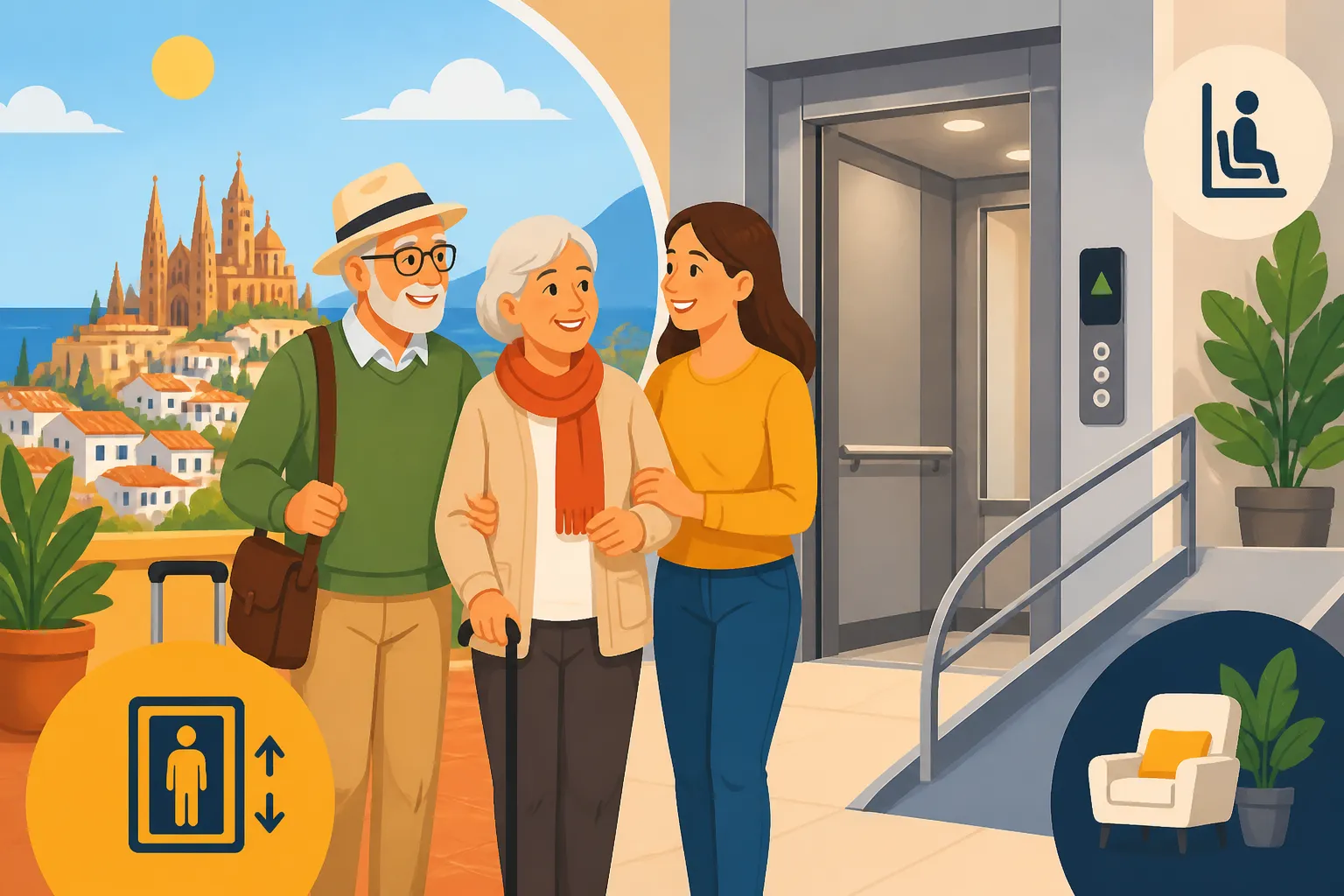
Booking for Visiting Parents in Spain: Lifts, Access, and Comfort
Your mum’s knees aren’t what they were, your dad needs a proper shower rather than a bathtub, and the “charming first-floor flat” you booked in Seville turns out to be three flights up with no lift. This guide shows you how to book lifts, step-free access and real comfort for visiting parents in Spain without unpleasant surprises at the door.
Disclosure: This post may contain affiliate links. We may earn a commission at no extra cost to you if you make a purchase through these links. Read full disclosure.
Why Booking for Visiting Parents in Spain Needs Its Own Strategy
The first time my parents came out to visit me, I booked what looked like a perfect apartment in Madrid’s Lavapiés. It had a balcony, good reviews and a lovely tiled kitchen. It also had a lift so small that my dad and his suitcase had to go up separately. The lift started half a flight of stairs above the street. Between the lift and the front door there were four more steps nobody had mentioned. My mother still brings it up.
Spain is wonderful for older visitors. The food is gentle, the evenings are long, and terraces and benches are everywhere. But the buildings, the streets and the way listings are written can catch you out if your parents have limited mobility, joint pain, or just want a comfortable stay. These are the specific traps to know before you book.
The Spanish Floor Number Trap
Spanish buildings, especially older ones, count floors differently from much of the world. Street level is the planta baja. Above it there may be an entresuelo (a mezzanine), and then a principal, before you reach what the building calls the primero. A listing that says “first floor” in a classic Barcelona Eixample block can therefore be three full flights of stairs above the pavement.
This matters a lot when a building has no lift, or when the lift doesn’t serve every level. When you see a floor number on a listing, treat it as a code, not a promise. Ask the property directly how many steps there are from the street to the room door. If you want the wider vocabulary of Spanish listings decoded, see Reading Spanish Hotel Listings: Room Types, Bed Sizes, and Terms Decoded.
Here’s a scenario that comes up often. A family books a “second floor” flat in Cádiz’s old town for their parents. On arrival, they find the building is a converted nineteenth-century house with a steep marble staircase and no lift, plus a low ceiling at the turn of the stairs. Nothing in the listing was untrue. It just wasn’t written for someone with a dodgy hip.
Old Buildings and the Half-Flight Problem
Many Spanish city-centre buildings had lifts fitted decades after they were built. Owners squeezed them into the stairwell, so they’re often tiny and frequently start from the entresuelo rather than the street. That leaves a short flight of stairs at the bottom, sometimes with no handrail. A listing can honestly tick “lift”, and your parent can still face a dozen steps before reaching it.
Hotels in historic buildings usually solve this better than private apartments, because renovations for hotel use often include a proper entrance ramp or a platform lift. Even so, a boutique hotel in a seventeenth-century palace in Toledo or Úbeda may have rooms on split levels, with two or three steps between the corridor and the bedroom. If accessibility is a firm requirement rather than a preference, Wheelchair-Accessible Hotels in Spain: The Filters That Matter goes deeper into the specific features to insist on.
Noise is the other old-building issue. Thin walls, tiled floors and internal courtyards called patios de luces carry sound remarkably well. Older people who sleep lightly can find a lively Spanish night hard going. Spanish Noise‑Insulation Reality: What to Expect in Older Buildings explains why, and it’s worth reading before you pick a cheap room overlooking a courtyard.
Hills, Cobbles and Taxi Access
The street outside matters as much as the building itself. Granada’s Albaicín is magical, but it’s a maze of steep cobbled lanes that taxis can only partly reach. Some lanes are restricted to residents’ vehicles. Toledo’s old town is a hilltop with narrow streets, and the walk up from the river is serious. Lisbon gets the reputation for hills, but parts of Bilbao’s Casco Viejo, Cuenca and Ronda are just as tough on tired legs.
Before booking, check whether a taxi can drop off at the door or whether the last stretch is pedestrian-only. Many historic centres in Seville, Salamanca and Santiago de Compostela have pedestrianised cores. That’s lovely for strolling but awkward with suitcases and a walking stick. For broader planning on getting around with limited mobility, see Accessible Travel in Spain: Mobility and Planning Tips.
Using Booking.com Filters to Find Parent-Friendly Stays
After that first Lavapiés disaster, I changed how I search, and I now run almost every parent visit through Booking.com. It isn’t the only platform in Spain. I use it because its accessibility filters are detailed enough to rule out the worst options in seconds. It also puts reviews, photos, cancellation terms and a direct message channel to the property in one place, which saves me a lot of back-and-forth.
The Accessibility Filters Worth Ticking
On Booking.com, scroll down the filter panel on the left of the search results (or tap “Filter” in the app) until you reach the accessibility section. The labels change from time to time, but the filters I find most useful for parents are these:
- Upper floors accessible by lift or elevator. This rules out walk-ups, though you still need to confirm that the lift reaches street level.
- Entire unit located on ground floor. This is gold for apartments, as long as you check for steps at the building entrance.
- Walk-in shower. It tells you there’s no bathtub to climb into, which is one of the most common hazards for older guests.
- Toilet with grab rails. This is a sign the property has thought about older or less mobile guests.
- Raised toilet and lower sink. These are useful for anyone with stiff knees or limited reach.
- Emergency cord in bathroom. It’s less common, but valuable for a parent who’ll be alone in the room.
Tick these one at a time rather than all at once. In a small city like Cáceres or Teruel, ticking every box can leave you with no results at all. In Madrid, Barcelona, Valencia or Málaga, you’ll usually still have plenty of choice. Then work out which features your parents genuinely need and which are nice extras. A parent who walks fine but can’t manage a bathtub needs the shower filter far more than the lowered sink.
Reading Photos and Reviews Like a Detective
Filters are a starting point, not a guarantee. The property owner sets the facility ticks, and owners don’t always understand what “accessible” means to someone with arthritis. That’s why I always open the photo gallery and look for specific details:
- the building entrance, to spot steps up from the pavement or a heavy door,
- the bathroom, to see whether the shower has a raised tray or a glass screen that’s awkward to step around,
- the bed height, since low platform beds are fashionable in design hotels and terrible for stiff hips,
- the presence of a chair or sofa in the bedroom, so a parent can rest without lying down.
Reviews on Booking.com come from guests who’ve actually stayed, and you can search within them. Type words like “stairs”, “lift”, “elevator”, “steps” or “hill” into the review search. A reviewer saying “the lift is tiny but works” or “the street is very steep from the taxi rank” tells you more than any facility list. Also look at reviewers who describe themselves as travelling as a couple or as older guests. Their priorities will be closer to your parents’ than those of a group of students.
Messaging the Property Before You Pay
This is the step that saves trips. Once you have a shortlist, use the Booking.com messaging feature to ask each property direct questions before you commit. Hotels in tourist areas usually reply in English. For smaller family-run places, a short message in Spanish gets a faster and warmer response. Phrases I use regularly:
- “¿El edificio tiene ascensor desde la calle, sin escalones?” (Does the building have a lift from street level, with no steps?)
- “¿Cuántos escalones hay desde la calle hasta la habitación?” (How many steps are there from the street to the room?)
- “¿La ducha es a ras de suelo o hay bañera?” (Is the shower level with the floor, or is there a bathtub?)
- “¿Puede llegar un taxi hasta la puerta?” (Can a taxi reach the door?)
- “Viajan mis padres, mayores, y tienen movilidad reducida.” (My elderly parents are travelling and have reduced mobility.)
The answers sit in your booking record, so you have them in writing if something turns out differently on arrival. If a property replies vaguely or doesn’t reply, that tells you something too. Sometimes calling a small hotel directly gets you a better-situated room. Booking Platforms vs Direct Booking in Spain: When Calling the Hotel Wins covers when that makes sense.
Choosing the Right Type of Stay for Your Parents
Not every accommodation type suits older visitors equally. I’ve put my parents up in almost all of them over the years. The right choice depends on how long they’re staying, how independent they are, and whether they’ll be staying with you or nearby.
Comparing Accommodation Types
| Accommodation type | Lift and step-free access | Bathroom suitability | Daily comfort | Best suited to |
|---|---|---|---|---|
| Modern city hotel | Usually reliable, with lifts from street level in most newer builds | Walk-in showers increasingly common; adapted rooms often available | Reception help, room cleaning, breakfast on site | Short visits, parents who want everything handled |
| Historic or boutique hotel | Varies widely; split levels and small lifts are common | Often stylish but sometimes impractical, such as freestanding tubs | Atmospheric, central, sometimes noisy | Confident walkers who value charm |
| Aparthotel | Generally good, as most are purpose-built or fully renovated | Usually showers; check tray height | Kitchen, space, plus a reception desk | Visits of a week or more |
| Private tourist apartment | The biggest variation; many older blocks have no lift or partial lifts | Bathtubs are common in older flats | Space and privacy, but no on-site help | Mobile parents, or ground-floor units only |
| Parador | Many have adapted rooms, but castle and monastery layouts can involve long corridors | Typically updated bathrooms | Restaurant on site, calm atmosphere | Special-occasion trips outside cities |
| Casa rural | Often ground-floor rooms but uneven paths and gravel outside | Mixed | Peaceful, but usually needs a car | Parents who love the countryside and have a driver |
Hotels vs Apartments for Longer Visits
For a long weekend, I nearly always book a hotel. A reception desk means someone can call a taxi, store luggage before check-in, and help if anything goes wrong while I’m at work. Breakfast downstairs also means my parents don’t have to navigate a supermarket on their first morning.
For stays of a week or more, an aparthotel often hits the sweet spot. Parents can keep their own routine, make a cup of tea at five in the morning when jet lag wakes them, and do a little laundry, while there’s still a desk downstairs. Aparthotels in Spain: Kitchens, Laundry, and Long Stays explains what to expect. On Booking.com you can filter the property type to “Aparthotels” and then layer the accessibility filters on top.
Private tourist apartments can be wonderful but carry the most risk. If you go that route, restrict yourself to listings with the ground-floor or lift filter, then confirm the details by message. Remember that a check-in for an apartment might mean meeting someone at a key box down the street, which isn’t ideal for tired parents arriving late. Whatever you book, the property will need passport details for every guest, so have your parents’ documents ready. Check-In Documents in Spain: Why Hotels Register Your Passport explains why.
Picking the Right Neighbourhood
Location can make or break the visit. In Madrid, I steer my parents away from the steeper streets of Lavapiés and toward flatter areas such as Salamanca, Chamberí or around the Retiro, where pavements are wide and benches plentiful. Where to Stay in Madrid for Families: Quiet Barrios With Space has more on the calmer barrios, and the same logic applies to older guests.
In Barcelona, the Eixample’s grid is flat and has wide chamfered corners, which makes it far easier on the legs than the narrow lanes of the Gòtic. In Seville, staying just outside the tightest part of Santa Cruz gives easier taxi access while keeping the cathedral within a gentle walk. In Granada, a hotel down in the Centro with a short taxi ride up to the Alhambra beats a romantic but steep Albaicín perch. On Booking.com, the map view lets you see exactly where each property sits. Check it against the street gradient and the nearest taxi rank before choosing.
Think about what your parents want to see, too. If the Prado or the Alhambra is the highlight, staying close to it cuts down on tiring transfers. For planning the sightseeing side, see How to Find Wheelchair-Accessible Attractions in Spain.
Comfort Details and a Step-by-Step Booking Plan
Once access is sorted, comfort is what turns a tolerable trip into a lovely one. These are the details to check for parents.
Bathrooms, Beds and Climate Control
Bathrooms are where most falls happen. A shower with a raised tray and a sliding screen is manageable for most people. A deep bathtub with a shower attachment is a genuine hazard for anyone unsteady. Look for non-slip floors, a grab rail, and space to put a toiletry bag within reach. If a property says “bathtub or shower”, ask which your room will have.
For beds, twin beds that can be pushed together give flexibility if one parent sleeps restlessly. Spanish “double” beds can be narrower than in some countries, so check the bed size in the room description. A higher mattress is easier to get in and out of. A firm chair in the room gives somewhere to sit while putting on shoes.
Climate is the other big one. Southern Spain in summer can be brutally hot, and inland cities like Madrid and Toledo get properly cold in winter. Older people often feel temperature extremes more strongly. Make sure the room has air conditioning that works independently, not just a central system the hotel switches on by season. Air Conditioning and Heating in Spanish Accommodation: What to Verify goes through the specific questions to ask.
Flexible Rates and Arrival Day Planning
Plans change more often when older relatives travel. A flare-up, a family matter, or a delayed flight can shift everything. That’s why I almost always pick a flexible rate on Booking.com for parent visits, even when the non-refundable option is cheaper. The “Free cancellation” filter keeps your options open, but read exactly when the free window closes. Free Cancellation in Spain: What the Policy Really Allows explains the fine print.
Arrival day deserves its own planning. A tired parent after a long flight shouldn’t be dragging cases onto a metro. Pre-book a transfer or arrange a taxi from the airport. If arriving by train, request assistance at the station in advance through the rail operator. Accessible Travel on Spanish Trains: Booking Assistance in Advance explains how. Ask the property whether early check-in is possible, or at least whether they’ll hold luggage so your parents can rest in the lobby rather than wander the streets.
If you’re hiring a car to take them around, check whether the hotel has parking and whether it costs extra. Parking at Spanish Hotels: Why ‘Parking Available’ Often Means Paid is worth a read before you assume it’s free.
Step-by-Step Plan for Booking a Parent-Friendly Stay
Here’s the exact process I follow now, every time my parents or anyone else’s come out to Spain:
- Talk to your parents honestly first. Ask about stairs, bathtubs, walking distance, sleep, heat and any medical equipment they bring. Write the non-negotiables down.
- Choose the area before the property. Pick a flat, central neighbourhood with easy taxi access near the things they want to see.
- Search on Booking.com and set your dates and guest numbers. Add property type filters, such as hotels or aparthotels, if you’ve already decided.
- Apply the accessibility filters one by one. Start with the lift or ground-floor filter, then walk-in shower, then grab rails, and stop before the results disappear.
- Add the free cancellation filter. It gives you room to change plans if health or circumstances shift.
- Open the photos of each shortlisted property. Check the entrance, the bathroom and the bed height.
- Search the reviews for key words. Try “stairs”, “lift”, “steps”, “hill” and “noise”.
- Message your top two or three properties through Booking.com. Use the Spanish phrases above and keep the replies.
- Book the room that answered clearly and confidently. If you can, request a specific room type, such as a quiet interior room, a low floor or an adapted room, in the special requests box.
- Confirm a few days before arrival. Send a brief message reminding the property of your parents’ arrival time and needs, and arrange the airport or station transfer.
Following this sequence has meant that, for years now, my parents have arrived to rooms they can actually live in for a week. That means no surprise staircases, no bathtub balancing acts, and no sleepless nights over a courtyard full of late diners. If they’re combining several cities in one trip, Booking Multiple Spanish Cities: Sequencing Around Rail Routes will help you plan the order so the travel days stay short and easy.
The difference between a stressful visit and a happy one usually comes down to twenty minutes of careful checking before you click “Reserve”. Start your search on Booking.com with the accessibility filters switched on, message the properties before paying, and your parents can spend their visit enjoying long lunches, gentle evening walks and time with you, not counting steps.
Disclaimer
This article is for general informational purposes only and does not constitute professional advice. Laws, prices and regulations vary by location and change over time. Consult a qualified professional for guidance on your specific situation.