Closing Costs When Buying in Spain: How Much to Budget
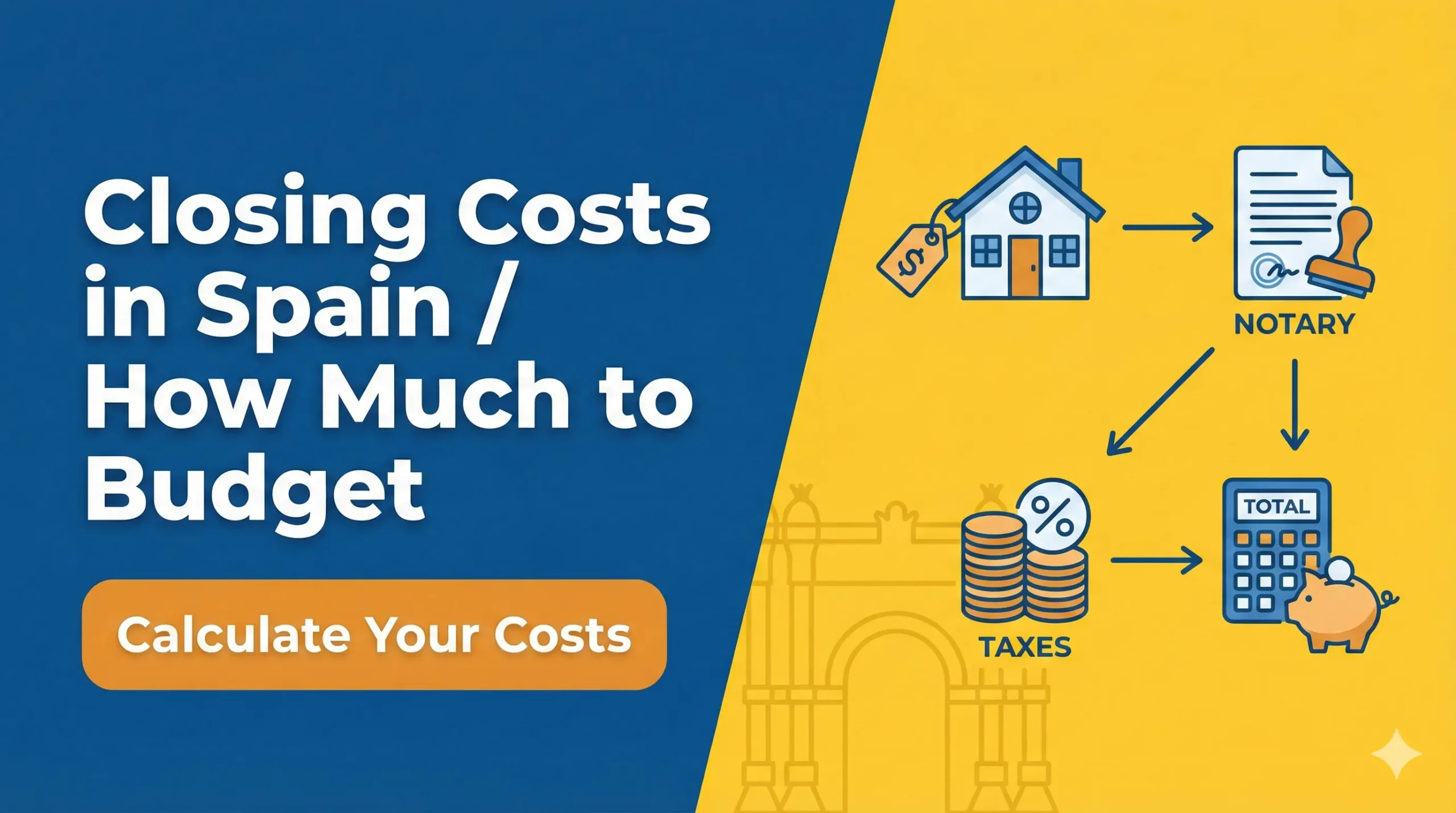
Most foreign buyers in Spain plan carefully for the agreed price and then get caught out by the extra money due at the notary’s table. Taxes, deed fees, registry charges, a gestoría and a lawyer all arrive within days of each other. After that comes the cost of actually moving in. This guide explains each closing cost and shows a worked Madrid example.
Disclosure: This post may contain affiliate links. We may earn a commission at no extra cost to you if you make a purchase through these links. Read full disclosure.
What Closing Costs Actually Cover When You Buy a Home in Spain
When I bought my first flat here, my estate agent gave me a cheerful single figure for “gastos”. It turned out to be wrong in both directions: too high on one tax and missing two items completely. Spanish closing costs are not one fee. They are a cluster of separate charges paid to different people, and each follows its own rules. Once you can see that cluster clearly, the budgeting becomes much less frightening.
If you are at the very start of the process, our overview Buying Property in Spain as a Foreigner: Process and Costs walks through the whole purchase from viewing to keys. Here I want to focus only on the money that sits on top of the price.
Purchase Taxes: IVA and AJD on New Builds, ITP on Resale Homes
The single biggest closing cost is tax, and which tax you pay depends on whether the home is new or second-hand.
New builds bought from a developer carry IVA, Spain’s value added tax, at 10% for residential homes. You pay it to the developer as part of the price at completion, and the developer passes it to Hacienda. On top of IVA, the deed itself attracts AJD, the Actos Jurídicos Documentados stamp duty. AJD is a regional tax, so each comunidad sets its own rate. This is where many online guides go wrong. They quote one “typical” AJD range as if it applied everywhere, when in fact rates differ noticeably between regions. The Comunidad de Madrid, for example, applies 0.75% on the deed of a home bought by an individual when the home is worth over EUR 180,000. Lower bands apply below that threshold, and these are covered in the worked example further down. Madrid sits at the lower end of the scale, and several other regions charge more. Always check the rate in the comunidad where the property is located, not the region you happen to be living in or the figure on a forum.
Resale homes bought from a private seller do not carry IVA. Instead you pay ITP, the Impuesto sobre Transmisiones Patrimoniales, a regional transfer tax charged on the price. You pay either ITP or IVA plus AJD on the purchase itself, never both. Regions set ITP rates independently and some offer reduced rates for young buyers, large families or people with disabilities. That means two identical flats an hour apart can produce very different tax bills. For a deeper side-by-side explanation, see Buying Property in Spain: What Is ITP vs IVA.
A quick scenario: Anna, a Swedish friend of mine, was choosing between a resale flat in an older building and a new-build apartment on the edge of the same city. She had been comparing the asking prices only. Once her lawyer laid out ITP on one and IVA plus AJD on the other, the “cheaper” flat was no longer clearly cheaper. The tax category matters as much as the sticker price.
The Professional Fees: Notary, Land Registry, Gestoría and Lawyer
After tax come the professional fees. They are smaller, but there are several of them.
- Notary. Every Spanish property sale is signed before a notario, who checks identities, confirms there are no charges recorded against the property and reads the deed aloud. Notary fees follow an official scale linked to the deed and its length, so they are not negotiable in the usual sense. The buyer normally pays for the purchase deed. Our guide Notary (Notario) in Spain: What They Do in Home Purchases explains what happens in the room.
- Land Registry. After signing, the deed is registered at the Registro de la Propiedad so that you appear as the legal owner. This is also a scale-based fee. Before you commit, it is worth ordering a nota simple from the same registry to check ownership and any debts recorded against the property. See What Is a ‘Nota Simple’ and Why You Need One When Buying for how to read one.
- Gestoría. Many buyers, and almost all mortgage buyers, use a gestoría to pay the taxes, file the forms and take the deed to the registry. Pricing is set by each firm, so ask for a written quote.
- Lawyer. A lawyer is not legally required, but as a foreigner I would not buy without one. They check planning status, outstanding community fees, utility debts and the contract terms. Lawyers set their own fees, some as a fixed price and some linked to the purchase price, so compare a few written quotes before you choose.
Mortgage-Related Costs and Who Pays What
If you are borrowing, a few more lines appear. Spanish mortgage rules have shifted most of the costs of the mortgage deed onto the lender, and the stamp duty on the mortgage deed is generally borne by the bank rather than by you. You will usually still pay for the property valuation, called the tasación, which the bank requires before approving the loan. Some banks also push linked products such as home or life insurance in exchange for better terms. Ask for the binding offer and compare it carefully. Our guide Mortgage in Spain for Foreigners: Eligibility and Documents covers what lenders ask non-residents to provide.
One more rule catches buyers off guard. If the seller is not tax resident in Spain, the buyer is required to withhold part of the price and pay it to Hacienda on the seller’s behalf. It is not an extra cost to you, but it changes how much money goes to whom on signing day. Your lawyer and notary should flag it.
A Worked Example: Budgeting a EUR 300,000 New Build in Madrid
Abstract explanations only go so far, so here is a concrete example. Imagine you are buying a newly built EUR 300,000 apartment from a developer in the Comunidad de Madrid, as an individual and as your home.
How Madrid’s AJD Bands Work
Madrid’s AJD on the deed of a home bought by an individual is banded by the value of the property:
| Value of home bought by an individual | AJD on the deed in the Comunidad de Madrid |
|---|---|
| Up to EUR 120,000 | 0.4% |
| EUR 120,000-180,000 | 0.5% |
| Over EUR 180,000 | 0.75% |
| Small protected VPO homes | 0.2% |
Our EUR 300,000 apartment is over EUR 180,000, so the 0.75% rate applies. If you are buying in another comunidad, do not reuse this table. Look up that region’s own AJD rate, which may be higher.
The Full Calculation in One Table
Here is how the closing costs stack up. The tax lines are firm numbers you can calculate today. The professional fee lines depend on quotes, so the honest answer is “get it in writing” rather than a guess.
| Cost line | Paid to | EUR 300,000 new build in Madrid |
|---|---|---|
| IVA at 10% | Developer, who passes it to Hacienda | EUR 30,000 |
| AJD at 0.75% | Comunidad de Madrid tax office | EUR 2,250 |
| Total purchase taxes | EUR 32,250 | |
| Notary for the purchase deed | Notario | Official scale, ask the notary’s office for an estimate |
| Land Registry | Registro de la Propiedad | Official scale, your gestoría can estimate it |
| Gestoría | Gestoría | Written quote from the firm |
| Independent lawyer | Lawyer | Written quote, fixed or linked to price |
| Valuation if you take a mortgage | Valuation company chosen through the bank | Ask the bank before you apply |
| Removal into the new home | Removal company | Compare several quotes, for example through Sirelo |
So before any professional fees, this buyer needs EUR 32,250 in tax on top of the EUR 300,000 price. Notice that the total purchase tax line is simply the IVA of EUR 30,000 plus the AJD of EUR 2,250. There is no hidden extra tax hiding between them.
Why Your Region Changes the Answer
If the same apartment were a resale home, IVA and AJD would disappear from the table and ITP at the regional rate would replace them. If the same new build were in another comunidad, the IVA line would stay at 10%, but the AJD line would follow that region’s rate. A common mistake is to take a Madrid example, like this one, and assume it applies on the Costa del Sol or in Valencia. Our companion piece How to Estimate Closing Costs When Buying in Spain shows how to rebuild this table for your own region and property type.
The Closing Cost Nobody Puts on the Spreadsheet: Moving In
Here is the part that often surprises buyers, and it is a story many buyers report. You finish the spreadsheet, wire the money, sign at the notary, and collect the keys. Then you realise you still have to get your sofa, bed, boxes and possibly an entire household from another country into the new place. At that point your savings are at their lowest.
Why the Move Belongs in Your Closing Budget
On paper, the move is not a closing cost. In practice, it is money you must spend in the same few weeks as the taxes and fees, and it can be substantial. A local move across Madrid is one thing. A move from the UK, Germany or the US, involving a container or road freight, is another. Moves into older Spanish buildings add their own complications: narrow streets, small lifts, parking permits for the van and sometimes furniture hoisted through a balcony. If you want to understand those practicalities, see Delivery Day in a Spanish Building: Narrow Streets, Lifts, and Permits.
I learned this the hard way. My lawyer’s estimate was accurate to the euro, but I had budgeted nothing for the move because I assumed “it won’t be much”. The first quote I received was well above what I expected. The second, from a company I found by asking around, was lower but did not include packing or the parking permit. I spent a stressful week comparing apples with oranges while living out of a suitcase.
How Sirelo Helps You Price the Move Before You Sign
This is exactly the gap Sirelo fills, and it is why I now tell every buyer to use it before completion day, not after. Sirelo is a comparison platform for removal companies operating across Europe, including Spain. Instead of phoning movers one by one and getting quotes in different formats, you describe your move once: where from, where to, roughly how much you are moving and when. You then receive quotes from several removal companies that cover that route.
There are three reasons this belongs in your closing-cost planning:
- It turns an unknown into a number. Your tax and notary lines are predictable. The move is the one major line that is usually a guess. Requesting quotes through Sirelo while your purchase is still in progress lets you put a real figure into the same spreadsheet as your IVA and AJD.
- It makes quotes comparable. When several companies quote for the same described move, it becomes much easier to spot which one leaves out packing, insurance, storage or access costs. Our guide How to Choose a Moving Company in Spain (What to Check) lists the questions to ask each mover once the quotes arrive.
- It fits around a Spanish completion date. Completion dates move. Developers deliver late, banks take longer than expected and notary slots shift. Having several movers already quoting means you are not starting from scratch if the date slips.
For anyone moving from abroad, Sirelo is even more useful, because international pricing depends heavily on volume and origin. To understand how those factors drive the price before you request quotes, read International Move to Spain: Full Shipping Price Breakdown by Volume and Origin. For how Sirelo itself works and whether it charges anything, check its own website, because the details can change.
A Step-by-Step Plan to Book Your Removal Around Completion
Here is the sequence I recommend to friends. It keeps the move in step with the legal timeline.
- Once the reservation or arras contract is signed, you have a provisional completion date. If you are unclear on what the arras contract commits you to, see Spanish ‘Contrato de Arras’ Explained: The Property Reservation Contract.
- Make a rough inventory of what you are moving: rooms, large furniture, fragile items and anything you plan to sell rather than ship.
- Submit your move details through Sirelo and request quotes for your route, mentioning the provisional date and any access issues at either end.
- Compare the quotes line by line in a simple table: packing, insurance, parking permit, storage, stairs or lift, and delivery window.
- Add the chosen quote to your closing budget next to the taxes and professional fees, so you can see your real total cash need.
- Confirm the booking only when the notary appointment is fixed, and ask the mover about flexibility if the date moves.
- Arrange storage as a fallback if completion slips past your move-out date. Many movers can quote for this at the same time.
Building Your Final Budget and Avoiding Nasty Surprises
With taxes calculated, professional fees quoted and the move priced, you can finally build a budget you trust. A few habits make the difference between a calm completion and a panicked one.
A Practical Buffer Strategy
I avoid percentage rules of thumb for total closing costs because they hide too much regional variation. Instead, I build the budget from the bottom up:
- Calculate the tax line exactly for your property type and region, as in the Madrid example above.
- Get written quotes from the lawyer and gestoría, and ask either of them to estimate notary and registry fees.
- Add the valuation if you are taking a mortgage.
- Add your chosen removal quote from the Sirelo comparison.
- Add a buffer of your own choosing for things like a delayed completion, a few nights in temporary accommodation, utility connection, and the first community fees and IBI. The ongoing costs are covered in How to Budget for Annual Homeowner Costs in Spain.
- Check how the money will reach Spain in time. If you are transferring from another currency, exchange rate swings between agreeing the price and signing can change your euro total.
Common Mistakes Foreign Buyers Make
These are the ones I see again and again, usually from intelligent people who simply did not know the Spanish system:
- Using the wrong region’s tax rate. A blog post written about Madrid’s 0.75% AJD band does not apply in other comunidades, and a high figure quoted elsewhere does not apply in Madrid. Check the rate for the region where the property is located.
- Adding ITP to a new build, or IVA to a resale home. You pay one tax regime on the purchase, not both.
- Forgetting the move entirely. Taxes and fees are easy to find online. The removal is personal to you, and only a real quote tells you what it costs. That is why I push people towards Sirelo early.
- Assuming the bank pays everything on a mortgage. Most mortgage deed costs now sit with the lender, but the valuation and any linked insurance products usually stay with you.
- Leaving no cash cushion. Completion dates move. Without a buffer, a short delay can mean paying for storage and accommodation at the same time.
For a broader look at how taxes, notary fees and registry costs combine, our guide Buying Property in Spain: Taxes, Notary Fees, and Registry Costs goes deeper into each official charge.
Your Next Step
If you have an accepted offer or a reservation contract, now is the time to turn your closing costs into hard numbers. Ask your lawyer for the tax calculation for your region and property type. Get written quotes from the gestoría. Then describe your move on Sirelo and collect removal quotes while there is still time to compare them properly. Once all of those lines are filled in, you will know exactly how much cash you need, and signing day becomes the exciting moment it should be rather than a nervous scramble.
Disclaimer
This article is for general informational purposes only and does not constitute professional advice. Laws, prices and regulations vary by location and change over time. Consult a qualified professional for guidance on your specific situation.