Can a Landlord Enter Your Apartment in Spain? Tenant Privacy Rules
Many tenants in Spain worry about landlords keeping spare keys or visiting unannounced. This guide explains your constitutional right to privacy, the specific legal exceptions for entry, and the steps to take if your landlord violates the “inviolability of the home.”
Disclosure: This post may contain affiliate links. We may earn a commission at no extra cost to you if you make a purchase through these links. Read full disclosure.
The Constitutional Right: Inviolability of the Home
The foundation of tenant privacy in Spain is Article 18.2 of the Spanish Constitution. It declares the “inviolability of the home” (inviolabilidad del domicilio). This is a fundamental right that applies to the person living in the property, regardless of who owns the title deed.
Article 18.2: “The domicile is inviolable. No entry or search may be made without the consent of the occupant or a legal warrant, except in cases of flagrant delict.”
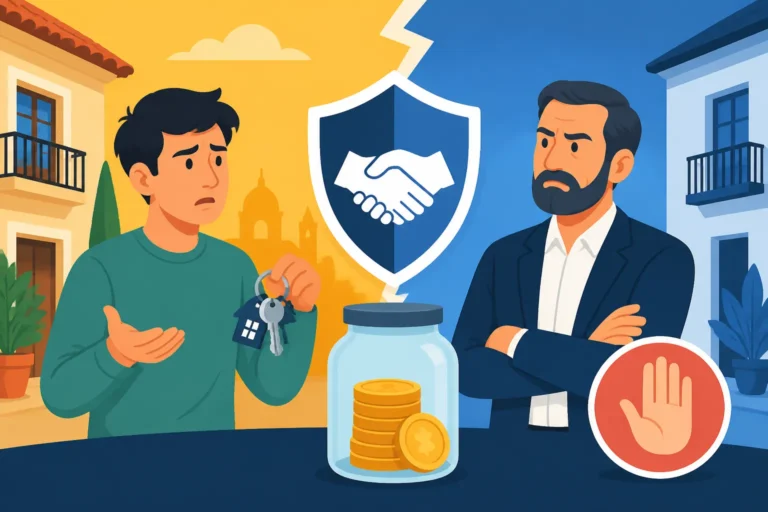
This means that from the moment you move in, the landlord becomes, legally speaking, a stranger at your door. They cannot enter without your express permission, not even to inspect the condition of the furniture or check the meter readings. If they do enter without consent or a court order, they may be committing the crime of trespassing (allanamiento de morada), punishable under the Spanish Penal Code.
Invalid Clauses in Rental Contracts
Landlords often try to circumvent this by adding clauses to the lease. You might see a sentence stating, “The landlord reserves the right to inspect the property once a month to verify its condition.”
While you might feel pressured to sign such a document, it is important to know that a private contract cannot override the Constitution. Clauses that force you to waive your fundamental rights are typically considered null and void by Spanish courts. However, navigating these clauses can be tricky for non-Spanish speakers. If you are unsure about what you are signing, you should consult our guide on How to Read a Spanish Rental Contract If You Don’t Speak Spanish to identify potential red flags before you commit.

When Is Entry Actually Permitted?
While the general rule is strict, it is not absolute. There are specific scenarios where a landlord can legally enter, or where refusing entry could put you in breach of your contract.
1. Mutual Consent
The most straightforward way a landlord can enter is simply by asking. If the landlord messages you to ask if they can measure a window for replacement and you agree to a time, the entry is legal.
- Tip: Always keep a record of this consent via WhatsApp or email. Do not rely on verbal agreements.
2. Necessary Repairs (Article 21 LAU)
The Ley de Arrendamientos Urbanos (LAU) establishes a duty for the tenant to facilitate the entry of the landlord or technicians for verifying and executing necessary repairs.
If a pipe bursts in your wall and is flooding the apartment below, you cannot use your privacy rights to block the plumber. Article 21.3 states that the tenant must allow verification of the damage. However, this does not give the landlord the right to barge in with a key. They must still coordinate with you. If you unreasonably deny access for urgent repairs, you could be held liable for the worsening damage. To better understand the distinction between minor wear and tear and major structural fixes, read our article on Tenant vs Landlord Responsibilities in Spain: Repairs and Maintenance.
3. Judicial Order
If a tenant refuses entry for a legitimate reason (like a structural survey mandated by the building community), the landlord cannot take matters into their own hands. They must apply to a judge for an entry order (orden judicial). Only with this document can they enter against your will, usually accompanied by a court official.
4. Flagrant Delict
This refers to a crime in progress. If the police (not the landlord) see a crime occurring inside the property, or if there is a clear emergency like a fire visible from the street, authorities can enter without a warrant to prevent harm.
Common Scenarios: Privacy vs. Property
To clarify the gray areas, here is a breakdown of common landlord requests and whether you are required to grant access.
| Scenario | Can Landlord Enter? | Explanation |
| “I want to check if the house is clean.” | NO | Cleanliness is your private business unless it causes structural damage or pests. |
| “I have a spare key for emergencies.” | NO ACCESS | They can keep a key, but they cannot use it without permission. |
| “I need to show the flat to potential buyers.” | NO (Usually) | Unless your contract explicitly agrees to viewings with specific terms, you can refuse. |
| “The neighbors reported a water leak.” | YES (Coordination req.) | You must allow access to fix damage affecting others (Art. 21 LAU). |
| “I want to see if you have pets.” | NO | This is an inspection of your lifestyle and is not a valid reason for entry. |
| “I need to certify the energy efficiency.” | YES (Coordination req.) | This is a legal requirement for selling/renting, and you should facilitate it. |
The “Spare Key” Dilemma
A frequent question from expats is: “Does the landlord have the right to keep a set of keys?”
Legally, there is no law forbidding the landlord from possessing a set of keys. However, there is a strict law forbidding them from using them. This creates a tension where the tenant feels vulnerable knowing a stranger has access.
Can You Change the Locks?
Yes. As the legitimate occupant of the dwelling, you have the right to secure your home. You can change the lock cylinder (bombín) immediately after moving in.
- Permission: You do not need the landlord’s permission to do this.
- Copies: You are not legally required to give the landlord a copy of the new key during your tenancy.
- Restoration: You must keep the original lock and reinstall it when you move out. If you fail to return the property with the original lock, the landlord can deduct the replacement cost from your deposit.
Changing the lock is the single most effective way to ensure your privacy. It prevents “accidental” entries and protects you from previous tenants who might still have copies.
Handling Emergencies
If you change the lock and do not give the landlord a key, what happens if there is a fire or flood while you are on vacation?
In a true emergency (fire), the fire department will break down the door regardless of who has a key. However, for a water leak, the lack of a key might necessitate a locksmith, the cost of which could arguably be passed to you if your unavailability caused increased damage.
- Solution: Leave a sealed key with a trusted neighbor or the building concierge (portero), or inform the landlord that a friend nearby holds a spare key for emergencies.
Viewings for Sale or Re-rental
The most friction often occurs at the end of a lease or if the landlord decides to sell. Landlords naturally want to show the property to prospective tenants or buyers to minimize vacancy periods.
Unless your contract contains a specific clause regulating viewings (e.g., “The tenant agrees to allow viewings during the final 30 days, with 24 hours notice”), you are under no legal obligation to allow strangers into your home while you are living there.
However, refusing all viewings can sour the relationship, which might complicate the return of your deposit. A pragmatic approach is to negotiate. You might agree to one specific viewing slot per week (e.g., Tuesdays from 6 PM to 7 PM) in exchange for a written guarantee that the landlord will be present. If the situation becomes contentious, referencing your rights in a calm manner is usually enough. For a broader overview of your rights during the rental period, check out Renting in Spain: Contracts, Deposits, and Tenant Rights.
What to Do If Your Privacy Is Violated
If you discover that your landlord has entered your apartment without permission—perhaps a neighbor saw them, or you found things moved—you should take immediate action.
1. Document the Evidence
If the landlord admits it via text (“I just popped in to grab some mail”), screenshot that conversation immediately. It is a confession of trespassing.
2. Send a Formal Warning
Do not just complain over the phone. Send a written communication (email or WhatsApp is a start, Burofax is legally binding) stating that their entry was unauthorized.
Example: “I have become aware that you entered the property on [Date] without my consent. I remind you that this violates Article 18.2 of the Constitution. Please respect my privacy and do not enter again without my written permission.”
3. Change the Lock
If you haven’t already, do it now. It is the cheapest and fastest way to restore your security.
4. Report to Authorities
In severe cases—where the landlord enters repeatedly, aggressive behavior is involved, or items go missing—you can file a police report (denuncia) for allanamiento de morada. If you feel threatened or unsafe in your own home, do not hesitate to contact the authorities. You can find the correct numbers to call in our guide on Emergency Numbers in Spain: 112 and When to Use It.
The Final Inspection
The one time a landlord must inspect the property is the day you hand back the keys. This is the final inspection, and it determines whether you get your deposit back.
Never simply drop the keys in the mailbox and leave. The landlord could enter days later, damage something, and blame you. Always insist on a joint walkthrough on your final day. You should sign a document confirming the state of the apartment and the return of the keys. If there are disagreements about damages during this inspection, knowing how to document the dispute is crucial. We explain the exact process for protecting your money in Getting Your Deposit Back in Spain: Disputes and Documentation.
Conclusion
Privacy is not a luxury; it is a legal right that defines the concept of “home.” In Spain, the law protects this right fiercely. While most landlords are respectful, understanding the boundaries of the Ley de Arrendamientos Urbanos empowers you to handle the exceptions with confidence.
Remember: The landlord owns the bricks, but you own the time and space within them. Be reasonable with necessary repairs, be firm with unjustified inspections, and if in doubt, change the lock.
References
Primary sources (official)
- Constitución Española (Article 18): https://www.boe.es/buscar/act.php?id=BOE-A-1978-31229
- Ley de Arrendamientos Urbanos (LAU): https://www.boe.es/buscar/act.php?id=BOE-A-1994-26003
- Código Penal (Article 202 – Allanamiento de morada): https://www.boe.es/buscar/act.php?id=BOE-A-1995-25444
Other helpful sources
- Idealista News (Legal Advice): https://www.idealista.com/news/inmobiliario/vivienda
- OCU (Organization of Consumers and Users) – Tenants Rights: https://www.ocu.org/vivienda-y-energia/alquiler
Disclaimer
The information provided in this article is for informational purposes only and does not constitute legal advice. Housing laws and criminal codes can be complex and subject to interpretation by local courts. If you are facing a serious privacy violation or legal dispute with your landlord, please consult with a qualified Spanish lawyer or gestor.