Childcare Waitlists in Spain: How to Apply Early
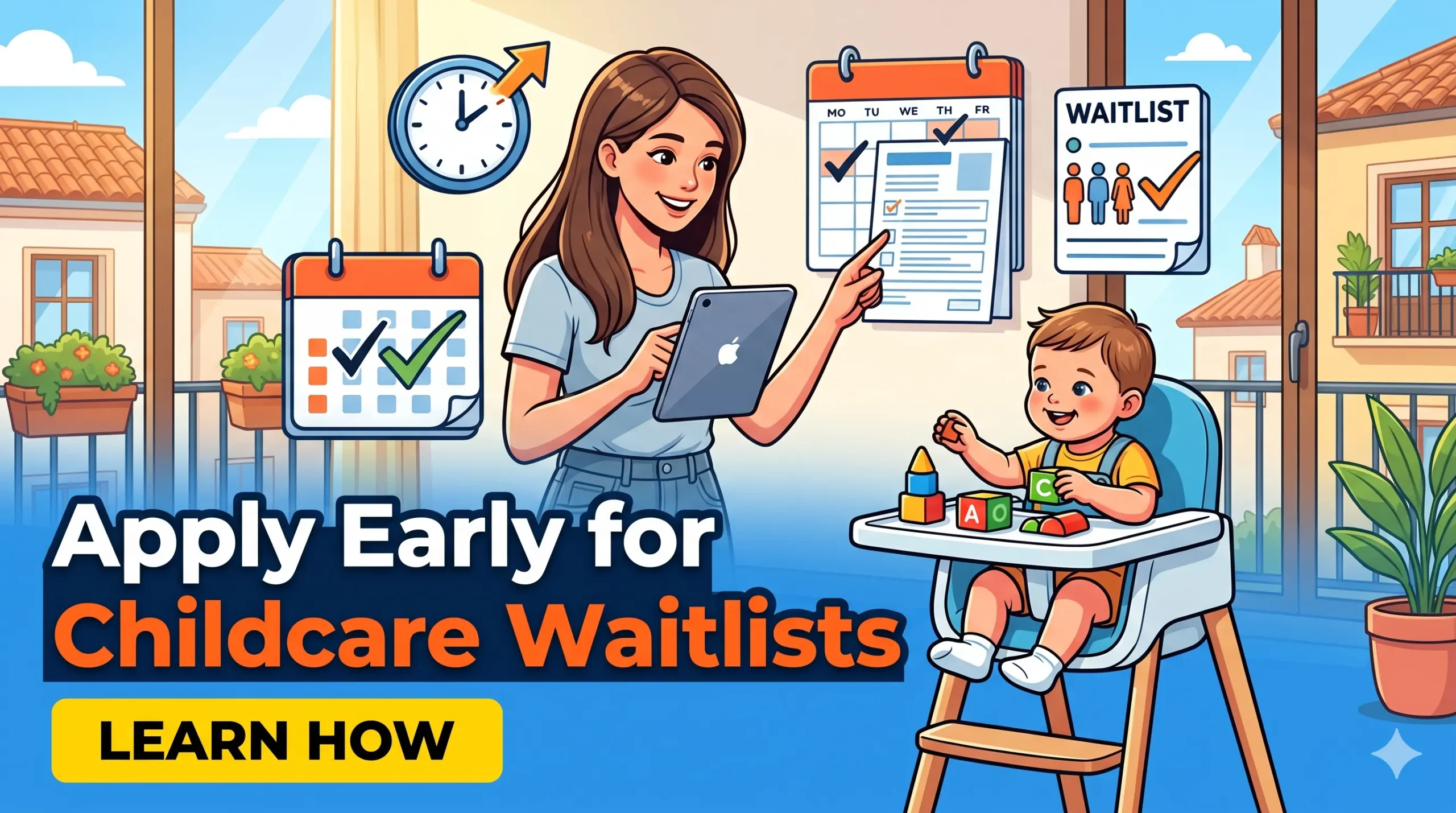
Discovering that Spanish public daycares require you to apply in April for a spot that opens in September induces pure expat panic. I entirely missed the spring application window during my first year in Madrid and was forced to pay double for a private center across the city. This guide breaks down the rigid Spanish childcare timeline, decodes the confusing municipal point system, and explains exactly how to secure a spot for your child without losing your mind.
Disclosure: This post may contain affiliate links. We may earn a commission at no extra cost to you if you make a purchase through these links. Read full disclosure.
The Reality of Spanish Childcare Waitlists
Before diving into the bureaucracy, you must understand the landscape of early childhood education in Spain. The system is heavily subsidized and highly competitive, operating on a strictly regulated calendar that takes no prisoners.
Guarderías vs. Escuelas Infantiles
In Spain, childcare for children aged 0 to 3 years old is not legally mandatory, but the vast majority of working parents utilize it. The terminology can be confusing for new arrivals. You will hear locals use the word guardería casually, but the official, regulated centers are known as Escuelas Infantiles (Early Childhood Schools).
There are three primary categories of Escuelas Infantiles. Public schools (públicas) are heavily subsidized by the regional government and the local town hall, making them incredibly cheap or even free, but they are fiercely competitive to get into. Concertada schools are semi-private; they are privately managed but receive public funding, meaning fees are subsidized but still higher than fully public schools. Finally, private schools (privadas) are fully independent, significantly more expensive, but generally feature much shorter waitlists and far more flexible hours. If you fail to secure a public spot, you must immediately adjust your budget to absorb the high cost of a private center, a financial shock deeply detailed in Cost of Living in Spain: Budgeting for Expats.
Why Early Planning is Non-Negotiable
The most devastating mistake expats make is assuming they can simply walk into a local public daycare in August and sign their toddler up for September. The Spanish public childcare system does not operate on a rolling admission basis.
The application window (plazo de presentación de solicitudes) is a heavily publicized, incredibly brief period that usually occurs in April. If you miss this two-week window, you are entirely locked out of the public system for the entire academic year unless you qualify for an extreme emergency placement. To navigate this unyielding timeline, you must be intensely organized months in advance. You cannot wait until you arrive in the country to figure it out; your child’s enrollment must be synchronized perfectly with your own corporate relocation timeline, a cultural rhythm explored in Spanish Work Culture: Hours, Holidays, and Workplace Etiquette.
Decoding the Baremo (Point System)
You do not get to simply choose your favorite public Escuela Infantil. The Spanish government allocates spots using a strict, mathematical point system known as the Baremo. Your application is scored, and the children with the highest points win the limited spots. Understanding how to maximize your points is your only defense against the waitlist.
The Empadronamiento Baseline
The single most critical factor in the Baremo system is your residential address. The system is designed to prioritize families who live or work immediately adjacent to the school.
If your official municipal census document (Certificado de Empadronamiento) proves you live in the exact same neighborhood (barrio) as the school, you receive the maximum proximity points. If you live in a different neighborhood but still within the same municipality, you receive fewer points. If you are not registered in the municipality at all, you receive zero points and have almost no chance of admission. Therefore, securing your housing and officially registering at the town hall is the absolute most urgent task upon arrival. If your proof of address is delayed, your child’s education is delayed. To ensure your paperwork is pristine and accepted by the town hall without rejection, rigorously review How to Get a Spanish ‘Certificado de Empadronamiento’ Copy and What Proof of Address Do Spanish Banks Accept?.
Employment and Income Points
The Spanish government desperately wants to support working parents, so the Baremo system heavily rewards dual-income households. If both parents can prove they are actively employed full-time, you are awarded a massive block of points. If you are a freelancer or working under a remote visa, you must provide official social security or tax documents proving your active economic status. Expats utilizing digital nomad frameworks must ensure their localized tax footprint is visible to the regional education board; review Spain Digital Nomad Visa: Income, Taxes, and Step-by-Step Guide for the exact documentation required.
Income is also a major factor. The system prioritizes lower-income families. When you apply, you must authorize the regional education department to access your previous year’s Spanish tax return (Declaración de la Renta). If your household income is below a certain threshold, you gain extra points. If you are a newly arrived high-earning expat without a Spanish tax history, you will generally not receive these income-based points, making your proximity and employment points even more critical.
Furthermore, you earn additional points if you have a legally recognized large family (Familia Numerosa – generally three or more children), or if the applicant child already has older siblings enrolled in that exact same school.
The Step-by-Step Application Timeline
The actual application process is a grueling bureaucratic sprint. You must have your digital infrastructure established and your documents translated well before the spring window opens.
The Spring Application Window
While exact dates vary slightly by Autonomous Community, the timeline generally follows a strict sequence:
- Late March / Early April: The town hall officially publishes the dates for the application window and the list of available vacancies (plazas vacantes) for each school.
- Mid-April: The submission window opens. You have roughly two weeks to submit your solicitud (application). You can typically list your top three to six school choices in order of preference.
- May: The Listas Provisionales (provisional lists) are published. This shows your total points. You have a three-day window to file a formal claim (reclamación) if you believe they miscalculated your points.
- June: The Listas Definitivas (final admitted lists) are published. If you secured a spot, you must immediately execute the formal Matriculación (enrollment) before late June, or you forfeit the spot to the waitlist.
Submitting via the Sede Electrónica
While you can technically submit paper applications in person by securing a prior appointment, the most secure and trackable method is applying online through your regional government’s Sede Electrónica (Electronic Headquarters) using a Digital Certificate (Certificado Digital).
This digital portal requires you to upload heavy PDF files of your passports, family book (Libro de Familia), and employment contracts. The government servers are notoriously fragile and frequently crash during the final days of the application window. Attempting to submit these critical documents on a weak, lagging Wi-Fi connection is a recipe for disaster. Securing a reliable, high-speed home fiber connection from an expat-friendly provider like Tiekom ensures you have the uninterrupted bandwidth necessary to complete the digital handshake and upload your application without timing out.
Furthermore, you must monitor the portal obsessively during May and June to check the provisional and final lists. Because you might be out exploring the city or running errands when the results are published, having a robust mobile data plan from Tiekom is a brilliant failsafe, allowing you to instantly log into the portal from your smartphone and accept your spot before the tight deadline expires. If you miss the enrollment deadline, you will be forced to hunt for a private center. Navigating the sudden financial shock of paying high private tuition requires intense cash flow management; deeply review Student Finances in Spain: Bank Accounts and Budgeting Tips to prepare your budget.
| Factor | Points Value (Varies by Region) | Required Documentation |
| Proximity to School | Very High | Certificado de Empadronamiento |
| Employment Status | High | Work contract / Social Security records |
| Siblings in Center | Very High | School verification |
| Household Income | Medium | Previous year’s Declaración de la Renta |
| Familia Numerosa | Medium | Official Large Family Title |
Preparing for the Periodo de Adaptación
Once you miraculously secure a spot and matriculate in June, you cannot just drop your child off for eight hours on the first day of September. Spanish Escuelas Infantiles enforce a mandatory psychological transition period.
Easing the Cultural Transition
The first two weeks of September are dedicated to the Periodo de Adaptación (Adaptation Period). The school explicitly forbids you from leaving your child for a full day. On day one, your child might only attend for 45 minutes, and you are required to stay in the building. By day three, they attend for two hours, and you wait at a nearby cafe.
This gradual ramp-up is designed to minimize separation anxiety, but it is an absolute logistical nightmare for working expat parents. You must coordinate heavily with your employer to take time off or work highly flexible hours during the first half of September. Understanding how Spanish companies view family leave and adjusting your own corporate schedule to survive this month is a vital cultural skill.
Required Gear and Daily Supplies
Spanish daycares are fiercely specific about what your child must wear and bring to school. They will provide you with an incredibly detailed list in July, and you must have everything ready by September.
Almost all public and private centers require a babi (a protective school smock) to prevent their clothes from being ruined during art projects and meals. Instead of desperately hunting through local physical stores in late August when all the babis are sold out, veteran expats immediately order high-quality, customizable babis directly from Amazon Spain.
Furthermore, you are strictly required to label absolutely every single item your child brings into the building. From their tiny backpacks to their pacifiers, extra socks, and water bottles, it must bear their name. You can order customized, waterproof name sticker packs and iron-on clothing labels from Amazon Spain to ensure you meet the school’s strict tagging requirements.
If your child is staying for the afternoon nap (siesta), the school will also require a specific fitted sheet and blanket for their small cot. Securing these highly specific dimensions locally can be frustrating, but Amazon Spain provides exact matches with next-day delivery. If you are ordering these supplies before you have fully moved into your permanent apartment, you must understand how the local postal system handles package holds. Thoroughly review How Package Pickup Works at Correos Aviso ID Hours to ensure your child’s required school gear isn’t returned to sender.
Setting up your home infrastructure quickly—from the internet required to submit the application to the utilities required to wash endless dirty school smocks—is the foundation of a successful family transition. To ensure your baseline apartment setup is flawless before September begins, meticulously review Utility Costs in Spain: Electricity, Gas, Water, and Internet.
References
Primary sources (official)
- Ayuntamiento de Madrid – Admisión en Escuelas Infantiles: https://www.madrid.es/portales/munimadrid/es/Inicio/Educacion-y-empleo/Escuelas-Infantiles-de-titularidad-del-Ayuntamiento-de-Madrid/?vgnextfmt=default&vgnextoid=69b3db36a21d1610VgnVCM1000001d4a900aRCRD
- Ministerio de Educación, Formación Profesional y Deportes – Educación Infantil: https://www.educacionfpydeportes.gob.es/educacion/mc/lomce/el-curriculo/curriculo-primaria-eso-bachillerato/educacion-infantil.html
Other helpful sources
- Expatica – Childcare in Spain: Preschool and Daycare Options: https://www.expatica.com/es/living/family/childcare-in-spain-101465/
- MumAbroad Spain – Nurseries & Pre-schools: https://mumabroad.com/spain/education/nurseries-pre-schools/
Disclaimer
The information provided in this article is for educational and informational purposes only and does not constitute formal educational, legal, or immigration advice. The Baremo point system, the exact dates of the spring application window, and the required documentation for Escuelas Infantiles vary drastically across the 17 Autonomous Communities in Spain and are subject to frequent changes by local Consejerías de Educación. Always verify the exact deadlines, proximity zone maps, and income thresholds directly with your local municipal town hall (Ayuntamiento) or regional government’s official Sede Electrónica before assuming you qualify for a subsidized public childcare placement.