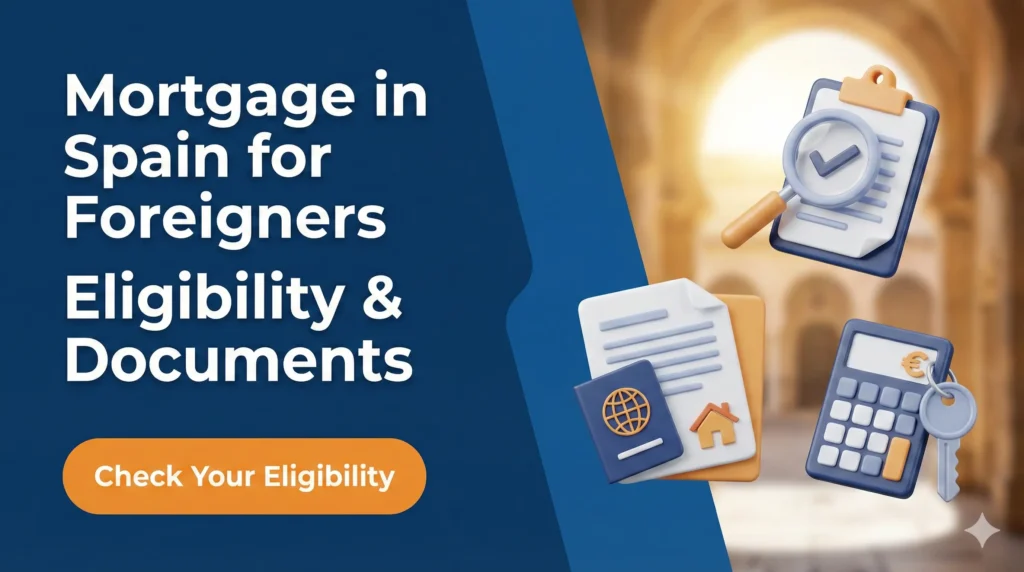
Mortgage in Spain for Foreigners: Eligibility and Documents
Disclosure: This article contains affiliate links. If you buy through them, we may earn a commission at no extra cost to you. Read our full disclosure.
Securing a mortgage in Spain as a non-resident requires navigating lower Loan-to-Value ratios, stricter debt calculations, and extensive paperwork. This comprehensive guide details eligibility criteria, essential documents, the application timeline, and how to prepare your finances for a successful property purchase.
Understanding Non-Resident Mortgage Lending
The first distinction you must understand is how Spanish banks classify you. In the eyes of a lender, your nationality matters less than your fiscal residency.
If you pay your taxes in Spain and have lived there for more than 183 days a year, you are a fiscal resident. If you live and work abroad—regardless of whether you hold an EU passport or a non-EU passport—you are classified as a non-resident.
Spanish banks offer specific “non-resident mortgage” products. These loans are designed to mitigate the bank’s risk. Because your income and assets are located in a foreign jurisdiction, the bank has less recourse if you default on payments. Therefore, they offset this risk by demanding a larger deposit from you upfront.
Key Differences in Loan Conditions
Before you begin property hunting, you must calculate your budget based on the specific lending criteria applied to foreigners.
Maximum Loan to Value Ratios
The most significant difference lies in the Loan-to-Value (LTV) ratio.
- For Residents: Banks typically lend up to 80% of the property price (and in rare cases involving young first-time buyers, up to 90%).
- For Non-Residents: Banks typically limit lending to 60% or 70% of the property price.
This means you must have a substantial down payment ready. If you are buying a home for €200,000, a bank might only lend you €120,000 (60%). You must provide the remaining €80,000 in cash. Furthermore, you must also pay the transaction taxes and fees (ITP, notary, registry) which add another 10-12% to the purchase price.
To manage these substantial transfers and ongoing payments, you will need a robust local banking setup, which you can read about in Setting Up a Spanish Bank Account for Rent and Bills.
Interest Rates and Terms
Spanish mortgages generally come in three forms:
- Fixed Rate: You pay the exact same monthly amount for the entire life of the loan. This offers security but often comes with a slightly higher initial rate.
- Variable Rate: Your interest rate is pegged to the Euribor (the European interbank rate) plus a fixed margin (e.g., Euribor + 1.5%). If the Euribor rises, your monthly payment increases.
- Mixed Rate: A popular option where the rate is fixed for the first 5 to 10 years, and then switches to variable for the remainder of the term.
Non-residents may be offered slightly higher interest rates than residents, though the gap has narrowed in recent years. The maximum term for a mortgage is typically 20 to 25 years for foreigners (compared to 30 for residents), and most banks require the mortgage to be fully repaid by the time the borrower turns 75 years old.
Eligibility Requirements for Foreign Borrowers
Spanish risk analysts are conservative. They do not rely on your potential future rental income from the property; they look strictly at your current ability to repay the debt.
The Debt to Income Ratio Rule
The golden rule in Spanish banking is the Debt-to-Income (DTI) ratio. Lenders generally require that your total monthly debt payments—including your new Spanish mortgage plus any existing mortgages, car loans, or credit card debt in your home country—must not exceed 30% to 35% of your net monthly income.
If you earn €4,000 a month after tax, your total allowable debt payments are roughly €1,400. If you already pay €800 a month for a mortgage in your home country, you only have €600 of “capacity” left for your Spanish mortgage. This strict calculation is the primary reason many applications are rejected.
Credit History and Stability
Banks will conduct a forensic examination of your creditworthiness. They will request an official credit report from your home country (such as Experian for the UK/US, or Schufa for Germany). A clean credit history is non-negotiable.
Employment stability is also paramount. If you are an employee, banks prefer to see indefinite contracts with at least six months of seniority. If you are self-employed or a business owner, you will need to provide at least two years of tax returns and company accounts to prove steady income.
Essential Documentation Checklist
The paperwork required for a Spanish mortgage is extensive. All documents must be provided in Spanish. If your original documents are in English, French, or German, many banks have internal teams that can read them, but you may be asked to provide Sworn Translations (Traducción Jurada) for legal documents.
Below is a checklist of the standard documents required for a mortgage application.
| Document Category | Required Items | Purpose |
| Identification | Valid Passport | Proof of identity. |
| Fiscal ID | NIE Certificate (Número de Identidad de Extranjero) | Mandatory tax ID for all financial transactions in Spain. |
| Proof of Income (Employee) | Last 3-6 payslips + Employer letter confirming role/salary | Verifies current earnings and job stability. |
| Proof of Income (Self-Employed) | Last 2 years of tax returns + 2 years of company accounts | Verifies sustainable business income. |
| Bank Statements | Last 6 months of main personal account | Shows spending habits and proof of funds for deposit. |
| Credit Report | Official report from home country bureau (e.g., Experian, Equifax) | Verifies global debt and repayment history. |
| Asset Proof | Deeds to other properties, investment portfolio statements | Demonstrates overall solvency (optional but helpful). |
| Property Info | Nota Simple (Land Registry Extract) or Reservation Contract | Identifies the asset being purchased. |
Getting Your NIE Number
You can start the mortgage inquiry process with just your passport, but you cannot formalize the loan or sign the purchase deed without an NIE number. Since obtaining this number can take several weeks due to appointment shortages, you should apply for it immediately. You can find the step-by-step application process in our guide on Obtaining a Spanish NIE Number: The Complete Guide.
The Property Valuation (Tasación)
Once the bank has reviewed your financial documents and pre-approved you as a borrower, they must approve the property itself. This requires an official valuation known as a Tasación.
The bank will send an independent, certified appraiser (tasador) to the property. The appraiser visits the home, measures the square footage, checks the legal registration, and compares it to recent sales in the area to determine its official value.
Crucial Note: The bank will lend you 60-70% of the lower value between the purchase price and the valuation price.
- Scenario A: You agree to buy a house for €200,000. The valuation comes in at €220,000. The bank lends based on €200,000.
- Scenario B: You agree to buy a house for €200,000. The valuation comes in at €180,000. The bank lends based on €180,000.
If the valuation comes in low (which happens frequently), you will need to cover the shortfall with extra cash. This is why you must understand the property’s true value before signing contracts. For more on the purchase timeline, review Buying Property in Spain: Offer, Deposit, Notary, and Registry Steps.
The Mortgage Application Process Step by Step
Securing a mortgage takes time. From the first contact with the bank to the final signature, expect the process to take between 4 to 8 weeks.
1. Pre-Approval and Budgeting
Before you even look at properties, gather your financial documents and speak to a few banks or a mortgage broker to get a rough idea of your borrowing capacity.
2. The FEIN (Formal Offer)
Once the valuation is complete and the risk department approves the file, the bank will issue the FEIN (Ficha Europea de Información Normalizada). This is the binding offer. It details the interest rate, the APR (TAE), the monthly repayment amount, early repayment penalties, and all associated conditions. Once issued, the bank usually must respect the offer for 10 to 14 days.
3. The Cooling-Off Period
Spanish mortgage law (specifically the 2019 Mortgage Credit Law) mandates a transparency period. Once you and the bank agree on the FEIN, you must send the documents to the Notary. You then have a mandatory 10-day cooling-off period (14 days in Catalonia) before you can sign the deed. During this time, you must visit the notary (without the bank present) to answer a test confirming you understand the conditions of the loan.
4. Signing at the Notary
On the day of the purchase, you will sign two deeds: the property purchase deed (Escritura de Compraventa) and the mortgage deed (Escritura de Hipoteca). The notary ensures both are legal and binding.
Hidden Costs and Taxes
When calculating your mortgage, do not forget the associated setup costs.
- Opening Fee: Some banks charge an opening commission of 0.5% to 1% of the loan amount. Many modern banks have abolished this, so shop around.
- Valuation Fee: You must pay the appraiser, usually between €300 and €600.
- AJD Tax (Stamp Duty): Following legal changes in 2018, the bank is now responsible for paying the Stamp Duty (Impuesto de Actos Jurídicos Documentados) on the mortgage deed. You do not pay this tax on the loan, though you still pay taxes on the property purchase itself.
- Insurance: Banks will almost always require you to take out home insurance (seguro de hogar) as a condition of the mortgage. They may also pressure you to take out life insurance (seguro de vida). While they can require insurance, you are legally allowed to source your own policy rather than accepting the bank’s expensive one, though this might slightly increase your interest rate (bonification). To navigate these policies, read Health Insurance in Spain and Home Insurance in Spain: What Renters and Owners Should Know.
Using a Mortgage Broker
Given the complexity of non-resident lending, many foreign buyers utilize a mortgage broker. Brokers have established relationships with multiple banks and can often negotiate better rates or higher LTVs than you could secure on your own. They are particularly useful for complex cases, such as self-employed applicants or US citizens (who face specific compliance hurdles due to FACTA). Brokers typically charge a success fee only if the mortgage is approved, or receive a commission from the bank.
Conclusion
Securing a mortgage in Spain as a foreigner is a rigorous process, but it is a well-trodden path. Spanish banks are eager for international business, provided you can prove your solvency and meet their strict documentation requirements.
Success lies in preparation. Ensure you have a substantial deposit saved (at least 30-40% of the purchase price), keep your credit record spotless, and organize your paperwork before you find your dream home. By understanding the LTV limits, the importance of the Tasación, and the mandatory cooling-off period, you can approach the Spanish property market with confidence, knowing exactly what you can afford.
To ensure you can maintain your new property and mortgage payments comfortably, be sure to create a long-term financial plan using our Cost of Living in Spain: Monthly Budget Guide for Expats. With the right financing in place, your Spanish home is well within reach.
References
Primary sources (official)
- Banco de España (Mortgage Market Guide): https://www.bde.es/
- Boletín Oficial del Estado (Law 5/2019 Regulating Real Estate Credit Contracts): https://www.boe.es/
- Association of Spanish Land Registrars (Statistics on Foreign Buyers): https://www.registradores.org/
Other helpful sources
- Idealista (Mortgage News and Calculators): https://www.idealista.com/en/news/property-for-sale-in-spain/mortgages
- Mortgage Direct (Broker Insights for Non-Residents): https://www.mortgagedirectsl.com/
Disclaimer
The information provided in this article is for educational and informational purposes only and does not constitute formal financial or legal advice. Mortgage conditions, interest rates, and loan-to-value ratios are subject to change based on market conditions and individual bank policies. We strongly recommend consulting with a qualified independent mortgage broker or financial advisor before signing any loan agreements.