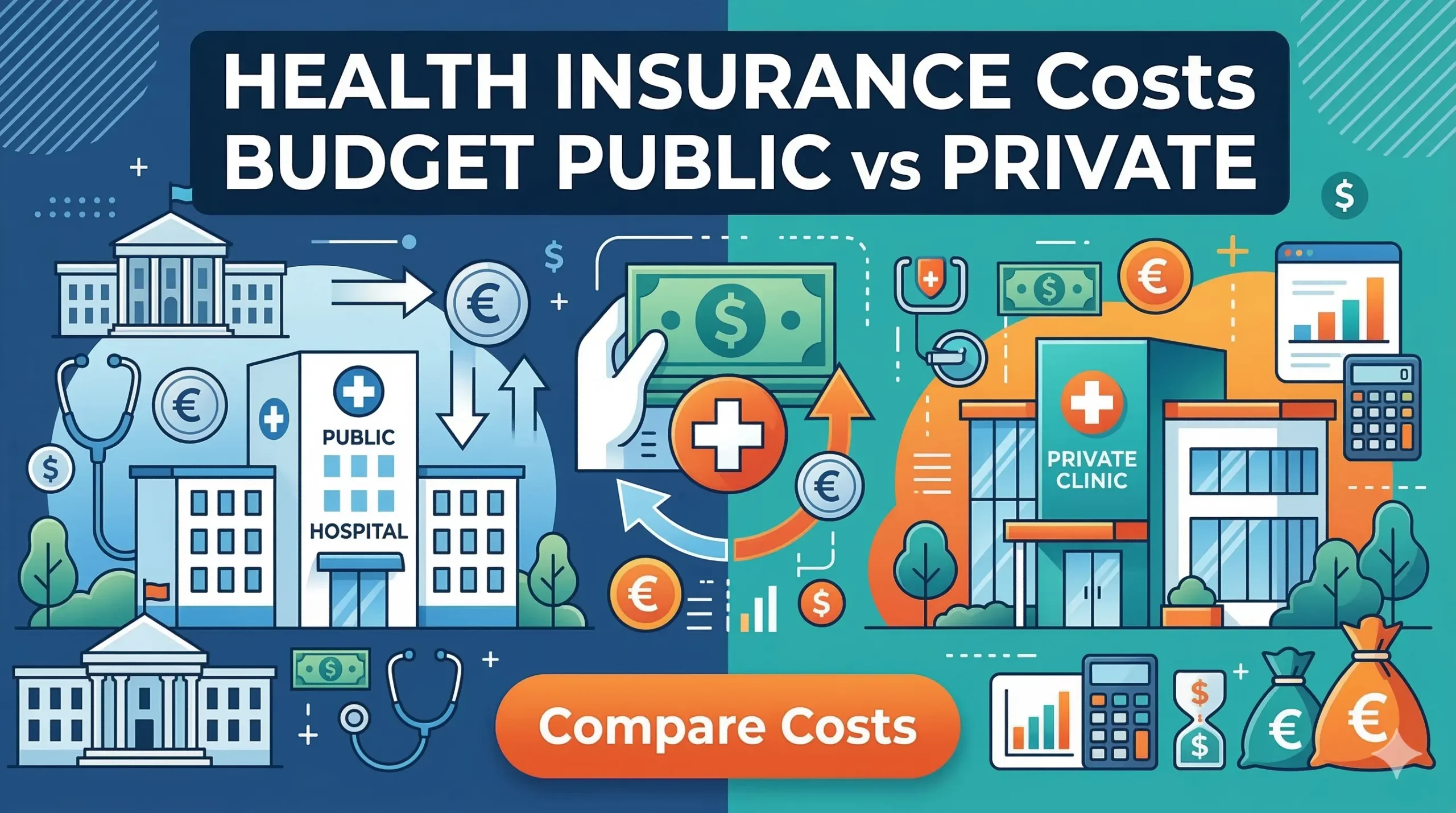
Health Insurance Costs in Spain: Budgeting Public vs Private
Navigating Spanish healthcare costs is incredibly confusing, especially when your visa legally demands expensive private coverage while locals constantly boast about “free” public clinics. I once paid over a thousand euros upfront for a private policy I never used just to get my residency card approved. This guide breaks down the exact costs of public and private healthcare to protect your budget.
Disclosure: This post may contain affiliate links. We may earn a commission at no extra cost to you if you make a purchase through these links. Read full disclosure.
The Reality of the Spanish Public Healthcare System
When expats first research a move to Spain, they are bombarded with articles praising the country’s universal healthcare system. While the quality of medical care is undeniably world-class, the assumption that it is completely “free” is a dangerous financial misconception that catches many foreigners completely off guard.
How You Actually Pay for Public Care
The Spanish public healthcare system, known officially as the Sistema Nacional de Salud (SNS), is not a magical, free-flowing charity. It is heavily and systematically funded by the grueling social security contributions levied on every legally employed resident operating within the country. If you are working in Spain, you are actively paying for this system every single month, regardless of whether you ever actually visit a doctor or step foot in a hospital.
If you secure a traditional employment contract, your employer automatically deducts roughly six to seven percent of your gross salary for your portion of social security, while simultaneously paying a massive hidden contribution of nearly thirty percent on top of your wage directly to the government treasury. This heavy, inescapable taxation is what keeps the clinics running. To understand exactly how these mandatory deductions impact your real monthly take-home pay, you must review our detailed breakdown in Spanish Salary Basics: Gross vs Net Pay and Common Deductions.
If you operate as a freelancer or small business owner, the financial burden rests entirely on your shoulders. You must physically pay a mandatory monthly social security quota directly out of your own pocket to access the public health system. This quota can easily exceed three hundred euros a month depending on your real income bracket. The system is undeniably excellent, but you are absolutely paying a heavy premium for it through the taxation of your labor. If you are navigating this entrepreneurial route, ensuring your quotas are set up correctly is paramount; read Autonomo System in Spain: How to Register as a Freelancer for the exact steps to get your coverage activated.
The Hidden Costs of Prescriptions and Dental
Even with full, unrestricted access to the public system, you will quickly discover that not absolutely everything is covered at one hundred percent. The most common financial shock for new expats occurs directly at the pharmacy counter. Spain operates a strict co-payment system for pharmaceutical prescriptions, which is scaled based on your specific income tier and whether or not you hold pensioner status.
The most jarring exclusion from the Spanish public healthcare system, however, is dental care. Routine dentistry, preventative cleanings, cavity fillings, and orthodontics are strictly classified as private medical expenses for adults. The public system will generally only cover emergency dental extractions if a tooth is severely infected and threatening your overall health. Expats routinely fail to budget for private dental checkups and out-of-pocket procedures, which can severely strain a tight monthly budget. To see how these out-of-pocket medical expenses fit into your broader financial life, check out Cost of Living in Spain: Budgeting for Expats.
The Convenio Especial for Uninsured Expats
What happens if you decide to retire early to the Spanish coast, live entirely off your foreign savings, and therefore do not actively pay into the social security system through local employment? You are not legally entitled to free public healthcare. However, the Spanish government provides a unique, highly localized buy-in mechanism known as the Convenio Especial.
The Convenio Especial allows expats who have been legally and continuously registered on their local town hall census (padrón) for at least one full year to pay a flat, subsidized monthly fee to access the public healthcare network. For expats under the age of sixty-five, the fee is generally set at a highly reasonable sixty euros per month. For expats aged sixty-five and older, the monthly fee jumps to one hundred and fifty-seven euros, directly reflecting the higher statistical cost of elder medical care.
While this is an incredible financial lifeline for retirees who are priced out of the private insurance market due to their age or severe pre-existing conditions, it comes with strict, non-negotiable limitations. The Convenio Especial strictly covers physical medical treatment within hospitals and clinics; it does not cover subsidized pharmaceutical prescriptions or non-emergency medical transport. You must pay one hundred percent of your pharmacy costs out of pocket. Furthermore, the mandatory one-year waiting period means you must survive your first twelve months in Spain using an alternative private policy before the state will let you buy into the public network.
Demystifying Private Health Insurance in Spain
Because immediate access to the public system is tied entirely to active employment or long-term residency, the vast majority of expats arriving in Spain are forcefully thrust into the private health insurance market by the stringent requirements of the immigration authorities.
Why Expats Are Forced to Buy Private Plans
If you are applying for a Non-Lucrative Visa (NLV), a Student Visa, or frequently a Digital Nomad Visa, the Spanish consulate demands absolute, undeniable proof that you will not become a financial burden on the state’s welfare system. To satisfy this rigid legal requirement, you must purchase a comprehensive private health insurance policy before your visa application is ever officially approved.
The immigration office (Extranjería) is incredibly strict regarding the specific parameters of this mandated policy. It must offer coverage that is entirely and unequivocally equivalent to the Spanish public system. This means the policy must fully cover primary care, hospitalizations, major surgeries, and emergency room visits without any financial limitations or waiting periods for standard care. Furthermore, the policy must strictly include repatriation coverage, ensuring that if you pass away in Spain, the insurance company will pay to transport your remains back to your home country.
You absolutely cannot simply buy a cheap, catastrophic travel insurance plan or a backpacker policy. You must buy a fully comprehensive, localized Spanish health policy from a recognized, state-approved provider like Sanitas, Adeslas, or DKV. Navigating these highly specific legal requirements while trying to decipher complex Spanish insurance jargon is a massive headache for new arrivals. To properly compare the nuances of navigating these two parallel systems simultaneously, you must review Spain Healthcare System for Expats: Public vs Private.
Copay Versus No Copay Policies
When browsing Spanish health insurance websites for the first time, you will immediately encounter two distinct types of policies: con copago (with copay) and sin copago (without copay). Understanding the fundamental difference between these two structures is the absolute key to both successfully securing your visa and protecting your monthly wallet.
A policy con copago features a significantly lower monthly premium, but it requires you to physically pay a small fee every single time you use a medical service. For example, you might pay five euros to see a general practitioner, or fifteen euros to see a specialist or get an MRI. This type of policy is incredibly popular among local Spaniards who already have free public healthcare but want a cheap private policy just to skip the long waiting lines for specialists. However, Spanish consulates will flatly and immediately reject your visa application if you submit a con copago policy, as they view the copay as a potential financial barrier that might prevent you from seeking necessary care.
Age and Pre Existing Conditions
The private insurance market in Spain is heavily deregulated regarding who they actually choose to accept as a client. Unlike some national systems that mandate universal acceptance regardless of health history, Spanish private insurers are perfectly and legally allowed to discriminate based on your age and your comprehensive medical history.
When you apply for a private policy, you must complete a rigorous, legally binding medical questionnaire. If you have severe pre-existing conditions—such as a history of cancer, severe heart disease, or chronic autoimmune disorders—the insurance company can and will outright deny your application. Alternatively, they may approve the policy but place highly specific exclusions (carencias) on your contract, flatly refusing to cover anything related to your pre-existing illness. This creates a terrifying catch-22 for older expats trying to secure a retirement visa.
Exact Costs and Budgeting for Private Healthcare
Understanding the abstract legal rules is helpful, but planning a cross-border relocation requires hard, concrete numbers. Budgeting effectively for private healthcare requires preparing for both the monthly cash flow drain and the massive upfront shocks required by immigration officials.
Baseline Monthly Premiums by Age Bracket
Compared to the United States or even the UK private market, Spanish private health insurance is shockingly affordable, provided you are relatively young and healthy. The domestic market is highly competitive, keeping baseline premiums exceptionally low for standard coverage.
For a healthy expat in their twenties or thirties, a top-tier, zero-copay policy from a major national provider will generally cost between forty and sixty euros a month. For expats in their forties and fifties, the premium edges up slightly due to increased statistical risk, typically landing between seventy and one hundred euros a month, depending on the specific coverage tiers and whether you include dental add-ons.
The severe price jumps begin in your early sixties. A healthy sixty-five-year-old can expect to pay anywhere from one hundred and twenty to two hundred euros a month. For an expat in their late seventies, if a comprehensive policy can be secured at all, it can easily exceed three hundred euros a month. When calculating your long-term financial viability in Spain, you absolutely must factor in this aggressive healthcare inflation. To ensure your baseline financial assumptions are accurate across all living expenses, cross-reference these medical costs against the broader budget outlined in Cost of Living in Spain: Budgeting for Expats.
The Shock of Annual Upfront Payments
The most brutal financial hurdle expats face regarding healthcare isn’t the total annualized cost of the policy, but exactly when the Spanish government demands you part with the money.
When you apply for a Non-Lucrative Visa or a Digital Nomad Visa, the Spanish consulate does not blindly trust that you will actually continue to pay your monthly insurance premiums once you physically cross the border. Therefore, they routinely demand a certified document from the insurance company proving that you have paid for one entire year of coverage strictly in advance.
This means that if your policy costs one hundred euros a month, you must part with a massive, non-refundable lump sum of one thousand two hundred euros before your visa is ever approved. For a retired couple moving together, this upfront shock can easily exceed three or four thousand euros. This sudden, non-negotiable lump-sum payment completely ruins the moving budget cash flow for expats who are not adequately prepared for the administrative rigidity of the Spanish immigration system.
Managing Currency Conversion and Payments
Paying that massive upfront annual premium from a United States or United Kingdom bank account via a traditional SWIFT transfer introduces a massive, hidden financial penalty that destroys your capital. Traditional legacy banks hide aggressive profit margins in terrible currency exchange rates and charge exorbitant international wiring fees.
To fiercely protect your moving budget, you must use a dedicated currency specialist like Wise. By executing your massive upfront insurance payment through a Wise account, you bypass the legacy banking system entirely, securing the true, transparent mid-market exchange rate. This strategic move can easily save you hundreds of euros on a single premium payment, keeping your hard-earned capital where it belongs: in your pocket.
For subsequent years, when you successfully renew your residency visa and are finally allowed to transition to standard monthly payments, Spanish insurance companies will aggressively demand a local IBAN for the direct debit. Attempting to use a foreign account often results in rejected payments and swiftly canceled policies. To solve this friction, open a dedicated account with N26. Because N26 operates as a fully licensed digital European bank, you instantly receive a recognized, official Spanish IBAN directly from your smartphone, entirely bypassing the bureaucratic nightmare of dealing with traditional Spanish branch managers. If you lack the formal residency cards usually required by legacy banks to open a basic checking account, read Opening a Bank Account in Spain as a Non-Resident for modern digital workarounds.
Navigating the Dual Healthcare Strategy
Many veteran expats and wealthy locals utilize a “dual strategy,” happily paying out of pocket for private insurance even when they have full, legal access to the free public healthcare system. Understanding why requires looking at the systemic bottlenecks of Spanish public care.
Using Private Insurance to Skip Wait Times
The Spanish public healthcare system is globally renowned and deeply respected for its handling of catastrophic medical emergencies. If you suffer a major heart attack, are involved in a severe car accident, or require complex oncology treatments, the public hospitals are exactly where you want to be. They possess the absolute best diagnostic equipment, the top-tier surgeons, and unparalleled critical care infrastructure.
However, the public system suffers from chronic government underfunding and severe staffing shortages at the primary care and specialist levels. If you discover a strange mole and want a public dermatologist to check it, or if you need an elective, non-life-threatening knee surgery, you will be placed on a bureaucratic waiting list. Depending on your specific autonomous community, these waiting lists can drag on agonizingly for six to nine months.
Protecting Your Health Budget Long Term
If you plan to retire permanently in Spain and maintain your private insurance to guarantee fast, reliable access to specialists, you must actively protect your wealth against localized healthcare inflation. Private premiums rise by an average of five to eight percent every single year, compounding aggressively as you age into higher statistical risk brackets.
To actually protect and aggressively grow the wealth required to seamlessly fund your long-term healthcare needs, veteran expats bypass the local banks and utilize global brokerage platforms like Interactive Brokers. By transferring your savings into an institutional-grade account with Interactive Brokers, you gain direct, unfiltered access to low-cost, globally diversified ETFs, index funds, and sovereign bonds. This allows you to build a highly portable, tax-efficient global portfolio that easily outpaces healthcare inflation. To ensure you do not inadvertently trigger massive asset taxes while building this protective portfolio, review the critical tax exemptions detailed in Wealth Tax and Solidarity Tax in Spain: Overview for Foreigners.
Dropping Private Insurance After Permanent Residency
The heavy financial burden of mandatory private insurance does not necessarily last forever. For expats arriving on temporary visas, there is a clear, legal finish line to the administrative extortion.
Once you legally and continuously reside in Spain for five years, you earn the right to apply for permanent residency (Larga Duración). Once you physically hold a permanent residency card, the strict immigration requirement mandating comprehensive private insurance generally vanishes. You are legally integrated into the state apparatus and are no longer viewed as a temporary visitor.
Furthermore, if you secure a proper Spanish employment contract or register as a freelancer at any point during your journey, you instantly gain irrevocable access to the public system through your active social security contributions. At this juncture, you can legally and safely drop your expensive, zero-copay private plan. Many veteran expats choose to downgrade to a much cheaper con copago plan just to keep their fast-track access to private specialists, shifting the bulk of their heavy medical reliance onto the excellent public system they are now actively funding. To understand how transitioning into the local workforce drastically shifts your broader annual tax obligations, read How to File a Tax Return in Spain: A Guide for Expats (IRPF).
| Healthcare Feature | Spanish Public Healthcare (SNS) | Private Health Insurance (Sin Copago) |
| Monthly Cost | Free (Funded via mandatory payroll taxes) | €40 to €200+ (Scales heavily with physical age) |
| Visa Compliance | Rarely accepted for initial non-working visas | Mandatory for NLV, Student, and Nomad visas |
| Wait Times | Excellent for emergencies; Months for specialists | Usually 24 to 48 hours for top specialists |
| Dental Coverage | Excluded for adults (Emergencies only) | Basic checkups included; major work discounted |
| Pre-Existing | Covers everything unconditionally | Can result in policy denial or strict exclusions |
References
Primary sources (official)
- Ministerio de Sanidad – Asistencia Sanitaria Pública: https://www.sanidad.gob.es/profesionales/saludPublica/sanidadExterior/salud/home.htm
- Seguridad Social – Convenio Especial de Asistencia Sanitaria: https://www.seg-social.es/wps/portal/wss/internet/InformacionUtil/44539/43384/44100/44102/44266
Other helpful sources
- Expatica – Guide to getting health insurance in Spain: https://www.expatica.com/es/healthcare/healthcare-basics/health-insurance-spain-439814/
Disclaimer
The information provided in this article is for educational and informational purposes only and does not constitute formal financial, medical, or immigration advice. Spanish visa requirements regarding health insurance policies (specifically regarding sin copago clauses and strict repatriation requirements), public healthcare co-payment percentages, and the regional administrative costs for the Convenio Especial are highly complex and subject to frequent legislative updates. Always consult directly with a certified Spanish immigration lawyer (abogado de extranjería) or a registered insurance broker regarding your specific visa application and pre-existing medical conditions before purchasing legally binding health policies.