Buying Property in Spain: Offer, Deposit, Notary, and Registry Steps
Disclosure: This article contains affiliate links. If you buy through them, we may earn a commission at no extra cost to you. Read our full disclosure.
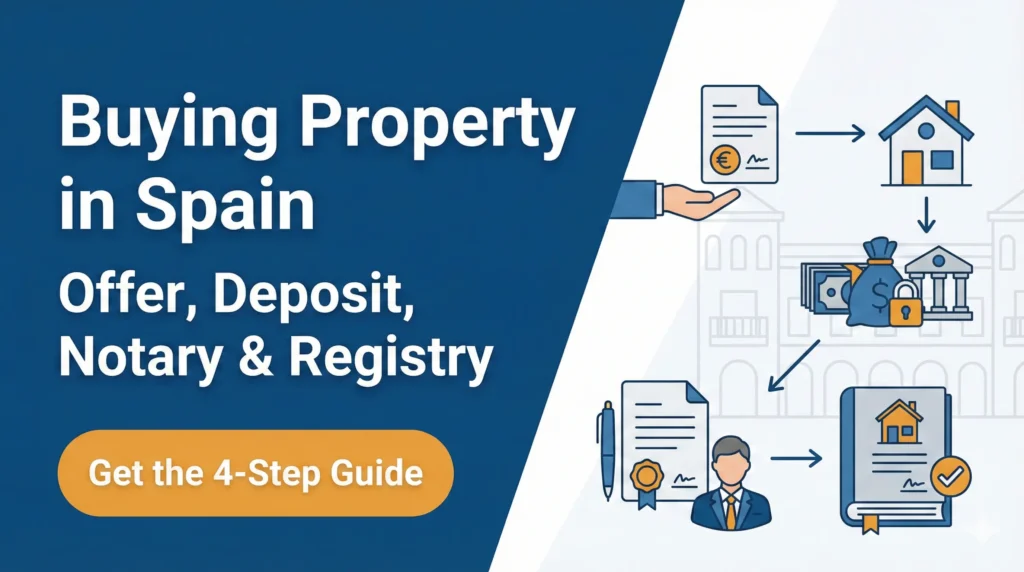
Purchasing real estate in Spain involves a strict legal sequence distinct from other countries. This comprehensive guide walks you through every stage, from making the initial offer and signing the deposit contract to the final notary signing and registering your title deed.
Step 1 Making the Offer and the Reservation Agreement
Once you have viewed potential homes and identified the property you wish to purchase, the process begins with a verbal offer. In Spain, negotiation is standard practice. Depending on the market conditions and the seller’s urgency, offers between 5% and 10% below the asking price are common starting points.
If the seller accepts your verbal offer, the real estate agent will typically push for the immediate signing of a Reservation Contract (Documento de Reserva). This is a preliminary document designed to take the property off the market. It is usually accompanied by a small fee, typically ranging from €3,000 to €6,000.
Caution is required at this stage. The reservation contract is legally binding. If you sign it and pay the fee, but later discover a legal issue with the property—such as an illegal extension or a dispute over land boundaries—getting your money back can be exceptionally difficult unless specific clauses were included in the document.
Ideally, you should never sign a reservation contract or pay a cent until your legal representative has conducted a basic check of the property’s legal status. This early intervention is crucial. To understand the type of professional support available for these initial steps, you should review our guide on How to Choose a ‘Gestor’ for Housing Paperwork in Spain. A qualified professional can quickly verify if the person selling the property is actually the registered owner.
Step 2 Legal Due Diligence and the Nota Simple
Before moving to the formal deposit stage, your lawyer (abogado) must perform comprehensive due diligence. The cornerstone of this investigation is the Nota Simple Informativa.
The Nota Simple is an official extract from the Spanish Land Registry (Registro de la Propiedad). It contains vital information that confirms the legal reality of the property.
- Ownership: It verifies the identity of the current registered owners.
- Debts and Embargoes: It reveals if there are any outstanding mortgages, unpaid taxes, or court seizures attached to the property. In Spain, debts are attached to the property, not the person. If you buy a house with an unpaid mortgage, you inherit that debt.
- Description: It details the registered size of the land and the building. A common issue in rural Spain is finding that a house with a swimming pool is registered simply as an agricultural plot.
Beyond the Nota Simple, your lawyer will check with the local Town Hall (Ayuntamiento) to ensure there are no urban planning infractions and that the property has a valid Habitation Certificate (Cédula de Habitabilidad), which is required to connect utilities.
This phase is also when you must secure your own documentation. You cannot buy property in Spain without a Foreigner Identification Number. Since appointments can be scarce, you must start this process immediately.
Step 3 The Deposit Contract (Contrato de Arras)
Once due diligence is complete and the property is deemed safe to buy, you will move to the most critical document in the entire transaction: the Contrato de Arras (Deposit Contract).
This is a private contract between the buyer and the seller. It outlines every detail of the purchase: the final price, the deadline for signing at the notary, the description of the property, and the division of costs. Upon signing this contract, the buyer typically pays a deposit of 10% of the purchase price (minus any reservation fee already paid).
The Penalties of Withdrawal
The Contrato de Arras is powerful because of its penal clauses, established by the Spanish Civil Code. Most agreements are drafted as Arras Penitenciales.
- If the Buyer Defaults: If you decide not to proceed with the purchase for any reason not stipulated in the contract (such as finding a better house or failing to secure a mortgage), you lose your entire 10% deposit.
- If the Seller Defaults: If the seller decides not to sell, or accepts a higher offer from someone else, they must return your 10% deposit plus an additional 10% as a penalty. Effectively, they pay you double the deposit amount.
Because the financial stakes are high, ensuring you have your finances ready is paramount. If you require a mortgage, you must have a binding offer from the bank before signing the Arras. To facilitate the transfer of these large sums, you will need a compliant local account, which you can read about in Opening a Spanish Bank Account for Real Estate Purchases.
Step 4 The Notary Appointment (La Escritura)
The final stage of the purchase occurs at the office of the Public Notary (Notaría). Unlike in some countries where closing can happen via mail or between lawyers, in Spain, both the buyer and seller (or their legal proxies) must be physically present to sign the public deed, known as the Escritura Pública.
The notary is a public official who represents the Spanish state. Their role is strictly to certify the identity of the parties, ensure the payment is made according to anti-money laundering regulations, and confirm that the property is free of charges on the day of signing. They do not represent your interests; they represent the legality of the transaction.
What Happens on Signing Day
- Review: The notary reads the deed aloud in Spanish. If you do not speak Spanish, you must bring a translator or have a lawyer present to translate for you.
- Payment: You will hand over the remaining balance of the purchase price. This is typically done via a bank draft (cheque bancario) issued by a Spanish bank.
- Keys: Once the deed is signed by all parties and the notary, the seller hands you the keys. You are now the legal owner.
Step 5 Taxes and Associated Costs
The purchase price agreed upon with the seller is not the final amount you will pay. You must budget for significant transaction costs and taxes. In general, you should add between 10% and 12% to the purchase price to cover these expenses.
Taxes for Resale Properties
If you are buying a second-hand property (one that has been sold before), you do not pay VAT. Instead, you pay Property Transfer Tax (ITP – Impuesto sobre Transmisiones Patrimoniales).
- Rate: The rate is determined by the autonomous region. For example, it is generally 10% in the Valencian Community and Catalonia, but it may be lower in Madrid (6%) or Andalusia (7%).
- Deadline: You have 30 working days from the date of signing the deed to pay this tax to the regional tax authority.
Taxes for New Build Properties
If you are buying a brand-new property directly from a developer, you pay Value Added Tax (IVA).
- Rate: The standard rate is 10% for residential properties across the mainland and Balearic Islands (it is lower in the Canary Islands).
- Stamp Duty: In addition to IVA, new builds are subject to Stamp Duty (Actos Jurídicos Documentados or AJD), which varies by region but is typically between 1% and 1.5%.
Breakdown of Transaction Costs
| Cost Item | Who Pays? | Estimated Amount |
| Property Transfer Tax (ITP) | Buyer (Resale) | 6% – 10% (Region dependent) |
| VAT (IVA) | Buyer (New Build) | 10% |
| Stamp Duty (AJD) | Buyer (New Build) | 1% – 1.5% |
| Notary Fees | Buyer (Mostly) | €600 – €1,000 (Fixed by law) |
| Land Registry Fees | Buyer | €400 – €700 |
| Legal Fees | Buyer | 1% of purchase price + VAT |
| Agency Commission | Seller (Usually) | 3% – 5% (Included in price) |
Step 6 Registering the Property
Leaving the notary office with your keys and a copy of the deed (Copia Simple) does not mean the process is legally complete. The final and most critical step is to register your title deed at the Land Registry (Registro de la Propiedad).
While signing the deed makes you the owner, registering the deed protects your rights against third parties. It prevents the seller from selling the property again or taking out a mortgage on it after you have bought it.
Your lawyer or gestor will typically handle this for you. They will take the signed deed, prove that the relevant taxes (ITP or IVA) have been paid, and present the documents to the Registrar. The registration process can take one to three months. Once completed, the original deed is returned to you with an official stamp proving registration.
Step 7 Post-Purchase Logistics
Once the legalities are finalized, the practical work of homeownership begins. You must transfer all utility contracts—electricity, water, gas, and community fees—into your name.
This is often more complicated than simply calling a provider. You may need to provide the new Escritura, your bank details, and an updated electrical bulletin if the installation is old. Failure to switch these accounts quickly can lead to supplies being cut off, resulting in expensive reconnection fees. To ensure a smooth transition of services, follow the steps outlined in Setting Up Utilities in Your New Spanish Home.
Furthermore, as a property owner in Spain, you assume ongoing fiscal responsibilities. Even if you do not live in Spain full-time, you are liable for annual non-resident taxes based on the value of your property. Ignoring this can lead to the freezing of your bank accounts. It is vital to stay compliant by reading Filing Non-Resident Property Taxes in Spain.
Conclusion
Buying property in Spain is a structured process that rewards preparation and penalizes haste. The system is designed to provide legal certainty through the intervention of the notary and the Land Registry, but it places the burden of due diligence squarely on the buyer.
By understanding the distinction between the reservation and the deposit, budgeting accurately for the regional taxes, and ensuring your title is properly registered, you can secure your investment. Do not rush the initial stages. A thorough investigation of the property’s legal status before signing the Contrato de Arras is the best insurance policy you can buy. With the right professional support and a clear understanding of the steps involved, purchasing a home in Spain can be the start of an exciting new chapter.
References
Primary sources official
- Colegio de Registradores de España (Land Registrars Association): https://www.registradores.org/
- Consejo General del Notariado (General Council of Notaries): https://www.notariado.org/
- Agencia Tributaria (Tax Agency – Property Transfer Tax Info): https://sede.agenciatributaria.gob.es/
Other helpful sources
- Spanish Property Insight (Market News and Legal Guides): https://www.spanishpropertyinsight.com/
- Idealista News (Real Estate Market Trends): https://www.idealista.com/news/
Disclaimer
The information provided in this article is for educational and informational purposes only and does not constitute formal legal or financial advice. Property taxes (ITP), notary fees, and regional regulations vary significantly across Spain’s autonomous communities. We strongly recommend engaging a qualified Spanish lawyer (abogado) and a registered tax advisor to assist with your specific real estate transaction.