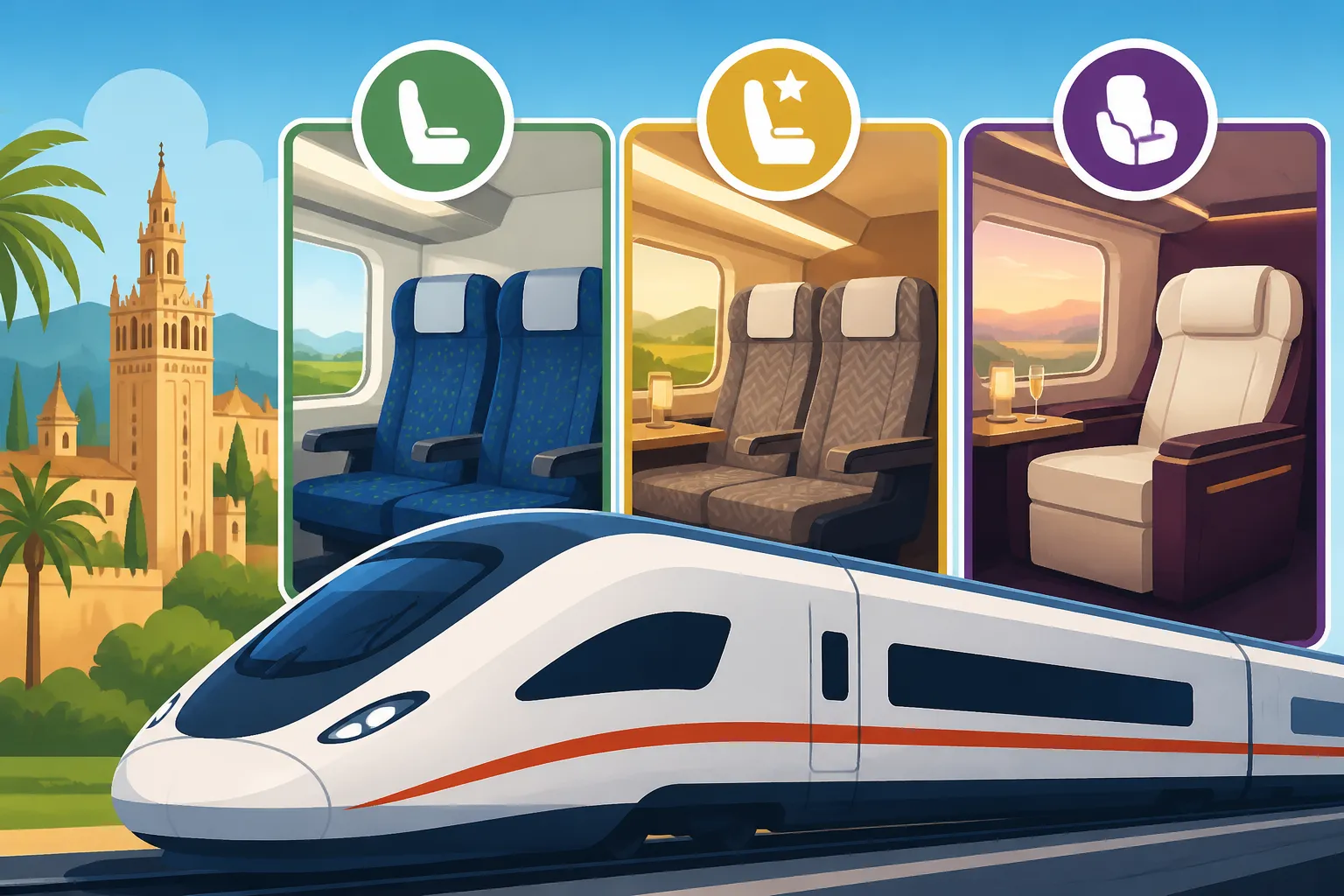
Spanish Train Classes Explained: Turista, Elige, and Premium
Disclosure: This article contains affiliate links. If you buy through them, we may earn a commission at no extra cost to you. Read our full disclosure.
You’ve just landed in Madrid, opened a train booking page, and you’re staring at three options for the same AVE to Seville: Turista, Elige and Premium. The price gap looks big, the descriptions are vague, and the Spanish fine print doesn’t help. This guide explains what each class gets you, which one suits which kind of trip, and how to compare them without guessing.
How Spanish Train Classes Actually Work
When I took my first long-distance train in Spain, I thought “class” meant what it does on most European railways: a cheaper carriage at the back and a nicer one at the front. That’s only half of it here. On Spanish high-speed and long-distance trains, what you pay for is a mix of where you sit and what you’re allowed to do with your ticket afterwards. Once that clicks, the booking screens make much more sense.
Seat Class Versus Fare Type
Spanish train tickets have two layers. The first is the physical seat: a standard carriage or a more spacious premium carriage with wider seats and fewer per row. The second is the fare: the rules attached to your booking, such as whether you can change the departure time, whether you get money back if you cancel, whether you can pick your seat, and what extras are included.
Renfe, the state operator, links these layers through its fare families. A basic fare usually puts you in the standard carriage with tight rules. The middle tier, Elige, lets you add flexibility and, depending on the version, upgrade the seat. Premium bundles the better seat, the most flexible rules and extra services. So two people in identical standard seats can hold very different tickets: one can’t change anything, the other can move to a later train for little or no penalty.
This is why I tell friends visiting Spain to stop asking “which class is nicer?” and start asking “how certain are my plans?” If your plans are fixed, the seat is the only real question. If they might move, the fare rules matter more than the legroom. For the full detail on what each fare family allows, see Renfe Ticket Types: Change and Refund Rules by Fare Class.
Where the Name Turista Still Shows Up
“Turista” is the traditional Spanish name for standard class, and it hasn’t disappeared. You’ll see it on older printed tickets, on some routes, on carriage signs and on third-party booking sites that kept the familiar wording. Spaniards still say “en turista” for the standard carriage, just as English speakers say “economy” for flights whatever the airline calls it.
Renfe’s own system now often uses “Estándar” for the standard seat and ties it to the Básico and Elige fares. That’s why people get confused: a booking site shows “Turista,” the Renfe app shows “Estándar,” and the printed ticket may show something else again. In practice, Turista means the standard carriage, usually with the lowest-flexibility fare.
My advice is to ignore the label and read the conditions. On any booking screen, open the fare details and check four things: the seat type, whether changes are allowed, whether cancellations are refunded, and whether seat selection is included. Those four answers tell you more than the name.
Why Each Operator Uses Its Own Labels
Since liberalisation, Spain’s high-speed lines are no longer Renfe-only. Ouigo, Iryo and Renfe’s low-cost brand Avlo all run trains on the busiest corridors, and each uses its own vocabulary. Iryo has its own tiered names, Ouigo sells a basic seat with paid add-ons, and Avlo follows a low-cost model where almost everything beyond the seat is extra.
For travellers this is good and bad. Good, because competition has made high-speed travel far more affordable on routes like Madrid to Barcelona and Madrid to Valencia. Bad, because comparing “standard” across four companies is hard when nobody uses the same words. Turista on Renfe, the basic tier on Iryo and the standard Ouigo seat are roughly comparable, but the luggage, food and change rules differ.
That’s the main reason I search on a multi-operator platform like Omio: it puts Renfe, Ouigo, Iryo and others in one results list with comparable departure times and fare descriptions. For a deeper look at how the companies compare, see Renfe vs Ouigo vs Iryo vs Avlo: Spain’s High-Speed Competition Compared.
Turista and the Basic Fare in Detail
Most visitors and plenty of residents travel Turista almost all the time, and there’s nothing second-rate about it. Spanish high-speed trains are clean, quiet and comfortable even in standard. The trade-offs are in flexibility and extras, not in basic comfort.
What You Actually Get in Turista
A Turista or standard seat on an AVE gives you a reclining seat, usually arranged two plus two across the carriage, with a fold-down tray table, overhead luggage racks and luggage space at the carriage ends. Most modern trains have power sockets at or near the seats, though older stock varies. Toilets, air conditioning and on-board screens showing speed and stops are standard.
Many long-distance trains also have a café-bar carriage open to all passengers. In Turista you buy food and drinks there; nothing is brought to your seat. On a two-and-a-half-hour run like Madrid to Seville that’s fine: I usually pick up a bocadillo and a coffee at the station, settle in, and watch La Mancha roll past.
Legroom is reasonable, noticeably better than a budget airline, and I’ve done the full trip from Madrid to Málaga in standard without discomfort. The main physical difference from premium is width: four seats across instead of three, so on a full train you’ll share an armrest with a stranger.
The Restrictions That Bite
The real cost of the cheapest Turista tickets is rigidity. Basic fares usually carry strict conditions on changes and cancellations. Depending on the fare, changing your departure may cost a fee or not be allowed, and cancelling may return little or nothing. Seat selection may cost extra, so you get whatever the system assigns, which can split up couples and families.
Here’s a typical scenario. A friend of mine booked the cheapest Turista fare from Barcelona to Madrid for a Friday afternoon, then her meeting moved to the morning. Her fare didn’t allow a free change, so she paid for a new ticket and lost most of the first. The more flexible Elige fare would have cost only a little more and let her switch trains easily.
Luggage is the other thing to watch. Renfe’s standard allowance is generous compared with low-cost operators, but limits exist, and the low-cost brands charge for anything beyond a small bag. If you’re travelling with suitcases, read Luggage Rules on Spanish Trains and Buses: Limits and Fees before choosing the cheapest option.
Who Should Book Turista
Turista suits you if your plans are firm, you’re comfortable in a standard seat for a few hours, and you’d rather spend the savings on tapas in Seville than on a wider armrest. Backpackers, students, budget weekenders and anyone on a fixed itinerary will be happy here.
It’s also usually the right choice for shorter high-speed hops, such as Madrid to Toledo or Madrid to Segovia, where the journey is so short that premium perks barely register. Paying extra for a lounge you’ll spend ten minutes in rarely makes sense.
Where Turista goes wrong is with uncertain plans. Business travellers, people connecting from flights that might be delayed, and families with small children often find that a slightly more flexible fare pays for itself the first time something changes. If you’re travelling with kids, see Booking Spanish Transport With Kids: Child Fares, Seats, and Prams before you lock in the cheapest seat.
Elige: The Middle Tier That Confuses Everyone
Elige is Spanish for “choose,” and that’s the point of the fare. Instead of a fixed bundle, you start with a base and add what matters to you. It’s the most useful fare for many travellers, and the least understood.
Elige Estándar Versus Elige Confort
Renfe generally offers Elige in two seat versions. Elige Estándar keeps you in the standard carriage, the same physical seat as Turista, but with better ticket conditions and the option to add extras. Elige Confort moves you into the premium carriage with its wider, more spacious seats, while still letting you customise flexibility.
This split explains why some booking screens show two Elige prices for the same train. If you see both, the gap is mainly the seat. If the cheaper one is close to the basic fare, it’s often worth taking just for the improved conditions.
Here’s how I explain it to visiting friends. Elige Estándar is for people who want flexibility but don’t care much about the seat. Elige Confort is for people who want a more comfortable ride without paying for every Premium extra, such as lounge access or full meal service. Many long-time residents I know book Elige Confort for longer trips and Turista for short ones.
The Flexibility and Extras You Can Add
Elige’s main advantage is choice. Depending on the version and current conditions, you can typically add or include options such as easier changes to your departure, better cancellation terms, seat selection and other services. The exact menu varies, so read the fare conditions at the moment you book rather than relying on memory or a friend’s advice from last year.
In practice, Elige often means that if your plans shift by a few hours, you can move trains without losing your ticket. For anyone whose day depends on something unpredictable, like a medical appointment, a job interview, a flight arrival or a toddler’s nap, that matters.
Seat selection is the other underrated benefit. If you want a window on the scenic stretch, a seat facing the direction of travel, or to sit with your travel companion, being able to choose is worth a lot. Couples who end up three rows apart on a basic fare learn this quickly.
When Elige Pays for Itself
Elige pays off when there’s a realistic chance your plans will change. Say you’re flying into Madrid-Barajas and want to take the AVE to Valencia the same afternoon. Flight delays happen. With a basic fare, a late landing means a missed train and a new ticket. With a flexible Elige fare, you can usually move to a later departure instead of starting over.
It also pays off on long journeys where comfort matters. A four- or five-hour trip from Madrid to Galicia, or a long cross-country route like Barcelona to Seville, is far nicer in a Confort seat, and Elige Confort usually gets you that seat without Premium’s full price.
Elige matters less on short, fixed trips. If you’re doing a quick day trip with a firm return time, the basic fare is usually enough. For a full breakdown of the corridor most visitors start with, see Madrid to Seville by AVE: Tickets, Timings, and Cheapest Booking Window.
Premium: Is the Top Tier Worth It?
Premium is Renfe’s top fare: the most comfortable seat, the most flexible conditions and the most services. It isn’t always expensive, especially if you book early, and on some trips it’s genuinely good value. But it isn’t automatically the right choice.
The Lounge, Meals and Seat
Premium puts you in the spacious carriage, typically three seats across instead of four, so you get more width, more legroom and less chance of sharing an armrest. The carriage is usually quieter too, with more business travellers working or reading.
Premium fares usually include extras such as at-seat food and drink service on many long-distance services, and access to Renfe’s station lounges at major hubs like Madrid Puerta de Atocha and Barcelona Sants. The lounge is a quiet space to wait, with seating and refreshments, away from the crowds in the main concourse. What’s included varies by train, route and time of day, so check the specific service before assuming you’ll get a full meal.
On a long journey the difference is real. On a short commuter-style hop, you’d barely notice it.
Full Flexibility Without the Headaches
Premium’s biggest practical benefit is its flexible conditions. Premium fares generally offer the most generous change and cancellation terms in Renfe’s range, and you usually choose your seat. If your schedule is genuinely uncertain, Premium removes most of the stress.
Business travellers book Premium for exactly this reason, often less for the food than for being able to move from the 8am to the 11am train when a meeting runs over. If your company is paying and needs a proper invoice, Premium on a direct operator booking is usually easy to expense.
Note that Premium flexibility applies to the operator’s own conditions. When things go wrong on the railway side, such as strikes, major delays or cancellations, passenger rights apply whatever class you hold. For what you’re entitled to in those situations, see Strikes and Cancellations in Spain: Your Rights and Rebooking Options.
Real Scenarios Where Premium Makes Sense
Premium makes sense when at least two of these apply: the journey is long, your plans are uncertain, comfort matters a lot to you, and the price gap is small. That last one surprises people. Booked far ahead, the gap between Elige Confort and Premium can be modest, and sometimes Premium is the better deal once you count the food and flexibility.
It also suits travellers who need extra space or a calmer environment, such as older relatives, people recovering from an injury, or anyone who finds busy carriages tiring. For passengers with reduced mobility, Renfe’s assistance service is a separate matter from class; see Accessible Travel on Spanish Trains: Booking Assistance in Advance.
Premium makes little sense on short trips, on tight budgets, or when you’ll be asleep or on your phone the whole way. If you’re travelling Madrid to Barcelona mainly to get there, Turista or Elige Estándar will do the job. For a broader comparison of that route, see Madrid to Barcelona: Train vs Flight vs Bus Compared.
Comparing Classes Across Renfe, Ouigo, Iryo and Avlo
Once you leave Renfe’s own website, the class names multiply. This section helps you compare like with like, which is where a multi-operator search saves a lot of time.
Side-by-Side Comparison of Spanish Train Classes
The table below summarises the main categories. Conditions change and vary by route, so treat it as a guide to the structure, not a guarantee of what any ticket includes on a given day.
| Option | Seat type | Change and cancellation | Seat selection | Food and extras | Best for |
|---|---|---|---|---|---|
| Renfe Turista or Básico | Standard carriage, four across | Most restrictive | Often paid or assigned | Café-bar purchases only | Fixed plans, short trips, tight budgets |
| Renfe Elige Estándar | Standard carriage, four across | More flexible, with options to add | Usually available | Café-bar purchases, optional extras | Uncertain plans without needing more space |
| Renfe Elige Confort | Premium carriage, three across | More flexible, with options to add | Usually available | Optional extras | Longer trips where comfort matters |
| Renfe Premium | Premium carriage, three across | Most flexible in Renfe’s range | Included | Lounge access at major stations and on-board service on many routes | Long trips, business travel, uncertain schedules |
| Avlo | Standard seat, low-cost model | Restrictive, extras paid | Paid add-on | Minimal | Budget travel on main corridors |
| Ouigo | Standard seat, low-cost model with add-ons | Restrictive unless flexibility is purchased | Paid add-on | Paid options | Budget travel with light luggage |
| Iryo | Tiered seats from basic to premium | Varies by tier | Varies by tier | Varies by tier, top tiers include more | Comparing a private alternative to Renfe |
The practical lesson: the low-cost brands’ cheapest fares are often the cheapest way to cross Spain, but every extra costs money. Once you add a large suitcase, seat selection and flexibility, a Renfe Elige fare can work out close in price and more comfortable. You only see that when the options sit side by side.
Regional and Commuter Trains Have Different Rules
Everything above applies to high-speed and long-distance services. Regional trains, Media Distancia, and local Cercanías or Rodalies commuter trains usually have a single class with simple ticketing. You won’t find Premium lounges on a Cercanías train from Madrid to Alcalá de Henares, and you don’t need them.
Some Media Distancia and regional services have fixed-seat reservations and some don’t, and the rules on buying ahead also vary. If you’re mixing a high-speed leg with a regional connection, say AVE to Córdoba then a regional onward, check the second leg’s rules separately; see Do You Need to Book Cercanias and Media Distancia? Ticketing Rules Explained.
This catches many visitors on longer itineraries. You book a nice Elige Confort seat to a major city, then discover your connecting regional train works differently. Planning both legs together avoids surprises, and it’s another case where seeing everything in one search helps.
Booking the Right Class With Omio
After years of booking trains around Spain for myself, visiting friends and family, I’ve settled on a simple routine: compare first on Omio, then decide on class and operator. It saves real time and makes the class differences much clearer than flicking between four operator websites in two languages.
Why Comparing Classes on Omio Makes Sense
The main frustration for foreigners booking Spanish trains isn’t the trains, it’s the booking. Operator websites can be confusing, change their wording, and sometimes reject foreign cards or ask for details in unfamiliar formats. Omio is a multi-operator platform with an English interface that brings Spanish rail operators together in one search, so you can see departures, operators and fare levels side by side.
That matters for class decisions. If you search Madrid to Valencia, you can see whether a Renfe Turista fare, a Ouigo basic seat or an Iryo tier fits your budget and needs, without opening multiple tabs. Fare names and conditions appear next to each option, so you can tell flexible tickets from restrictive ones before you pay. Omio may add a service or booking fee on some tickets, so check its own page for current charges and compare against booking direct when the price difference matters.
Payment is the other big plus. Many newcomers find that foreign cards work smoothly through an international platform when an operator’s own checkout causes problems. For the full story on card declines and passport fields, see Booking Spanish Trains From Abroad: Foreign Cards, Passports, and Failures. For me, the convenience and clarity are worth it, especially when booking for people who don’t speak Spanish.
Step-by-Step: Choosing Your Class on Omio
Here’s the process I walk friends through when they’re planning their first Spanish rail trip.
- Open Omio and enter your departure and arrival cities, such as Madrid and Seville, and your travel date. Use city names rather than specific stations unless you know which station you need, so you see departures from every relevant terminal.
- Filter the results to trains only, so buses and flights don’t clutter the list, then sort by departure time or price depending on your priority.
- Pick two or three departures that fit your schedule and open each one’s fare options. This is where you’ll see the class and fare levels, such as standard or Turista, Elige-type flexible fares and premium tiers.
- For each option, check the four key details: seat type, change rules, cancellation rules and seat selection. Ask yourself honestly how likely your plans are to change.
- Compare across operators. If a Renfe Elige fare and a low-cost basic seat are close in price, work out the low-cost total once you’ve added luggage and seat selection.
- Enter passenger names exactly as they appear on your passport or ID, because names on Spanish train tickets may be checked at boarding.
- Pay, then save the ticket in the app and download a copy for offline use, since signal can drop in tunnels and in stations.
- On travel day, check your departure platform on the station boards, arrive with time to spare for the security scan at major stations, and keep your ticket and ID ready.
Doing this before every trip takes a few minutes and stops the classic mistake of buying the cheapest seat on reflex and regretting it later.
Common Mistakes When Choosing a Train Class
The biggest mistake is choosing by price alone when plans are uncertain. The cheapest basic fare looks great until your flight lands late or your meeting moves. Spend thirty seconds asking how likely it is that you’ll need to change, and pick the fare that matches.
The second mistake is booking too late. Spanish high-speed fares usually rise as departure approaches and cheap seats sell out, so the gap between Turista and Premium can widen or shrink depending on when you book. For how fares move over time, see Spanish Train Price Curves: How Fares Move From 60 Days Out to Departure. Checking Omio a few weeks out and again closer to the date shows you how prices behave on your route.
The third mistake is forgetting the full journey. Travellers book a comfortable long-distance seat and forget the regional connection, the airport transfer or the luggage limits on the low-cost leg. Plan the whole trip from door to door, and if the AVE network is new to you, see High-Speed Trains in Spain (AVE): Routes, Booking, and Savings.
Choosing Your Class: A Practical Summary by Traveller Type
After all the detail, it helps to boil it down. Here’s how I’d book for different kinds of trips, based on years of riding Spanish rails in every class.
Budget Travellers and Short Trips
If you’re on a fixed itinerary, travelling light and counting euros, Turista or the cheapest low-cost seat is the obvious choice. Book early, accept the restrictions, and spend the savings at your destination. Day trips like Madrid to Toledo or Barcelona to Girona rarely justify anything more.
Even here, a quick look at flexible fares is worth it. If a flexible ticket costs only a little more than the basic one, it’s cheap insurance. A quick Omio search shows the gap at a glance.
Couples, Families and Longer Journeys
For couples and families, seat selection often matters more than the seat itself. Sitting together, especially with children, is worth paying for, which makes Elige Estándar a strong default. On longer journeys, such as Madrid to Galicia, Málaga or Alicante, Elige Confort’s wider seats make the trip noticeably more pleasant.
Families should also think about luggage and pushchairs. The standard Renfe allowance is usually more generous than on low-cost operators, so the cheapest headline fare isn’t always the cheapest once your bags are on board.
Business Travellers and Uncertain Schedules
If your schedule can change at short notice, Premium or a flexible Elige fare is the sensible choice. The ability to switch trains, the quieter carriage and access to station lounges at hubs like Atocha and Sants all make work trips easier. When the company is paying and needs clean invoices, keep your booking confirmations organised from the start.
Whatever your situation, the method is the same: decide how firm your plans are, decide how much comfort you need, then compare operators and classes side by side on Omio before you book. Spanish trains are some of the best in Europe, and with the right class you’ll enjoy every kilometre.
Disclaimer
This article is for general informational purposes only and does not constitute professional advice. Laws, prices and regulations vary by location and change over time. Consult a qualified professional for guidance on your specific situation.