Should You Ship Appliances to Spain? Voltage, Plugs, and Practicality
Disclosure: This article contains affiliate links. If you buy through them, we may earn a commission at no extra cost to you. Read our full disclosure.
You have a fridge, a stand mixer and a dryer you love, and a container quote that charges you for every cubic metre. Will they work on Spanish electricity, fit a Spanish kitchen, and justify the cost of shipping? This guide covers voltage, frequency, plugs, contracted power, kitchen sizes and gas setups. It also shows how to compare movers on Sirelo before you commit.
How Spain’s Electrical System Works for Imported Appliances
When I packed for my own move, I stood in my old kitchen with a roll of bubble wrap. I tried to decide whether the coffee machine was coming. I wish someone had sat me down first and explained how Spanish homes are wired. Most of the ship-or-sell decision comes from three technical facts: the voltage, the frequency and the plug.
Voltage and Frequency in Spanish Homes
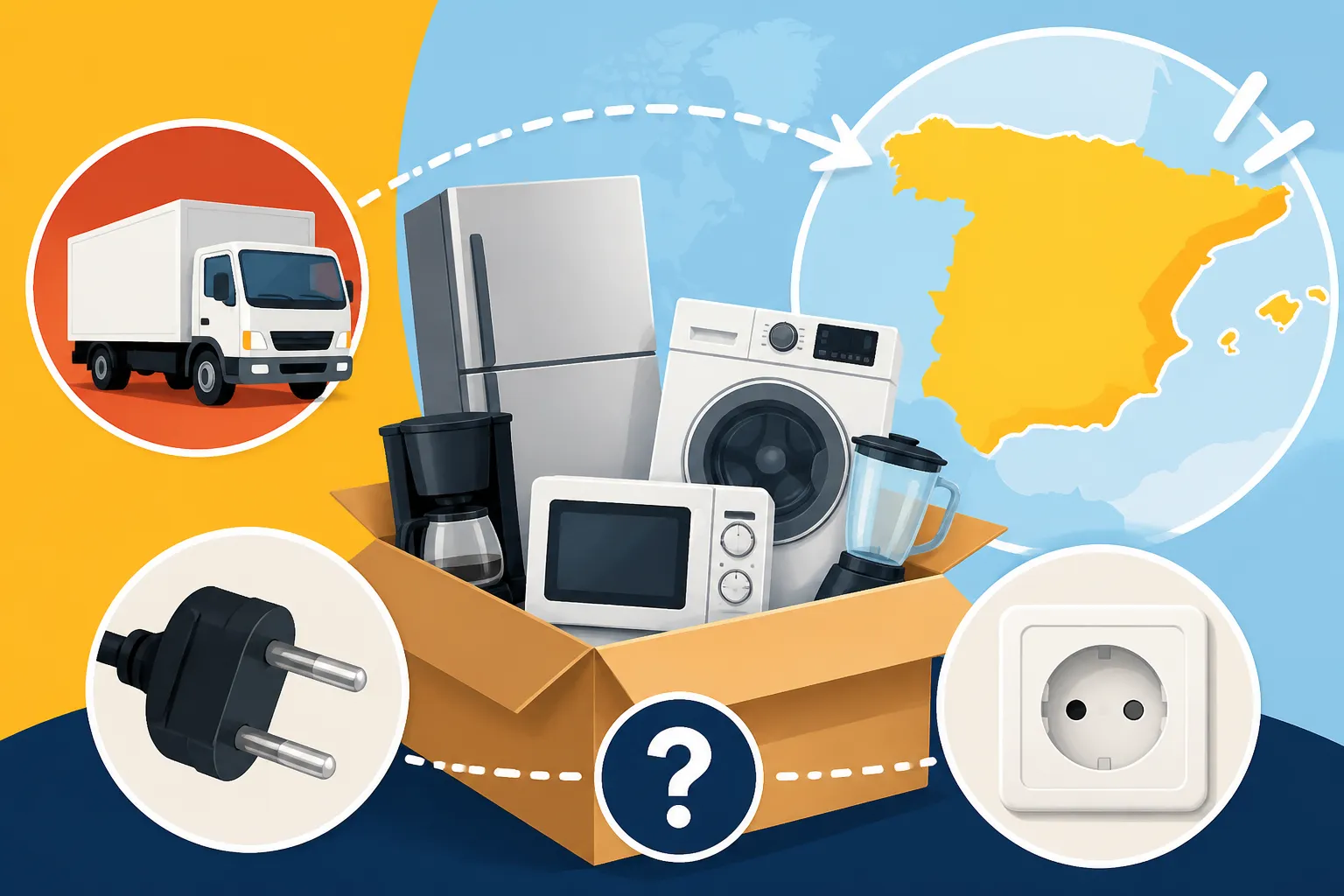
Spain runs on 230 volts at 50 hertz, like the rest of continental Europe. Voltage matters most. If an appliance is built for 230 volts, it will run on Spanish mains without complaint. If it is built for 120 volts, the North American standard, plugging it straight into a Spanish socket can destroy it in seconds. It can also start a fire.
Frequency is the quieter problem, and it often gets missed. North America uses 60 hertz and Spain uses 50 hertz. Anything with a motor or a timing circuit tied to the mains frequency can behave differently. A 60-hertz motor on a 50-hertz supply turns more slowly and can run hotter. Analogue clocks on ovens and microwaves can drift, and some mixers, fans and turntables lose speed. A transformer fixes voltage but does nothing for frequency. That catches out plenty of Americans who think the problem is solved once the transformer arrives.
Here is a scenario that often comes up. A family from Texas ships their favourite microwave and runs it through a sturdy step-down transformer. It heats food, but the clock is wrong within a day and the turntable spins sluggishly. After a few months the transformer is too hot to touch after long reheats. Nothing exploded, but they ended up buying a Spanish microwave anyway. They had paid for container space, a transformer, and finally a replacement.
Plug Types and Why Adapters Are Only Half the Story
Spanish sockets take the round two-pin plugs known as Type C and Type F. Type F is the Schuko style with side earthing clips, and you will find it everywhere from new-build flats in Valencia to old apartments in Lavapiés. A Type C plug fits a Type F socket, which is why so many small European devices come with a slim two-pin plug.
A plug adapter only changes the shape of the connection, so treat it as a physical bridge. It does not convert voltage or frequency. For a British kettle that already runs at 230 volts, an adapter is all you need, though swapping the plug for a proper Schuko one is neater and safer for something you use every day. For an American hair dryer, an adapter alone is dangerous. The plug will fit, but the appliance will not survive.
Adapters also wear out. Cheap travel adapters are fine for charging a phone overnight. They are a bad idea for a heater, an iron or anything else that pulls serious power for long periods. Heavy loads through a loose adapter cause heat at the contact points, and in an older Spanish building with tired wiring that is a risk worth avoiding. If you keep an appliance long-term, have the plug replaced by someone who knows what they are doing. Better still, decide in your home country that it is not worth bringing.
Contracted Power and Tripped Limiters
This one surprises newcomers far more than plugs do. Spanish electricity contracts include a potencia contratada, the maximum power your home can draw at any one moment. Run the oven, the dishwasher, a portable heater and the kettle together, and you can exceed it. The power then cuts out, and you are in the dark hunting for the fuse box.
That changes how you should think about big imported appliances. A large American-style range, a powerful tumble dryer or a high-output electric heater might work on the voltage. It can still push a modest contract over the edge at dinner time. Older rental flats often come with low contracted power, and raising it means a change to your contract with its own cost and paperwork. For how the system works and how to read your contract, see How to Understand ‘Potencia’ on Your Spain Power Contract.
So when you assess an appliance, look at its wattage as well as its voltage. Ask whether your Spanish home can realistically run it alongside everything else. A machine that worked happily on a big suburban supply at home may be a nuisance in a two-bedroom piso in Seville.
Your Home Country Decides Most of the Answer
The single biggest factor in this decision is where you are moving from. The same espresso machine can be a smart thing to ship from Dublin and a mistake to ship from Denver. The table below gives the quick picture before we go through each group.
| Moving from | Voltage and frequency | Plug at home | What it means in Spain |
|---|---|---|---|
| United States and Canada | 120 volts, 60 hertz | Type A and B | Most kitchen and laundry appliances need a transformer and still face frequency issues; usually sell rather than ship |
| United Kingdom and Ireland | 230 volts, 50 hertz | Type G | Electrically compatible; plug swap or quality adapter needed; size and practicality become the deciding factors |
| Australia and New Zealand | 230 volts, 50 hertz | Type I | Electrically compatible; plug swap needed; long shipping route makes volume the main question |
| EU countries such as Germany, France, the Netherlands | 230 volts, 50 hertz | Type C, E and F | Usually plug-and-play; decide on space, age and transport cost alone |
| Latin America, varies by country | Mix of 110 to 127 volts and 220 volts, 50 or 60 hertz | Mix, often Type A, B, C or I | Check each appliance’s rating plate individually before deciding |
Coming From the US and Canada
For North Americans the honest answer is short. Large appliances almost never make sense. Washers, dryers, fridges, ranges and dishwashers are built for 120 volts and 60 hertz, and some American dryers and ranges use a split 240-volt supply that has no Spanish equivalent. Transformers big enough for these machines are heavy, noisy and wasteful, and the frequency mismatch still affects motors and timers.
Small electronics are a different story. Laptop chargers, phone chargers, camera batteries and many modern gadgets have universal power supplies. Look for a rating plate saying something like “100 to 240 volts, 50 to 60 hertz”. Those need only a plug adapter or a new cable. Before you pack anything, turn it over and read the label. That one habit will save you more money than any other tip here. For the full story on chargers, TVs and certification marks, see Shipping Electronics to Spain: Warranty, Voltage, and CE Marks.
Container economics push the same way. From the US you are often paying for a long sea route plus port handling and inland delivery. A full-size fridge takes up space you could use for furniture, books or sentimental items that cannot be replaced in Spain. For the route itself, see Moving to Spain from the US: Container Costs, Ports, and Timelines.
Coming From the UK, Ireland, and Australia
If you are coming from Britain, Ireland or Australia, your appliances are already built for 230 volts at 50 hertz. Electrically, that kettle, toaster, washing machine and fridge will run fine in Madrid or Málaga once the plug is sorted. This is where people get overconfident and ship everything, only to find the real problems are physical rather than electrical.
British washing machines and dishwashers generally use standard European widths, which is good news. Large American-style fridge-freezers that have become popular in UK kitchens are a different matter. They often struggle with the narrow doorways, tight stairwells and small lifts of Spanish apartment blocks. UK cookers with integrated grills may not match Spanish kitchen layouts, and gas cookers raise conversion questions, covered below. Post-Brexit, British movers also face customs paperwork that EU movers do not; see Moving to Spain from the UK After Brexit: Customs, Costs, and ToR Relief.
Australians and New Zealanders face the longest route of all, so every cubic metre counts. The appliances are compatible, but the shipping journey is long. By arrival your washing machine is a little older, and it has crossed oceans in a container. Many families I know shipped only high-value small appliances and bought large white goods locally after landing.
Moving Within the EU
If you are coming from Germany, France, the Netherlands, Italy or another EU country, you are in the easiest position. Same voltage, same frequency, largely the same plugs, and no customs duty on household goods moving within the single market. Your appliances will most likely work the day they arrive.
The decision then comes down to plain practicality. Is the machine new enough to be worth moving? Will it fit the kitchen you have rented? Does road freight pricing make it cheaper to bring than to replace? For EU movers sharing a truck through groupage, the space a fridge or washing machine takes up is often what decides it. See Full Load vs Groupage to Spain: Cost Break-Even by Cubic Metre for how that maths works.
Appliance by Appliance: What Is Worth the Container Space
Once you know your electrical compatibility, go through your home one item at a time. I did this with a notebook and a tape measure, and it turned a vague worry into a clear packing list. The table below sums up how I would think about the common categories. The sections after it explain the reasoning.
| Appliance type | From 230-volt countries | From 120-volt countries | Key practical question |
|---|---|---|---|
| Fridge-freezer | Ship only if standard size and fairly new | Sell before moving | Will it fit the kitchen, doorway and lift? |
| Washing machine | Often worth considering if recent | Sell before moving | Is there a space and connection, often in the kitchen? |
| Tumble dryer | Think twice; many Spanish flats lack space or venting | Sell before moving | Will you actually use it in a sunny climate? |
| Dishwasher | Worth shipping only if it matches local integrated sizes | Sell before moving | Does your rental kitchen have a dishwasher slot? |
| Cooker or range | Electric may work; gas needs conversion | Sell before moving | What fuel does your Spanish kitchen use? |
| Stand mixer, blender, coffee machine | Usually worth shipping | Only if dual-voltage, otherwise sell | Is it high value and hard to replace? |
| Laptops, phones, chargers | Ship | Ship if rated for 100 to 240 volts | Check the rating plate |
| Television | Usually fine | Often fine if multi-voltage; check the label | Will it pick up Spanish broadcast signals? |
Large White Goods
Large appliances are where the money is won or lost. They are bulky and heavy, they need careful handling, and they are the items most likely to be damaged in transit. A fridge that has been tipped on its side has to stand upright for a while before you switch it on, and compressors do not enjoy long sea journeys. Washing machines need their transit bolts refitted before transport, or the drum can be damaged. That is something you or your mover must handle properly.
There is also the question of what your Spanish home already has. Many long-term rentals in Spain come with a fridge, washing machine and hob already installed, especially furnished and semi-furnished flats. You may arrive with an expensive washing machine and find a perfectly good one already plumbed in. Your landlord may not want it removed, and you have nowhere to store yours. Before shipping any white goods, ask your landlord or agent exactly what is included. For what usually comes with rented flats and how to fill the gaps, see Buying Furniture and Appliances in Spain: Delivery, Warranties, Returns.
Tumble dryers deserve a special mention. In much of Spain, especially the south and the Mediterranean coast, people dry laundry on a tendedero (clothes rack) or a line in an interior patio. Many flats have no room for a dryer and no vent route. A dryer that ran every day back home may sit unused here, and when you do run it, it pulls a lot of power against your contracted limit.
Small Kitchen Appliances and Gadgets
Small appliances are usually the opposite case. They are light, compact, often expensive, and personal. A good stand mixer, an espresso machine you have tuned to perfection, or a specialist rice cooker can be worth bringing from a 230-volt country. They take little space, and replacing them in Spain at equivalent quality can cost you.
From 120-volt countries, take each one case by case. A kettle or toaster is cheap to replace in any Spanish supermarket or electronics shop, so ship it only if it has sentimental value. A high-end stand mixer is tempting, but its motor is sensitive to frequency. Running it on a transformer can mean slower speeds and extra strain over time. Many Americans I know sold theirs and bought the European version once settled.
Do not forget hair dryers, straighteners, electric shavers and toothbrush chargers. Some are dual-voltage and need only an adapter. Others are 120-volt only and must stay behind. A hair dryer is one of the most common appliances people plug in wrongly in their first week. It is also one of the cheapest to replace locally.
Electronics, TVs, and Home Office Gear
Electronics are the easy win for almost everyone. Most laptops, monitors, printers, games consoles and phone chargers have universal power supplies. A new cable or a plug adapter is usually all you need, regardless of where you are moving from. Pack them carefully, ideally in original boxes, and insure them properly.
Televisions are slightly more nuanced. Most modern flat-screens accept a wide voltage range, but check the rating plate. The bigger question is whether the TV’s built-in tuner works with Spanish digital terrestrial broadcasts. If you mostly stream, it hardly matters. If you want to watch Spanish channels through an aerial, check that the set supports the European broadcast standard, or plan to use an external box.
Home office gear for remote workers is usually worth shipping too: a good monitor, an ergonomic chair, a printer. These items are high value relative to their volume. Moving them by container rather than in your luggage means less hassle at the airport and better protection if your mover packs them well.
Practical Reality Inside a Spanish Home
Even when an appliance is electrically perfect, a Spanish home can stop it in its tracks. The best way to avoid disappointment is to think about the specific flat you are moving into, not an ideal kitchen.
Fitting Appliances Into Spanish Kitchens and Lifts
Spanish apartment kitchens tend to be compact, and the washing machine often lives in the kitchen itself rather than a separate utility room. Fitted kitchens commonly have integrated slots built to standard European dimensions. A freestanding British or American dishwasher or fridge may not match them in height, width or depth. Measure the spaces in your new home if you can, or ask your agent for exact dimensions and photos.
Then think about getting the appliance into the building. In the historic centres of Madrid, Barcelona, Seville or Cádiz, you may face narrow streets where a large truck cannot park. Buildings may have tiny lifts or no lift at all, and winding stairs. A large fridge-freezer that came out of your old house easily may simply not get up to a fourth-floor flat in the Barrio Gótico without a hoist through the balcony. For what moving day looks like in practice, see Delivery Day in a Spanish Building: Narrow Streets, Lifts, and Permits. For measuring your furniture against Spanish room sizes, see Will Your Furniture Fit? Spanish Apartment Layouts vs Northern European Homes.
A friend of mine moved from Manchester to an old building near Plaza de la Merced in Málaga. She had shipped a large double-door fridge, and it would not fit through the stairwell turn. The removal crew had to arrange a balcony hoist at short notice, at extra cost. The fridge also blocked half the kitchen window once installed. She sold it within a year and bought a narrower local model.
Gas Hobs, Butane Bottles, and Conversion
Kitchen fuel in Spain varies a lot. Some homes have mains natural gas, many use electric or induction hobs, and plenty of homes, especially in older buildings and rural areas, still rely on orange butane bottles. A gas cooker from your home country may be set up for a different gas type or pressure. Using it without proper conversion by a qualified installer is unsafe, and it may breach your rental agreement or insurance conditions.
Before shipping any gas appliance, find out what your Spanish home uses. For how bottled gas and mains gas differ in daily life, see Spanish Gas Bottles vs Natural Gas: What You’ll Encounter. In my experience, gas cookers are among the least worthwhile appliances to ship. Conversion parts can be hard to source for foreign brands, and installers may hesitate to certify an unfamiliar model.
Induction hobs from 230-volt countries are usually electrically fine. They do draw a lot of power, which brings back the contracted power question. If your Spanish flat has a low potencia, an induction hob plus an electric oven running at the same time may trip the limiter until you raise your contract.
Warranties, Repairs, and Spare Parts
This is the long-term view that often decides the matter. Appliances bought outside the EU, or bought for a foreign market, may not be covered by a Spanish dealer’s warranty. Even when the brand exists in Spain, the local service network may not repair or stock parts for a model sold only in North America, Australia or the UK.
When something breaks, the technician may tell you they cannot source the part, or that it must be ordered from abroad. You then wait weeks for repairs or pay for shipping and import costs on a single component. Buying locally gives you a Spanish warranty, local repair options, and spare parts available through ordinary channels. See Buying Appliances in Spain: Energy Labels and Warranty Basics for how energy labels and consumer guarantees work here.
Think about energy efficiency too. A new appliance bought in Spain will carry the EU energy label, which makes comparing running costs straightforward. An older imported machine may use more electricity, and Spanish electricity bills are something every expat watches closely. Over several years, a more efficient local appliance can partly offset its purchase price.
Running the Numbers With Sirelo Before You Decide
Every appliance has a real cost to move: the space it takes in the container or truck, the handling and packing, the insurance, and the delivery logistics at your Spanish address. You cannot make a good ship-or-sell decision until you know roughly what that space costs. That is why I send people to Sirelo early in their planning, before they have sold anything or booked anything.
How Volume Shapes Your Removal Quote
International removal quotes are built mostly on volume and route. A fridge-freezer, washing machine and dryer together can take up a significant share of a small shipment. That might be the difference between sharing a groupage load and needing more space. The more large white goods you include, the more you pay to move items you may be able to replace locally.
Quotes also include line items that are easy to miss: packing services, disconnection and reconnection of appliances, special handling for fridges, access fees for difficult streets, and insurance valuation. Two quotes that look similar at first can differ a lot once you read the detail. For how to read a removal quote line by line, see Comparing International Removal Quotes for Spain: Line Items That Hide Costs. For how price builds by volume and origin, see International Move to Spain: Full Shipping Price Breakdown by Volume and Origin.
The practical move is to get two sets of quotes. One should include your large appliances, and one should leave them out. The difference is the true cost of bringing them. Set that against what you could get by selling them at home and what equivalent new or second-hand appliances cost in Spain. You then have a real answer instead of a gut feeling.
Using Sirelo to Compare Movers and Appliance Handling
Sirelo is a comparison platform for removal companies. You enter details of your move, such as origin, destination and approximate volume, and can receive quotes from several international movers. It also publishes reviews and profiles of removal companies, which helps you shortlist movers with experience on your specific route to Spain. For current details on how the service works, check Sirelo’s own website.
I value it most for appliance decisions because comparing quotes makes the per-item cost visible. When you request quotes through Sirelo, be specific in your inventory. List each large appliance by type and size, and note whether you need disconnection, reconnection or special packing. Then compare how each mover handles these items. Some will include fridge handling and transit bolts in their service. Others will price them separately or exclude them.
Here is a straightforward process I suggest to anyone weighing up their appliances:
- Walk through your home and list every appliance, noting its voltage and frequency rating from the label, its approximate size, and its age.
- Remove anything that is 120-volt only and cannot run safely in Spain, unless it has strong sentimental value.
- Ask your Spanish landlord or agent which appliances are already included in your new home, and get the exact kitchen dimensions.
- Request quotes through Sirelo for your full inventory, then request a second set with the large appliances removed.
- Compare the difference in cost against the resale value of your appliances at home and the cost of buying replacements in Spain.
- Check each mover’s terms for appliance handling, insurance valuation and access arrangements at your Spanish address.
- Make your final ship, sell, or donate decision appliance by appliance, then confirm your booking with the mover that best fits your inventory.
Insurance matters as well. Appliances are fragile in transit, and you want valuation that reflects what replacing them would actually cost. Ask each mover you find through Sirelo exactly how they insure electrical items and how claims work for damage that only shows up when you switch the appliance on in Spain. For the general principles, see Moving Insurance for Shipments to Spain: Coverage, Valuation, and Claims.
For non-EU movers, a transfer of residence can let household goods enter Spain without import duty, provided you meet the ownership and residence conditions and file the paperwork correctly. Recently purchased appliances may not qualify, which is another reason not to buy new machines just before you move. See Cambio de Residencia Exemption: The Paperwork That Waives Import Duty for the details, and ask any mover you shortlist on Sirelo whether they handle the customs side for you.
Selling, Recycling, or Donating What Stays Behind
Whatever you decide not to ship has to go somewhere. Selling large appliances in your home country is usually easiest a few weeks before your move. Buyers can collect them, and you can arrange to keep essentials like the fridge until the last days. Local marketplace apps, community groups and neighbours are all good options. Coordinate the timing with your removal date so you are not living without a fridge for a fortnight.
Once in Spain, filling the gaps can be quick and economical. Large electronics chains, department stores and online retailers deliver and install appliances. Many will take away an old machine when they deliver a new one. The second-hand market in Spain is also active, especially in cities with a high turnover of expats and students. See Second-Hand Shopping in Spain: Apps and Tips for Expats for where to look and what to check, and How to Furnish a Spanish Apartment on a Budget if you are starting from scratch.
If you end up with an appliance in Spain you need to get rid of, such as a dryer you never use or a transformer you no longer need, do not leave it beside the communal bins. Spanish municipalities run collection points for large items and electrical waste, and many towns offer scheduled bulky-item collections. See How to Use Spain’s Recycling Punto Limpio Facilities for how these facilities work.
My honest summary after years here: ship small, valuable and compatible items, and think very carefully about large white goods. Before you decide, get comparable quotes through Sirelo with and without your big appliances, so you can see exactly what each one would cost to move. Combine that with a tape measure, a look at every rating plate, and a clear answer from your landlord. You will arrive in Spain with what you need and without the fridge that will not fit through the door.
Disclaimer
This article is for general informational purposes only and does not constitute professional advice. Laws, prices and regulations vary by location and change over time. Consult a qualified professional for guidance on your specific situation.