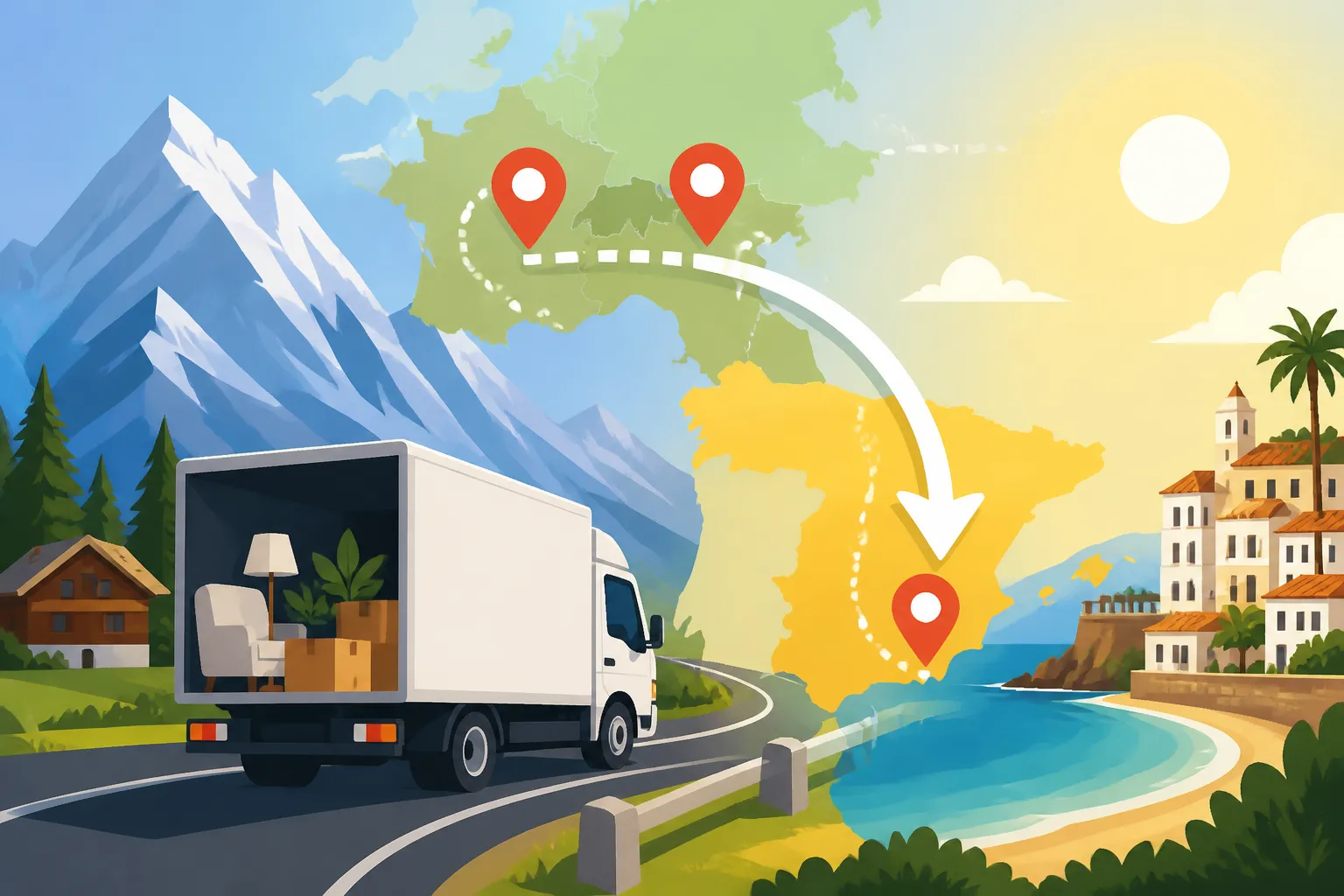
Moving to Spain from Switzerland and Austria: Alpine Route Logistics
Packing up a flat in Zurich or Vienna and sending it to Valencia or Málaga sounds simple until you need to choose a route. On one side are Alpine passes, a Swiss customs border, truck bans and winter closures. On the other is the problem of finding a mover who knows all of it. This guide covers route planning, customs, paperwork and how to compare quotes for an Alpine move without overpaying.
Disclosure: This post may contain affiliate links. We may earn a commission at no extra cost to you if you make a purchase through these links. Read full disclosure.
Why an Alpine Move to Spain Is Its Own Category
When I first priced my own move south, I assumed “Central Europe to Spain” was one category. That assumption was wrong. An Alpine move has two quite different starting points, and which one is yours changes almost everything about the logistics.
Switzerland Is Schengen but Not EU Customs
This is the point that catches people who left Switzerland after a happy decade there. Switzerland is in the Schengen Area, so you drive through Basel or Geneva with barely a glance from border staff. For goods, though, Switzerland sits outside the EU customs union. Your sofa, your bike and your boxes of books are leaving a non-EU customs territory and entering the EU. That needs an export declaration on the Swiss side and an import process on the EU side.
In practice, a competent international remover handles most of this. You still have to supply the right documents, an inventory and proof that you are really changing residence. If you do that, your household goods can usually enter without import duty or VAT under the transfer-of-residence relief. Cambio de Residencia Exemption: The Paperwork That Waives Import Duty walks through that file in detail. The short version is that Spain wants evidence that you lived outside the EU, that the goods are personal and used, and that you are now settling in Spain.
There is also an ownership condition. The relief generally applies to belongings you have owned and used for at least six months before the move. That brand-new espresso machine you bought in Bern last month may not qualify. The Six-Month Ownership Rule: Proving Your Goods Qualify for Duty Exemption explains how to prove the dates with receipts and bank statements.
Austria Moves Like a Domestic EU Haul
If you are leaving Innsbruck, Graz or Vienna, life is easier on the customs front. Austria is in the EU and the EU customs union, so household goods travel to Spain without customs formalities. The truck leaves your building, crosses Germany, France or Italy, and arrives in Spain with no declaration or duty file. EU vs Non-EU Moves to Spain: Why Customs Treats Them Completely Differently goes deeper into why this split matters so much.
That does not make an Austrian move effortless. The distance is long, and Austria has its own weekend and holiday restrictions for heavy trucks. Mountain sections can slow things in winter, and you still need to deregister properly before you go. What Austrian movers save on paperwork, they often spend on route planning.
How the Two Starting Points Compare
| Factor | Moving From Switzerland | Moving From Austria |
|---|---|---|
| Customs union status | Outside EU customs union | Inside EU customs union |
| Export declaration needed | Yes, handled at the Swiss border or an inland customs office | No |
| Spanish import relief file | Yes, transfer of residence documentation | Not applicable |
| Six-month ownership rule | Relevant for duty-free entry | Not relevant for customs |
| Quote currency | Often Swiss Francs, sometimes euros | Euros |
| Deregistration at home | Abmeldung at the municipality | Abmeldung at the Meldeamt |
| Plug type at home | Swiss type J sockets | Type F sockets, same as Spain |
| Typical overland route | Through France via Lyon | Through Germany and France, or through Italy |
| Truck time restrictions | Night and Sunday driving bans for heavy vehicles | Weekend and holiday restrictions for heavy vehicles |
The plug point in that table is a small, practical detail. Swiss appliances generally run on the same mains voltage as Spanish ones, but Swiss plugs often do not fit Spanish sockets. Pack a handful of adapters in your “open first” box or plan to swap plugs. Austrian appliances fit Spanish sockets with no fuss.
Mapping the Overland Route From the Alps to Spain
Nearly every household move from Switzerland or Austria to Spain goes by road. Sea freight makes little sense from a landlocked country when Spain is reachable overland. The real question is which road, and that depends on where you start, the time of year and whether your load fills a whole truck.
Routes From Zurich, Basel, and Geneva
From northern Switzerland, the usual path heads west into France around Basel and Mulhouse. It then runs south through the Rhône valley past Lyon, cuts west along the Mediterranean towards Montpellier and Perpignan, and enters Spain at La Jonquera. From there it is the AP-7 down to Girona and Barcelona, or further to Valencia, Alicante and Andalusia. For Madrid, many drivers turn inland at Barcelona towards Zaragoza.
Geneva is even more direct, since you are practically in France already. Trucks leave via the French motorway network towards Lyon and follow the same Rhône-Mediterranean corridor. If you are moving from Lausanne, Montreux or Sion, your mover may route through Geneva rather than north via Basel. The customs clearance point is then usually at the Geneva border crossings.
Movers from Ticino, the Italian-speaking south, sometimes take the Italian route instead. That runs through Milan, along the Ligurian coast past Genoa, into France at Ventimiglia, then west past Nice and Marseille. It suits a family relocating from Lugano to the Costa Brava. It is less useful if your destination is Galicia.
A scenario I see often: a couple in Zug are moving to a rented flat in Ruzafa, Valencia. Their mover collects on a Thursday and clears Swiss export at an inland customs office before leaving the country. The truck crosses at Basel and goes through France without stopping for customs. It then arrives in Valencia after the weekend, because the driver had to respect French and Spanish rest rules. Nothing went wrong. The couple simply had not budgeted for a few nights in a hotel between handing back their Swiss keys and getting their Spanish ones. For that gap, Storage While You Relocate: Home-Country Units vs Spanish Trasteros is worth reading.
Routes From Vienna, Salzburg, Innsbruck, and Graz
From Vienna and Linz, the classic route runs west across Austria past Salzburg into Germany. It continues through Munich and Stuttgart, crosses into France near Strasbourg or Mulhouse, and then joins the same Rhône-Mediterranean corridor as the Swiss moves. Some trucks pass through northern Switzerland as a shortcut. That brings Swiss transit rules and the heavy vehicle fee into play but no import clearance, because transit goods are handled differently from exports.
From Graz and Carinthia, the southern option through Italy is often shorter. It runs via Villach and Udine into the Po valley, along to Genoa and the coast, and into France at Ventimiglia. A family moving from Klagenfurt to Málaga will often find their mover quietly prefers this route.
Innsbruck sits at a crossroads. A mover can head south over the Brenner into Italy or west through the Arlberg towards Switzerland and France. They can also go north through Germany. Which is fastest depends on season, traffic and the truck’s weight class, so ask your mover which route they plan and why.
Seasonal and Truck Restrictions
This is the Alpine reality your quote should reflect. Switzerland enforces night and Sunday driving bans on heavy goods vehicles. Austria has its own weekend and public holiday restrictions for heavy trucks, plus sectoral limits on some Tyrolean routes. Germany, France and Italy have holiday driving bans of their own. A removal truck leaving on a Friday afternoon may park up until the restrictions lift, which adds time but rarely adds risk.
Winter is the other big variable. Alpine passes close in snow, tunnels get congested and winter equipment is mandatory on many mountain roads. Most removal trucks stay on low-altitude motorways and avoid high passes entirely, but even lowland sections around Salzburg or the Swiss plateau can be slowed by heavy snowfall. If you have flexibility, late spring through early autumn usually brings fewer surprises on the road. Bear in mind that summer is also peak removal season across Europe.
If you hire a van and drive yourself, remember that Switzerland and Austria both require a motorway vignette for light vehicles. Check the current requirements on the official sites before you set off. Plan your fuel stops, too.
Using Sirelo to Get Quotes That Reflect Alpine Reality
This is where most of the stress of my own move disappeared. I spent a week emailing removal companies one by one in German, French and English. Half replied with vague estimates, one never replied at all, and two clearly had no idea that Switzerland needed export clearance. Then a colleague in Basel told me to put the move into Sirelo, and it was the most useful tip I got that whole year.
Why Comparison Matters on This Corridor
Alpine-to-Spain is a niche route. Plenty of removal firms do local moves inside Zurich or Vienna, and plenty of Spanish companies do moves within Spain. Far fewer run this corridor regularly and know Swiss customs, Austrian truck rules and Spanish delivery conditions all at once. When you contact companies at random, you spend a lot of time just finding out who can do the job properly.
Sirelo is a comparison platform for moving companies. You describe your move once, and you receive quotes from removal companies that handle international work. You can also read reviews left by people who actually moved with them. For a corridor this specialised, that combination matters. You are not just comparing prices; you are filtering for companies that have done Zurich to Barcelona or Vienna to Valencia before. Check Sirelo’s own pages for how the service currently works and what it involves for you as a customer.
The other advantage is leverage. When you hold several written quotes for the same job, you can see which ones include customs handling, packing, insurance and delivery-end extras. You can then ask the cheaper firms exactly what they left out. Comparing International Removal Quotes for Spain: Line Items That Hide Costs is the companion piece I would read next to your quotes.
Step-by-Step: Getting Comparable Quotes for Your Alpine Move
- Do a room-by-room inventory before you request anything. Write down large furniture pieces, the approximate number of boxes, fragile items such as artwork or a piano, and anything awkward like a bike rack or ski equipment. Accurate volume is the foundation of an accurate quote.
- Note your access conditions at both ends. In Switzerland or Austria, record the floor, whether there is a lift, and whether the truck can park at the door. Do the same for your Spanish address, as far as you know it. Many Spanish city-centre streets are narrow, and old buildings often have tiny lifts or none at all.
- Submit the move through Sirelo, giving your origin city, your Spanish destination and your preferred moving window. Mention clearly whether you are leaving Switzerland, which triggers customs, or Austria, which does not. Movers will price those jobs differently.
- Specify the services you want, such as full packing, partial packing, dismantling and reassembly, storage, or a dedicated truck versus shared space.
- Compare the quotes in a simple spreadsheet. Give each service its own column so you can see who includes customs clearance, who includes insurance and who has priced delivery-end extras like an external furniture lift.
- Read the reviews on Sirelo for each shortlisted company. Look specifically for comments from people who moved internationally, ideally on a similar corridor.
- Ask follow-up questions in writing. Confirm the route, whether customs paperwork is included, how damage claims work and what happens if the delivery date shifts.
- Book a video or in-person survey with your top two choices before signing. A survey turns an estimate into a firmer quote and protects you from surprise volume charges on the day.
Full Truck, Shared Load, or Your Own Van
One decision your quotes will force on you is whether to pay for a dedicated truck or share space with other customers’ goods. A dedicated load gives you a fixed collection and delivery window and fewer handling stages. A shared load, often called groupage, can work out cheaper for smaller moves, but your goods wait until the truck is full and may be transferred between vehicles. Full Load vs Groupage to Spain: Cost Break-Even by Cubic Metre covers the break-even logic.
| Option | Best Suited To | Advantages | Drawbacks |
|---|---|---|---|
| Dedicated full load | Families, full apartments, tight timelines | Fixed dates, less handling, simpler customs from Switzerland | Higher total cost for small volumes |
| Shared load or groupage | Singles, couples, partly furnished moves | Lower cost for modest volumes | Flexible dates, more handling, longer wait |
| Self-drive rental van | Studio flats, very light movers | Full control over timing | Long Alpine and French driving, Swiss customs done by you, insurance gaps |
| Hybrid of shipped boxes plus luggage | Students, minimalists | Very flexible | Furniture must be bought in Spain |
When I compared my own Sirelo quotes, the price spread between dedicated and shared options was wider than I expected. That spread was what made me realise half my furniture was not worth shipping. Swiss rental flats often come with built-in kitchens and wardrobes, and many Spanish flats come furnished. Before you pay to haul a bulky wardrobe across the Alps, check whether your Spanish flat already has one. International Move to Spain: Full Shipping Price Breakdown by Volume and Origin shows how volume drives the bill.
A Realistic Scenario: Vienna to Madrid
Take Katharina, a teacher in Vienna’s Alsergrund district relocating to a job in Madrid. She has a two-bedroom flat with a piano, a lot of books and a bicycle. She submits her move through Sirelo and gets quotes from several firms. One is noticeably cheaper but quotes shared space with an open-ended delivery window. Another includes a specialist piano crate and a dedicated truck. A third looks mid-range but turns out to exclude parking permits at her destination in Chamberí.
By reading reviews and asking pointed questions, she sees that the mid-range option would have pushed the Madrid street permit onto her, in Spanish, at short notice. She goes with the firm that handles the permit and the piano. The final bill is not the lowest, but there are no surprises on delivery day. That is the real value of comparing properly on Sirelo: you see what you are actually buying, not just a headline figure.
Paperwork, Money, and the Spanish End of the Move
A smooth truck journey means little if your paperwork stalls at the border or you arrive in Spain with no right to receive your goods. This part is unglamorous but decisive.
Deregistering in Switzerland or Austria
In Switzerland, you deregister with your municipality before you leave. This is the Abmeldung, done at the Einwohnerkontrolle or the equivalent office in French-speaking cantons. The deregistration confirmation is often one of the documents a mover or customs officer wants to see as proof that you are really changing residence. Get it early and keep several copies. Also cancel or transfer your Swiss health insurance, and notify your tax authority of your departure date.
In Austria, you deregister at the Meldeamt, which ends your Meldezettel registration at your address. It is less critical for customs, since there are none, but you will want it for your own records. Spanish authorities and some employers may also ask for proof of where you lived before.
Swiss Customs and Spanish Duty Relief
For Swiss moves, your mover typically prepares the export documentation and coordinates EU import formalities. Your part is the file. That means a detailed, signed inventory, ideally in Spanish or with a translation. You will also need your passport, Swiss deregistration proof and evidence of your new Spanish address such as a rental contract or deeds. Add proof of your Spanish residence status, which for non-EU citizens means a visa or residence permit. Some customs offices also ask for a declaration that the goods are for personal use and will not be sold.
Timing matters here, and it is easy to get the order wrong. Spanish authorities generally want to see that you have established residence, so documents like your NIE and padrón registration often need to exist before or around the time your goods arrive. Getting Your NIE and Padron Before Your Container Lands: The Sequencing Problem explains how to line these up. If your residence documents are still pending, talk to your mover early. There are procedures for this situation, but they work far better when planned than when improvised at the border.
If you are shipping a car from Switzerland, that is a separate process with its own registration steps in Spain. Shipping a Car to Spain: Registration, ITV, and the Matriculacion Cost covers it. Do not assume the car can simply ride along with your household goods on the same paperwork.
Paying Your Mover When You Earn in Swiss Francs
For Austrian moves, everything is in euros: your salary, your mover’s quote and your Spanish deposit. There is nothing to convert.
For Swiss moves, the currency question is real. Your savings and final salary are probably in Swiss Francs. Your Swiss mover may quote in Francs, a Spanish or international firm may quote in euros, and your Spanish landlord will certainly want euros. Each conversion between Francs and euros can carry an exchange margin. A traditional bank transfer often builds that margin into the rate rather than showing it as a visible fee.
A few habits help:
- Ask movers whether they can quote and invoice in euros, so you compare quotes on a like-for-like basis.
- Convert larger sums from Francs to euros in planned amounts rather than piecemeal, and compare the rate you are offered against the mid-market rate.
- Keep the Spanish deposit transfer separate from the mover payment, with clear references, so you have a clean paper trail for both.
- Never pay a mover’s full balance before collection unless the contract and the company’s reviews give you confidence.
For a deeper look at routes for Franc-to-euro transfers, see Sending Money to/from Spain: Comparing Banks vs Transfer Services.
Delivery Day in a Spanish Building
Arriving in Spain is where many Alpine movers get their biggest culture shock. Swiss and Austrian apartment buildings tend to have generous stairwells, orderly parking and a building manager who knows the drill. Spanish city-centre buildings can be wonderful to live in, but they bring narrow streets, tiny lifts and restricted access zones. You may also face a neighbourhood association that wants advance notice.
In cities like Barcelona, Madrid, Seville and Valencia, a large removal truck often cannot park outside your door without a temporary permit from the ayuntamiento. Good movers arrange this themselves. Others leave it to you. When large furniture will not fit in the lift or stairwell, crews often use an external furniture lift through a balcony or window, which may need its own permission. Delivery Day in a Spanish Building: Narrow Streets, Lifts, and Permits has the full checklist.
Before delivery day, I strongly suggest:
- Photograph your Spanish street, building entrance, lift and stairwell, and send the images to your chosen mover.
- Confirm in writing who is responsible for the street parking permit and any external lift.
- Tell your building’s administrator or president of the comunidad which day and time the truck will arrive.
- Have your inventory ready to tick off as items come in, and note any damage on the delivery receipt before the crew leaves.
- Keep your phone charged and a Spanish number active if you can, since drivers often call from the motorway with updated arrival times.
On damage, make sure you understand the insurance terms before the truck leaves the Alps, not after. Standard carrier liability is often limited, while full-value cover usually costs extra and needs a valued inventory. Moving Insurance for Shipments to Spain: Coverage, Valuation, and Claims explains how to set this up so a cracked table does not become a months-long argument.
Bringing It All Together
An Alpine move to Spain is very manageable once you see it clearly. Swiss leavers have customs work and Franc-to-euro conversion to deal with. Austrian leavers have an easier customs picture but long distances and truck restrictions. Both groups face winter roads and Spanish delivery conditions that look nothing like home.
My honest advice, after doing this myself and helping friends from Lucerne to Linz do the same, is to start early and inventory carefully. Then put your move through Sirelo and compare quotes from companies that know this corridor. The right mover will talk you through the route, the paperwork and the Spanish street permit without you having to ask twice. The wrong one will be cheapest on paper and most expensive on delivery day. With several written quotes and real customer reviews from Sirelo in front of you, the choice usually becomes obvious, and you can get on with the move itself.
Disclaimer
This article is for general informational purposes only and does not constitute professional advice. Laws, prices and regulations vary by location and change over time. Consult a qualified professional for guidance on your specific situation.