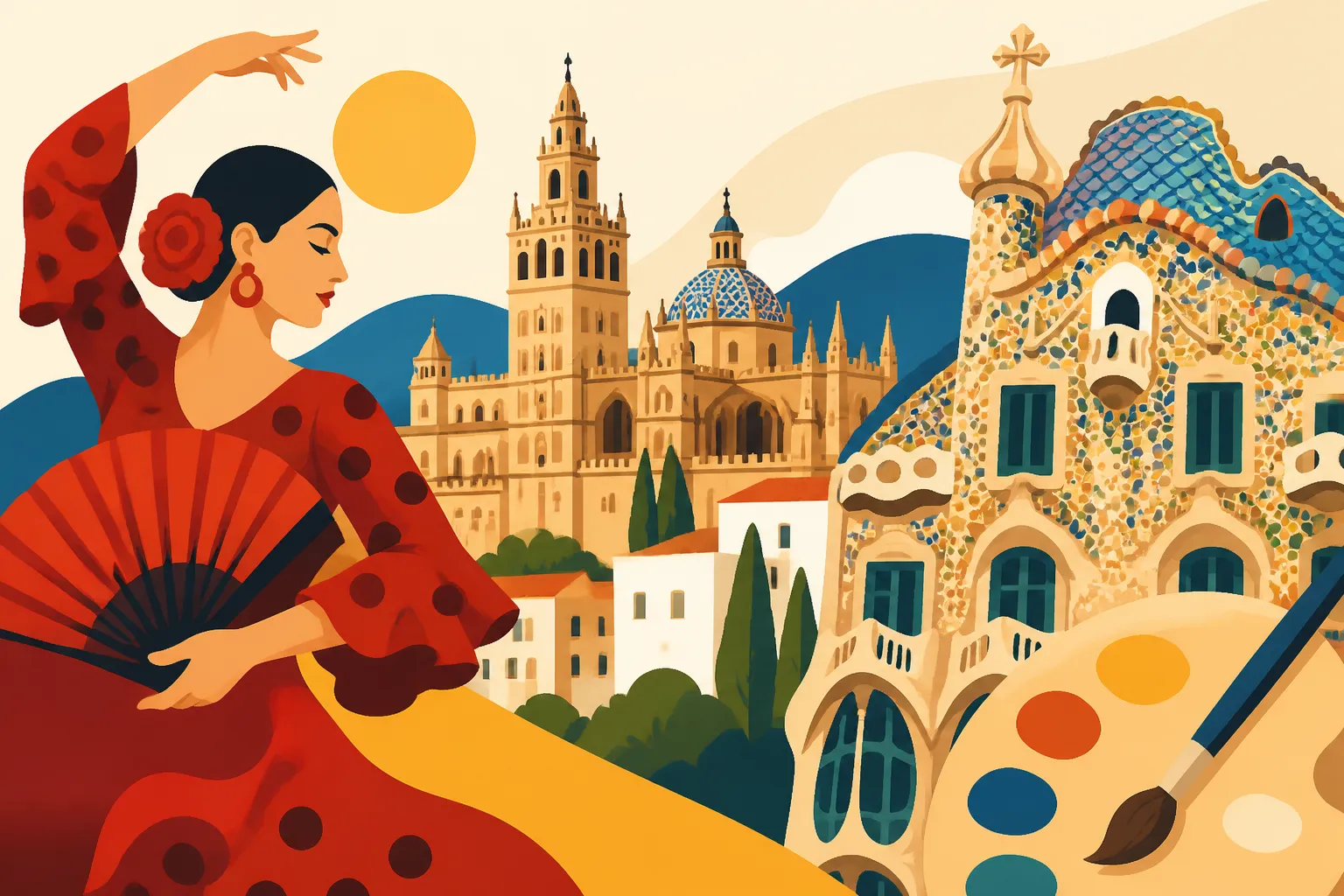
History, Art, and Architecture in Spain
Trying to wrap your head around Spain’s overlapping layers of history while standing in the middle of a sweltering plaza can feel like trying to read a book where every third page is written in a different language. I remember my first month in Toledo, staring at a wall that was part Roman, part Visigothic, and part Moorish, feeling utterly defeated by the sheer density of it all. This guide strips away that confusion, offering a clear roadmap through the centuries of art and design that shaped this country.
Disclosure: This post may contain affiliate links. We may earn a commission at no extra cost to you if you make a purchase through these links. Read full disclosure.
The Roman Foundation and Ancient Roots
The bedrock of Spanish identity is undeniably Roman, a fact that hits you the moment you see a structure that has stood for two millennia without a drop of mortar. When the Romans arrived in 218 BC, they didn’t just occupy the land; they paved it, plumbed it, and built it to last forever. For an expat or a curious traveler, understanding these ruins is the first step in realizing that Spain was a global crossroads long before the Age of Discovery.
Segovia and Tarragona
In Segovia, the Roman Aqueduct is the undisputed star, a granite giant that slices through the city center. I’ve sat at the cafes in Plaza de Azoguejo dozens of times, and the scale of those 167 arches never stops being intimidating. It is a masterclass in engineering, originally built to carry water from the Fuente Fría river seventeen kilometers away. For the modern visitor, it serves as a reminder that the Spanish "mañana" attitude doesn't apply to their construction history—when the Romans built something, they intended for it to be the center of the world.
Further east, Tarragona—once the Roman capital known as Tarraco—offers a different perspective. Here, the ruins are coastal, with an amphitheater that overlooks the Mediterranean. Walking through the Roman Circus, where chariot races once drew thousands of spectators, you begin to see how the layout of modern Spanish cities often follows these ancient footprints. If you are planning to visit these sites, using Spain's UNESCO World Heritage Sites: A Visitor's Guide will help you understand why these specific locations were chosen for protection.
Mérida The Little Rome of Spain
If you want to see the most complete Roman city in the country, you have to head to Extremadura. Mérida was founded as Emerita Augusta for veteran soldiers, and the legacy of those retirees is a collection of ruins that rivals anything in Italy. The Roman Theater and Amphitheater are still used today for the Classical Theater Festival, and sitting on those stone benches on a warm July night is a transcendental experience. You aren't just looking at history; you are participating in a tradition that hasn't changed much in 2,000 years.
Beyond the theater, the Temple of Diana and the Roman Bridge—one of the longest in the world—showcase the sheer wealth and power the Empire poured into the Iberian Peninsula. For those coming from abroad, Mérida can feel a bit off the beaten path, but it is essential for anyone who wants to claim they’ve seen the "real" Spain. If you’re figuring out how to get there, checking out Roman and Ancient Spain: Sites and Ruins to Visit can give you a better idea of the logistical hurdles and the rewards that await you.
Islamic Spain The Al-Andalus Legacy
There is a specific feeling you get when you walk into a Moorish palace—a sudden drop in temperature, the sound of running water, and the smell of jasmine. For nearly 800 years, much of Spain was under Islamic rule, and this period, known as Al-Andalus, transformed the country into the intellectual and artistic center of Europe. This isn't just "history"; it is the soul of Andalusia, and it is where Spain’s architecture becomes truly poetic.
The Alhambra and Generalife
The Alhambra in Granada is arguably the most beautiful building on the planet, but it can also be the most frustrating for foreigners due to the strict ticketing system. Many tourists show up at the gates only to be told the Nasrid Palaces are sold out for the next three weeks. The architecture here is all about "the hidden"—modest exteriors that open into breathtaking courtyards like the Patio de los Leones. The intricate stucco work, which looks like lace made of stone, contains thousands of Arabic inscriptions, mostly repeating "There is no conqueror but God."
The Generalife, the neighboring summer palace, focuses on the Persian concept of paradise as a garden. The use of water is strategic; it isn't just for cooling, but for reflection and sound. When you are visiting, it is wise to consult How to Visit the Alhambra: Tickets, Timing, and Tips to ensure you don’t miss out on the most delicate parts of the complex. Many expats find that the best way to handle the logistical headache of these high-demand sites is to use platforms like GetYourGuide to secure a guided tour that includes the entry fee, saving you from the "no tickets available" heartbreak.
The Great Mosque of Córdoba
The Mezquita-Catedral of Córdoba is perhaps the best physical representation of Spain’s complex religious history. Inside, you are greeted by a forest of over 800 red-and-white striped arches that seem to go on forever. It was originally built as a mosque in the 8th century, but after the Reconquista, a Renaissance cathedral was built right in the middle of it. When Charles V saw the finished cathedral, he famously said, "You have built what you or others might have built anywhere, but you have destroyed something that was unique in the world."
Despite that critique, the result is a jarring, beautiful, and utterly Spanish hybrid. The Mihrab, with its gold mosaics sent from Constantinople, remains one of the finest examples of Islamic art in existence. Walking from the cool, dim arches of the mosque into the bright, soaring vaults of the choir is a sensory experience you won’t find anywhere else. For a deeper dive into this era, read Moorish Spain: Alhambra, Mezquita, and Al-Andalus Heritage to understand the cultural fusion that still defines the south.
Gothic and Renaissance Grandeur
As the Christian kingdoms pushed south during the Middle Ages, they brought with them the soaring verticality of the Gothic style. This was the era of "building for the glory of God," where stone was pushed to its absolute limits. If you’ve spent any time in Northern or Central Spain, these massive, dark, and awe-inspiring structures likely dominate the skyline of every city you’ve visited.
The Cathedral of Seville
Seville’s cathedral is the largest Gothic church in the world, and it was built with a specific goal: to make people think the builders were "mad." It stands on the site of the former Almohad mosque, and the Giralda bell tower is actually the mosque’s original minaret. Inside, the scale is difficult to process. The main altarpiece, the Retablo Mayor, is the largest in Christendom, covered in an eye-watering amount of gold brought back from the Americas.
For many expats, the cathedral becomes a landmark for navigating the city, but it’s also a place of pilgrimage for art lovers. It houses the tomb of Christopher Columbus—held aloft by four kings—and works by Goya and Murillo. The transition from the orange-scented courtyard (Patio de los Naranjos) into the cavernous interior is a classic Seville experience.
El Escorial and the Castilian Heart
Located about an hour from Madrid, San Lorenzo de El Escorial is the antithesis of the ornate Andalusian style. Built by Philip II, it is a stern, gray, and massive complex that served as a palace, monastery, and royal tomb. The architecture is known as "Herrerian," characterized by its lack of decoration and mathematical precision. It reflects the stoic, devout character of the Spanish Habsburgs.
The library at El Escorial is one of the most beautiful in the world, with frescoes on the ceiling and books turned with their gilded edges facing out to protect the pages. Below the main altar lies the Pantheon of the Kings, where almost every Spanish monarch since Charles V is buried. It’s a somber place, but it explains so much about the centralized power of the Spanish crown during the 16th century. If you are staying in the capital, finding a room via Booking.com in the nearby mountains can make for a great weekend escape from the city heat.
Spanish Art From Prado Classics to Modern Masters
Spanish art is not just about aesthetics; it is about passion, darkness, and a relentless focus on the human condition. From the court painters who captured the royal family’s deepest insecurities to the surrealists who explored the subconscious, the Spanish artistic tradition is one of the most influential in Western history.
The Golden Age Velázquez and El Greco
The Museo del Prado in Madrid is the "Big One." If you only visit one museum in Spain, this must be it. Diego Velázquez is the king here, and his masterpiece, Las Meninas, is a painting that everyone—from art historians to casual tourists—ends up staring at for twenty minutes. It’s a complex reflection on reality and the role of the painter. Nearby, you’ll find the works of El Greco, whose elongated figures and jarring colors were so ahead of their time that people once thought he had a vision defect.
The Golden Age was also the time of Bartolomé Esteban Murillo and Francisco de Zurbarán, whose religious paintings defined the Counter-Reformation. However, no discussion of this era is complete without mentioning Goya. His "Black Paintings," painted directly onto the walls of his house while he was deaf and disillusioned, are some of the most haunting images ever created. To avoid being overwhelmed by the thousands of masterpieces, I highly recommend checking How to Get Into the Prado Museum for Free to plan your visit around the busiest times.
The Modern Revolution Picasso and Dalí
In the 20th century, Spain blew the art world wide open. Pablo Picasso, born in Málaga but shaped by Barcelona and Paris, redefined what art could be with Cubism. The Reina Sofía Museum in Madrid houses Guernica, his massive monochromatic mural depicting the horrors of the Spanish Civil War. Standing in front of it is a heavy, sobering experience that reminds you that art in Spain has often been a tool for political protest.
Then there is Salvador Dalí. To truly understand him, you have to travel to Figueres in Catalonia to see the Dalí Theatre-Museum. It is a surrealist "object" in itself, topped with giant eggs and gold statues. Dalí took the weirdness of the Spanish landscape and turned it into a dreamscape of melting clocks and desert vistas. If you’re a fan of the avant-garde, Spain's Great Art Museums: Prado, Reina Sofía, and Beyond offers a comprehensive list of where to find these modern legends.
| Architectural Style | Key Period | Major Example | Core Characteristic |
|---|---|---|---|
| Roman | 2nd C. BC – 4th C. AD | Segovia Aqueduct | Functional, massive stone, arches |
| Mudéjar | 12th – 16th Century | Real Alcázar (Seville) | Islamic techniques in Christian buildings |
| Gothic | 13th – 15th Century | Burgos Cathedral | Pointed arches, stained glass, height |
| Plateresque | 15th – 16th Century | University of Salamanca | Intricate "silversmith-like" stonework |
| Modernisme | Late 19th – Early 20th | Sagrada Família | Organic shapes, colorful tiles (Trencadís) |
Modernist Architecture and the Vision of Gaudí
When you mention architecture in Spain to a foreigner, they almost always think of Barcelona. At the turn of the 20th century, Catalonia underwent a cultural renaissance called Modernisme. While it shared some DNA with Art Nouveau, it was uniquely Catalan, drawing inspiration from nature, medieval history, and local craftsmanship.
Sagrada Família and Eixample
The Sagrada Família is a building that feels like it’s breathing. Antoni Gaudí took over the project in 1883 and turned it into a "Bible in stone." Every column, every sculpture, and every stained-glass window has a symbolic meaning. The interior is designed to look like a forest, with columns branching out like trees to support the roof. I remember the first time I saw the light filtering through the orange and blue windows at sunset; it felt less like a church and more like being inside a kaleidoscope.
The church is located in the Eixample district, a grid-like expansion of the city that is a monument to urban planning. But within this grid are the "Manzana de la Discordia" (Block of Discord), where three different Modernist architects built houses right next to each other to show off. If you’re pressed for time, How to See Gaudí's Buildings in Barcelona in One Day is an essential read for navigating the crowds and the high ticket prices of these iconic sites.
Park Güell and Casa Batlló
Gaudí’s genius wasn’t limited to churches. Park Güell was originally intended to be a luxury housing estate, but it failed and became a public park instead. Today, it’s home to the famous multicolored salamander and the undulating benches covered in trencadís (broken tile mosaic). The views from the terrace over Barcelona and the Mediterranean are the stuff of postcards, but be warned: it is almost always crowded.
Then there are the houses, Casa Batlló and Casa Milà (La Pedrera). Casa Batlló, with its dragon-back roof and mask-like balconies, is one of the most imaginative residential buildings ever constructed. Many travelers use Omio to book their train tickets between Madrid and Barcelona, making it easy to see both the classic art of the Prado and the wild architecture of Gaudí in a single trip. For a deeper look at this specific movement, don't miss Gaudí and Modernist Architecture in Barcelona.
Navigating Spain’s Cultural Landscape
If there’s one thing I’ve learned as an expat, it’s that "winging it" when it comes to Spanish culture is a recipe for standing in long lines and missing out. The most famous sites now require advanced planning, sometimes months in advance. But beyond the logistics, there is an etiquette to experiencing Spain’s history that makes the journey much smoother.
Booking Logistics and Ticket Strategies
The "Golden Triangle" of art in Madrid and the big hits in Andalusia are no longer walk-in friendly. Most museums have moved to timed entry slots. If you show up at the Reina Sofía at 2:00 PM without a ticket, you might be waiting until 5:00 PM to get in. It is advisable to use a mix of official sites and platforms like GetYourGuide, especially for the Alhambra or the Sagrada Família, where "skip-the-line" access is worth every penny.
Another tip for the budget-conscious: almost every state-owned museum in Spain has free hours. The Prado, for instance, is free during the last two hours of every day. However, the line usually starts forming an hour before that. If you’re a resident, your TIE card (residency permit) often grants you discounts or free entry to local municipal museums. It’s always worth asking "Hay descuento para residentes?" at the ticket window.
Transport Between Historic Hubs
Spain is a surprisingly large country, and the history is spread out. While you can see a lot in Madrid and Barcelona, the soul of Spanish architecture is often found in the smaller cities like Toledo, Segovia, Córdoba, and Granada. The high-speed AVE train is a miracle of modern travel, whisking you from Madrid to Seville in under three hours. For booking these, I usually rely on Omio because it compares the different train operators (Renfe, Ouigo, Iryo) in one place, which is vital since the market recently opened up to competition.
If you are planning a multi-city "History Tour," consider using the trains for the long hauls and buses for the more remote areas like the White Villages of Andalusia or the Roman ruins of Mérida. The bus system in Spain (ALSA being the main provider) is clean, reliable, and much cheaper than the train. Staying centrally is also key; I usually check Booking.com for "Boutique" hotels in the old quarters (Casco Antiguo) so I can wake up and be a five-minute walk from the cathedral or the museum.
Practical Tips for Culture Seekers
Before you set out with your camera and your walking shoes, there are a few practicalities that can make or break your cultural experience. Spanish cities are meant to be walked, but those cobblestones aren't forgiving, and the local rhythms can be confusing for those used to a 9-to-5 culture.
Free Museum Days and Local Hacks
As mentioned, the free hours are a great way to save money, but they are also the most crowded. If you want a quiet experience with Las Meninas, pay for the early morning slot. Also, look out for "La Noche de los Museos" (Museum Night), usually in May, when museums stay open until midnight or later and offer free concerts and workshops. It’s one of the best nights of the year to be in a city like Madrid or Barcelona.
Another local hack: many churches are free to enter during mass times. However, this is for worship, not for sightseeing. If you want to see the architecture, don't walk around with a camera while people are praying. Wait for the designated tourist hours, which usually start after the morning mass and end before the evening service. This is especially true for smaller, stunning churches that aren't on the main tourist map.
Photography and Etiquette in Sacred Spaces
In many of Spain’s most famous art galleries, like the room housing Guernica or certain parts of the Prado, photography is strictly prohibited. The guards (vigilantes) are very serious about this and will not hesitate to call you out loudly in front of everyone. It’s better to put the phone away and actually look at the art.
In cathedrals, the dress code is generally relaxed compared to Italy, but it’s still respectful to cover your shoulders and avoid very short shorts. Men should remove hats when entering. Also, remember that many of these historic buildings are still active community hubs. You might be admiring a 14th-century altar while a local wedding or funeral is taking place. Being a "veteran" traveler means knowing when to step back and observe the living culture alongside the ancient stone.
Disclaimer
The information provided in this guide is for informational purposes only and does not constitute legal, financial, or professional travel advice. While every effort has been made to ensure the accuracy of the details regarding historical sites, museum hours, and transport options, these are subject to change by local authorities and private operators. Always verify current requirements and opening times directly with the official venues or service providers before your visit. Participation in any activities mentioned is at your own risk.