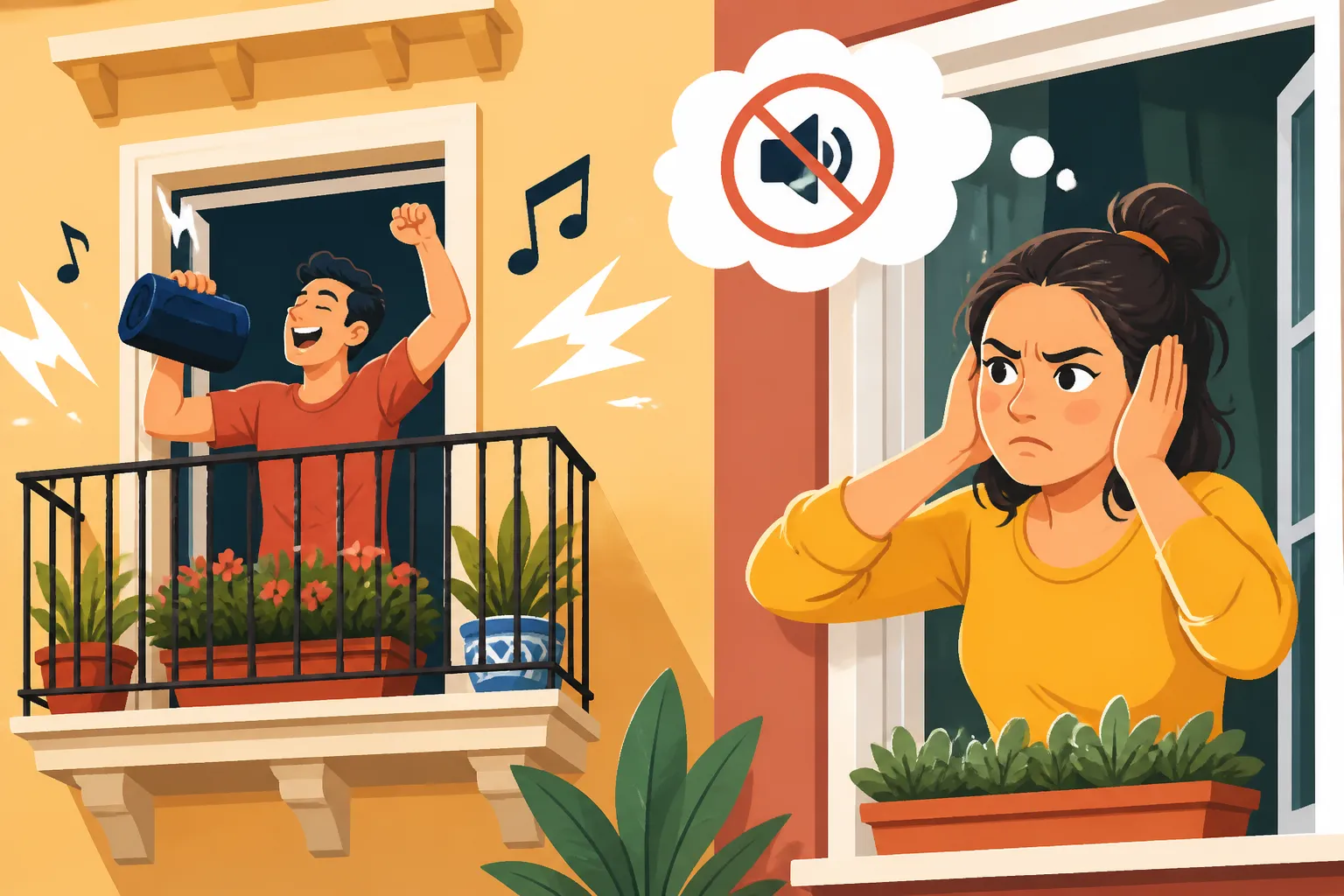
How to Deal With Noisy Neighbors in a Spanish Building
Your neighbour’s TV booms through the wall at one in the morning, chairs scrape across tiles overhead, and the party next door is still going when you leave for work. This guide walks you through dealing with noisy neighbours in a Spanish building, from the first polite knock to the comunidad, the town hall, the police and the courts, without souring building life.
Disclosure: This post may contain affiliate links. We may earn a commission at no extra cost to you if you make a purchase through these links. Read full disclosure.
Why Noise Hits Differently in Spanish Apartment Buildings
I remember my first winter in a classic Madrid finca. I thought my upstairs neighbour was rearranging furniture every night. It turned out she was just walking around in heeled house slippers on a terrazo floor with no underlay. Nobody was being malicious. The building itself was amplifying ordinary life. Understanding why Spanish buildings sound the way they do will save you a lot of misplaced anger, and it will help you pick the right battle.
Hard Floors, Thin Walls, and Open Patios
Spanish flats are built for heat, not silence. Tile, marble and terrazo floors stay cool in summer, but they carry impact noise like a drum. Many older buildings have interior partition walls made of single-layer brick, and windows that open onto a shared patio de luces. That patio is a light well that funnels every conversation, clattering pan and washing machine spin cycle straight into your bedroom. If you live in a pre-renovation building, read Spanish Noise‑Insulation Reality: What to Expect in Older Buildings before you decide whether your neighbour is a problem or the walls are.
A useful test is to ask yourself whether the noise is airborne or impact. Airborne noise is voices, music and TV. Impact noise is footsteps, dropped objects and furniture dragging. Airborne noise is usually behaviour you can ask someone to change. Impact noise is partly behaviour and partly construction. That difference shapes your request, because asking someone to turn music down is easy, but asking them to stop walking is not.
The Spanish Daily Rhythm Plays a Part
Spain runs late. Dinner often starts when people in northern Europe are thinking about bed, children play outside well into the evening in summer, and weekend socialising can stretch past midnight on a terrace. None of this is rude by local standards, and plenty of Spaniards complain about noisy neighbours too. Still, it helps to separate “this is a normal Spanish evening” from “this is genuinely excessive.” Spanish Social Etiquette: Invitations, Time, and Small Talk gives good context on how timing works socially here.
What is regulated is noise during the municipal rest period at night. Every ayuntamiento sets its own ordenanza on noise, so the exact hours, the stricter rules for weekends, and any summer or fiesta exceptions vary from city to city. For the general framework, see Noise Rules in Spain: Quiet Hours and What to Do About Complaints. Then look up your own town’s ordenanza municipal de ruidos on the town hall website so you know precisely which hours apply to you.
Common Culprits You Will Recognise
Shared buildings in different Spanish cities often see the same offenders come up again and again:
- Late-night gatherings on balconies and rooftop terraces, especially in summer
- Furniture dragged across tiled floors, often at dinner and after
- Barking dogs left alone during working hours
- Washing machines and dishwashers run at night to use cheaper electricity periods
- Tourist apartments with a rotating cast of guests who treat the flat like a hotel
- Renovation work. This has its own rules, covered in How to Deal With Building Renovations Noise in Spain
- Bars and terraces at street level, which are a municipal licensing matter rather than a neighbour matter
Your First Moves: Talking, Documenting, and Softening the Impact
The temptation, especially after a sleepless night, is to go straight to the police. Resist it for now unless the noise is extreme or happening right this minute. In my experience the informal route solves the majority of cases. If it does not, the evidence you gather along the way becomes the backbone of every formal step that follows.
The Polite Knock and the Note on the Door
Start with a friendly, face-to-face conversation at a reasonable hour, not at the moment you are furious. Spaniards generally respond well to warmth and directness. A cold note slipped under the door often lands badly. Introduce yourself, mention which flat you live in, and describe the specific issue. Assume they have no idea how much sound travels.
A few phrases that have worked for me:
- “Hola, soy el vecino del tercero. Perdona que te moleste, pero quería comentarte algo.” This means: Hi, I’m your neighbour from the third floor. Sorry to bother you, but I wanted to mention something.
- “Por la noche se escucha mucho la música desde mi dormitorio.” This means: At night I can hear the music a lot from my bedroom.
- “¿Sería posible bajarla un poco a partir de las once?” This means: Would it be possible to turn it down a bit from eleven? Adjust the time to your local quiet hours.
- “Si alguna vez te molesto yo, dímelo sin problema.” This means: If I ever bother you, just tell me, no problem.
That last line matters a great deal. It frames the chat as mutual respect rather than an accusation. If speaking Spanish makes you nervous, bring a written version, or ask a Spanish-speaking friend to come along.
If you cannot catch them at home, a handwritten note is fine, as long as it is signed, polite and specific. Anonymous notes in the lift or the portal tend to start whole-building feuds.
Build a Noise Log Before You Need It
From the very first night, keep a record. You may never use it, but if the situation escalates, the administrador, the town hall, the police and any lawyer will all ask for evidence. Without it, it is your word against theirs.
A solid noise log includes:
- The date, start time and end time of each episode
- The type of noise, such as music, shouting, impact or a dog
- Where you heard it, for example the bedroom or the living room
- Audio or video recordings taken from inside your own flat
- Readings from a sound-level app on your phone, noted as indicative only
- Names of other neighbours who heard it too
- Copies of any messages, notes or replies exchanged with the neighbour
Phone decibel apps are not calibrated legal instruments, so do not expect a reading from one to win a case. They are still useful to show patterns over weeks. If you are still in a rental waiting for fibre to be installed, the recordings themselves work offline, but sending them to your landlord or the administrador on WhatsApp needs mobile data. A travel eSIM from a provider like Airalo can cover that gap until your home connection is live.
Reduce the Noise on Your Side While You Wait
This is not about accepting unreasonable behaviour. It is about protecting your sleep while the slower processes run their course. I kept a small “survival kit” by my bed for the months it took to resolve a dispute with a late-night DJ next door.
Practical options you can order from Amazon Spain or pick up in a local ferretería:
- Foam or silicone earplugs. Try a few types, because fit varies a lot
- A white noise machine or a fan to mask voices and music
- Adhesive door seals and a door draft stopper for gaps under bedroom doors
- Thick rugs and heavy curtains to absorb echo in tiled rooms
- Felt pads for your own chairs, which are also a nice gift to offer your downstairs neighbour
On the subject of felt pads: when the problem is chair-dragging from upstairs, I have twice solved it simply by buying a pack and handing it over with a smile. It costs little on Amazon Spain, and it turns a complaint into a friendly gesture. If you rent, check your contract before fixing anything to walls or window frames. Tenant vs Landlord Responsibilities in Spain: Repairs and Maintenance explains what you can change without permission.
Escalating Through the Comunidad, the Landlord, and the Town Hall
If the friendly approach fails, Spain has a well-defined ladder of formal options. The right rung depends on whether you own or rent, who the noisy neighbour is, and whether the noise is a one-off or a persistent pattern.
Using the Comunidad de Propietarios and the Administrador
Every Spanish apartment building with multiple owners is governed by a comunidad de propietarios under the Ley de Propiedad Horizontal. The comunidad has a president, usually an elected owner, and often a professional administrador de fincas who manages day-to-day affairs. The building may also have its own internal rules, the estatutos or normas de régimen interior, which can include rules on noise and the use of shared areas. For how all this fits together, see How Spanish Building Communities Work (Comunidad): Fees and Rules and How to Deal With Spanish Building Rules: Pets, Noise, and Renovations.
Spanish horizontal property law prohibits occupants from carrying out activities in their flats that are annoying, unhealthy or harmful to the building. Persistent, excessive noise can fall into that category. When it does, the president can formally require the offender to stop, and if the behaviour continues, the comunidad can authorise legal action. This is called an acción de cesación. In serious cases the courts can order the activity to stop, award compensation, and even temporarily deprive the occupant of the right to use the flat. That last outcome is rare and reserved for persistent, well-documented cases, but the mere possibility tends to get people’s attention.
How to engage the comunidad step by step:
- Find out who the president and the administrador are. This information is usually posted in the portal or available from the portero.
- Send the administrador a short written complaint with dates and your noise log attached.
- Ask whether other neighbours have complained, because a joint complaint carries far more weight.
- Request that the issue be added to the agenda of the next junta de propietarios.
- If the noise continues, ask the president to send a formal written warning, the requerimiento.
- If ignored, the junta can vote to authorise legal action against the occupant.
If your building’s bylaws are only in Spanish and you struggle with the legal wording, ask the administrador for a plain-language summary, or work through them with a bilingual friend. If you end up raising the matter at your town hall, How to Get an Interpreter for City Hall Appointments in Spain covers the options for that appointment.
When You Rent: Getting Your Landlord on Side
Tenants are not members of the comunidad. You generally cannot vote at the junta or start a cesación action through it yourself, but your landlord can. Write to your landlord, attach your log, and ask them to raise it with the administrador. Keep it factual and calm. Dealing with Landlords in Spain: Communication Tips and Paper Trail has useful templates for building the written record that protects you.
If the noisy neighbour is also a tenant, the cesación procedure can be directed against both the occupant and the owner of that flat. In practice, a call from the administrador to the other owner often resolves things quickly. No landlord wants a lawsuit over a tenant.
Your own lease is a separate question. Persistent neighbour noise does not automatically entitle you to leave early or pay less rent, so read your contract’s early termination clause before making decisions. If you do decide to move, choose more carefully next time. Checklist: What to Inspect Before Signing a Lease in Spain includes noise checks. Platforms like Spotahome show video tours of rooms and flats, which help you spot obvious red flags such as a bedroom over a bar. Still, try to visit in person in the evening or ask the landlord directly about street-level businesses and terraces.
Town Hall Complaints and Neighbourhood Mediation
Your ayuntamiento enforces the municipal noise ordinance. You can usually file a formal complaint, a denuncia or queja, online, through the citizen services office, or by phone with the local police. Larger cities like Madrid, Barcelona and Valencia also run free community mediation services, servicios de mediación vecinal or mediación comunitaria. In these, a trained neutral mediator meets both parties to find a compromise.
I am a big fan of mediation for the long-term, low-grade conflicts that never quite justify police involvement, such as the dog that barks all day or the neighbour who hosts every weekend. It is confidential, it costs nothing, and it keeps the relationship intact. You will be living next to these people for years.
For the municipal process in detail, read How to Report Noise Complaints in Spain: Municipal Steps. Where tourist apartments are involved, also check whether the flat displays a valid tourist licence number. Unlicensed holiday lets can be reported to your regional tourism authority, and some comunidades have voted to restrict them.
Comparing Your Escalation Options
| Option | Who acts | Effort for you | Best for | Typical outcome |
|---|---|---|---|---|
| Friendly conversation | You | Low | First incidents, unaware neighbours | Quick fix and good relations |
| Written note or message | You | Low | Neighbours you rarely see | Paper trail starts |
| Landlord intervention | Your landlord | Low to medium | Tenants with a noisy neighbour | Pressure through the owner network |
| Administrador or president | The comunidad | Medium | Repeated noise affecting several flats | Formal warning to the occupant |
| Municipal mediation | Town hall mediators | Medium | Long-running disputes, ongoing tension | Negotiated agreement |
| Town hall complaint | Ayuntamiento | Medium | Breaches of the noise ordinance | Inspection, possible fine |
| Local police call | Policía Local or Guardia Urbana | Low in the moment | Noise happening now, at night | Visit, warning or report |
| Acción de cesación | Comunidad through a lawyer | High | Persistent, documented nuisance | Court order, compensation |
Calling the Police and Going Further
Sometimes it is two in the morning, there is a full-blown party next door, and you have work at eight. That is the moment for the police, not the administrador.
When and How to Call the Police
For noise complaints, contact your Policía Local. In Barcelona this is the Guardia Urbana, and in many cities it can be reached on 092. Some regions route these calls through the general emergency number 112. Use 112 if there are signs of a fight, violence, someone in danger, or a medical emergency. Emergency Numbers in Spain: 112 and When to Use It explains which number fits which situation.
When you call, have this information ready:
- Your full address, including the floor and door, for example “tercero B”
- The address of the noisy flat
- What the noise is and how long it has been going on
- Whether this has happened before
- Your name and contact number, in case they need to follow up
Officers may come, assess the noise level, issue a warning, or write up an official report, the acta or denuncia. Always ask for the report or an incident reference number. A string of police reports is very strong evidence for the comunidad or a court. If you do not speak much Spanish, practise these details in advance and keep them written on your phone.
Be aware that some people will resent a police visit, so weigh this against the long-term relationship. For a single loud birthday party, one call may be all you ever make. For a weekly occurrence, the reports become your best leverage.
Legal Routes When Nothing Else Works
If months pass and you have exhausted the friendly, comunidad and municipal routes, legal action is possible. The main civil route is the comunidad’s acción de cesación described above. In addition, an individual owner or occupant who suffers persistent noise can bring civil claims, and extreme cases can raise criminal or fundamental-rights issues. Spanish courts have recognised that serious, sustained noise can affect the right to privacy at home.
Before going down this path:
- Consult a lawyer who specialises in propiedad horizontal or neighbourhood disputes
- Gather your log, recordings, police reports, letters and witness names
- Consider an acoustic report from a certified technician, which courts take far more seriously than phone apps
- Send a formal burofax to the offender. It is a certified letter with proof of delivery and content, and often triggers a settlement on its own
- Ask your home or contents insurance provider whether your policy includes legal defence cover, defensa jurídica. Many Spanish policies do
Litigation is slow and stressful, and it permanently changes your relationship with the neighbour. It can work, but some people win in court and still sell their flat because the atmosphere became unbearable. Use it as a last resort, not a threat.
Deciding Whether to Stay or Move
There is no shame in walking away. If you rent and the noise is structural, such as a bar below or a terrace-heavy street, rather than one bad neighbour, moving may be the healthiest option. Next time, use How to Choose a Neighborhood in Spain: A Practical Decision Checklist to screen for nightlife streets, tourist flat density and building age. When you browse listings on Spotahome or elsewhere, ask specifically which way bedrooms face, whether windows are double-glazed, and what is on the ground floor.
| Noise source | First response | Escalation route | Realistic chance of a fix |
|---|---|---|---|
| Music or parties next door | Friendly chat | Police at night, then comunidad | High |
| Footsteps and furniture overhead | Chat plus felt pads, rugs | Comunidad if extreme | Medium |
| Barking dog | Chat with owner | Mediation, town hall | Medium |
| Tourist apartment guests | Contact the host or owner | Comunidad, regional tourism authority | Medium |
| Bar or terrace below | Contact the business | Town hall licensing complaint | Low to medium |
| Renovation works | Check permit and hours | Town hall if outside permitted hours | High, as it is temporary |
| Poor insulation, ordinary living | Soundproof your own space | Usually none | Low |
After many years and many buildings, my honest advice is this: start soft, document everything, involve the comunidad early, and save the police and lawyers for when they are truly needed. Most Spanish neighbours, once they know there is a problem, genuinely want to fix it.
Disclaimer
This article is for general informational purposes only and does not constitute professional advice. Laws, prices and regulations vary by location and change over time. Consult a qualified professional for guidance on your specific situation.