Living in Smaller Spanish Towns vs Big Cities: Trade-Offs
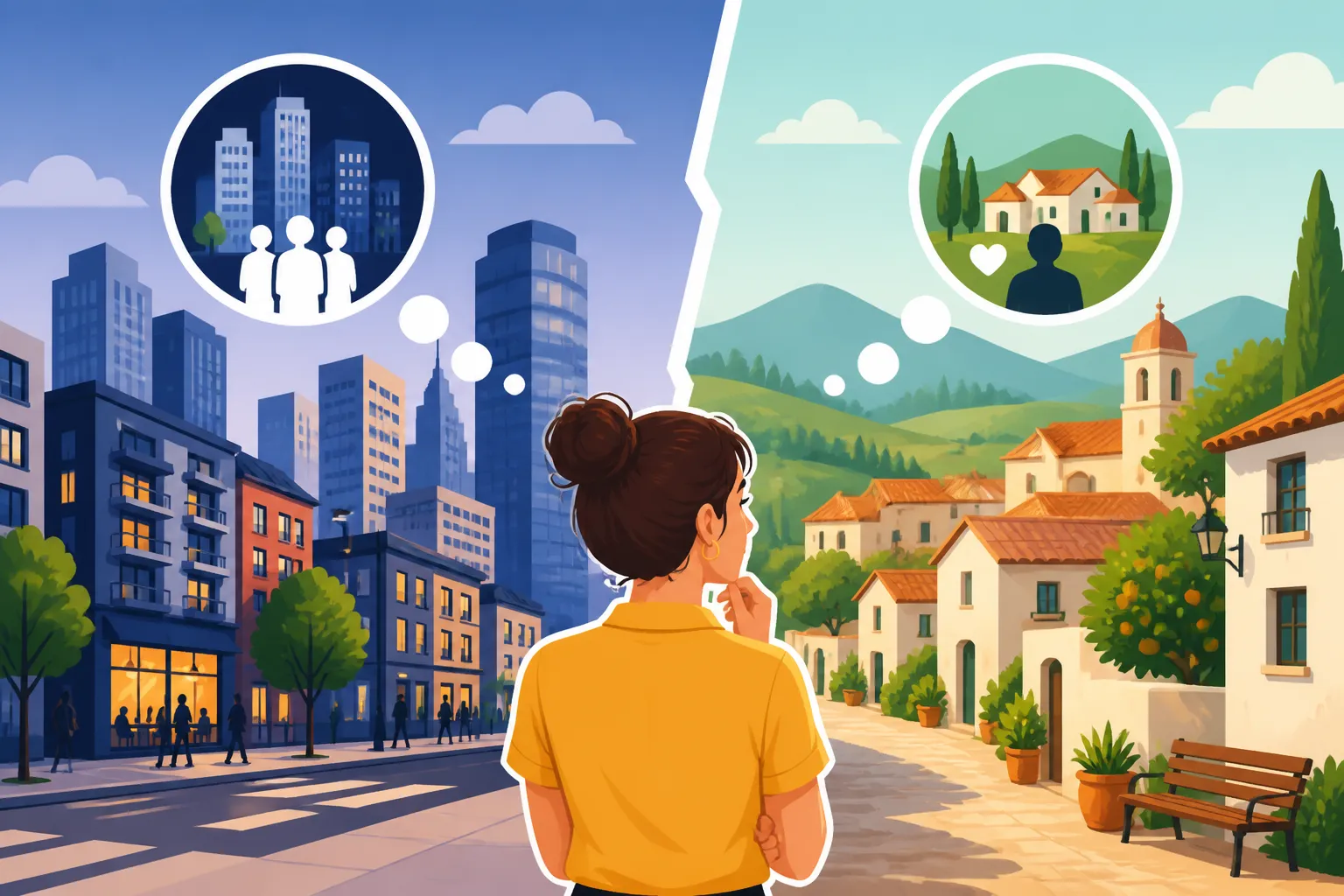
Choosing where to plant your roots in Spain often feels like a high-stakes gamble between the electric energy of a metropolis and the dusty silence of a rural village. When I first arrived, I spent months agonizing over whether to chase the career opportunities in Madrid or the slow-paced dreams of a white-washed pueblo in Andalusia. This guide dissects the raw, unvarnished trade-offs of urban versus rural living to ensure your Spanish dream doesn't become a logistical nightmare.
Disclosure: This post may contain affiliate links. We may earn a commission at no extra cost to you if you make a purchase through these links. Read full disclosure.
The Cost of Living Reality: Rent, Utilities, and Your Wallet
The financial divide between Spain’s major hubs and its smaller municipalities is perhaps the most jarring shock for new arrivals. In cities like Madrid, Barcelona, or even Valencia, you aren't just paying for a roof; you are paying for the privilege of proximity. Conversely, moving just forty minutes outside a provincial capital can cut your monthly outgoings by nearly half, but it comes with hidden costs that aren't always visible on a spreadsheet.
Housing Markets: Madrid and Barcelona vs. The Rest
In the big cities, the rental market is aggressive, fast-moving, and often soul-crushing. You will likely find yourself competing with twenty other applicants for a shoebox apartment that hasn't been renovated since the 1970s. This is where services like Spotahome can be a lifesaver, allowing you to secure a place without the "Hunger Games" style viewings that define the urban experience. In a big city, you should expect to pay a premium for any outdoor space, and "quiet" is a luxury that few can afford.
When you pivot to smaller towns, the script flips entirely. You can often find a four-bedroom townhouse with a terrace and a view for the price of a studio in Barcelona. However, the supply is lower. While cities have a constant churn of available flats, small towns rely on local networks. You might not see the best deals on a portal; you find them by talking to the owner of the local bakery. Understanding Renting in Spain: Contracts, Deposits, and Tenant Rights is crucial here, as small-town landlords can sometimes be more "informal" with their paperwork, which can lead to headaches during residency renewals.
Daily Expenses: From Coffee to Groceries
It’s a common expat trope that Spain is "cheap," but that depends entirely on your zip code. In a Madrid "barrio," a café con leche might set you back €2.50. In my favorite pueblo in Extremadura, it’s still €1.20, and it usually comes with a free piece of sponge cake. These small differences compound over a month. Groceries, however, are a bit of a toss-up. While local markets in small towns offer incredible seasonal produce for pennies, you may lack the variety of international goods found in city supermarkets.
If you are living in a remote area, you’ll find yourself relying heavily on e-commerce for niche items. I’ve found that using Amazon Spain is almost non-negotiable when you live in a town where the local hardware store closes for three hours at midday and doesn't stock the specific water filter or laptop stand you need. The "pueblo tax" often manifests in travel costs; if you don't have a car, you’ll spend what you saved on rent on bus tickets or taxis just to reach a larger shopping center.
| Expense Category | Big City (Madrid/Barcelona) | Small Town (Population <10,000) |
|---|---|---|
| 1-Bedroom Apartment | €900 – €1,400+ | €350 – €550 |
| Menu del Día | €14 – €18 | €9 – €12 |
| Monthly Transport | €54 (Standard Pass) | €0 (Walkable) or €100+ (Car) |
| Internet (Fiber) | High Availability | Variable/Spotty in deep rural |
| Socializing (Beer/Wine) | €3.50 – €5.00 | €1.50 – €2.50 |
Social Life and Integration: Finding Your Community
The social landscape of Spain is built on the "plaza" culture, but how you access that culture varies wildly depending on your environment. In the city, you are anonymous; in the town, you are a protagonist in a long-running soap opera.
The Expat Bubble vs. Local Immersive Living
In cities, it is incredibly easy to fall into the "Expat Bubble." You can spend an entire year in Barcelona and never speak a word of Spanish because your coworkers, your yoga instructor, and your barista all speak English. While this is comfortable, it can lead to a sense of superficiality. You are living in Spain, but not necessarily with Spain. You’ll find plenty of Support Groups for Expats in Spain: Mental Health and Community Options in urban centers, which provide a vital safety net during the first year.
Small towns offer no such cushion. If you move to a village in Castilla-La Mancha, you are the local "extranjero." People will know when you arrive, what you bought at the market, and whether you’ve successfully figured out how the recycling bins work. Integration is mandatory. You will be invited to festivals, questioned about your family, and checked on during heatwaves. It is a much deeper, warmer level of community, but it can also feel intrusive if you value your privacy. You have to be prepared to put in the work to Make Friends in Spain: Clubs, Meetups, and Language Exchanges because, in a small town, those exchanges happen over a fence or a bar counter, not an app.
Language Barriers: English Comfort vs. Spanish Fluency
Let’s be brutally honest: your quality of life in a small Spanish town is directly proportional to your Spanish level. In Madrid, you can navigate a hospital visit or a bank meeting with limited "Castellano." In a pueblo, the local doctor likely won't speak English, and the person at the post office certainly won't. This can make simple tasks feel like Herculean labors. I remember spent forty minutes trying to explain a leaking pipe to a local plumber using only hand gestures and a very poor drawing.
If you aren't fluent yet, the city provides a "soft landing." You can find an English-Speaking Doctor in Spain (Practical Guide) easily in urban areas, which reduces the anxiety of medical emergencies. However, the small-town "sink or swim" method is the fastest way to achieve fluency. After six months in a village, your Spanish will likely surpass someone who has lived in an expat-heavy coastal city for five years. It’s a trade-off between immediate comfort and long-term linguistic mastery.
Practical Infrastructure and Daily Logistics
This is where the romantic vision of a "quiet life" often hits a brick wall. Spain’s infrastructure is world-class in its cities, but it becomes "relaxed" the further you get from the provincial capitals.
Transport and Getting Around Spain: Practical Guide
In a big city, owning a car is a liability. Between the restricted low-emission zones (ZBE), the impossible parking, and the stellar metro systems, you are better off on foot. You can hop on a high-speed train and be across the country in three hours. For a detailed breakdown of these systems, check out the Driving, Transport, and Getting Around Spain: Practical Guide to see which city fits your commuting style.
In a small town, a car is your lifeline. Public transport often consists of one bus that leaves at 7:00 AM and returns at 3:00 PM. If you miss it, you are stranded. You also have to consider the maintenance of that vehicle. Finding a mechanic who won't overcharge the "new foreigner" requires building trust within the community. If you are someone who enjoys the freedom of spontaneous travel, the logistical hurdles of living in a town without a train station will eventually wear you down.
Connectivity and Remote Work Realities
If you are moving on a Spain Digital Nomad Visa: Requirements, Documents, and Timeline, your first question isn't about the view; it’s about the megabits. Spain has surprisingly good fiber-optic coverage even in rural areas, thanks to government initiatives to combat "España Vaciada" (Empty Spain). However, "good" is relative. A thunderstorm in the mountains can still knock out your connection for hours.
When I’m traveling between my city base and rural hideouts, I always keep a backup. I use Airalo to ensure I have a reliable data eSIM for my phone so I can hotspot if the local village Wi-Fi decides to take a "siesta." In a big city, you have the luxury of coworking spaces and cafes with high-speed internet on every corner. In a small town, your house is your office, your gym, and your cinema. You have to be incredibly disciplined to avoid the "pueblo lethargy" where the days bleed into each other because there is no physical separation between work and life.
Healthcare and Essential Services
Access to healthcare is often the deciding factor for retirees or families moving to Spain. The Spain Healthcare System for Expats: Public vs Private is excellent, but its physical presence is unevenly distributed.
Speed of Service: Public vs Private Coverage
In cities, you are spoiled for choice. There are massive public hospitals and sleek private clinics with the latest technology. If you have private insurance, you can often see a specialist within 48 hours. However, the public system in cities can be overwhelmed, leading to long Waiting Times in Spain’s Public System for non-urgent procedures.
In small towns, your primary point of contact is the "Centro de Salud." These are smaller clinics that handle everything from flu shots to basic emergencies. The beauty of these centers is the lack of queues. You can often walk in and see your assigned GP within minutes. The doctors here tend to know your history personally. However, for anything serious—an MRI, a surgery, or a specialized consultation—you will be referred to the nearest large hospital, which could be an hour's drive away. For families, this means the Pediatric Care in Spain: Choosing a Pediatrician process is much simpler in a village (there's usually only one), but more stressful if your child needs frequent specialist visits.
Specialized Care Access
If you have a chronic condition that requires regular visits to a specialist, living in a small town can become a part-time job in itself. The time and fuel spent driving to a provincial capital for a twenty-minute appointment add up. For mental health, the gap is even wider. While you can find many English-Speaking Therapists in Spain in Madrid or Barcelona, finding one in a town of 5,000 people is virtually impossible. You will likely rely on Online Therapy in Spain: What to Check Before You Book, which works well but lacks the personal touch of an in-person session in your local community.
Career Opportunities and the Job Market
Unless you are bringing your own job (remote work), the choice between city and town is effectively chosen for you by the economy.
Local Networking and Physical Presence
Spain’s job market is heavily centralized. If you work in tech, finance, or high-end services, the Job Market in Spain 2027: Sectors Hiring International Talent is almost entirely concentrated in Madrid, Barcelona, Bilbao, and Malaga. Networking in Spain is still very much a face-to-face endeavor. "Enchufismo" (the system of connections) is real, and it’s hard to build those connections from a remote village.
Even if a company allows hybrid work, they usually want you within a commutable distance for the occasional "reunión." Living in a small town essentially limits your local employment options to hospitality, agriculture, or teaching English. If you’re looking for professional growth within a Spanish company, the city is the only viable arena.
Freelancing and Remote Work Setup
For those who are Freelancing (Autónomo) in Spain: Taxes, Invoicing, and Setup Guide, the small town is a paradise. Your overheads are low, meaning your "burn rate" is much slower. You can afford to take risks on new projects because your rent isn't consuming 50% of your income. The challenge here is the lack of professional stimulation. Cities offer networking events, workshops, and a sense of "hustle" that can be motivating. In a small town, you have to be your own cheerleader.
Many expats move to a beautiful village only to find themselves lonely and uninspired after six months. They miss the "third spaces"—the coffee shops where you see other people working on laptops. If you choose the town, make sure you have a plan to Stay Healthy in Spain: Preventive Care, Vaccines, and Wellness that includes social interaction, or the isolation will eventually impact your productivity.
Quality of Life: Pace, Privacy, and Noise
This is the most subjective trade-off, and it’s the one that usually determines long-term happiness.
The Siesta Rhythm and Local Traditions
In a big city, the "siesta" is more of a suggestion. Most major shops stay open all day, and the city never really stops. It feels like any other global metropolis. You can find a 24-Hour Clinic in Spain (Urgencias) or a late-night pharmacy with ease. The pace is fast, the people are hurried, and the convenience is high.
In a small town, the siesta is sacred. From 2:00 PM to 5:00 PM, the streets are ghost-town silent. If you forgot to buy milk before 2:00 PM, you aren't getting milk until 5:30 PM. For some, this is a beautiful reminder to slow down and breathe. For others, it’s an infuriating inefficiency. You have to align your internal clock with the Opening Hours in Spain: What’s Different (Siesta, Holidays, Sundays) or you will live in a constant state of low-level frustration.
Noise Levels and Urban Density
There is a specific kind of "Spanish noise" that you only understand once you’ve lived here. In the city, it’s the roar of scooters, the late-night revelers, and the constant construction. Spanish apartments are notoriously thin-walled; you will hear your neighbor’s TV, their dinner conversations, and their toddler's tantrums. If you value silence, a city apartment might feel like a cage.
In a town, the noise is different. It’s the church bells every hour, the barking dogs, and the tractor at 6:00 AM. It’s "living" noise rather than "mechanical" noise. The air quality is also a major factor. If you suffer from respiratory issues, the Air Quality and Allergies in Spain: Seasonal Tips for New Residents will significantly favor the rural life. However, don't be fooled into thinking a pueblo is "quiet." During the local "feria" or festival week, your sleepy village will transform into a 24-hour party zone with speakers that can be heard from three towns away.
Summary Checklist for Your Decision
Before you sign a lease, ask yourself these five questions. Your honest answers will point you toward your ideal Spanish home.
- Do I need an English-speaking community to feel safe? If yes, go to a city or a coastal expat hub.
- Is my income stable and independent of the local economy? If yes, the small town offers incredible value.
- Do I crave anonymity or community? If you want to be "someone" in your town, go rural. If you want to be left alone, go urban.
- Am I prepared to own and maintain a car? If no, stay in a city with a metro.
- How do I handle "dead time"? If the thought of everything closing for three hours every day scares you, the pueblo life is not for you.
Spain is a country of extremes. Whether you find your joy in the shadow of a skyscraper in Madrid or under the shade of an olive tree in Jaén, the key is to understand that you aren't just choosing a house; you are choosing a tempo for your life.
Disclaimer
This guide provides a general overview of the differences between living in smaller towns and big cities in Spain based on personal experience and current data. It is intended for informational purposes only. Local laws, economic conditions, and infrastructure can change rapidly. Always conduct thorough research and consult with local experts or a Gestor before making significant financial or residency decisions.