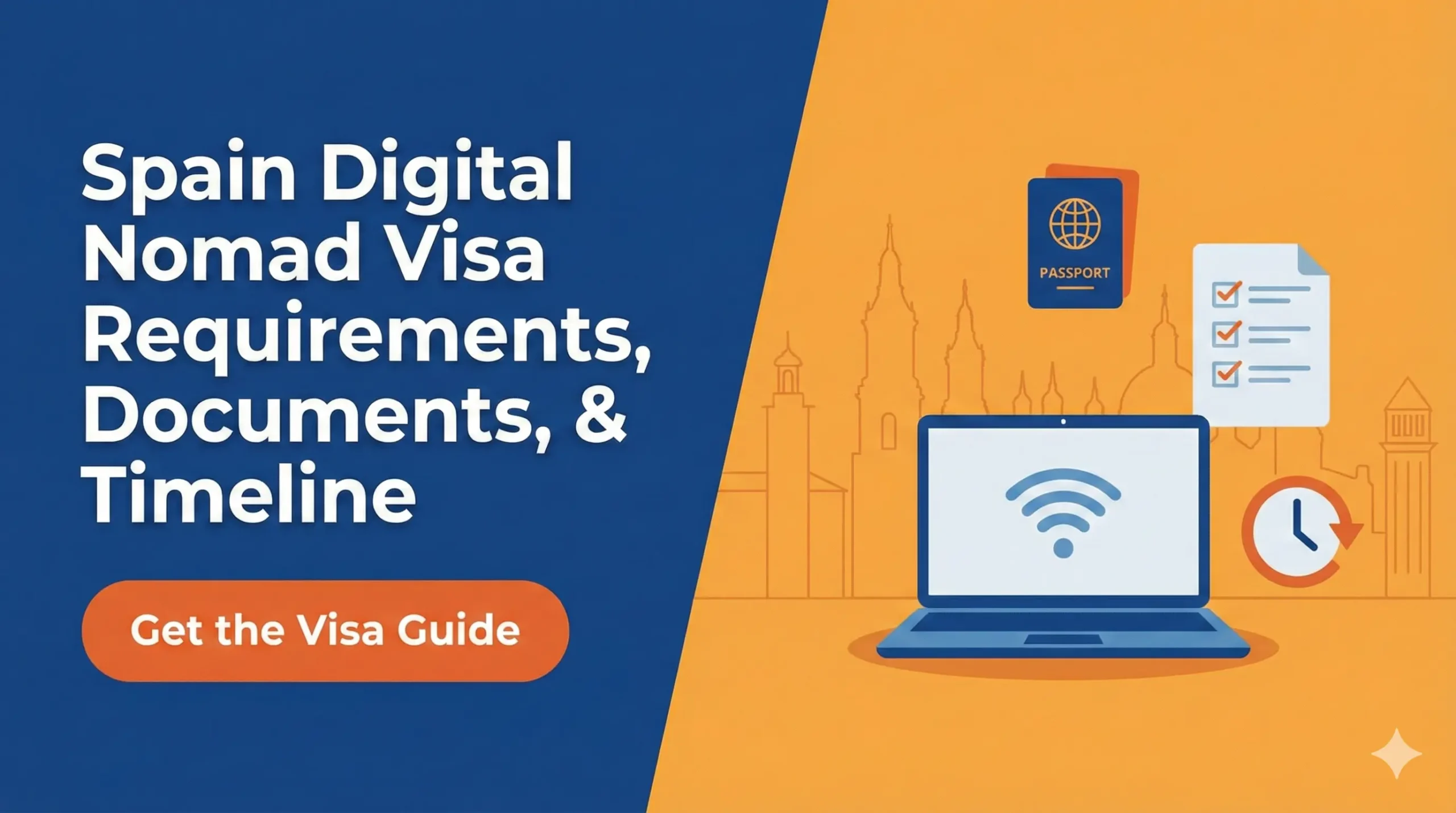
Spain Digital Nomad Visa: Requirements, Documents, and Timeline
You work remotely, your employer or clients are outside Spain, and you would love to swap your home office for a balcony in Valencia or a flat in Málaga. The Spain digital nomad visa makes that possible, but the official lists are dense, the social security rules confuse almost everyone, and forum advice often contradicts itself. This guide walks through who qualifies, which documents you need, and how the process unfolds step by step.
Disclosure: This post may contain affiliate links. We may earn a commission at no extra cost to you if you make a purchase through these links. Read full disclosure.
Who the Spain Digital Nomad Visa Is For
When Spain introduced its international teleworker route, my inbox filled up with the same question: “Is this visa for me?” The answer depends less on your job title and more on where your work comes from and how you can prove it. Let me break it down the way I wish someone had explained it to me.
The Core Idea: Remote Work for Companies Outside Spain
The digital nomad visa, officially a residence for international teleworkers, is designed for people who live in Spain while working remotely for a company or clients based outside Spain. You use computers, phones and the internet to do your job from here, while the business relationship sits abroad.
There are two broad profiles:
- Employees who work remotely for a company based outside Spain.
- Self-employed professionals and freelancers whose clients are mainly outside Spain. Freelancers may also take on some Spanish clients, but only within a limited share of their total work, so the international side must remain the main source.
If most of your income would come from Spanish clients or a Spanish employer, this is not the right route. Look at the overview in Spain Residency Permits Explained: Types, Eligibility, and Timelines instead.
Qualifications and Professional Experience
Spain wants to see that you are a qualified professional. In practice, you show this either with a university degree or professional qualification, or with documented professional experience in your field. Consulates and the immigration unit look at your CV, diplomas and reference letters together, so make sure they tell a coherent story. A degree in graphic design plus years of freelance design work is easy to read; a mismatch between your qualifications and your current job needs more explanation.
Proving a Genuine Remote Work Relationship
This is where many applications stand or fall. You must show that your work relationship is real, ongoing and compatible with remote work from Spain. For employees, that typically means an employment contract and a letter from the employer confirming that you can work remotely from Spain. For freelancers, it means contracts with clients describing the services, the terms and the remote nature of the work.
Both the company and the relationship should have some track record, and the authorities look at how long they have existed. Check the current requirements with your consulate or the official guidance before you apply. Our guide Spain Digital Nomad Visa: How to Prove Remote Work Relationship goes into the paperwork in detail.
Income Requirements Without the Guesswork
The income threshold is linked to Spain’s minimum wage (the SMI), with additional amounts for each family member who comes with you. Because the SMI is updated, the euro figure changes, and copying an amount from an old article is a common reason for rejection. Check the current figure on the official pages of the consulate or immigration authority before you apply, and see What Income Do You Need for the Spain Digital Nomad Visa? for how the calculation works.
| Profile | Main documents | What the authorities want to see |
|---|---|---|
| Remote employee | Employment contract, employer letter authorising remote work from Spain, company documents | A real, ongoing job with a company outside Spain |
| Freelancer | Client contracts, invoices, proof of professional activity | Mainly international clients, with any Spanish work kept within the permitted share |
| Both | Degree or proof of experience, criminal record certificate, health insurance, proof of income | Qualified professional who can support themselves and is covered |
Social Security: The Part Everyone Gets Wrong
If there is one topic that generates bad advice, it is social security. Under the digital nomad route, you have to show how you will be covered. Broadly, there are two options: you are registered in the Spanish social security system, or you remain covered by your home country’s system under a bilateral agreement, with a certificate proving it.
Option One: Registering in Spanish Social Security
If you are self-employed, this usually means registering as autónomo in Spain and paying monthly contributions. If you are an employee, your foreign employer may be able to register you in Spanish social security, which requires the company to take on certain obligations in Spain. Not every employer is willing or able to do this, so raise it early. For the self-employed side, Registering as Autónomo for Freelancers in Spain: Work Setup explains the process.
Option Two: Staying Covered by Your Home Country
If your home country has a social security agreement with Spain, you may be able to remain covered at home and show a certificate of coverage from your home system. This is often the simpler route for employees of foreign companies, because neither you nor your employer has to set up contributions in Spain.
What About Americans? Yes, There Is a US-Spain Agreement
Some guides list the United States under “countries with no agreement”. That is wrong. Spain and the United States do have a bilateral social security agreement, often called a totalization agreement. A new agreement was signed in Madrid on 8 April 2024, and the Spanish Congress authorised it on 14 November 2024.
Under the agreement, an employee sent by a US employer to work in Spain for a limited period can remain covered by US Social Security. The certificate of coverage is requested from the US Social Security Administration, not from Spain.
Here is the important nuance: whether you, as a remote worker on a Spanish digital nomad visa, qualify for that certificate depends on the facts of your case. Not every US remote employee automatically fits the conditions. Your employment setup, who your employer is and how your posting is structured all matter. Before you rely on this route, confirm your situation with the US Social Security Administration and with the Spanish social security authorities. If the certificate is not available for your situation, you will need to look at registering in Spanish social security instead.
| Situation | Typical social security route | What to confirm first |
|---|---|---|
| Employee of a company in a country with an agreement with Spain | Certificate of coverage from your home system, where you qualify | Whether your case meets the agreement’s conditions |
| US employee of a US company | Possible certificate of coverage from the US Social Security Administration under the US-Spain agreement | Your eligibility with the US Social Security Administration and Spanish social security |
| Employee whose employer can register in Spain | Registration in Spanish social security by the employer | Whether the employer will take on the obligations |
| Freelancer | Usually registration as autónomo in Spain | Contributions and any agreement-based alternative for your country |
Tax Is a Separate Question
Social security coverage and income tax are different systems. Moving to Spain on a digital nomad visa can make you a Spanish tax resident, and some teleworkers look at Spain’s special regime for inbound workers. That is a big topic of its own; start with The Digital Nomad Visa and the Beckham Law: How They Interact, and if you are a US citizen, Remote Employees of US Companies Living in Spain: Withholding and Double Filing explains how the two tax systems overlap.
Documents You Need and How to Prepare Them
The documents list is long, but most of it is predictable. The trick is preparing everything in the right format, with the right legalisation and translation, so nothing gets bounced back.
The Core Document Checklist
- Valid passport, with copies of all pages that the authority asks for.
- The completed application form for the consulate or the residence authorisation.
- Proof of your remote work relationship: employment contract and employer letter, or client contracts.
- Company documents showing the employer or clients exist and are active.
- Proof of qualifications or professional experience: diplomas, CV, reference letters.
- Proof of income meeting the current SMI-based threshold.
- Criminal record certificate from the countries where you have lived in recent years, as the authority specifies.
- Health insurance meeting the visa’s requirements.
- Proof of social security coverage, either Spanish registration or a certificate of coverage.
- The fee payment receipt.
Legalisation and Sworn Translations
Foreign public documents, such as criminal record certificates and diplomas, usually need an apostille or other legalisation. Documents not in Spanish usually need a sworn translation (traducción jurada) by a translator recognised in Spain. Services such as Translayte offer sworn translations into Spanish, but always check what the authority accepts and leave time for apostilles to come back before you order translations. Spain Visa Translations & Apostilles: What Needs Legalization? covers which documents need which treatment.
Watch out for validity: criminal record certificates in particular are only accepted if they were issued recently, so do not request them too early.
Health Insurance That Meets the Visa Rules
Spanish visa applications generally require comprehensive private health insurance from an insurer authorised to operate in Spain, unless you are covered by the Spanish public system. Many consulates expect the policy to have no co-payments and no waiting periods. A global travel or nomad policy is great for travel, but it is usually not built to satisfy these visa rules on its own. I used SafetyWing while I was scouting cities before applying, and then took out a Spanish policy for the application itself.
Providers such as Innoinsure offer policies designed with Spanish visa applications in mind; compare the conditions on the provider’s own page and check that the certificate they issue lists what your consulate requires. More detail is in Do You Need Health Insurance for the Spain Digital Nomad Visa?.
Showing Your Funds Clearly
Your financial evidence should be easy to follow: payslips, bank statements and contracts that clearly connect your remote work to the income on your account. If your money moves between accounts in different countries, label every statement and explain the flow. Funding a Digital Nomad Visa Application: Showing Funds Across Two Countries has examples of how to present this cleanly.
Common Reasons Applications Get Delayed
Most delays come from a handful of avoidable problems rather than from anything exotic. Before you submit, run through this list:
| Problem | How to avoid it |
|---|---|
| Income figure copied from an old article | Check the current SMI-based threshold on the official pages before applying |
| Employer letter that does not mention remote work from Spain | Ask the employer to state clearly that you may work remotely from Spain |
| Criminal record certificate too old by the time you apply | Request it close to your submission date and check its validity |
| Translations ordered before apostilles arrive | Get the apostille first, then the sworn translation of the full document |
| Health policy with co-payments or waiting periods | Choose a policy that meets the visa conditions and ask for a matching certificate |
| Assuming a US certificate of coverage is automatic | Confirm eligibility with the US Social Security Administration and Spanish social security |
If the authority asks for extra documents, answer quickly and completely. A partial reply often leads to a second request, which costs you more time than getting everything together at once.
The Application Timeline Step by Step
There are two ways to apply. You can apply from outside Spain for a visa at a Spanish consulate, then travel to Spain and get your residence card. Or, if you are already legally in Spain, for example as a visitor, you can apply directly for the residence authorisation from inside Spain, which is processed by the immigration unit for large companies and strategic groups, the Unidad de Grandes Empresas y Colectivos Estratégicos (UGE).
Applying From Abroad at a Consulate
- Check your consulate’s current requirements, including the income figure and accepted insurance.
- Gather and legalise documents, then order sworn translations.
- Confirm your social security route, including a certificate of coverage if that applies.
- Book and attend your consulate appointment and submit your file.
- Wait for the decision, responding promptly to any request for extra documents.
- Collect your visa and travel to Spain.
- Register your address with the town hall (empadronamiento).
- Book your fingerprint appointment and collect your residence card, the TIE.
Applying From Inside Spain
- Make sure you are legally in Spain on the day you apply.
- Prepare the same core documents, legalised and translated.
- Submit the application online to the UGE, usually through a representative or with a digital certificate.
- Wait for the decision, answering any requests for more documents.
- Once approved, book your fingerprint appointment and collect your TIE.
Many people prefer the inside route because the UGE handles digital nomad applications regularly. On the other hand, applying from inside means you need to plan your stay carefully, so your legal stay does not run out while you wait. Ask a lawyer or gestor if your timing is tight.
After Arrival: Registration and the TIE
Once you have your approval, the practical side of settling in begins. Register your address at the town hall, which you will need for almost everything from bank accounts to health care. Empadronamiento in Spain: How to Register Your Address explains the process. Then get your TIE card; How to Get the TIE Card in Spain: Fingerprints, Fees, and Pickup walks you through the appointment.
If you are moving furniture and belongings rather than arriving with two suitcases, start comparing movers early. Platforms like Sirelo let you compare quotes from removal companies, which makes it easier to plan around your approval date rather than rushing at the last minute.
Renewals and Planning Ahead
The digital nomad route allows you to renew while you continue to meet the conditions. Keep your employment letters, contracts, payslips and insurance up to date throughout, because the renewal will ask you to show the same things again. Our guide Renewing Spanish Residency: Timing, Requirements, and Common Rejections covers common renewal pitfalls.
A Real-World Example
Megan is a US product designer employed by a company in Austin. She arrives in Spain as a visitor, scouts Valencia and Seville, and decides on Valencia. Before applying from inside Spain, she asks her employer for a letter confirming she can work remotely from Spain, gathers her diplomas and apostilled background check, orders sworn translations and takes out a Spanish health policy that meets the visa rules. For social security, she contacts the US Social Security Administration to ask whether her situation qualifies for a certificate of coverage under the US-Spain agreement, and she checks the answer with the Spanish social security office. Only once both confirm her route does she submit.
Megan’s approach is slower at the start, but it is the reason her application goes through without a request for missing documents.
Disclaimer
This article is for general informational purposes only and does not constitute professional advice. Laws, prices and regulations vary by location and change over time. Consult a qualified professional for guidance on your specific situation.