Choosing a Neighborhood in Spain: How to Research Before You Move
Picture this: you sign a twelve-month lease on a gorgeous flat in a Madrid barrio you saw once, on a quiet Tuesday morning. By Friday night, you realise your balcony overlooks three bars whose terraces stay full until well past midnight. This guide shows you how to research Spanish neighborhoods properly, both from home and on the ground, before you commit.
Disclosure: This post may contain affiliate links. We may earn a commission at no extra cost to you if you make a purchase through these links. Read full disclosure.
Why Neighborhood Research Matters More in Spain Than You Think
The Barrio Shapes Your Daily Rhythm
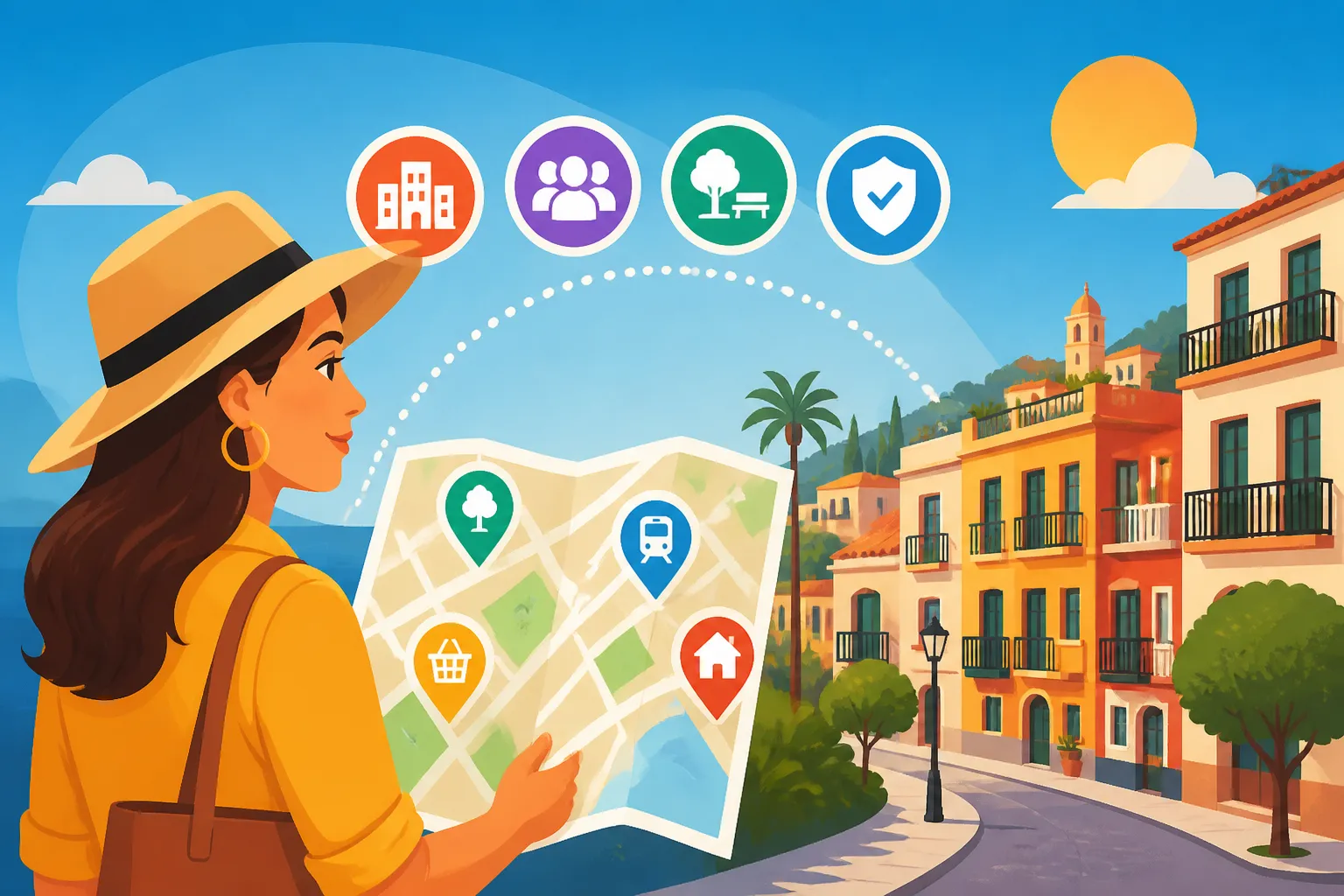
In many countries, your neighborhood is just where you sleep. In Spain, the barrio is where you live most of your life. Spaniards shop at the local mercado municipal, take their coffee at the same corner bar every morning, walk the kids to the nearby colegio, and spend evenings on plazas a few minutes from their door. Life happens at street level. That means the character of your immediate few blocks affects your happiness far more than the size of your kitchen.
I learned this the hard way in my first year. I chose a flat on paper because it had a second bedroom and a lift. What I did not check was that the nearest proper supermarket was a twenty-minute walk uphill, the local market had closed years earlier, and the only bar nearby shut at eight. I spent a year feeling oddly isolated in a city famous for its social life. My next move, to a smaller flat in a livelier barrio, changed everything.
The lesson is that you are not just choosing an apartment. You are choosing a daily routine, a soundscape, a commute, and a social circle. If you are still deciding between city life and somewhere quieter, read Living in Smaller Spanish Towns vs Big Cities: Trade-Offs before you narrow down specific barrios.
Listings Hide What Streets Reveal
Spanish property listings are notoriously optimistic. Words like luminoso (bright), tranquilo (quiet) and bien comunicado (well connected) appear so often that they lose meaning. A listing photographed with a wide-angle lens at midday in June tells you nothing about how the flat feels in January, or what the street sounds like at two in the morning on a Saturday.
Many problems that ruin a rental in Spain are neighborhood problems, not flat problems. Late-night terraces, a weekend botellón spot in the nearby park, a delivery depot whose lorries start before dawn, a street that floods during autumn storms, or a block that has quietly become mostly tourist apartments. None of this appears in the listing. To decode the vocabulary that does appear, see How to Read Spanish Real Estate Listings: Key Words Decoded.
Desk Research Before You Fly
Reading Listings as Neighborhood Data
Even if you do not trust individual listings, the pattern across many listings is valuable. Spend an evening on the big Spanish portals such as Idealista and Fotocasa, filtering by the barrios you are considering. Notice how many flats are available, how quickly they disappear, and what types of buildings dominate. A barrio full of renovated studios marketed to foreigners tells a different story from one full of three-bedroom family flats in older buildings.
Pay attention to recurring details. If almost every listing in an area mentions aire acondicionado, the area probably gets very hot. If many ground-floor flats are listed, ask yourself why owners are struggling to rent them. If listings repeatedly say ideal inversores (ideal for investors), the area may be shifting toward short-term rentals, which affects both noise and community feel.
Platforms aimed at international renters can help with this early stage too. Spotahome, for example, is useful for seeing furnished mid-term options in a city before you arrive, and its video tours give you a rough sense of building style and street atmosphere from abroad. Treat these as a first filter rather than a final answer, and check the platform’s own pages for current terms and conditions.
Mapping Commutes and Transport Realistically
Distance on a map lies in Spain. A barrio that looks close to your office might sit on the wrong side of a hill, a motorway or a river with only one bridge. Plan your actual commute in a mapping app for the time you would really travel, not at midnight when the roads are empty. Check the route by metro, bus, Cercanías commuter train and on foot, because each city’s network has its own strengths and gaps.
Look specifically at frequency, not just existence. A bus line that passes every few minutes on weekdays may run far less often on Sundays and in August. Some suburban rail lines are excellent at rush hour and sparse at night. If you plan to rely on public transport, read Public Transport in Spain: Cards, Discounts, and Etiquette to understand the passes and zones in your target city before you rule an outer barrio in or out.
If you will drive, investigate parking early. Older central barrios often have resident-only parking schemes, low-emission restrictions and almost no garage space. A flat that seems affordable can become expensive once you add a rented parking spot, so ask about plaza de garaje availability in the building or nearby.
Using Street-Level Imagery and Local Forums
Street-level imagery is a superb remote research tool. “Walk” the streets around a shortlisted flat and look at what is on the ground floors: bars, shuttered shops, bakeries, pharmacies, schools, gyms, empty lots. Count the terraces. Check whether the street is pedestrianised, narrow and shaded, or a wide avenue with heavy traffic. Look at older captures if available, because they show whether an area is gentrifying or declining.
Then dig into local conversation. Expat Facebook groups, city subreddits and neighbourhood associations (asociaciones de vecinos) are full of honest complaints and praise. Search for the barrio name plus words like ruido (noise), seguridad (safety), obras (building works) and pisos turísticos (tourist flats). Local news sites often cover disputes over terrace licences, planned metro extensions or long-running construction projects that will shape the area for years.
Boots-on-the-Ground Research When You Arrive
Setting Up a Temporary Base
The single best decision I ever made was refusing to sign a long lease before I arrived. Instead, I booked a furnished flat for a few weeks in a central, well-connected area, and used it as a base for scouting. The guide Booking a Base for an Apartment Hunt in Spain: Location and Length covers how to pick that base so you can reach several candidate barrios easily.
If your arrival date and your lease start date do not line up neatly, you will need somewhere to stay in between. I explain the options in Bridge Accommodation: Where to Stay Between Landing and Getting Keys, and Short-Term and Mid-Term Rentals in Spain: When They Make Sense goes deeper into the legal and practical differences between stay types. Spotahome and similar platforms are popular for this bridge period because you can book remotely, but always confirm cancellation rules and what is included directly with the provider.
Before you land, sort out mobile data. You will be walking unfamiliar streets with maps open all day, photographing buildings and messaging landlords, often before you have a Spanish contract SIM. A travel eSIM from a provider like Airalo can keep you connected from the moment you leave the airport. Check the provider’s current plans and coverage for Spain before you buy.
The Three-Visit Rule: Morning, Evening, Weekend
Never judge a Spanish barrio on a single visit. Spain’s daily rhythm means the same street can feel completely different at different times. I insist on at least three visits to any serious candidate: one on a weekday morning, one on a weekday evening after nine, and one on a Friday or Saturday night. If you can manage a Sunday morning too, even better.
On the morning visit, watch the school run, the delivery traffic and how busy the market and bakery are. On the evening visit, notice whether people are out walking, whether families are in the plaza, and how lit and populated the streets feel. On the weekend night, stand outside the actual building and listen. That is when you discover the nearby bar with live music, the street that becomes a shortcut home for nightclub crowds, or the park where groups gather until late.
Use this table as a checklist for each visit:
| Visit Time | What to Observe | Warning Signs |
|---|---|---|
| Weekday morning | School traffic, delivery vans, market activity, café life | Constant lorry noise, closed shutters on most shops |
| Weekday evening | Street lighting, people walking, families in plazas | Empty dark streets, groups loitering near the building |
| Friday or Saturday night | Bar terraces, music, crowds heading home | Shouting under balconies late, bottles left in doorways |
| Sunday morning | Street cleaning, leftover mess, how residents use the area | Heavy litter, broken glass, no sense of local community |
| Rainy day if possible | Drainage, puddles, how the building entrance copes | Flooded crossings, water stains at street level |
Talking to Locals Without Being Awkward
Locals are your best data source, and most Spaniards are happy to chat about their barrio if you ask politely. The easiest opener is at the counter of a neighbourhood bar while ordering a coffee: “Estoy pensando en mudarme aquí. ¿Qué tal es el barrio para vivir?” (I’m thinking of moving here. What’s the neighbourhood like to live in?). You will usually get a frank answer, sometimes with gossip about specific streets.
Other great sources are shop owners who have been in the area for years, building porteros (doormen) in older blocks, and parents waiting outside school gates. Ask specific questions rather than general ones: Is it noisy in summer? Are there many tourist flats now? Is the market still good? Where do people park? Specific questions get specific answers.
If your Spanish is still basic, prepare a few phrases in advance. A good option is practising with a tutor, which I cover in Apartment Hunting in Spanish: Rehearsing the Conversation With a Tutor. Even a clumsy attempt at Spanish earns more goodwill than starting in English.
Comparing Neighborhood Types Across Spanish Cities
Historic Centers vs Ensanches vs Outer Barrios
Most Spanish cities follow a similar pattern. There is a historic core, the casco antiguo or centro histórico, with narrow streets, old buildings and the main monuments. Around it sits the ensanche, a planned grid of wider streets built from the nineteenth century onward. Beyond that come residential barrios, newer developments and finally satellite towns connected by commuter rail.
Each type comes with predictable trade-offs. Here is how they usually compare:
| Neighborhood Type | Atmosphere | Noise Level | Light and Space | Rent Level | Best Suited To |
|---|---|---|---|---|---|
| Historic center | Charming, walkable, touristy | Often high, especially at night | Small flats, narrow streets, less light | High relative to size | Singles, couples, short stays |
| Ensanche grid | Elegant, urban, well serviced | Moderate, traffic on main streets | Larger flats, interior patios | High | Professionals, couples, some families |
| Traditional residential barrio | Local, authentic, market-based | Moderate, depends on street | Mixed building stock | Moderate | Long-term residents, families |
| Newer developments | Quiet, modern, car-oriented | Low | Bigger flats, pools, garages | Moderate to high | Families, drivers |
| Satellite towns | Suburban, community feel | Low | Most space for money | Lower | Families, remote workers, budget movers |
Building age matters as much as location. Many older central buildings have thin walls and wooden floors that carry sound, and very few have lifts. Before you fall in love with exposed beams, read Spanish Noise‑Insulation Reality: What to Expect in Older Buildings.
City Examples From Madrid, Barcelona, Valencia and Andalusia
In Madrid, Malasaña and La Latina are wonderful for nightlife and terrible if you need early nights. Lavapiés is diverse and lively but varies sharply street by street. Chamberí and Retiro are calmer, greener and popular with families, while barrios like Carabanchel and Usera offer more space for the money with improving transport links. La Latina also hosts the August fiestas of La Paloma, which is great fun unless you live directly above the stage.
In Barcelona, the Gòtic and El Born are atmospheric but crowded with visitors. Eixample offers classic flats with high ceilings and interior courtyards, though main avenues carry heavy traffic. Gràcia feels like a village within the city, yet its Festa Major in August fills the streets with decorations, concerts and crowds for days. Poblenou and Sant Andreu attract people who want a more residential feel with good access to the centre.
In Valencia, Russafa is creative and buzzing but noisy at weekends, Benimaclet has a student and community vibe, and El Cabanyal offers beach proximity in a neighbourhood that has changed fast. Remember that Fallas in March brings fireworks, mascletàs and street parties across much of the city. In Seville, Triana and the Alameda area are lively, while Nervión is more practical and residential. In Málaga, the Soho area is central and arty, while El Palo and Pedregalejo offer a seaside, local feel slightly away from the tourist core.
Spain-Specific Factors Newcomers Overlook
Noise, Fiestas and Terraces
Noise is the number one complaint I hear from new arrivals. Spain lives late, and outdoor terraces are central to that life. Before signing, check not only what is under the flat, but what is within earshot across the street and around the corner. Sound bounces off stone walls in narrow streets, so a bar two doors down can sound like it is in your living room.
Every barrio also has its own fiestas, which may last days and run late. Look up the local fiestas del barrio dates for any area you are considering. Some people love them; others plan their holidays around them. If you end up with noise problems after moving in, see How to Deal With Noisy Neighbors in a Spanish Building for practical and polite next steps.
Heat, Light and Building Orientation
Orientation is a serious issue in Spain, especially in the south and inland. A south- or west-facing flat in Seville or Córdoba can become unbearably hot in summer afternoons, while a north-facing flat in Bilbao or Santiago may stay damp and dark in winter. Ask about orientación, and visit at different times to see when sunlight actually reaches the windows.
Also learn the difference between exterior and interior flats. Exterior flats face the street and get more light but more noise. Interior flats face the patio de luces, an internal light well, and are quieter but can be dim and share sounds and cooking smells with neighbours. Ground-floor bajos are often cheaper but may have less privacy, more humidity and more street noise. Áticos (penthouses) have terraces but can be ovens in summer without good insulation.
Paperwork Geography: Padrón, School Zones and Services
Your address affects more than your commute. When you register on the padrón at your local town hall, it determines which local services you can access and, for families, which public schools you are likely to be assigned. See How to Register Your Address (Empadronamiento) as a Renter in Spain and make sure your landlord is comfortable with you registering before you sign, because some are not.
If you have children, school catchment zones can make or break a barrio choice. Research which schools serve the streets you are considering, and read How to Find Family-Friendly Neighborhoods Near Spanish Schools alongside School Enrollment in Spain: Registration Steps for Foreign Families before committing.
Check the practical services too. Is there fibre in the building? Older buildings sometimes have limited options, which matters for remote workers. The guide Getting Internet Installed in Spain: Typical Timelines and Documents explains what to ask. Also look at how parcels arrive. If you order essentials from Amazon Spain to your temporary base, notice whether deliveries arrive smoothly, whether there is a doorman or nearby pickup point, and how the local delivery network handles your area. It is a small test that tells you a lot about day-to-day convenience.
Turning Research Into a Decision
A Step-by-Step Shortlisting Process
Once you have gathered information, turn it into a decision with a simple process:
- Write down your non-negotiables, such as maximum commute, need for a lift, quiet nights, school access or pet-friendliness.
- Shortlist four or five barrios using desk research, listing patterns and commute maps.
- Book a temporary base within easy reach of most of them.
- Visit each barrio at least three times, using the checklist table above.
- Talk to at least two or three locals in each area and note their comments.
- Score each barrio against your non-negotiables, not against how charming it felt on a sunny afternoon.
- Narrow down to two finalists and start viewing flats only in those areas.
- Before signing, revisit the specific street at night and on a weekend.
For a more detailed scoring system, see How to Choose a Neighborhood in Spain: A Practical Decision Checklist.
Red Flags That Should End the Search
Some warning signs should make you walk away from a barrio, or at least from a particular street. A block where most flats are clearly tourist rentals often means rotating guests, suitcases at all hours and little community. Persistent litter and broken glass on weekend mornings suggest regular late-night gatherings. Many shuttered shops can indicate a declining area, while scaffolding everywhere may mean years of obras.
Be equally wary of situations that feel too easy. If a flat in a sought-after barrio is suspiciously cheap, or a landlord pushes you to pay before you have visited the area, something is wrong. Read How to Spot Rental Scams in Spain Before You Pay a Deposit before transferring any money.
Finally, trust your instincts. If you walk down a street and feel uneasy at night, or if you cannot imagine yourself buying bread there every morning, that feeling is valid data. The right barrio in Spain should make you want to step outside your door. Take your time, do the legwork, and you will end up somewhere that feels like home rather than just an address.
Disclaimer
This article is for general informational purposes only and does not constitute professional advice. Laws, prices and regulations vary by location and change over time. Consult a qualified professional for guidance on your specific situation.