Does Spain’s Public Healthcare Cover Pre-Existing Conditions?
Moving to Spain with a chronic illness or a "bad back" is a massive stressor that kept me awake for weeks before my flight. I remember landing in Madrid with a suitcase full of inhalers, terrified that my medical history would leave me uninsurable or bankrupt in a foreign language. This guide solves the confusion by detailing exactly how the public system handles your history versus the private sector.
Disclosure: This post may contain affiliate links. We may earn a commission at no extra cost to you if you make a purchase through these links. Read full disclosure.
Understanding the Philosophy of the Spanish National Health System
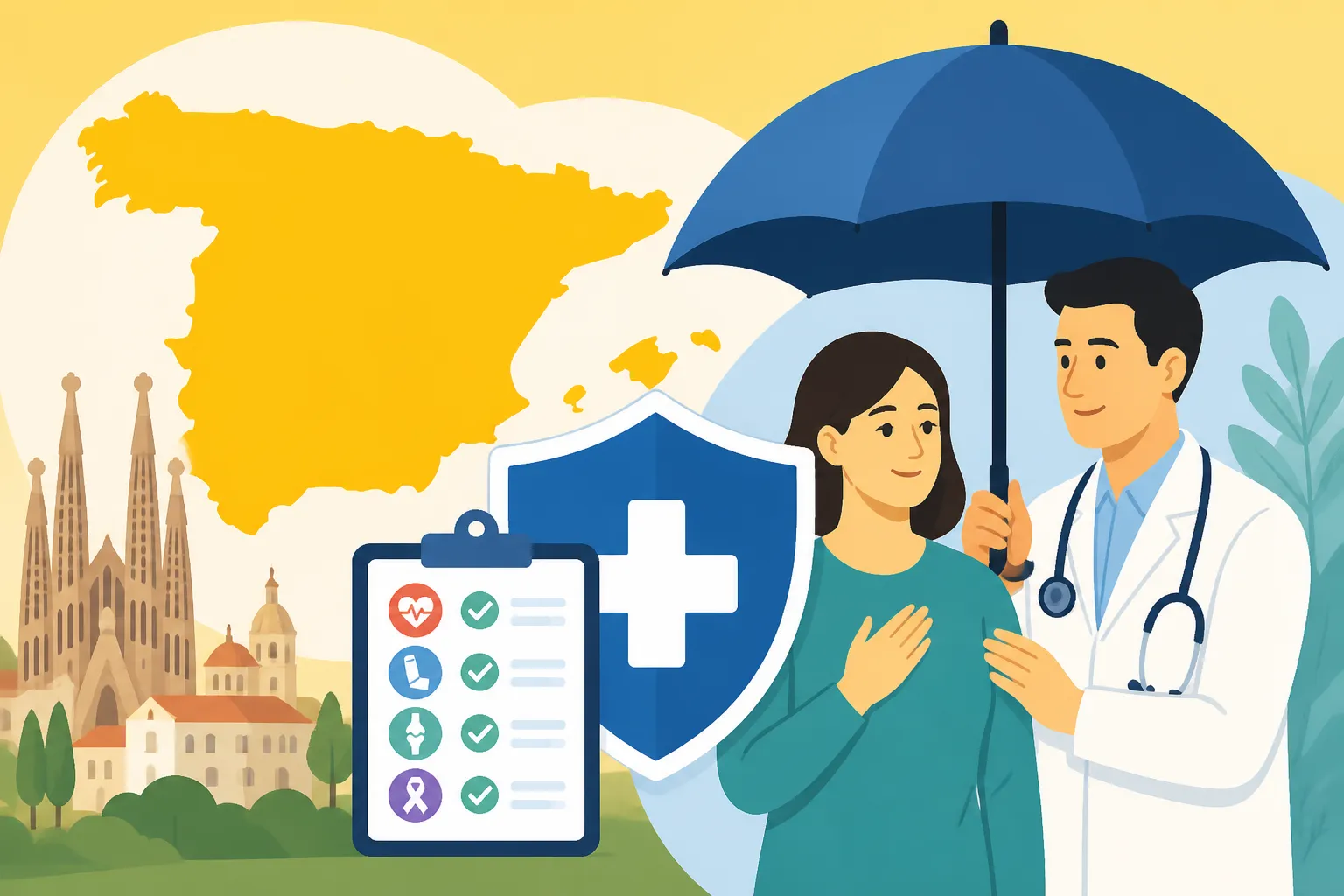
The first thing you need to wrap your head around is that the Spanish public healthcare system, known as the Sistema Nacional de Salud (SNS), operates on a completely different logic than the insurance-based models found in the US or even parts of Northern Europe. It is a tax-funded, universal system. This means it doesn’t actually care about your "risk profile" in the way a private corporation does. If you are eligible to be in the system, you are in—period.
Universal Coverage Without Risk Assessment
In the public system, there is no such thing as a medical questionnaire. When you go to your local health center to register, nobody is going to ask you for a blood test or a history of your surgeries to decide if they will "accept" you. The system is built on the principle of solidarity. Whether you are a perfectly healthy 20-year-old or someone managing complex Chronic Conditions in Spain: Managing Ongoing Care as an Expat, your right to treatment is identical once you have your health card.
This is a massive relief for those of us who have been denied coverage elsewhere. Expats often arrive with everything from autoimmune disorders to previous cardiac events, and the moment they receive their Tarjeta Sanitaria, they have access to the same specialists and medications as a Spanish citizen who has paid into the system for forty years. There are no "waiting periods" (known as carencias) for pre-existing conditions in the public system. If you need an oncologist on day one, the system is designed to provide one, provided you have cleared the administrative hurdles of residency.
The Reality of Public System Wait Times
While the public system won't exclude your pre-existing condition, it’s important to be realistic about the "I've-been-there" frustrations of the SNS. Because the system is universal and "free" at the point of use, it is often stretched thin. If your pre-existing condition requires non-urgent elective surgery—like a hip replacement or a deviated septum repair—you might find yourself on a waiting list for several months.
However, for life-altering chronic management, the system is remarkably robust. The GP (your médico de cabecera) acts as the gatekeeper. They will be the ones to review your foreign records and issue the referrals you need. You can find more about this process in our guide on Seeing a Specialist in Spain: Referral Process Explained. The key takeaway here is that while the system covers you, it doesn't always move at the speed you might prefer for non-emergencies.
How Medications are Handled for Pre-existing Issues
Another area where the public system shines for those with ongoing health issues is the prescription system. In Spain, medications are heavily subsidized. Instead of paying the "sticker price" for your monthly insulin or blood pressure pills, you usually pay a small percentage of the cost, known as a co-payment.
Your specific co-payment level depends on your income and whether you are a pensioner or a working resident. If you’re coming from a country where life-saving medication costs as much as a monthly mortgage payment, the Spanish Prescription System in Spain: How ePrescriptions Work will feel like a miracle. Your doctor will link your prescriptions to your digital health card, allowing you to pick them up at any pharmacy in the country.
Eligibility and the Gateway to Coverage
The question isn't usually "Does the public system cover my condition?" but rather "Am I eligible to join the public system?" In Spain, your right to healthcare is tied to your residency status and your contribution to the Social Security system. This is the "administrative hurdle" that trips up most newcomers.
Working Residents and Social Security
If you are working in Spain, either as an employee for a Spanish company or as a freelancer (autónomo), you are automatically covered. Your monthly social security contributions grant you and your "beneficiaries" (spouse and children) full access to the SNS. In this scenario, your pre-existing conditions are covered from the moment your work contract begins or your freelancer status is active.
For those moving on a work-related path, the process involves getting your Social Security Number and then taking your work contract to the local health center. There is no health check involved. This is the most straightforward way to ensure that your medical history doesn't prevent you from receiving care. It also applies to those who are receiving certain Spanish state benefits, such as unemployment or maternity pay.
The Convenio Especial: A Safety Net for Others
But what if you aren't working? Perhaps you are here on a Non-Lucrative Visa or you are an early retiree. This is where many expats feel stuck. If you’ve lived in Spain for at least one continuous year and are registered on the padrón (census), you can apply for the Convenio Especial. This is essentially a "pay-in" scheme that allows you to access the public healthcare system for a fixed monthly fee (currently around €60 for those under 65 and €157 for those over 65).
The Convenio Especial is a godsend for people with pre-existing conditions who cannot get private insurance. Because it is part of the public system, it also has no medical exclusions. You pay your monthly fee, and you get full access to the SNS, including specialists and hospitals. The only catch is that it generally doesn't cover the subsidy on prescriptions; you’ll have to pay the full price for your meds, though that price is still regulated and often much lower than in the US or UK. You can read more about who qualifies in Who Can Access Public Healthcare in Spain? Eligibility Basics.
Residency Status and the Padrón
The absolute foundation of your healthcare access is your Empadronamiento in Spain: How to Register Your Address. Without being on the padrón, the gates to the public system remain firmly shut, regardless of your health status. I cannot emphasize this enough: the moment you have a permanent address, get to your local Ayuntamiento and register.
Once you have your padrón certificate and your residency papers (TIE or Green Box), you can visit your local Centro de Salud to register for your health card. This card is your passport to medical services. If you’re new and the paperwork is dragging, check out How to Access Public Healthcare If You’re New and Paperwork Isn’t Done Yet for some stop-gap advice.
Public vs. Private: The Pre-existing Condition Gap
This is where the conversation gets a bit more difficult. While the public system is inclusive, the private sector in Spain operates on a very different set of rules. For many visas, such as the Non-Lucrative Visa or the Student Visa, the Spanish government requires you to have private health insurance that offers "coverage equivalent to the public system."
Why Private Insurers Use Medical Questionnaires
Private companies like Cigna Global or Innoinsure are businesses. To keep premiums low for the general population, they assess the risk of every applicant. When you apply for a private policy, you will be required to fill out a Cuestionario de Salud. You must be brutally honest here. If you hide a pre-existing condition and later try to claim for it, the insurer can—and likely will—void your policy.
For someone with a major pre-existing condition, a private insurer will typically take one of three paths:
- Acceptance with Exclusions: They cover you for everything except your pre-existing condition.
- Acceptance with a Premium Loading: They cover everything, including your condition, but you pay a much higher monthly fee.
- Rejection: They decline to offer you a policy because the perceived risk is too high.
Understanding Waiting Periods and Exclusions
Even if you are accepted, private policies often have carencias (waiting periods). For example, you might have to wait six months before they will cover a complex diagnostic test or twelve months for a surgical intervention. This is why many expats choose to use a hybrid approach. They might use a company like SafetyWing for travel-related emergencies or initial relocation gaps, but they aim for the public system as soon as they are eligible to ensure their chronic issues are handled without exclusions.
If you are looking at private options specifically for a visa, you need to be very careful. The policy must have "no co-payments" and "no waiting periods" to satisfy immigration officials. This can be tricky if you have a medical history. Some specialized brokers, like Innoinsure, focus on policies that meet these strict visa requirements. You can learn more about these nuances in Private Health Insurance for Spain Visas: What Policies Must Include.
When to Use Both Systems Concurrently
Many veterans of the expat life in Spain choose to maintain both. They use the public system for their pre-existing condition management—the expensive stuff like biological drugs, regular blood work, and major surgeries—because the public hospitals in Spain are world-class. Then, they keep a basic private policy with a provider like Cigna Global to get faster access to "minor" specialists like dermatologists or physical therapists, where the public wait times can be frustrating.
| Feature | Spain Public Healthcare (SNS) | Private Healthcare in Spain |
|---|---|---|
| Pre-existing Conditions | Always covered if you are eligible. | Often excluded or requires a higher premium. |
| Medical Questionnaire | None. | Mandatory and detailed. |
| Waiting Periods | None for emergency/essential care. | Usually 3-12 months for non-emergencies. |
| Specialist Access | Requires GP referral; longer waits. | Direct access; very fast. |
| Prescription Costs | Heavily subsidized (Co-pay). | You pay 100% of the pharmacy price. |
| Cost | Tax-funded or fixed monthly fee. | Risk-based monthly premium. |
Navigating the System with a Chronic Condition
Once you have your health card in hand, the real work of managing your health in a new country begins. Spanish bureaucracy is a beast, and medical bureaucracy is no exception. You need to be your own best advocate, especially if your Spanish isn't fluent yet.
Registering with a GP and the First Visit
Your first point of contact is the Centro de Salud in your neighborhood. You will be assigned a Médico de Cabecera (Family Doctor). I recommend booking an "administrative" appointment as soon as you get your card, rather than waiting until you are sick. This is the time to establish your history.
Bring a folder with your translated medical records. While many doctors in big cities speak some English, it is not guaranteed. If your condition is complex, having a summary of your history translated into Spanish by a professional is invaluable. For tips on the language barrier, check our Spanish Medical Terminology: Common Words Expats Should Know or look into How to Ask for an English‑Speaking Doctor Appointment in Spanish (Phrase Guide).
Transferring Medical Records from Abroad
Spain doesn't have a magic button that pulls your records from the UK, the US, or elsewhere. You are the bridge. I found it most effective to have my previous specialist write a "Summary of Care" letter including my current diagnosis, medication list (using generic names, not brand names), and recent test results.
In Spain, many specialists will want to run their own tests to "re-confirm" the baseline before they continue a treatment plan started abroad. Don't take this as a sign of distrust; it’s just the Spanish clinical protocol. If you need copies of these new Spanish records later, perhaps for an insurance claim or moving again, follow the steps in How to Request Medical Records in Spain for a New Doctor Abroad.
Accessing Specialist Care and Prescriptions
In the public system, you cannot just walk into a cardiologist's office. You must go through your GP. If you have a pre-existing condition that requires specialist monitoring, tell your GP clearly: "I have [Condition], and back home I saw my specialist every six months. I need a referral to continue this care."
Once the referral is in the system, you will receive an appointment via mail, SMS, or the regional health app (like Tarjeta Sanitaria Virtual in Madrid or La Meva Salut in Catalonia). These apps are incredibly useful for tracking your history and renewing prescriptions without having to visit the clinic every time. For a deeper dive into the digital side of things, see our guide on Health Apps in Spain: Booking, Records, and Telemedicine Options.
Spain Healthcare System for Expats: Public vs Private
Determining whether to rely on the public or private sector often comes down to the nature of your pre-existing condition. If you have a condition that requires very expensive, cutting-edge medication—think MS treatments, biologicals for Crohn’s, or advanced oncology—the public system is almost always the better choice. The financial protections provided by the SNS for chronic patients are among the best in the world.
On the other hand, if your "pre-existing condition" is something like a trick knee or a history of migraines that isn't life-threatening but requires occasional specialized attention, the speed of private care is a huge advantage. You can see a specialist in 48 hours rather than 48 days. Just remember that the private insurer will ask about it upfront. If they exclude it, you’ll be paying out-of-pocket for those visits, but the costs of a private consultation in Spain (often €60-€100) are still much lower than in many other Western countries.
Ultimately, Spain is a fantastic place to live with a pre-existing condition because the "floor" of care is so high. You are never at risk of being completely without medical options simply because of your past. Whether through social security contributions or the Convenio Especial, the system eventually opens its doors to everyone who calls Spain home.
Disclaimer
This guide is for informational purposes only and does not constitute legal or medical advice. Healthcare regulations and residency requirements in Spain are subject to change. Always consult with official government sources, a qualified immigration lawyer, or a professional insurance broker before making decisions regarding your healthcare coverage.