How to Switch Electricity Provider in Spain (Step-by-Step)
Opening an electricity bill in Spain and seeing a charge of 150 euros for a tiny flat is a terrifying expat rite of passage. I remember staring at my first utility bill, completely paralyzed by the fear that switching providers meant my power would be cut off for weeks. This guide breaks down exactly how to safely switch your Spanish electricity provider to stop overpaying.
Disclosure: This post may contain affiliate links. We may earn a commission at no extra cost to you if you make a purchase through these links. Read full disclosure.
Decoding Your Current Electricity Contract
Before you can switch to a better deal, you need to understand exactly what you are currently paying for. When most expats move into a new rental, the landlord simply transfers the existing, often outdated, utility contract into the tenant’s name. This means you are likely inheriting a terrible rate.
The Distributor Versus the Marketer
The most confusing part of the Spanish energy system is the separation of powers. There are two entities involved in your electricity supply: the distributor (distribuidora) and the marketer (comercializadora).
The distributor owns the physical cables, the street infrastructure, and the meter in your building’s basement. You cannot choose your distributor; it is assigned based on where you live (for example, e-Distribución in Andalusia or i-DE in Madrid). If there is a power outage in your neighborhood, you call the distributor.
The marketer, on the other hand, is the company that actually buys the electricity and bills you for it (such as Endesa, Iberdrola, or Holaluz). This is the company you can switch. You are free to choose any marketer operating in the market. Understanding this split is critical, and we explore the billing breakdown of these two entities deeply in Understanding Utility Bills in Spain.
Locating Your CUPS Number
To initiate a switch, your new provider will need to identify your specific physical meter. They do this using the Código Universal de Punto de Suministro (CUPS).
Think of the CUPS as the Social Security Number for your electricity meter. It is a 20-to-22 alphanumeric code that always begins with “ES”. You can find this number at the top of your current electricity bill, usually under the Datos del Suministro (Supply Details) section.
Comparing Providers and Finding the Best Tariff
Spain has an incredibly crowded electricity market. If you don’t know what you are looking at, the marketing jargon will trick you into a bad contract.
The Regulated Market vs Free Market
The Spanish electricity market is broadly split into two camps. The Mercado Regulado (Regulated Market) offers the PVPC tariff (Precio Voluntario para el Pequeño Consumidor). Here, the price of electricity fluctuates every single hour of every day based on supply and demand on the wholesale market. During an energy crisis, this tariff can be brutally expensive, but historically, it has been the cheapest option.
The Mercado Libre (Free Market) is where private companies offer fixed rates, flat monthly fees, or specific time-of-use discounts (like free electricity on weekends). A fixed rate protects you from market volatility, but you pay a slight premium for that peace of mind. Knowing how these daily fluctuations impact your monthly budget is a core element of managing your Cost of Living in Spain.
| Tariff Type | Price Stability | When to Use Electricity | Best For |
| PVPC (Regulated) | Highly Volatile | Mid-afternoon or late night | Tech-savvy users who track daily prices |
| Fixed Rate (Free) | Stable / Locked-in | Anytime | Expats who want predictable monthly bills |
| Time-of-Use (Free) | Predictable schedules | Nights and weekends | People who work away from home all day |
| Flat Rate (Tarifa Plana) | Fixed monthly cap | Anytime (up to a limit) | High-consumption households needing safety nets |
Checking Your Potencia (Contracted Power)
A massive chunk of your Spanish electricity bill is a fixed charge based on your potencia contratada (contracted power), measured in kilowatts (kW). This dictates how many appliances you can run simultaneously before the main breaker trips.
Many landlords blindly contract 5.7 kW or higher, which is wildly excessive for a single expat and drastically inflates the bill. Conversely, if your power cuts out every time you run the washing machine and the oven together, your potencia is too low. Lowering your potencia is one of the easiest ways to save money, a trick heavily discussed in Setting Up Electricity and Gas in Spain.
Before you switch providers and adjust your potencia, I highly recommend finding out exactly which appliances are draining your power. You can order cheap smart plugs from Amazon Spain to monitor the exact wattage of your heavy-draw appliances. Tracking the energy spike of a portable heater using these plugs is vital if you are relying on the supplemental heating methods outlined in Spanish Apartment Heating: What Systems You’ll Commonly Find.
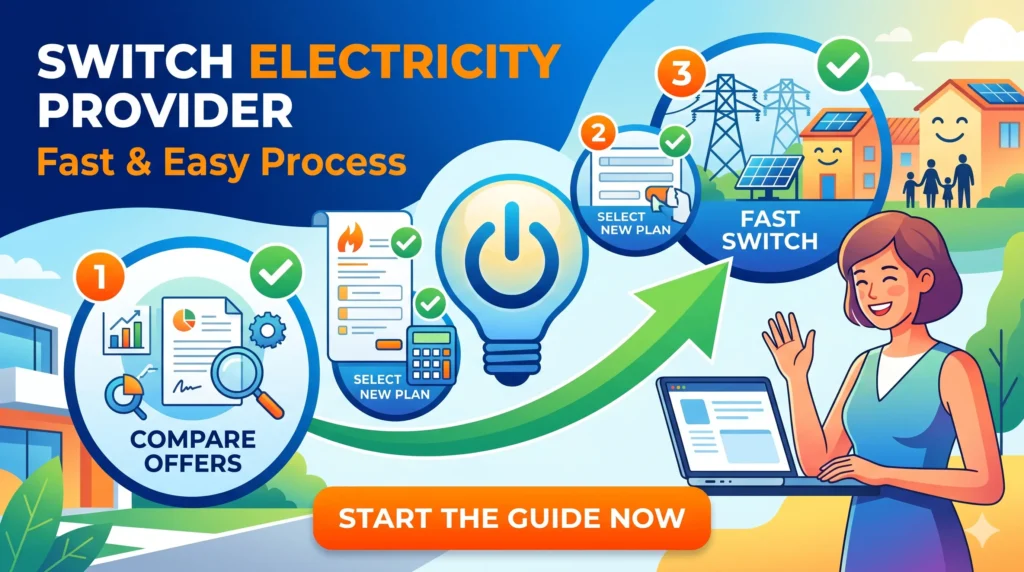
The Step-by-Step Switching Process
The biggest fear foreigners have is that switching providers will result in a week without electricity. This is a complete myth. The physical cables do not change, and nobody comes to your house to disconnect the meter. The switch is entirely administrative and happens digitally.
Gathering Your Required Documents
Once you have used the official CNMC comparison tool (Comisión Nacional de los Mercados y la Competencia) to find your ideal tariff, you will need to gather your documentation. To complete the online application with your new provider, you must have:
- Identification: Your TIE card, passport, or your official NIE certificate. If you don’t have this yet, review Getting an NIE for Employment or Study: Practical Overview.
- The CUPS Number: Located on your old bill.
- A Spanish Bank Account: You must provide a local IBAN for the direct debit (domiciliación bancaria). Very few providers accept foreign accounts. If you are struggling with this, see Opening a Bank Account in Spain: Step-by-Step for Foreigners.
- Proof of Address: Your rental contract (contrato de arrendamiento) or your property deed (escritura). Ensuring your name is legally tied to the address is essential, a rule emphasized in Renting an Apartment in Spain: A Guide for Expats.
Initiating the Switch and Timelines
The golden rule of switching electricity providers in Spain is this: Do not cancel your current contract yourself. You simply sign up with the new provider online or over the phone. The new provider will contact your regional distributor and initiate the transfer. They will automatically cancel your old contract on your behalf. If you call your old provider to cancel, you risk an actual physical disconnection, or they will trap you on a high-pressure retention call.
By law, the switch takes a maximum of 15 to 21 days, though in my experience, it usually happens within 3 to 5 business days. You will receive a final, prorated bill from your old provider, and your new billing cycle will seamlessly begin. Keep in mind that this process only affects your private apartment usage; the electricity used in the hallways and elevators is billed to the building administration, which you pay through your gastos de comunidad, detailed in A Guide to Spanish Community Fees.
Managing Your Energy Consumption Post-Switch
Once your new contract is active, you need to actively manage your consumption so you don’t fall back into the trap of high bills. Spanish smart meters record your usage in real-time, and you can access this data through your distributor’s official mobile app.
Tracking Consumption Digitally
To constantly monitor your smart meter through the distributor’s portal, your home network must be reliable. If your internet drops, your smart home apps stop communicating, and you lose precious energy data. I use Tiekom for my apartment’s internet because their fiber optic connection is incredibly stable, meaning my energy tracking dashboards never miss a data point. Having an expat-friendly provider that doesn’t suffer from the notorious outages of local telecom giants is a massive relief, a benefit explored deeply in Best Internet Providers in Spain for Expats.
Automation is your best friend when fighting high Spanish utility costs. Instead of leaving the heating or cooling running all day, I strongly suggest ordering a smart thermostat off Amazon Spain. You can program it to activate just before you get home. When you are out exploring the city and want to check your daily consumption or adjust your new smart thermostat remotely, having a solid mobile data plan from Tiekom ensures your apps load instantly without frustrating latency.
Finally, remember that the best electricity tariff in the world won’t save you if your apartment leaks air. Before the peak summer heat hits, buy high-quality draft excluders from Amazon Spain to seal your front door and windows. Trapping the cooled air inside your flat drastically reduces how hard your AC has to work, a fundamental strategy we discuss in Is Air Conditioning Worth It in Spain? Cost and Comfort Guide.
References
Primary sources (official)
- Comisión Nacional de los Mercados y la Competencia (CNMC) – Electricity and Gas Offer Comparator: https://comparador.cnmc.gob.es/
- Ministerio para la Transición Ecológica y el Reto Demográfico (MITECO) – Voluntary Price for the Small Consumer (PVPC): https://www.miteco.gob.es/es/energia/energia-electrica/electricidad/contratacion-suministro/precio-voluntario.html
Other helpful sources
- Endesa – What is the CUPS number and where to find it: https://www.endesa.com/en/light-and-gas-advice/the-electricity-bill/cups-code
- Iberdrola – Differences between Distributor and Marketer: https://www.iberdrola.es/en/electricity-distributor
Disclaimer
The information provided in this guide is exclusively for educational and informational purposes and does not constitute official financial or legal advising. The Spanish electricity market, tariff structures (such as the PVPC), and the regulations set by the CNMC and MITECO are highly dynamic and subject to frequent updates. While we strive to ensure absolute accuracy regarding best practices for switching providers, you should always thoroughly read the fine print of any utility contract, verify the exact pricing terms directly with the commercializer, and ensure there are no hidden permanence clauses (compromiso de permanencia) before signing.