Spain Immigration Document Checklist Template (Printable)
Standing at the Spanish consulate window only to be told your application is rejected because you forgot one photocopied form is a gut-wrenching expat rite of passage. I once had to fly back across the country because I missed a single Apostille stamp on my background check. This printable checklist ensures your immigration packet is flawlessly organized so you get approved on the first try.
Disclosure: This post may contain affiliate links. We may earn a commission at no extra cost to you if you make a purchase through these links. Read full disclosure.
The Core Identity and Application Documents
Every successful visa application to Spain begins with proving exactly who you are and what you are asking the government to do. The Spanish bureaucracy operates on a rigid system of standardized forms, wet-ink signatures, and perfectly sized photographs. Missing a single signature on page three of a tax form is enough for the receiving officer to hand your entire packet back to you.
Passports, Photos, and Official Forms
Your passport is your absolute lifeline, but simply having a valid one isn’t enough. The Spanish government explicitly requires your passport to be valid for at least one full year from your intended date of entry. Furthermore, it must have at least two completely blank pages for the physical visa stamp. One of the most common—and infuriating—reasons for delays is failing to provide copies of the entire passport. You cannot just photocopy the photo page; you must photocopy every single page, including the blank ones, to prove your entire travel history.
Alongside your passport, you must provide official passport-sized photographs. Do not attempt to print these at home. They must be professionally taken, perfectly centered, with a pure white background, and your face must be completely unobstructed (no glasses, no hats).
Finally, you must conquer the national visa application forms (often the EX-01 or EX-11, depending on your visa type). These forms are notoriously dense and entirely in Spanish. You must fill them out digitally or in block capital letters with blue or black ink. You will also need to download, print, and pay the corresponding Tasa (the administrative tax form, like the Modelo 790-052). You must pay this fee at a physical bank branch and bring the stamped receipt to your appointment. Understanding exactly which forms correspond to your specific visa type is the foundational step covered in the Spanish Visa Application Guide: Required Documents.
The NIE and Initial Registrations
If you are applying for a visa from your home country, the consulate will typically generate your Foreigner Identity Number (NIE) automatically when they approve your visa.
However, if you are already in Spain—perhaps entering as a tourist to apply directly for a Digital Nomad Visa or a Student Visa—you might need to apply for your NIE separately to establish your initial local footprint. Your NIE is the skeleton key to Spanish life; without it, you cannot legally rent a long-term apartment, sign a mobile phone contract, or set up your local utilities. If you are navigating this specific hurdle, mapping out the steps is deeply explained in Getting an NIE for Employment or Study: Practical Overview. Once you secure your NIE and your visa is approved, you will eventually transition this number onto a physical biometric residency card, a process you will repeat annually as detailed in How to Renew Your Spanish Residency TIE Before It Expires.
Proving Your Financial and Medical Solvency
The Spanish government is terrified of foreigners running out of money, falling ill, and becoming a massive burden on the state’s social welfare system. To alleviate this fear, you must overwhelm them with undeniable proof of your financial independence and private medical safety net.
Financial Statements and Income Proof
Financial solvency is calculated using a strict national indicator called the IPREM. Depending on whether you are applying for a student visa or a non-lucrative visa, you must prove you have a specific multiple of this IPREM in liquid, immediately accessible cash or guaranteed passive income.
You cannot simply print a blurry screenshot of your online banking portal. The consulate demands official bank statements covering the last three to six months. Ideally, these statements should be stamped in wet ink by your local bank manager. If you are relying on corporate dividends, pension letters, or a spouse’s income to meet the threshold, you must provide the official tax returns and corporate declarations proving that the income is legitimate and passive. Understanding the exact math required to satisfy the consular officer is heavily mapped out in Proof of Income for Spain Non-Lucrative Visa: Salaried vs Self-Employed.
Because these complex financial documents are issued in English, they are legally useless to the Spanish reviewer until they are translated. You should use RushTranslate to quickly process your massive stacks of bank statements and tax returns. Because RushTranslate provides highly accurate, certified translations with a lightning-fast turnaround, you can ensure the consular officer perfectly understands your financial standing without delaying your appointment. If you plan to transfer these large sums into euros after your visa is approved, establishing your localized financial infrastructure early is vital, a dynamic explored in Opening a Bank Account in Spain: Step-by-Step for Foreigners.
Health Insurance Certificates and Medical Clearances
Your medical documentation consists of two distinct hurdles: proving you are currently healthy, and proving you have a private safety net if you get sick later.
First, you must provide a medical certificate (Certificado Médico) signed by a registered doctor on official letterhead. The letter must contain a very specific legal phrase stating that you “do not suffer from any of the diseases that can have serious implications for public health in accordance with the provisions of the 2005 International Health Regulations.” If the doctor forgets to include this exact phrase, your certificate is invalid.
Second, you must purchase comprehensive private health insurance. Generic travel insurance is instantly rejected. Your policy must explicitly state that it has zero co-payments (sin copagos) and no waiting periods (sin carencias). If you purchase a massive foreign health policy from your home country, the consulate will demand that you translate the entire forty-page terms and conditions booklet into Spanish, which will cost a fortune.
To completely bypass this administrative nightmare, you should secure a localized Spanish health policy natively through Innoinsure. Because Innoinsure natively underwrites policies designed explicitly to satisfy Spanish immigration laws, their certificates clearly display the required “sin copagos” phrasing right on the front page. By utilizing Innoinsure, your policy is issued directly in Spanish, meaning the consulate accepts it immediately upon presentation without requiring a single translated page. Relying on Innoinsure guarantees your medical safety net is flawlessly compliant, saving your relocation budget. This strategic integration is heavily aligned with the advice detailed in Spain Visa Medical Insurance: Minimum Coverage and Exclusions to Avoid and Health Insurance in Spain: Options for Residents, Students, and Families.
Legal Background and Authentication Standards
The most time-consuming and expensive phase of building your application packet is gathering your legal background checks and authenticating them for international use. This is where most expats lose weeks of valuable time.
Criminal Background Checks and The Apostille
Spain requires a criminal background check from every single country you have lived in during the past five years. If you are from the United States, you must provide a federal FBI Identity History Summary; a state-level police check is generally not accepted for national visas.
Once you receive this background check, you cannot just hand it to the Spanish consulate. Because they have no way of knowing if a foreign police document is real or forged, it must carry a Hague Apostille. The Apostille is a highly specific international authentication stamp permanently riveted to your original document by your home government (e.g., the US Department of State). If you translate your document before securing the Apostille, your entire packet is ruined. You can review the exact, frustrating sequence of securing this specific international stamp in Apostille for Spain: Which Documents Need It and How to Get One.
Navigating Professional Translation Requirements
Spain operates strictly in Spanish. Every single English document in your packet—your background check, your Apostille stamp, your medical certificate, your marriage certificate, and your financial proofs—must be translated. However, you must carefully navigate how they are translated.
For highly sensitive government documents, like your Apostilled FBI background check or your vital birth and marriage records, the consulate will strictly demand a Sworn Translation (Traductor Jurado). This is a professional directly authorized by the Spanish Ministry of Foreign Affairs (MAEC) whose official seal grants the translation full legal validity within the Spanish legal system. Understanding when you are legally forced to pay for this premium MAEC stamp is deeply explained in How to Translate Documents for Spain: Sworn Translators (Traductor Jurado) Guide.
For your supporting documents—such as your three months of bank statements, your corporate sabbatical letters, or your personal tax returns—you do not always need the expensive MAEC stamp. For these dense financial files, you can rely on RushTranslate. Utilizing RushTranslate provides you with perfectly formatted, certified translations that bridge the administrative gap efficiently. By leaning on RushTranslate for your massive stacks of financial evidence and everyday civil documents, you present an organized, highly professional packet that instantly deflects consular suspicion without completely draining your budget on premium sworn linguists for every single page.
The Printable Master Checklist
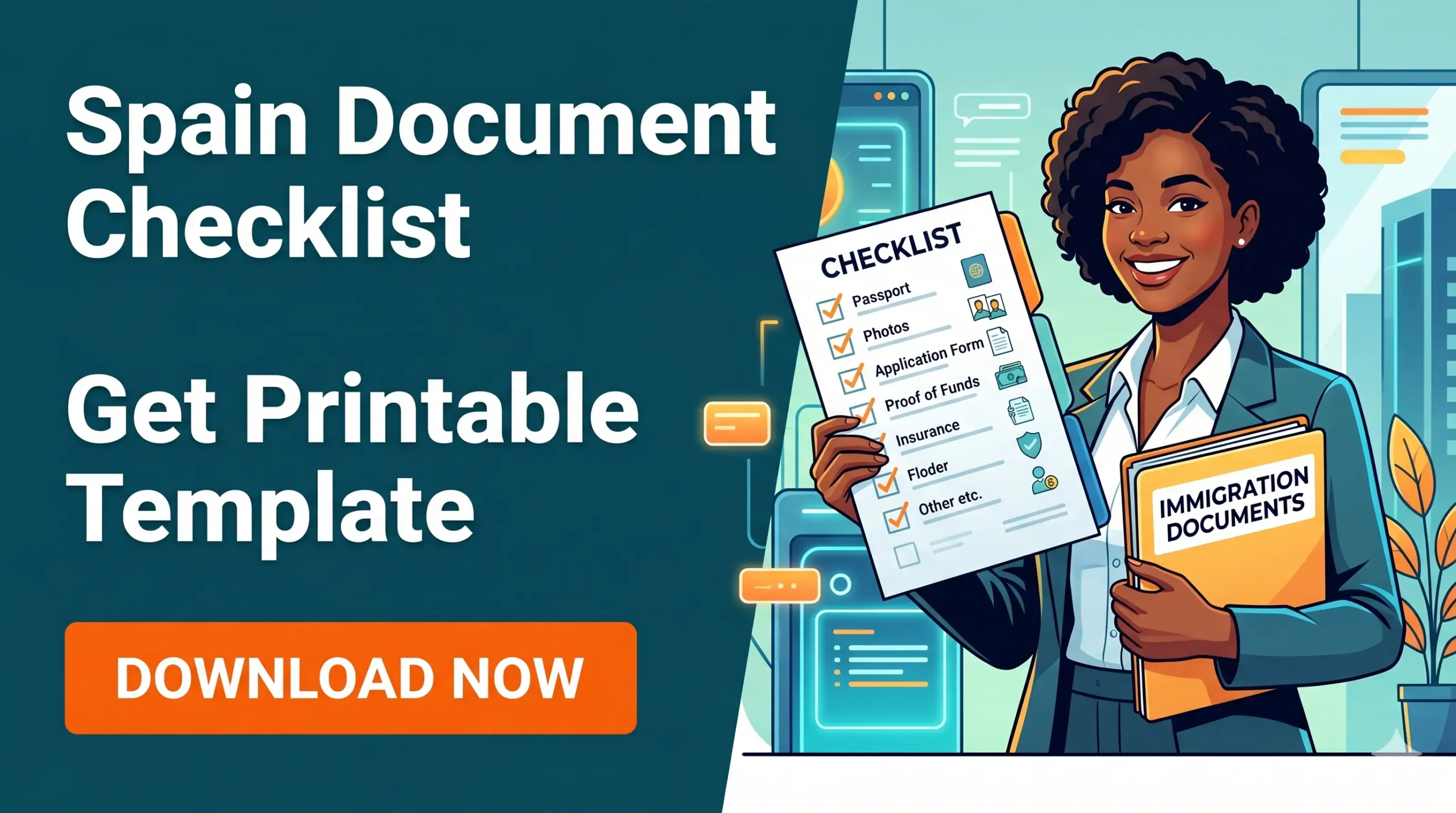
To survive your consulate appointment, you must employ the “Two Folder Rule.” Folder One contains all your pristine, original documents with their wet-ink signatures and physical Apostille stamps. Folder Two contains exact, high-quality photocopies of everything in Folder One, perfectly arranged in the exact same order. Use the table below to build your physical folders.
| Document Name | Format Required | Apostille Required? | Translation Required? | Notes / Pro-Tips |
| National Visa Form (EX-01/EX-11) | Original + Copy | No | No (Already in Spanish) | Must be signed in blue/black ink. |
| Valid Passport | Original + Full Copy | No | No | Must copy every page, even blank ones. |
| Passport Photos | 2 Physical Copies | No | No | Pure white background, recent (under 6 months). |
| Tasa Form (Modelo 790) | Stamped Original | No | No | Pay at a physical bank branch before the appointment. |
| Criminal Background Check | Original + Copy | Yes (Federal Level) | Yes (Sworn / MAEC) | Valid only for 90 days from issuance. |
| Medical Certificate | Original + Copy | Depends on Consulate | Yes (If not written in Spanish) | Must include the “2005 Int. Health Regulations” clause. |
| Health Insurance Certificate | Original + Copy | No | No (If using Innoinsure) | Must clearly state “Sin Copagos” and “Sin Carencias”. |
| Financial Proof (Bank Statements) | Original + Copy | No | Yes (Certified / RushTranslate) | 3-6 months of history; minimum balances must meet IPREM. |
| Proof of Income / Tax Returns | Original + Copy | No | Yes (Certified / RushTranslate) | Required if showing passive business income or pensions. |
| Marriage/Birth Certificates | Original + Copy | Yes (State Level) | Yes (Sworn / MAEC) | Only required if applying with dependents. |
| Proof of Residence in Consular District | Original + Copy | No | No | Driver’s license or utility bill proving you belong to that specific consulate. |
References
Primary sources (official)
- Ministerio de Asuntos Exteriores, Unión Europea y Cooperación (MAEC) – Visados: https://www.exteriores.gob.es/es/ServiciosAlCiudadano/Paginas/Servicios-consulares.aspx
- Ministerio de Inclusión, Seguridad Social y Migraciones – Hojas Informativas: https://www.inclusion.gob.es/web/migraciones/hojas-informativas
Other helpful sources
- Portal de la Administración General del Estado – Trámites de Extranjería: https://administracion.gob.es/pag_Home/atencionCiudadana/SedesElectronicas-y-Webs-Publicas/websPublicas/AGE-Ministerios/MISM.html
- Embajada de España en Washington D.C. – Requisitos y Trámites: https://www.exteriores.gob.es/Consulados/washington/es/Comunicacion/Noticias/Paginas/Requisitos%20y%20tramites%20consulares/Visados-y-NIEs.aspx
Disclaimer
The information provided in this checklist is exclusively for educational and informational purposes and does not constitute official legal, immigration, or consular advising. The specific documents required for a Spanish visa, the rigid 90-day validity window applied to background checks and medical certificates, and the discretionary enforcement of Hague Apostille and Sworn Translator (Traductor Jurado) mandates are highly dynamic and vary significantly between individual regional Spanish consulates. While we strive to ensure absolute accuracy regarding best practices, you should always consult a registered Spanish immigration lawyer (abogado de extranjería) and thoroughly verify the exact, updated documentary checklist published by the specific consulate handling your jurisdiction before paying for translation or authentication services.