Do You Need a Spanish Bank Account for Residency?
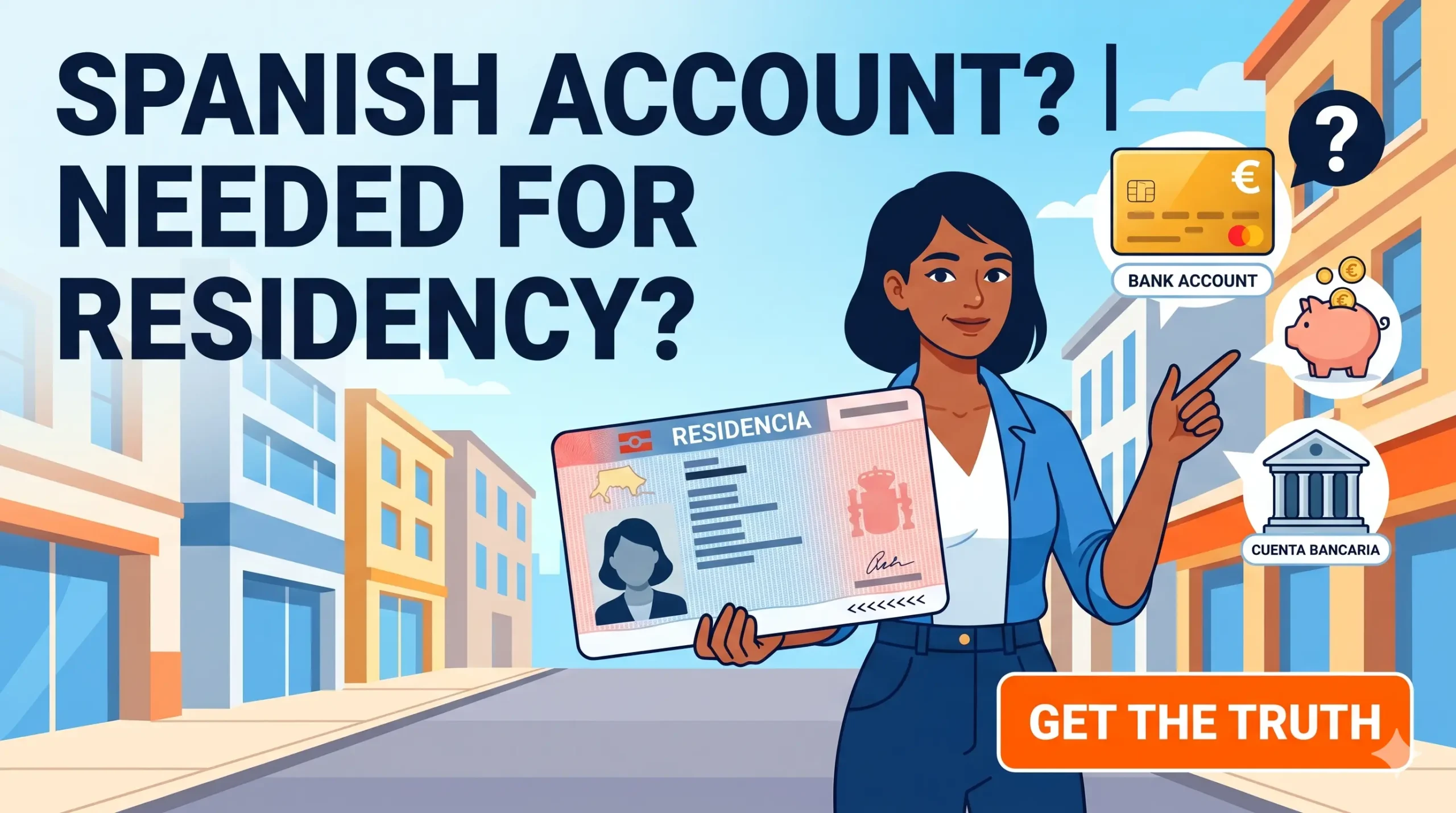
Arriving in Spain to finalize residency only to be told you cannot pay immigration taxes without a local bank account—which you cannot open without a residency card—is maddening. I spent my first weeks bouncing between banks and police stations fighting this exact loop. This guide clarifies exactly when a Spanish bank account is legally required and how to navigate this bureaucratic paradox.
Disclosure: This post may contain affiliate links. We may earn a commission at no extra cost to you if you make a purchase through these links. Read full disclosure.
The Chicken and Egg Dilemma of Spanish Visas
The confusion surrounding Spanish bank accounts stems from the fact that the Spanish immigration system is split into two entirely different phases: the initial visa application processed in your home country, and the physical residency card (TIE) issuance processed after you arrive in Spain. The rules change completely between these two phases.
Initial Visa Applications vs Moving to Spain
When you are sitting in your home country gathering paperwork for your initial consulate appointment, the Spanish government does not expect you to have a Spanish bank account. In fact, opening a traditional high-street Spanish account as a non-resident from abroad is notoriously difficult and expensive.
During this initial phase, the consulate explicitly wants to see your financial footprint in your home country. If you are applying for a Non-Lucrative Visa or a Student Visa, they want to see your American, British, or Australian bank statements proving you have accumulated the required wealth or hold steady passive income. The consular officers are evaluating your established financial history, not your ability to navigate local Spanish banking. Navigating these exact documentary standards is the foundation of the Spanish Visa Application Guide: Required Documents.
The Tasa Forms and Immigration Fees
The reality check hits the moment you step off the plane in Madrid or Barcelona. Once your visa is approved, you must visit a local police station to submit your fingerprints and order your physical Foreigner Identity Card (TIE). To do this, you must pay a government administrative tax known as a tasa (specifically the Modelo 790-012).
Here is the catch: you cannot pay this tasa online with a foreign credit card, nor can you pay the police officer directly. You must take the printed tax form to a physical Spanish bank branch and pay it there. However, most legacy Spanish banks outright refuse to process tasa payments for people who are not actively account holders at their specific bank. Even the banks that do allow non-customers to pay these taxes usually restrict the payment window to absurd hours, like Tuesdays and Thursdays between 8:30 AM and 10:00 AM. This early friction makes securing a local account an immediate survival priority, even if it wasn’t legally required by the consulate back home.
Navigating Foreign Bank Statements at the Consulate
While you do not need a Spanish bank account for the initial consulate application, using your foreign bank accounts introduces a massive administrative hurdle: the language barrier.
Translation and Authentication Requirements
The Spanish consulate will not accept a massive stack of English-language bank statements, brokerage accounts, or tax returns. Because the Spanish bureaucracy operates strictly in Spanish, every single page of your foreign financial proof must be translated before the consular officer will review it. If you attempt to prove your required IPREM solvency with untranslated US banking summaries, your application will be instantly rejected. Understanding the exact math required to satisfy the consular officer is heavily mapped out in Proof of Income for Spain Non-Lucrative Visa: Salaried vs Self-Employed.
To overcome this without delaying your application, you must use RushTranslate to convert your dense foreign financial records into professional Spanish. Because RushTranslate provides highly accurate, certified translations with a lightning-fast turnaround, you can ensure the consular officer perfectly understands your financial standing. Utilizing RushTranslate is highly strategic here because financial documents contain complex formatting and specific banking terminology that generic translation tools completely destroy. By leaning on RushTranslate for your massive stacks of financial evidence, you present an organized packet that instantly deflects consular suspicion. (Note that if your consulate specifically demands a premium MAEC-stamped linguist for background checks, you must understand the distinctions mapped out in How to Translate Documents for Spain: Sworn Translators (Traductor Jurado) Guide).
Securing Private Health Insurance Without a Local Bank
Another massive hurdle that expats face when they do not have a Spanish bank account is securing mandatory private health insurance. To get your visa approved, you must purchase a comprehensive Spanish medical policy. However, most traditional Spanish insurance brokers require a Spanish IBAN to set up a direct debit (domiciliación) before they will issue the policy.
To completely bypass this frustrating financial trap, you should secure a localized Spanish health policy natively through Innoinsure. Because Innoinsure caters specifically to relocating expats, their payment gateways accept foreign credit cards and international payment methods. You do not need a Spanish bank account to purchase a policy. Furthermore, Innoinsure natively underwrites policies designed explicitly to satisfy Spanish immigration laws, meaning their certificates clearly display the required “sin copagos” (zero co-payments) phrasing right on the front page. Relying on Innoinsure guarantees your medical safety net is flawlessly compliant, saving your relocation timeline. This strategic integration is heavily aligned with the advice detailed in Spain Visa Medical Insurance: Minimum Coverage and Exclusions to Avoid and Health Insurance in Spain: Options for Residents, Students, and Families.
When a Spanish IBAN Becomes Mandatory
You can survive the consulate without a Spanish bank account, but you cannot survive daily life in Spain without one. The local economy is entirely tethered to the Spanish IBAN (International Bank Account Number starting with “ES”).
Securing a Rental and Paying Utilities
When you arrive and begin touring long-term apartments, landlords will almost universally demand a Spanish bank account. They use it to verify your local stability and to set up the monthly rent transfers. If you try to pay rent via international wire transfers from your home country, landlords will reject your application out of fear of hidden cross-border receiving fees and delayed payments.
Furthermore, you cannot set up your home utilities—like electricity, water, and fiber internet—without a local account. Spanish utility companies operate exclusively through SEPA direct debits. They will not allow you to log into a portal and pay with an American or British credit card every month. You must provide an “ES” IBAN so they can automatically pull the funds. Navigating this automated billing chaos is central to controlling your household overhead, a reality detailed in Typical Utility Bills in Spain: Electricity, Gas, Water (Examples).
Residency Renewals and Proving Solvency
The lack of a Spanish bank account becomes a catastrophic liability when it is time to renew your residency at the end of your first year.
When you apply to renew your TIE card at the local Extranjería (Immigration Office), the government heavily scrutinizes your financial integration. They want to see that you actually brought your foreign wealth into the Spanish economy. If you apply for a renewal using only foreign bank statements, the reviewing officer will become highly suspicious that you do not actually live in Spain or that you are hiding assets. Showing a heavily utilized Spanish bank account proves you are genuinely participating in local commerce. Understanding the strict timelines required to maintain this status is the core focus of How to Renew Your Spanish Residency TIE Before It Expires. During this renewal, you can again rely on RushTranslate to quickly process any supplementary foreign tax returns the government may suddenly demand.
| Bureaucratic Phase | Is a Spanish Bank Account Legally Required? | Expat Recommendation Level |
| Initial Visa Application (Home Country) | No (Foreign accounts accepted) | Not Necessary (Focus on certified translations) |
| Paying Immigration Taxes (Tasas) | No (But practically required by banks) | Highly Recommended (Saves days of frustration) |
| Signing a Long-Term Lease | No (But landlords heavily demand it) | Mandatory in Practice |
| Setting Up Home Utilities | Yes (SEPA direct debit required) | Mandatory |
| First Year TIE Renewal | No (But Extranjería vastly prefers it) | Highly Recommended (Proves local integration) |
How to Bypass the Legacy Banking Trap
You need a Spanish IBAN, but walking into a traditional high-street Spanish bank branch as a new arrival is a recipe for high fees, mandatory life insurance up-sells, and endless paperwork. You must build an agile financial setup.
Setting Up Digital Accounts Before Arrival
The key to breaking the chicken-and-egg loop is realizing that you do not need a physical residency card (TIE) to open a basic local account; you only need your NIE (Foreigner Identity Number).
If your consulate assigned you an NIE during the visa approval process, you hold the legal key to the banking system. You can map out this specific identification dynamic by reviewing Getting an NIE for Employment or Study: Practical Overview. Once you have that number, you can bypass the legacy banks entirely by opening an account with an agile digital provider. Modern mobile banks will issue you a fully recognized local “ES” IBAN using just your home country passport and your assigned NIE. This instantly solves your rental, utility, and tasa payment problems. Building this frictionless infrastructure is deeply explored in Opening a Bank Account in Spain: Step-by-Step for Foreigners.
Avoiding Blocked Accounts During Processing
If you make the mistake of opening an account with a traditional Spanish legacy bank using just your passport, you must be hyper-vigilant. Spanish banks operate under incredibly strict Anti-Money Laundering (AML) regulations.
Legacy banking software is programmed to automatically freeze the accounts of non-residents if they do not periodically update their physical residency documents. If your TIE expires and you are waiting on a renewal, the bank will instantly lock your funds. You will not be able to buy groceries, and your utility direct debits will bounce. Knowing exactly how to unblock your life if this happens, and how to proactively provide documentation before the freeze hits, is a critical survival skill outlined in What to Do If Your Spanish Bank Account Is Frozen (Common Causes).
To maintain a stress-free transition, keep your foreign savings securely abroad, use agile translation tools for compliance, secure your medical needs through platforms like Innoinsure, and use a modern, fee-free digital account for your daily Spanish life. This separation keeps your global wealth safe while satisfying every local administrative requirement, including the nuances detailed in Spanish Bank Transfer Terms: Transferencia, Bizum, SEPA Explained.
References
Primary sources (official)
- Banco de España – Cuenta de Pago Básica: https://clientebancario.bde.es/pcb/es/menu-horizontal/actualidadeducac/educacion-financiera/cuenta-de-pago-basica/
- Ministerio de Asuntos Exteriores, Unión Europea y Cooperación (MAEC) – Visados Nacionales: https://www.exteriores.gob.es/es/ServiciosAlCiudadano/Paginas/Servicios-consulares.aspx
- Portal de Inmigración – Modelos oficiales de solicitudes: https://www.inclusion.gob.es/web/migraciones/modelos-oficiales-de-solicitudes
Other helpful sources
- Punto de Acceso General (Administración del Estado) – Extranjería: https://administracion.gob.es/pag_Home/atencionCiudadana/SedesElectronicas-y-Webs-Publicas/websPublicas/AGE-Ministerios/MISM.html
- Banco de España – Portal del Cliente Bancario (Cuentas para no residentes): https://clientebancario.bde.es/pcb/es/menu-horizontal/productosservici/cuentasdepositos/cuentascorriente/guia-textos/Cuentas_para_no_residentes.html
Disclaimer
The information provided in this guide is exclusively for educational and informational purposes and does not constitute official legal, immigration, or financial advising. The specific requirements for opening a Spanish bank account, the acceptance of foreign bank statements by consular officials, and the enforcement of the cuenta de pago básica regulations are highly complex and subject to the discretionary policies of individual banking institutions and regional Oficinas de Extranjería. While we strive to ensure absolute accuracy, you should always consult a registered Spanish immigration lawyer (abogado de extranjería) and verify the exact documentary requirements with the specific consulate handling your jurisdiction before transferring large sums of capital across borders.