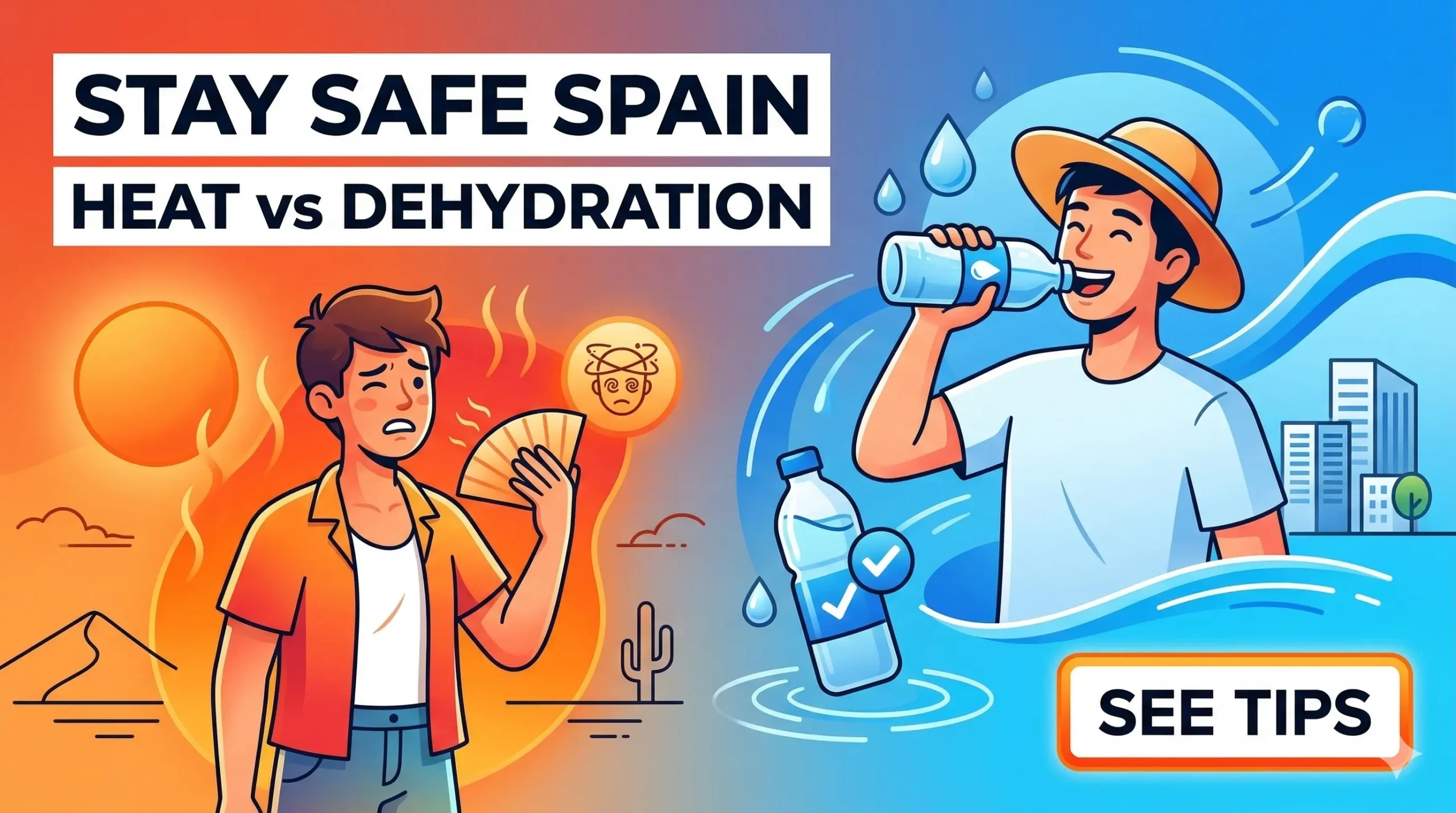
Heatstroke vs Dehydration: Prevention Tips for Spain Summers
Underestimating the lethal intensity of a Spanish July is a rite of passage that sends countless foreigners to the emergency room. I once spent three days violently ill in Seville because I thought I could power through a midday walking tour. This guide explains how to distinguish dehydration from heatstroke, prevent both, and handle summer medical emergencies in Spain.
Disclosure: This post may contain affiliate links. We may earn a commission at no extra cost to you if you make a purchase through these links. Read full disclosure.
The Brutal Reality of Spanish Summers
Before you move to Spain, the idea of a Mediterranean summer sounds like an endless, glamorous vacation. But when the reality of the ola de calor (heatwave) sets in, the physical toll on your body is absolutely staggering.
The Culture Shock of the Heat
In southern and central regions like Andalusia, Extremadura, and Madrid, summer temperatures routinely shatter the 40°C (104°F) mark. The heat here is not just warm; it is an aggressive, oppressive physical weight that radiates from the cobblestones long after the sun has set. If you come from a country like the United States or the United Kingdom, where central air conditioning is a standard human right, the Spanish summer will be a massive culture shock.
Many traditional Spanish apartments and even some public transportation networks lack robust air conditioning. You cannot simply walk from an air-conditioned car to an air-conditioned office. You will be walking, sweating, and exposed to the elements constantly. If you are managing pre-existing health issues, this extreme temperature shift can easily trigger flare-ups, a dynamic we discuss in Chronic Conditions in Spain: Managing Ongoing Care as an Expat.
Why Expats Are Most Vulnerable
The Spanish medical system specifically warns that tourists and new expats are among the highest-risk demographics during heatwaves. The reason is simple: a complete lack of acclimatization combined with stubbornness.
Locals know to retreat indoors and close their heavy blinds (persianas) when the sun is at its peak. Expats, however, often try to force their home-country productivity schedules onto a hostile climate. We insist on taking walking tours at 2:00 PM, drinking sangria on sun-drenched terraces, and pushing through the fatigue. This refusal to respect the sun is exactly how a fun afternoon spirals into severe dehydration or, much worse, a life-threatening heatstroke.
Recognizing Dehydration Before It Escalates
Dehydration (deshidratación) and heat exhaustion (agotamiento por calor) are the precursor stages to a full medical emergency. Catching these symptoms early is the key to staying out of a Spanish hospital.
Early Warning Signs to Watch For
When you are sweating profusely in the Spanish heat, you are losing massive amounts of water and critical sodium. The early signs of heat exhaustion sneak up on you. You will likely feel a dull, throbbing headache, profound muscle weakness, and sudden dizziness when you stand up.
Your skin might feel pale, cool, and clammy to the touch, and your pulse will become fast and weak. You might also experience intense nausea or muscle cramps in your legs and abdomen. The Spanish Ministry of Health explicitly notes that during heat exhaustion, your body temperature might be elevated, but it will remain under 40°C. If you ignore these signs and try to “tough it out” by simply sitting in the shade for ten minutes, your body will eventually lose its ability to regulate temperature entirely.
Pharmacy Solutions and Holistic Hydration
When the headache hits and you realize you are dangerously dehydrated, do not just chug a liter of plain tap water. You need to replace your lost electrolytes. In Spain, you can walk into any local chemist and ask for suero oral (oral rehydration salts). If you are unsure how to approach the counter, our guide on Can a Pharmacist in Spain Help With Minor Illness? What to Expect will help you navigate the interaction.
However, Spanish pharmacies have a notoriously limited selection when it comes to clean-ingredient, high-performance hydration. The suero oral they sell is often loaded with artificial dyes and refined sugars, and trying to find premium trace minerals or targeted hydration multipliers is incredibly frustrating. When pharmacies do stock imported holistic brands, the retail markups are completely brutal. To understand why local out-of-pocket costs escalate so quickly, review Health Costs in Spain: Typical Co-Pays and Out-of-Pocket Fees.
To bypass this frustrating retail gap, the savvy expat community relies heavily on iHerb. By stocking up on clean, zero-sugar electrolyte powders, high-grade magnesium, and trace mineral drops directly through iHerb, you can actively defend your body against the brutal Spanish summer without draining your wallet. Having a dedicated stash of premium hydration multipliers delivered directly to your apartment via iHerb ensures you are never caught empty-handed when a sudden heatwave hits. Instead of wandering the hot streets looking for an open pharmacy, you simply mix your trusted iHerb electrolytes into your water bottle and focus on recovering your strength.
Spotting and Treating Heatstroke in Spain
If heat exhaustion is ignored, it rapidly progresses into a golpe de calor (heatstroke). This is not just a bad case of dehydration; it is a catastrophic failure of your body’s central thermoregulatory system and an immediate, life-threatening emergency.
Symptoms of a Medical Emergency
The hallmark sign of a heatstroke is that the body completely stops sweating. The patient’s skin will become violently red, hot, and completely dry. Their pulse will be rapid and bounding, and their internal body temperature will spike above 40°C (104°F).
Neurological symptoms are the most terrifying indicator. A person suffering from a golpe de calor will become highly confused, delirious, or agitated. They may experience hallucinations, seizures, or completely lose consciousness. If you are trying to figure out how to communicate this terror to a triage nurse, memorizing the vocabulary in Spanish Emergency Phrases: How to Describe Symptoms Quickly is an absolute lifesaver.
| Medical State | Primary Symptoms | Skin Condition | Required Action |
| Heat Exhaustion | Dizziness, headache, nausea, heavy sweating | Pale, cool, clammy | Rest in shade, drink electrolytes, cool down |
| Heatstroke | Confusion, delirium, fainting, high fever (>40°C) | Red, hot, dry (no sweat) | Dial 112 immediately, cool body aggressively |
Navigating Urgent Care and Insurance
If you suspect someone is suffering from a heatstroke, you must call for an ambulance immediately. Do not offer them anything to drink if they are confused or unconscious, as they could choke. Move them to a dark, cool place and apply cold, wet towels to their body while you wait. If you do not know the exact protocol for emergency dispatch, read How to Call 112 in Spain: What to Say and What Happens Next.
If the situation is severe dehydration rather than a full heatstroke, and you need to get to a clinic for an IV drip, relying on the state-funded public system during the summer can be a nightmare. Public emergency rooms in July and August are completely overwhelmed with tourists suffering from heat-related illnesses. You could easily end up sitting in a chaotic, loud waiting room for six hours while feeling like you are going to pass out. You can deeply explore these systemic bottlenecks in our overview of the Spain Healthcare System for Expats: Public vs Private.
Bypassing this agonizing public queue is exactly why utilizing a specialized, expat-focused broker like Innoinsure is a massive game-changer. A bilingual agent from Innoinsure can seamlessly set up a premium private health policy that grants you immediate access to top-tier, air-conditioned private clinics in your specific city.
With a policy secured through Innoinsure, you can skip the public ER entirely, walk into a calm private hospital, and be seen by an English-speaking doctor in a fraction of the time. To understand the exact financial structure of these premium networks before signing a contract, read our breakdown on How to Compare Private Health Plans: Deductibles, Co-Pays, Networks. If you are unsure where the nearest private urgent care is located when the dehydration hits, review How to Find a 24-Hour Clinic in Spain (Urgencias).
Daily Habits to Survive the Spanish Heatwave
Surviving the Spanish summer is a marathon, not a sprint. You must completely adapt your lifestyle and daily rhythms to match the hostile climate, or your health will rapidly deteriorate.
Embracing the Siesta Schedule
The Spanish siesta is not a stereotype about laziness; it is an absolute biological necessity. Between the hours of 2:00 PM and 7:00 PM, the sun is essentially a lethal weapon.
You must adopt the local rhythm. Do all your grocery shopping, outdoor exercising, and heavy commuting before 11:00 AM. During the peak afternoon hours, you should be indoors behind closed, heavy shutters (persianas). Do not attempt to run errands, and certainly do not go to the beach to “tan” during these hours. If you happen to feel incredibly faint during this dead zone and are too dizzy to walk to a clinic, having digital healthcare is a massive relief. Premium private policies often include robust 24/7 digital health access; discover how to leverage this securely in Telemedicine in Spain: When It’s Useful and What to Expect.
Hydration Strategies for the Mediterranean Climate
You cannot rely on thirst as your primary indicator for hydration in Spain. By the time you feel thirsty, you are already dehydrated. You must proactively drink at least two to three liters of water a day.
Furthermore, you must dramatically reduce your alcohol and caffeine intake during a heatwave. Drinking cold beer or tinto de verano on a terrace feels refreshing, but alcohol aggressively strips your body of fluids and directly impairs your body’s ability to regulate its core temperature. If an unexpected heatwave hits over a long holiday and you feel your body shutting down, knowing your out-of-hours medical options is vital; check out What to Do If You Need Care on a Weekend in Spain. Keep your apartment stocked with your premium iHerb electrolytes, respect the afternoon sun, and listen to your body before a headache turns into a hospital visit.
References
Primary sources (official)
- Ministerio de Sanidad (Ministry of Health Spain) – Consejos para evitar el calor: https://www.sanidad.gob.es/campannas/campanas09/calor/golpe.html
- World Health Organization (WHO) – Heatwaves: How to stay cool: https://www.who.int/news-room/questions-and-answers/item/heatwaves-how-to-stay-cool
Other helpful sources
- Expatica – Emergency numbers and helplines in Spain: https://www.expatica.com/es/healthcare/healthcare-basics/emergency-number-spain-102154/
Disclaimer
The information provided in this article is for educational and informational purposes only and does not constitute formal medical advice. Heatstroke is a severe, life-threatening medical emergency. If you or someone you know stops sweating, becomes confused, or loses consciousness in the heat, do not attempt to treat it at home with fluids. Dial 112 immediately to connect with Spanish emergency dispatch services and seek urgent medical care.