Student Budget in Spain: Sample Monthly Budgets (Low/Medium/High)
Arriving in Spain as a student is thrilling until you realize that endless tapas and weekend trips to Ibiza drain your bank account faster than expected. I spent my first semester surviving on instant noodles because I severely underestimated my rent and hidden utility costs. This guide breaks down exactly how much you need to budget for your Spanish studies.
Disclosure: This post may contain affiliate links. We may earn a commission at no extra cost to you if you make a purchase through these links. Read full disclosure.
The Core Realities of Student Costs in Spain
Spain is frequently marketed to international students as a cheap, sun-soaked paradise where everything costs a fraction of what it would in the US or Northern Europe. While this can be true in smaller provincial towns, the reality of living in major educational hubs is starkly different. The “Cheap Spain” myth often leads students to severely under-budget before they even step off the plane.
Accommodation and the Fianza Shock
Your biggest monthly expense will always be your rent. Most students opt for a piso compartido (shared apartment). While renting a single room in a shared flat is economical, finding one in September or January is a bloodbath of competition. When you do find a room, you will be hit with the fianza—the mandatory security deposit. Spanish landlords typically demand one or two months of rent upfront, plus the current month, meaning you need a massive chunk of liquid cash simply to get the keys.
Once you move in, you also have to account for the utilities, which are rarely included in the baseline rent. Spanish electricity is notoriously expensive and heavily taxed, especially during the peak winter and summer months. If you are sharing a flat with three strangers from different countries, navigating how to fairly divide the electric, water, and internet bills can quickly become a massive headache. Reviewing Typical Utility Bills in Spain: Electricity, Gas, Water (Examples) will give you a baseline of what to expect, and learning How to Split Household Bills in Spain: Fair Methods for Flatmates will save you from bitter arguments over the thermostat.
Food, Transport, and Lifestyle
Fortunately, keeping yourself fed in Spain is incredibly budget-friendly if you shop smartly. Supermarkets like Mercadona, Dia, and Lidl offer high-quality produce, cheap olive oil, and affordable staples. If you cook at home five days a week, your grocery bill will remain exceptionally low. However, the Spanish lifestyle revolves around socializing outside the home. The temptation to eat a menú del día (a fixed-price lunch menu) or go out for evening cañas (small beers) is relentless. If you are not careful, those 10-euro daily lunches will obliterate your monthly budget.
Public transportation is another area where students can genuinely save money. Almost every major Spanish city offers heavily subsidized public transit passes for young people. In Madrid, for example, the Abono Joven gives anyone under the age of 26 unlimited access to the entire metro, bus, and regional train network for just 20 euros a month.

Sample Monthly Budgets (Low, Medium, High)
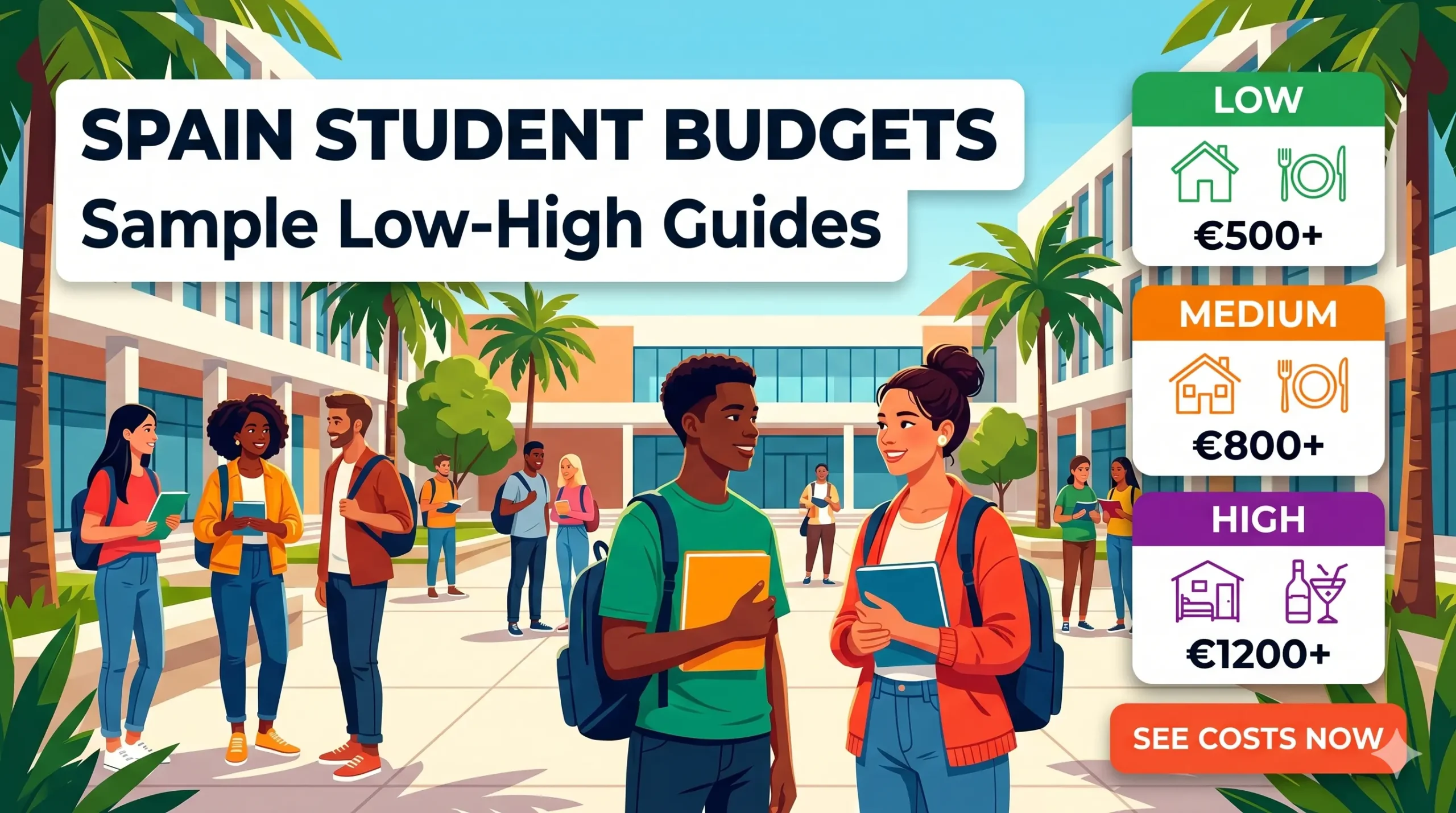
The exact amount of money you need to survive as a student is dictated almost entirely by your geographical location. The difference in rent between a small university town and the center of Barcelona is staggering. Below is a breakdown of what a student living in a shared apartment can expect to spend across three distinct tiers.
| Expense Category | Low Budget (Granada, Salamanca) | Medium Budget (Valencia, Seville) | High Budget (Madrid, Barcelona) |
| Rent (Shared Room) | €250 – €350 | €350 – €500 | €550 – €800+ |
| Utilities (Split) | €30 – €50 | €40 – €60 | €50 – €80 |
| Groceries | €150 – €200 | €200 – €250 | €250 – €300 |
| Transport Pass | €20 – €30 | €20 – €40 | €20 – €40 (Varies by age) |
| Leisure & Extras | €100 – €150 | €150 – €200 | €200 – €300+ |
| Estimated Monthly Total | €550 – €780 | €760 – €1,050 | €1,070 – €1,520+ |
The Low-Cost Budget (Southern and Central Spain)
If you are studying in historic university towns like Granada, Salamanca, or Santiago de Compostela, your money will stretch incredibly far. These cities are heavily tailored to the student demographic. You can often find a room in a shared apartment within walking distance of your faculty for 300 euros a month. Because these cities are smaller, you can often walk everywhere, eliminating the need for a monthly transport pass entirely. Furthermore, in cities like Granada, ordering a drink usually comes with a substantial free tapa, meaning you can essentially eat dinner for the price of two beers.
The Medium Budget (Coastal Cities and Regional Hubs)
Cities like Valencia, Seville, and Malaga offer an incredible balance of Mediterranean lifestyle and moderate costs. However, due to the massive influx of digital nomads and international expats driving up the cost of living, these cities are not as cheap as they were a decade ago. Finding a room in the trendy Ruzafa neighborhood of Valencia or the center of Seville will easily cost you 450 euros. You will also spend slightly more on public transportation and socializing, as the sheer volume of cultural events, beaches, and nightlife options provides constant temptation to spend.
The High-Cost Budget (Madrid and Barcelona)
If you choose to study in Spain’s two major economic powerhouses, you must be prepared for Northern European pricing regarding accommodation. Renting a standard room in a shared flat in a central neighborhood like Malasaña (Madrid) or Gràcia (Barcelona) can easily exceed 650 euros a month, and landlords are incredibly demanding regarding financial guarantees. While groceries and public transport remain relatively cheap, the overall lifestyle cost is significantly higher. If you do not have a robust savings plan or strict financial support, living in these hubs can become highly stressful.
Smart Financial Moves to Protect Your Student Budget
Surviving on a student budget is not just about spending less; it is about managing the logistics of your money so you do not lose hundreds of euros to invisible banking fees and administrative traps.
Moving Money Across Borders
If you are an international student relying on savings from your home country, or if your parents are sending you a monthly allowance, relying on traditional bank transfers is a massive mistake. If your parents go to their local US or UK bank and send a standard international wire to Spain, the banks will crush your budget with hidden SWIFT fees and terrible exchange rate markups.
To protect your tuition and rent money, you must use Wise. By routing your international transfers through Wise, you bypass the archaic SWIFT network entirely. Wise converts your home currency to euros using the real, transparent mid-market exchange rate. You pay a tiny upfront fee, ensuring your entire allowance actually reaches your Spanish life. Comparing these hidden legacy costs is deeply explored in Sending Money to/from Spain: Comparing Banks vs Transfer Services, which illustrates exactly why using Wise is mandatory for international students trying to stretch every penny.
Setting Up Your Daily Banking
Once your euros arrive in Spain, you need a safe place to hold them. Trying to pay your Spanish rent or sign up for a local gym membership with a foreign credit card is incredibly frustrating, as many local businesses simply will not accept them. You need a local IBAN.
However, walking into a traditional Spanish high-street bank as a student usually results in confusing paperwork and predatory monthly maintenance fees. To bypass this, opening your daily operational account with N26 is highly strategic. N26 instantly issues a fully recognized local Spanish IBAN directly from your smartphone, allowing you to establish direct debits for your phone bill and rent without paying a legacy bank 40 euros a quarter just to hold your money. The seamless app experience of N26 also helps you track your daily spending so you don’t blow your budget in the first two weeks of the month. If you are unsure of the administrative requirements, walking through Opening a Bank Account in Spain: Step-by-Step for Foreigners is your next critical step.
Furthermore, having a localized account allows you to integrate into the Spanish peer-to-peer payment network. When you go out for dinner with classmates, nobody splits the bill with cash anymore. Everyone uses Bizum. Understanding how to navigate this essential social-financial tool is explained in Spanish Bank Transfer Terms: Transferencia, Bizum, SEPA Explained.
Managing Bureaucracy and Surplus Income
As a student, you must also budget for the upfront administrative costs of becoming a legal resident. Securing your paperwork is not free. You must pay processing taxes to secure your residency cards, a process outlined in Getting an NIE for Employment or Study: Practical Overview. Furthermore, non-EU students are legally required to purchase comprehensive, upfront private medical coverage to maintain their visa status, which requires a significant chunk of cash before you even arrive. You can map out this specific expense by reviewing Health Insurance in Spain: Options for Residents, Students, and Families. Even minor health issues require budgeting for local medication, a dynamic covered in Pharmacies in Spain: Prescriptions, Over-the-Counter Meds, and Practical Tips.
Finally, if you are an older graduate student, a PhD candidate on a research fellowship, or a student working a lucrative part-time remote job, you might actually find yourself with surplus monthly income. Leaving those extra euros sitting idle in a student checking account exposes your hard-earned money to inflation. To build long-term wealth, many mature expat students sweep their surplus income into a global brokerage account like Interactive Brokers. Utilizing Interactive Brokers allows you to build a multi-currency portfolio that remains entirely portable once your studies conclude. It elegantly separates your long-term wealth building from the chaos of your daily student budget, ensuring your financial footprint is as agile as your international academic career.
References
Primary sources (official)
- Study in Spain (European Commission) – Education system, tuition fees, scholarships and student life: https://education.ec.europa.eu/study-in-europe/country-profiles/spain
- Ministerio de Juventud e Infancia – Social and economic indicators: https://www.juventudeinfancia.gob.es/
Other helpful sources
- Idealista – Living expenses in Spain for international students: https://www.idealista.com/en/news/erasmus-in-spain/2025/08/19/856251-living-expenses-in-spain-for-international-students
- Numbeo – Cost of living in Spain comparison data: https://www.numbeo.com/cost-of-living/country_result.jsp?country=Spain
Disclaimer
The information provided in this guide is exclusively for educational and informational purposes and does not constitute official financial or legal advice. Student living costs, rental market prices, and visa-related financial requirements are highly subjective and subject to frequent inflationary changes depending on the specific Spanish autonomous community. While we strive to ensure absolute accuracy, you should always verify the latest university tuition fees, immigration financial proof requirements, and local housing averages directly with your host university and the Spanish consulate prior to relocating.