Spain Visa Guide for Tunisia Citizens Tourist Study and Work Basics
Staring at a rejected visa application because your translated birth certificate lacked the proper authentication is a uniquely exhausting experience. I almost missed my move to Madrid because a single missing stamp on my police check completely derailed my timeline. This guide breaks down exactly how Tunisian citizens can successfully navigate Spanish tourist, student, and work visas without bureaucratic delays.
Disclosure: This post may contain affiliate links. We may earn a commission at no extra cost to you if you make a purchase through these links. Read full disclosure.
Conquering the Schengen Tourist Visa from Tunisia
Getting a Spanish tourist visa from Tunisia requires applying for a short-stay Schengen visa. You do not apply directly at the Embassy of Spain in Tunis for a standard tourist entry. Instead, all short-stay applications are routed through their official outsourcing partner, BLS International, which manages the intake process and forwards your dossier to the consular staff.
The BLS Appointment Battle in Tunis
The biggest initial frustration you will face is simply getting your foot in the door. Securing a BLS appointment during the peak European summer travel season or right before school holidays is an absolute logistical nightmare. Slots on the portal vanish within minutes of opening, and the online booking system frequently crashes under heavy traffic. You must begin hunting for an appointment at least 45 to 60 days in advance of your planned travel date.
Once your application is finally approved and your passport is stamped, you are strictly bound by the Schengen ninety-day limit. This allows a maximum stay of 90 days within any 180-day period across the entire Schengen zone. The system operates on a rolling calendar, meaning border officials will look back 180 days from your current date to count your cumulative days inside the territory. Overstaying by even a single day can result in heavy fines, detention at the border, and a multi-year ban from entering Europe. If you eventually transition to long-term residency, tracking these exact days becomes even more critical, a highly technical dynamic explored deeply in How Long Can You Leave Spain Without Losing Residency?.
Bulletproofing Your Financial and Civil Documents
The primary reason Tunisian tourist visas are rejected is weak, improperly formatted financial proof or failing to prove strong ties to your home country. The consulate assumes every applicant is a flight risk until proven otherwise. You must provide extensive documentation, including your CNSS (Caisse Nationale de Sécurité Sociale) declarations, salary slips, and six months of continuous bank statements. The closing balance must comfortably cover your flights, accommodation, and a daily minimum spending amount dictated by the Spanish government in Euros.
Crucially, downloading an unverified PDF from your Amen Bank or BIAT mobile app is an instant rejection. The statements must be printed on official bank letterhead, stamped on every single page, and signed in wet ink by the branch manager. Ensure your paperwork aligns perfectly with the strict standards outlined in Spanish Visa Application Guide: Required Documents.
Furthermore, proving deep economic roots in Tunisia is absolutely crucial. You must submit your civil registry documents, such as your family booklet or birth certificates. If you are submitting regional documents, commercial registries, tax documents, or property deeds written entirely in Arabic or French to prove your economic ties, the consulate needs to understand them perfectly. You can safely use RushTranslate to process these complex Tunisian business papers. Because RushTranslate provides highly accurate, certified translations into Spanish, the reviewing officer can immediately verify your domestic assets. Utilizing RushTranslate prevents instant rejections based on language barriers, ensuring your application package clearly demonstrates your economic stability in Tunisia.
Securing a Spanish Student Visa
Spain divides student visas into two distinct categories based on the duration of your academic program. Understanding this difference before you submit your application to the Spanish Consulate dictates your entire post-arrival strategy and the complexity of your paperwork.
Short Term Versus Long Term Studies
If you are going for a short university exchange program lasting between 91 and 180 days, you will receive a short-term student visa covering exactly that duration. You will not receive a physical residency card in Spain, and you cannot extend this visa or transition it into a work permit from within the country. You are expected to leave the Schengen area the moment your course concludes.
If you are enrolling in a full master’s or bachelor’s degree lasting more than 180 days, you will receive a 90-day entry visa in your passport. Once you land in Spain, you have exactly one month to register your fingerprints at a local police station and apply for your physical Foreigner Identity Card, commonly known as the TIE. Securing your local identification numbers is critical for this phase and is detailed extensively in Getting an NIE for Employment or Study: Practical Overview. To qualify for either visa, your admission letter must be from an officially recognized educational institution in Spain, a strict requirement thoroughly explored in Spain Student Visa Application.
Meeting Strict Financial and Medical Mandates
To get your student visa approved, you must prove you have sufficient funds to support yourself and you must hold comprehensive private health insurance. The financial threshold is legally set at 100 percent of the Spanish IPREM, which you must calculate properly to ensure your bank accounts hold the equivalent minimum balance in Euros for the entire duration of your stay. Given strict domestic currency exchange controls, proving these liquid funds in a universally accepted format is often the most stressful part of the application for local students.
The consulate will outright reject generic Tunisian travel insurance policies if they contain deductibles, co-payments, or waiting periods for standard medical procedures. The Spanish government requires absolute proof that you will not become a financial burden on their public healthcare system. Therefore, your policy must have zero co-payments and no waiting periods.
To completely bypass the headache of insurance rejections, you must secure a localized Spanish health policy natively through Innoinsure. Because Innoinsure caters specifically to the expat and international student market, their policies are explicitly underwritten to satisfy strict Spanish immigration laws. The medical certificates clearly display the required strict zero-copayment phrasing right on the front page. Relying on Innoinsure means the BLS center and the consular officers accept your medical cover immediately without algorithmic friction. Utilizing Innoinsure guarantees your medical safety net is perfectly compliant, a strategy aligned with Spain Visa Medical Insurance: Minimum Coverage and Exclusions to Avoid and Health Insurance in Spain: Options for Residents, Students, and Families.
Work Visas and Remote Residency Options
For tech professionals and freelancers in Tunis or Sfax, securing a standard Spanish corporate work permit from Tunisia is nearly impossible due to local labor market protections that heavily prioritize European Union citizens. However, new visa routes have completely revolutionized the expat landscape for ambitious Tunisians.
The Digital Nomad Visa Route
If you work remotely for a Tunisian company or have freelance clients entirely outside of Spain, the Digital Nomad Visa is an incredible pathway. You must prove you earn approximately 200 percent of the Spanish minimum wage and hold a specific HR letter explicitly permitting you to work from Spanish territory. The formatting for this corporate proof is incredibly rigid and is mapped out in Spain Digital Nomad Visa: How to Prove Remote Work Relationship.
Because your Tunisian employment contracts, experience letters, and salary slips are typically in Arabic or French, they are legally useless to the Spanish reviewers until translated into Spanish. You can rely on RushTranslate to quickly convert your massive stacks of corporate evidence into Spanish. Because RushTranslate offers lightning-fast turnarounds for certified translations, you can ensure the immigration officer perfectly understands your remote work arrangement. Leaning on RushTranslate keeps your digital nomad packet highly professional and prevents devastating delays caused by administrative misinterpretation.
Additionally, digital nomads must prove they have valid health coverage in Spain. Bypassing the local public system by securing a compliant policy through Innoinsure is the most efficient way to satisfy this strict medical requirement. Upgrading your coverage with Innoinsure ensures your digital nomad application meets all health mandates without the stress of navigating local forums for suitable providers. Plus, relying on Innoinsure guarantees continuous compliance when it comes time for your first residency renewal.
The Non Lucrative Visa for Passive Income
If you are a Tunisian retiree or hold substantial passive income, such as high rental yields from commercial properties, extensive stock portfolios, or corporate dividends, you can apply for the Non-Lucrative Visa.
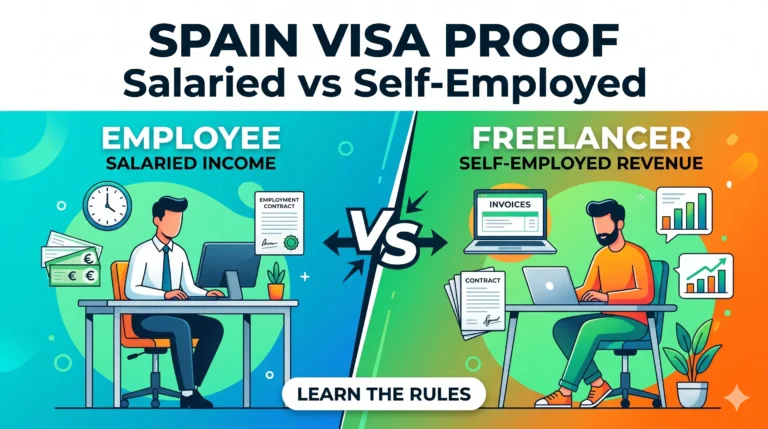
This visa strictly forbids any active work in Spain, including remote work. You cannot manage a Tunisian business from your laptop in Madrid on this visa. You must prove massive liquid savings or passive income streams that cover you and any dependents. Understanding the strict distinction between active and passive income is heavily mapped out in Proof of Income for Spain Non-Lucrative Visa: Salaried vs Self-Employed.
To prove this wealth, you will submit Tunisian bank statements, corporate tax records, and investment portfolios spanning several months. Every financial document must be flawlessly translated into Spanish to deflect consular suspicion regarding the origin of your funds. Utilizing RushTranslate is vital here to convert your dense financial files accurately. Since you might be presenting lengthy audit reports or dividend statements, entrusting them to RushTranslate ensures that no critical financial detail gets lost in translation. Furthermore, applicants are heavily scrutinized on their healthcare, making the use of native localized policies from Innoinsure an absolute necessity to avoid rejections based on foreign insurance deductibles.
| Visa Type | Duration Permitted | Can You Work | Key Requirement for Tunisian Citizens |
| Tourist Schengen | Up to 90 days per 180 days | No | 6 months stamped bank statements, CNSS records, strong ties |
| Student Visa | Duration of academic program | Up to 30 hours a week | Admission letter and compliant Spanish medical insurance |
| Digital Nomad | Up to 3 years if applied in Spain | Yes Remote work only | HR permission letter and 200 percent minimum wage income |
| Non Lucrative | 1 Year Renewable | No Strictly forbidden | Substantial passive income and comprehensive health cover |
Gathering and Authenticating Tunisian Documents
Regardless of the visa you pursue, the Spanish diplomatic missions in Tunisia demand a mountain of authenticated paperwork gathered in a very specific, unforgiving sequence. A single missing stamp will ruin your application.
Police Records and the Hague Apostille
Spain requires a criminal background check from any country where you have lived for the past five years. As a Tunisian citizen, you must obtain your Bulletin No. 3 (police record) issued by the Ministry of Interior.
Fortunately, Tunisia formally joined the Hague Apostille Convention. This means you do not need to endure an agonizing, multi-step consular legalization process at the Spanish Embassy for your civil documents. Instead, your original document must simply carry a Hague Apostille stamp.
In Tunisia, this international authentication stamp is typically issued by designated notaries or specialized public officials, depending on the document type. You must route your police checks and any vital civil registry documents to the correct authority to receive this stamp before doing anything else. If you translate the document before securing the Apostille, your entire application will be ruined because the translation must include the Apostille stamp itself. You can review the exact sequence of this international authentication in Apostille for Spain: Which Documents Need It and How to Get One.
Certified Translations and Sworn Linguists
Once your Tunisian documents are Apostilled, they must be translated into Spanish. The consulate enforces rigid rules regarding how specific documents are translated, and an amateur translation will be instantly rejected.
For highly sensitive government documents like your Apostilled Bulletin No. 3 or birth certificate, the consulate strictly demands a Sworn Translation. This must be completed by a Traductor Jurado, a linguist directly authorized and registered by the Spanish Ministry of Foreign Affairs. Understanding when you must pay for this premium stamp is deeply explained in How to Translate Documents for Spain: Sworn Translators Traductor Jurado Guide.
For supporting documents like your tax returns, corporate employment letters, or everyday bank statements, standard certified translations are generally acceptable. By safely relying on RushTranslate for your everyday financial and civil evidence, you drastically reduce your paperwork burden and keep your application moving swiftly. Utilizing RushTranslate prevents instant rejections based on language barriers, ensuring your cross-border background is crystal clear to the visa officer.
Once approved and you arrive in Spain, you will need to establish your local financial footprint, a process detailed in Opening a Bank Account in Spain: Step-by-Step for Foreigners. You must also register on the municipal census, a critical step outlined in How to Change Address on Your TIE Card After Moving in Spain. Mastering these early administrative requirements guarantees you can confidently navigate future renewals. When it is time to renew your residency, managing the strict timelines mapped out in Spain Residency Renewal Timing: Earliest and Latest Filing Windows is crucial to avoid losing your legal status.
References
Primary sources official
- Embassy of Spain in Tunis – Consular Services: https://www.exteriores.gob.es/Embajadas/tunez/en/Paginas/index.aspx
- BLS International – Spain Visa Application Center Tunisia: https://tunisia.blsspainvisa.com/
Other helpful sources
- European Commission – Schengen Visa Information: https://home-affairs.ec.europa.eu/policies/schengen-borders-and-visa/schengen-visa_en
- HCCH – Tunisia Apostille Authority: https://www.hcch.net/en/states/authorities/details3/?aid=1086
Disclaimer
The information provided in this guide is exclusively for educational and informational purposes and does not constitute official legal, immigration, or consular advising. The specific requirements for Spanish visas, the Apostille processing timelines in Tunisia, and the strict enforcement of Sworn Translator mandates are highly dynamic and subject to frequent updates by the Spanish diplomatic missions in Tunis. While we strive to ensure absolute accuracy regarding best practices, you should always consult a registered Spanish immigration lawyer and verify the exact documentary checklist directly with BLS International before submitting your passport and application.