Quarterly Tax Filings in Spain: Model 130 and 303 Basics for Freelancers
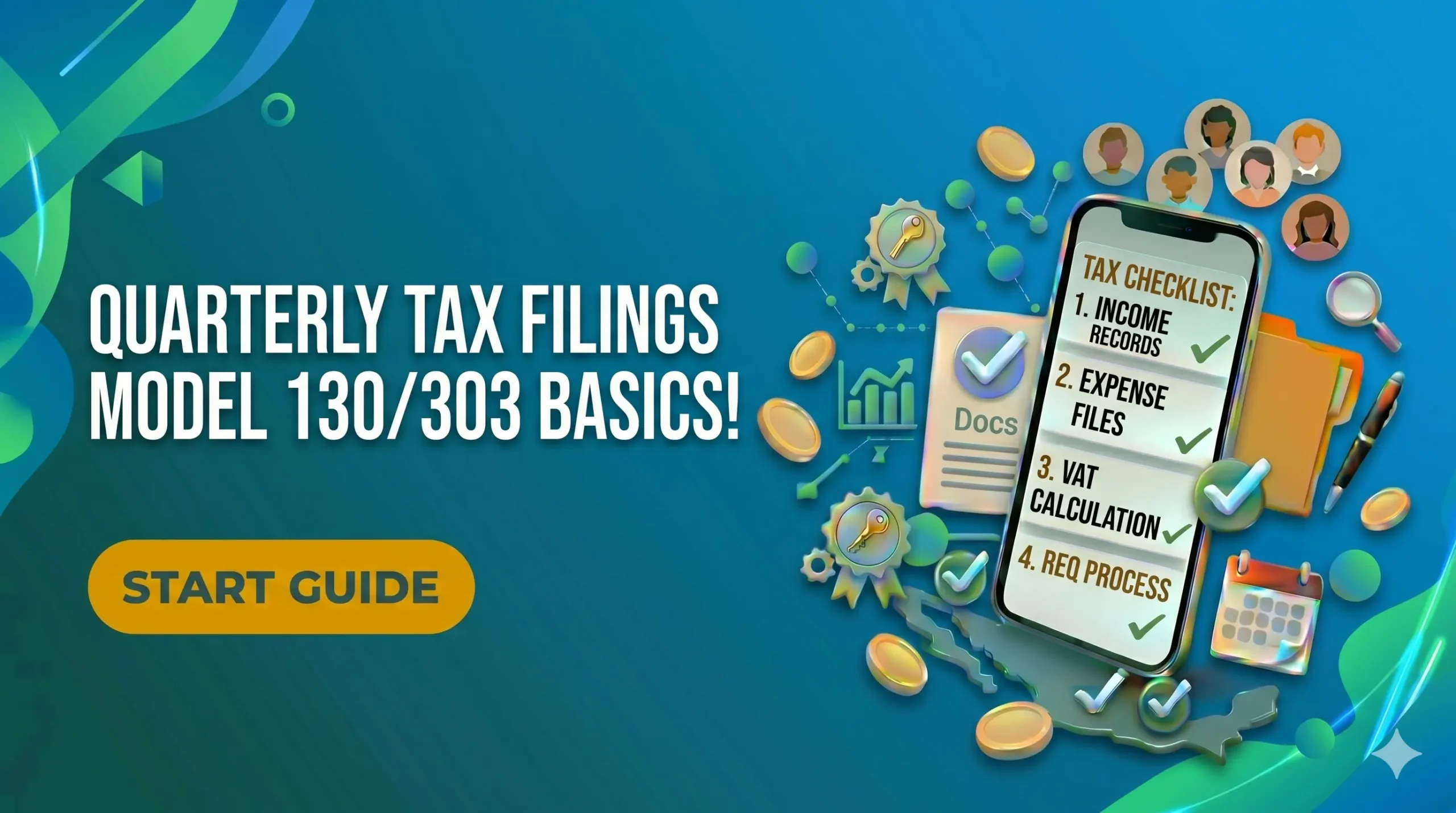
Picture this: your first quarter as an autónomo in Spain ends, and a Spanish friend asks whether you’ve “done your trimestrales yet.” You haven’t. You aren’t sure what Model 130 or Model 303 are, how Hacienda calculates them, or what happens if you get them wrong. This guide explains both forms in plain English, quarter by quarter, so you can file with confidence.
Disclosure: This post may contain affiliate links. We may earn a commission at no extra cost to you if you make a purchase through these links. Read full disclosure.
My first quarterly deadline was spent in a café in Ruzafa, Valencia, with a laptop, a stack of crumpled receipts, and the Agencia Tributaria website open in a browser that refused to accept my digital certificate. I had invoiced a handful of clients, bought a new monitor, and paid for software subscriptions. I had no idea which of those mattered for which form. If you’re in that position now, you’re not doing anything wrong. Nobody explains this system to newcomers. You’re expected to just know.
So let’s fix that.
What Model 130 and Model 303 Actually Are
Every registered autónomo in Spain deals with two recurring quarterly returns. One is about the tax you pay on your own earnings. The other is about the tax you collect from clients on Hacienda’s behalf. They are completely separate obligations, but they share deadlines, so most people file them together.
Model 303: The Quarterly IVA Return
Model 303 is your quarterly IVA return. IVA is Spain’s value added tax, the equivalent of VAT in the UK or sales tax in the US, though the mechanics differ. When you send an invoice to a Spanish client for most professional services, you add IVA on top of your fee. That IVA is never your money. You hold it temporarily and pass it to Hacienda every quarter.
The form works on a simple subtraction. You declare the IVA you charged on your invoices, called IVA repercutido. Then you subtract the IVA you paid on legitimate business purchases, called IVA soportado. That covers things like your laptop, your coworking membership, or your accounting software. The difference is what you owe. If you paid more IVA on expenses than you charged, the result is negative. You can usually carry that balance forward to offset future quarters, and in the final quarter of the year you can choose to request a refund.
Here’s a practical example. Lucía is a freelance translator in Seville. In her first quarter she invoices three Spanish agencies and adds IVA to each invoice. She also buys a new ergonomic chair and pays for a translation memory tool, and both purchases came with IVA on the receipts. On her Model 303 she reports the IVA collected from the agencies, subtracts the IVA on the chair and software, and pays the remainder. If she had bought an expensive new computer that quarter, she might have ended up with a negative balance to carry forward. I go much deeper into the box-by-box logic in Model 303 (IVA) Explained: What Freelancers Need to Know.
Not every freelancer charges IVA on everything. Some activities are exempt, including certain healthcare and educational services. Your invoices to clients outside Spain also follow different rules, which I’ll cover shortly. Even so, most autónomos must file Model 303 every quarter as long as they’re registered for an activity that falls within the IVA system.
Model 130: Paying Your Income Tax in Advance
Model 130 is a pago fraccionado, an advance payment toward your annual income tax (IRPF). Spain doesn’t let self-employed people wait until the end of the year to settle up. Instead, Hacienda collects a slice of your expected tax every quarter, based on your actual profit so far.
The calculation is cumulative, and this catches almost everyone off guard. You don’t calculate each quarter in isolation. You take all your income from the start of the year to the end of the current quarter. You subtract all your deductible expenses for the same period. Then you apply a fixed percentage set by the tax rules to that year-to-date net profit. From that result, you subtract the Model 130 payments you already made in earlier quarters, plus any IRPF your clients withheld from your invoices. What’s left is what you pay this quarter.
Take Tom, a British web developer living in Málaga. His first quarter is slow, so his Model 130 is small. His second quarter is busy. When he files in July, he doesn’t just calculate tax on April to June. He calculates on January to June combined, then subtracts what he paid in April. If his third quarter is slow but the year overall is profitable, his payment might be tiny or even zero. It never goes negative within the year, because any overpayment gets reconciled on the annual return. For a full walkthrough of the arithmetic, read Model 130 Explained: Paying Income Tax Advances as Autónomo.
Note that Model 130 is only an advance. Your real income tax bill is settled through the annual Renta return, filed in late spring of the following year. Everything you paid through Model 130 gets credited against that final bill.
The Model 130 Exemption Most People Have Never Heard Of
Not every autónomo has to file Model 130. If most of your invoicing in the previous year went to Spanish businesses or professionals who withheld IRPF directly from your invoices, you may be exempt. The share has to clear a threshold set out in the rules. The logic is that Hacienda is already collecting your income tax in advance through those withholdings, called retenciones, so a separate advance payment would be redundant.
This mostly helps freelancers who work almost entirely for Spanish companies, such as a consultant billing Spanish agencies or an illustrator working for Spanish publishers. If your clients are abroad, or are private individuals, or are Spanish businesses that don’t withhold, you’ll almost certainly need to file Model 130. Check this with your advisor during your first year rather than guessing. Skipping a form you were actually required to file is one of the quickest ways to receive an unpleasant letter.
Side-by-Side Comparison
| Feature | Model 303 | Model 130 |
|---|---|---|
| What tax it covers | IVA, the value added tax you charge clients | IRPF, your personal income tax |
| Whose money it is | Your clients’ tax, which you pass on to Hacienda | Your own tax on your profit |
| How it’s calculated | IVA charged minus IVA paid on business expenses, for the quarter only | A fixed percentage of year-to-date net profit, minus earlier payments and withholdings |
| Can the result be negative | Yes, carried forward or refunded at year end | No, the minimum quarterly payment is zero |
| Annual counterpart | Model 390 annual IVA summary | The annual Renta return, Model 100 |
| Possible exemptions | Certain exempt activities | Freelancers whose income mostly had IRPF withheld in the prior year |
| Do you file in a quarter with no activity | Yes, usually a zero return | Yes, usually a zero return |
The Quarterly Calendar and How Filing Works in Practice
Spain divides the tax year into four quarters, and each one comes with a filing window in the month after it closes. The deadline rhythm is the same every year. Once you’ve lived through one cycle, it becomes muscle memory.
When Each Quarter Is Due
| Quarter | Months covered | When you file |
|---|---|---|
| First quarter | January, February, March | April |
| Second quarter | April, May, June | July |
| Third quarter | July, August, September | October |
| Fourth quarter | October, November, December | January of the following year |
For the first three quarters, the window opens at the start of the month and closes partway through. Don’t treat it as a full month. The fourth-quarter window in January is somewhat longer. January is also when you file Model 390, the annual IVA summary, alongside your final Model 303. Hacienda publishes its official taxpayer calendar every year, and you should check exact cut-off dates there, because weekends and public holidays can shift them.
The second-quarter deadline in July and the third-quarter deadline in October are the ones expats most often miss. July falls right as Spain eases into summer mode. Clients slow down, the heat makes everything feel optional, and your brain says you’ll handle it next week. October arrives after a long August, when half your contacts were unreachable and you lost track of your receipts. Set calendar reminders early in each filing month, not near the end of it. For help building a cash buffer so these dates never cause panic, read How to Budget for Quarterly Taxes in Spain (Autónomo).
Filing Online Through the Agencia Tributaria
Model 130 and Model 303 are filed online through the Sede Electrónica of the Agencia Tributaria, which most people call AEAT or simply Hacienda. Paper filing is effectively not an option for autónomos. You’ll need a way to identify yourself electronically, usually a digital certificate (certificado digital) or the Cl@ve system. If you haven’t set up either yet, do it before your first deadline, not during it. The setup process can involve appointments, browser quirks, and identity checks that take longer than you’d expect. Everything you need is in Cl@ve and Digital Certificate: Accessing AEAT (Tax Agency) Online.
Here’s the basic process for a typical quarter:
- Gather every invoice you issued during the quarter, plus every receipt or invoice for business expenses that you plan to deduct.
- Total your income and the IVA you charged, separating Spanish clients, EU business clients, and clients outside the EU.
- Total your deductible expenses and the IVA you paid on them, keeping only expenses that come with a proper invoice in your name and NIF.
- Log into the AEAT Sede Electrónica with your digital certificate or Cl@ve and open the Model 303 form for the correct quarter.
- Enter the IVA figures in the relevant boxes, check the result, and choose how to handle it: pay, carry forward, or request a refund in the final quarter.
- Open Model 130 and enter your cumulative income and expenses from the start of the year, plus any earlier payments and any IRPF withheld by clients.
- Choose your payment method, submit both forms, and download the PDF receipts with their verification codes for your records.
The forms themselves aren’t mysterious once you’ve seen them. Most of the difficulty comes from steps one to three: keeping clean records, knowing which expenses qualify, and classifying your clients correctly.
Paying What You Owe
When you submit a return with an amount to pay, you normally have a few options. Direct debit (domiciliación) is the most popular because Hacienda pulls the money from your Spanish bank account on the deadline day. The catch is that direct debit has to be set up several days before the final deadline, so if you leave filing to the last moment, this option disappears. You can also pay immediately by bank charge through your online banking connection, or generate a payment reference code (NRC) through your bank and enter it in the form.
If you genuinely can’t pay the full amount, you can request a deferral or installment plan (aplazamiento o fraccionamiento) when you file. It’s better to file on time and ask for a payment plan than to skip filing because the money isn’t there. Late filing is treated much more harshly than late payment arranged through the official channels.
Another rule newcomers misunderstand: you must file even when nothing happened. If you’re registered as autónomo and had a quarter with zero invoices, you still submit Model 303 and Model 130, typically with zero results. Missing a “nothing” return still counts as missing a return.
Where Foreign Freelancers Get Tripped Up
The Spanish system was designed with a fairly traditional freelancer in mind: someone billing Spanish clients in euros. Expats rarely fit that mould. We have clients in London, New York, and Berlin. We get paid in dollars or pounds. Some of us also have tax obligations in our home countries. Here’s where things usually go sideways.
Foreign Clients and the IVA Puzzle
If you invoice a business client in another EU country, the usual rule for professional services is the reverse charge mechanism. You don’t charge Spanish IVA. Your client accounts for the VAT in their own country instead. To do this properly, you generally need to be registered in the EU’s intra-community operator register, known in Spain as ROI and checked through the VIES system. You also need to report these operations on Model 303 in the appropriate boxes, plus on the separate informational Model 349. Your invoice should state clearly that the reverse charge applies.
For business clients outside the EU, such as a US startup or a UK agency post-Brexit, most professional services are considered to take place outside Spain for IVA purposes. In practice you usually don’t charge Spanish IVA, but the income still appears on your Model 303 in the box for operations not subject to Spanish IVA, and it absolutely still counts toward your Model 130 profit.
The trap is assuming that “no IVA on this invoice” means “this income doesn’t need to be declared anywhere.” That is never true. All your income goes on Model 130. All your invoices, taxable or not, need to be issued correctly. Read How to Issue a Correct Spanish Invoice: Mandatory Fields before you send your first international invoice. Rules also differ when your clients are private individuals rather than businesses, so get advice if you sell directly to consumers abroad.
Getting Paid in Other Currencies
When a client pays you in dollars or pounds, your Spanish books still have to be in euros. You’ll need a consistent, defensible way to convert each invoice, usually based on the exchange rate on the invoice date. You’ll also have to handle the small differences between what you invoiced and what actually landed in your account after conversion. Record-keeping matters here because one sloppy quarter can put your Model 130 cumulative totals out of sync for the rest of the year. I walk through a clean system for this in Foreign-Currency Invoices and Spanish VAT: Record-Keeping for Freelancers.
My own habit, learned the hard way: every invoice gets a euro equivalent recorded the day I issue it, in a spreadsheet column I never edit after the fact. When the money arrives, I note the actual euro amount received in a separate column. That way I can always explain to an advisor, or to Hacienda, where each figure came from.
Expenses That Do and Don’t Count
Deductible expenses reduce both your Model 303 balance, through the IVA you paid, and your Model 130 balance, through lower profit. That makes it tempting to deduct everything. Hacienda is strict, though. An expense generally has to be linked to your activity, properly recorded, and backed by a full invoice (factura completa) showing your name and NIF. A simplified till receipt from a café usually isn’t enough. Your RETA social security contributions are deductible for income tax. Software, professional equipment, coworking fees, and accountant’s fees are typical deductions. Your personal groceries and your weekend trip to Granada are not.
Working from home is a grey area, with specific rules on what share of utilities you can claim. Meals and travel deductions come with conditions, too. A detailed rundown is in What Counts as a Business Expense in Spain for Freelancers?, which I recommend reading before you start asking every shop for a factura.
What Happens If You File Late
Life happens. You get sick, your digital certificate expires, a family emergency pulls you home. If you miss a quarterly deadline, it matters a lot whether you correct it yourself or Hacienda finds it first.
If you file late on your own initiative, before Hacienda has sent you any formal request (requerimiento), the system applies a late-filing surcharge, called a recargo extemporáneo. The surcharge scales with the delay. A return filed shortly after the deadline gets a smaller surcharge than one filed many months later, and interest can be added for longer delays. It’s an unwelcome cost, but it’s predictable, and it’s generally lighter than the alternative.
If Hacienda spots the missing or incorrect return first and contacts you, the situation changes. You may face a formal penalty procedure (procedimiento sancionador), and penalties at that stage are typically considerably heavier than the voluntary surcharges. That’s why the advice from every experienced freelancer I know is the same: if you realise you missed a filing or made a mistake, fix it yourself as soon as possible. Don’t wait and hope.
To make sure you never miss a letter, set up electronic notifications properly. Hacienda increasingly communicates through its electronic notification system, and an unread notification still counts as delivered after a set period. If you haven’t done this yet, read How to Set Up AEAT Online Notifications (DEHú) in Spain.
Getting Professional Help, Especially If You Also File Abroad
Some freelancers handle their quarterlies alone and do fine. Others try for a year, lose two weekends per quarter, and decide their time is worth more. There’s no shame in either path. It does matter, though, that you pick the right kind of help for your situation.
When a Local Gestor Is Enough
If you’re an EU or UK citizen with no tax obligations back home, and your business is fairly simple, a Spanish gestor or asesor fiscal may be all you need. A good one will file your Model 130 and Model 303 each quarter, prepare your annual Model 390 and Renta, remind you about deadlines, and flag expenses that won’t pass inspection. Quality varies enormously, though. Some gestorías are excellent. Others are glorified data-entry shops that will happily file whatever you send them without checking it. Before you sign up with anyone, read How to Choose an Accountant Gestor in Spain: Pricing and Red Flags.
The limitation of a typical local gestor is scope. Most are experts in Spanish tax and nothing else. They’ll do your trimestrales perfectly. Ask them how your Spanish autónomo income interacts with a US federal return, though, and you’ll likely get a polite shrug.
Why Americans Need a Different Kind of Support
If you’re a US citizen, the United States taxes you on your worldwide income no matter where you live. That means your Spanish freelance income gets reported twice: once to Hacienda through your quarterlies and Renta, and once to the IRS on your US return. Spanish Model 130 payments, US estimated tax payments, the foreign tax credit, the foreign earned income exclusion, self-employment tax, and foreign bank account reporting all have to fit together. If one side is done in isolation from the other, you can end up overpaying, underpaying, or filing forms that contradict each other.
This is where Taxes for Expats comes in. It’s a firm built specifically around US citizens living abroad, and in my experience it’s one of the most sensible solutions for American autónomos in Spain who are tired of feeling caught between two tax agencies. The value isn’t just preparing a US return. It’s having professionals who understand that your Model 130 figures, your Spanish IRPF, and your Spanish social security contributions all affect how your US return should be built.
Consider Daniel, an American copywriter in Madrid. He registered as autónomo, files his Spanish quarterlies through a gestor, and assumed his US obligations were simple. Then he realised he hadn’t considered US self-employment tax, didn’t know whether to claim the foreign tax credit or the exclusion, and had never filed FBAR for his Spanish bank accounts. A conversation with Taxes for Expats let him line up his Spanish and US filings so that the taxes he pays in Spain are used correctly on the US side, rather than being ignored or double-counted.
The self-employment tax question deserves special attention. The US and Spain have a totalization agreement that generally assigns social security coverage to one country. For self-employed people living in Spain, that usually means the Spanish system, which keeps you from paying into both systems on the same income. Using it correctly involves documentation from the Spanish side, plus the right treatment on your US return. The mechanics are explained in The US-Spain Totalization Agreement: Social Security Contributions, and it’s exactly the sort of detail a cross-border specialist like Taxes for Expats is set up to handle. For a broader look at how quarterly autónomo income flows onto US forms, read Autonomo Income on a US Return: Self-Employment Tax, Model 130, and Double Filing.
How to Work With Taxes for Expats Alongside Your Spanish Filings
A practical setup for American freelancers looks like this:
- Keep one clean set of records in euros, with every invoice, every expense, and every currency conversion documented as you go.
- File your Spanish Model 130 and Model 303 every quarter, either yourself or through a trusted gestor, using those records.
- Keep copies of every submitted quarterly return, your annual Model 390, and your Spanish Renta, because these become key evidence for your US filing.
- Share that full Spanish paper trail with Taxes for Expats when preparing your US return, so the Spanish taxes you paid are reflected correctly.
- Ask them early in the year about US estimated payments, totalization documentation, and bank account reporting, rather than discovering issues at the April or extension deadline.
Pricing for cross-border tax preparation depends on how complex your situation is. Number of forms, foreign accounts, self-employment, property, and catch-up filings all play a part. Check the Taxes for Expats website for current service details and fees, and confirm the exact scope of what they’ll handle for your Spanish and US situation before you commit. It also helps to ask them directly how they coordinate with a Spanish gestor, so you know who is responsible for what.
A Realistic Quarterly Routine That Keeps You Sane
Whether or not you use professional help, a simple routine makes the whole process far less painful. Here’s what I eventually settled into after a few chaotic years:
- Every Friday, spend ten minutes saving that week’s invoices and expense receipts into a single folder for the current quarter.
- At the end of each month, update a spreadsheet with income, IVA charged, expenses, IVA paid, and euro conversions for foreign payments.
- On the first working day of each filing month, open your figures, check them against your bank statements, and either file or send them to your advisor.
- Move the estimated Model 303 and Model 130 amounts into a separate savings pot as soon as invoices are paid, so the money is never “spent” before Hacienda asks for it.
- Once a year, review your setup with your advisor, and if you’re American, with Taxes for Expats, to catch any changes in your situation before they cause problems.
The first few quarters will feel like a lot. Then, one day, you’ll realise that April, July, October, and January have become routine. You’ll still grumble about it, but that’s just part of being an autónomo in Spain. And if you’re an American juggling Hacienda and the IRS, you don’t have to work out the two-country puzzle on your own. Getting Taxes for Expats involved early is one of the simplest ways to turn a stressful double obligation into a predictable yearly process.
Disclaimer
This article is for general informational purposes only and does not constitute professional advice. Laws, prices and regulations vary by location and change over time. Consult a qualified professional for guidance on your specific situation.