How to Set Up Water Service in a Spanish Home
Moving into a new home in Spain often feels like a triumphant end to a marathon, until you turn the kitchen tap and hear nothing but a dry hiss. I personally spent my first three nights in a beautiful Madrid apartment washing my face with bottled water because I underestimated the complexity of the local utility registry. This guide resolves that specific frustration, walking you through the administrative labyrinth of Spanish water services.
Disclosure: This post may contain affiliate links. We may earn a commission at no extra cost to you if you make a purchase through these links. Read full disclosure.
Deciphering the Spanish Water Utility Landscape
The first thing you need to understand is that water in Spain is not managed by a single national provider. Instead, it is a fragmented system of municipal monopolies. Depending on where you have moved, you will deal with a specific entity that has the exclusive right to provide water to your neighborhood. For example, if you are in the capital, you will be dealing with Canal de Isabel II. In Barcelona, it is typically Agbar, and in Valencia, you’ll find yourself at the offices of Emivasa.
This localized system is one of the many reasons why Living in Spain as a Foreigner: Complete Housing & Daily Life Guide can feel like learning twenty different sets of rules. Unlike electricity, which has been liberalized and allows you to shop around for the best rates, water is a take-it-or-leave-it deal. You cannot switch providers if you find the service poor or the prices high. This makes the initial setup even more critical, as you need to ensure the contract is established correctly from day one to avoid overcharging or inheriting the previous tenant's debt.
Many expats choose to use platforms like Spotahome to find their initial housing because these services often help clarify which utilities are included in the rent and which require a manual setup. However, even with help, the responsibility usually falls on the resident to ensure the "titularidad" (ownership) of the contract matches the person living in the property. This is vital for your residency paperwork later, as utility bills are frequently used as "prueba de vida" or proof of address for various administrative hurdles.
The Administrative Journey: From Application to Flow
There are generally two scenarios you will encounter when setting up your water. The first is a "Cambio de Titularidad," which is a simple change of the name on an existing, active account. This is the preferred route because it is cheaper and faster. The second is an "Alta de Suministro," which occurs if the water has been physically cut off or if you are moving into a brand-new building.
When I moved into my second apartment in Seville, the water had been disconnected for over a year. I had to apply for a brand-new connection, which involved a technician coming to the property to inspect the "contador" (meter). If you find yourself in this situation, be prepared for a wait. It is not uncommon for a new connection to take five to ten business days to activate. During this period, having a reliable data connection is essential for tracking your application and communicating with the provider. I found that having a local eSIM from Airalo was a lifesaver, allowing me to stay connected and use translation apps while standing in line at the municipal water office, where the public Wi-Fi is notoriously spotty.
The Hidden Requirement: The Boletín de Agua
If you are requesting a new connection (Alta), the company will likely ask for a "Boletín de Instalación de Agua." This is a certificate issued by a licensed plumber stating that the internal plumbing of the house meets current safety and sanitary regulations. This document can be a major headache for those Renting in Spain: Contracts, Deposits, and Tenant Rights, as it is technically the landlord's responsibility to provide it, but they may try to push the cost or the effort onto you.
The certificate is usually required if the property is very old or if the water has been off for more than two years. If you need to find a plumber to issue one, expect to pay between 60 and 150 Euros for the inspection and the paperwork. Always check your contract to see if this is covered under the landlord's obligations to provide a "habitable" home. If the water was working when you signed, but the contract simply needs a name change, you can usually bypass this expensive step.
Navigating the Meter Inspection
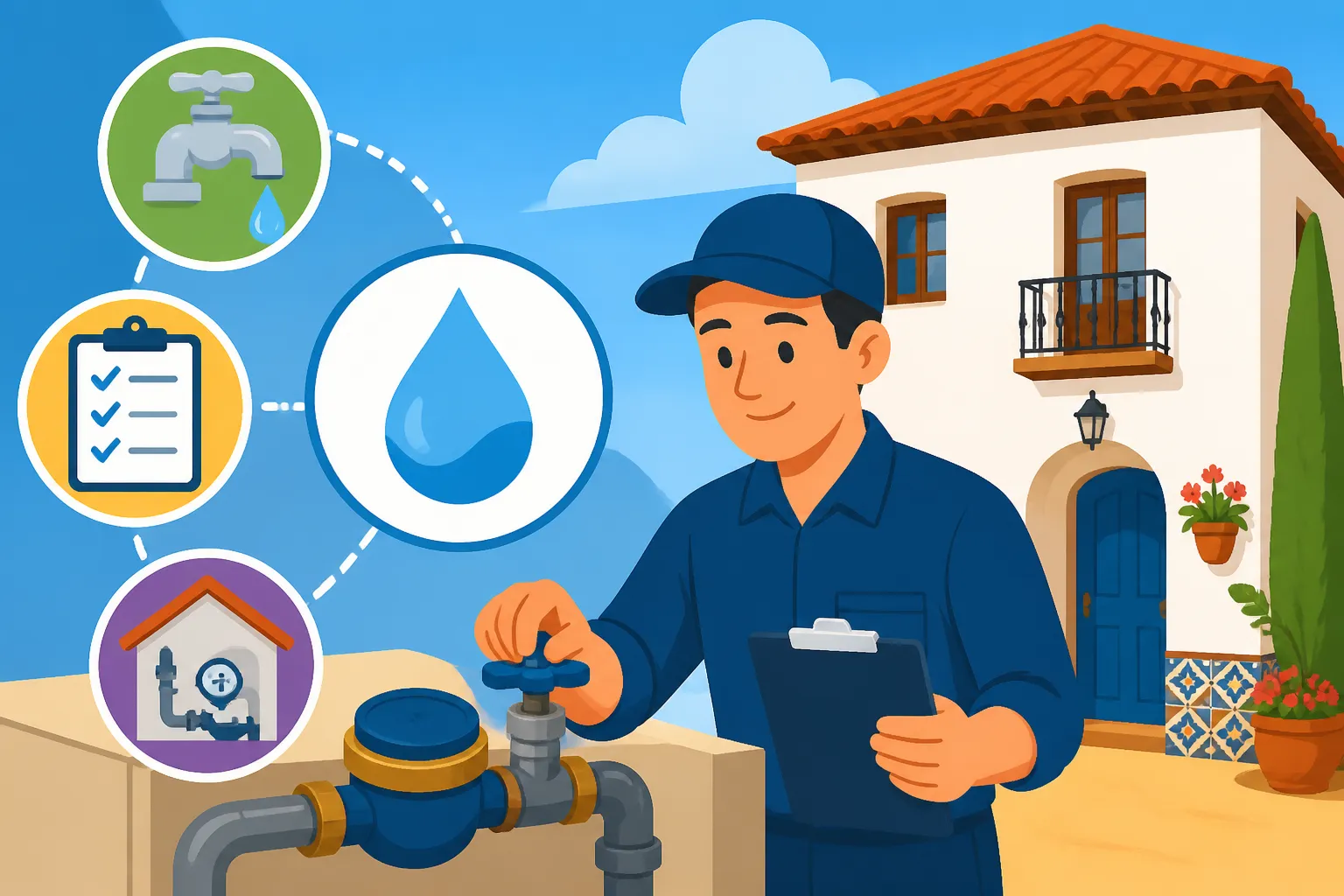
The "contador" is the physical meter that measures your consumption. In older Spanish buildings, these are often grouped together in a central "cuarto de contadores" (meter room) on the ground floor or in the basement. You will likely need a specific key to access this room, which the "Presidente de la Comunidad" or the "Portero" (doorman) will have.
When the technician arrives to activate your service, they will need access to this room. If you cannot provide it, they will leave, and you will be pushed to the back of the queue. I learned this the hard way after taking a half-day off work only to realize I didn't have the key to the basement. Make sure you have located the meter and secured access at least 24 hours before your scheduled appointment.
Essential Documentation for a Seamless Setup
Spanish bureaucracy is famous for its love of paperwork, and the water company is no exception. You should never show up at a utility office (or attempt an online registration) without a complete dossier. The requirements vary slightly by region, but the core list remains the same. You are trying to prove who you are, where you live, and that you have a way to pay.
First, you need your identity documents. For foreigners, this means your original passport and your NIE (Número de Identidad de Extranjero). If you have a TIE (the physical residency card), bring that as well. The water company will not accept a contract in your name without a valid NIE. This is a common sticking point for new arrivals who have not yet navigated the Spanish Bureaucracy for Daily Life: Padrón, IDs, and Local Services.
Second, you must provide proof of your right to occupy the property. If you are a tenant, this is your signed rental agreement. If you have recently purchased the home, you will need the "Escritura" (title deeds) or a "Nota Simple." Be aware that if you are Buying Property in Spain as a Foreigner: Process and Costs, the notary usually handles the notification to the utility companies, but you should always follow up manually to ensure the "domiciliación" (direct debit) has been set up with your bank details.
| Document Required | Purpose | Tip for Expats |
|---|---|---|
| NIE / TIE / Passport | Identity Verification | Always bring the original and at least two photocopies. |
| Rental Contract / Deeds | Proof of Address | Ensure the address matches exactly what is on the water meter. |
| Bank IBAN | Payment Setup | Most companies only accept Spanish or SEPA-zone bank accounts. |
| Certificado de Empadronamiento | Proof of Residency | Some regions offer lower "social rates" if you are registered on the Padrón. |
| Previous Bill | Reference Number | Essential for name changes to identify the specific "Contrato" or "Poliza." |
The Power of the Padrón
In some municipalities, your water rate is tied to how many people are officially living in the house. This is why you should prioritize getting your How to Register Your Address (Empadronamiento) as a Renter in Spain done as soon as possible. By providing a How to Get a Spanish ‘Certificado de Empadronamiento’ copy to the water company, you may qualify for a "tarifa reducida" or a larger allowance of water at the lowest price tier. Without it, the company might charge you the "non-resident" rate, which is significantly higher because they assume the property is a holiday home.
Managing Consumption and Understanding the Bill
Once the water is flowing, the next hurdle is the bill, which usually arrives every two months (bimestral). Spanish water bills are complex because they often include several unrelated taxes. You aren't just paying for the water you drink; you are paying for the maintenance of the sewage system (alcantarillado), a "canon" for water treatment improvements, and sometimes even a municipal trash collection fee (basura).
The bill is divided into a "fixed part" and a "variable part." The fixed part is what you pay just for the privilege of being connected to the grid, based on the diameter of your pipes or the type of property. The variable part is based on how many cubic meters you consume. Spain is a water-scarce country, so the pricing is tiered: the more you use, the more expensive each subsequent liter becomes.
Direct Debits and Domiciliación
It is highly recommended to use the "domiciliación bancaria" system. This is a direct debit that allows the utility company to pull the funds directly from your account. You can learn How to Set Up Automatic Utility Payments in Spain (Domiciliación) through your online banking portal or by providing your IBAN during the water registration process. This is the standard way to How to Pay Bills in Spain: Direct Debit, Cash, and Online Portals, and it prevents service cuts due to forgotten mail or lost paper bills.
If you are worried about the tap water quality—which varies wildly across the country—I suggest checking the local "dureza" (hardness). In coastal areas like Alicante or the Balearic Islands, the water is very "hard" and high in calcium. Many expats head to Amazon Spain to buy high-quality water filtration jugs or under-sink systems to avoid the environmental and physical cost of buying plastic bottles every week.
Common Challenges and Troubleshooting
Even with all your documents in order, things can go wrong. One of the most common issues for new tenants is discovering that the previous occupant left an unpaid balance. In Spain, the debt can sometimes be attached to the "punto de suministro" (the physical location) rather than just the person. This is why you should always check the status of the bills before signing a lease. This is also a critical part of understanding What is ‘Fianza’ in Spain? Deposit Rules Explained Simply, as some landlords will try to deduct unpaid utility bills from your security deposit at the end of your stay.
If you find that your water pressure is low, the issue might not be the city supply but your "calentador" (water heater) or a semi-closed "llave de paso" (stopcock). Every Spanish home has a main stopcock, usually located near the entrance, in the kitchen, or in the bathroom. It is a small lever or wheel that can be turned to cut off all water to the property. If you move in and the water is registered but not flowing, check every cupboard for this valve.
Dealing with Leaks and "Averías"
If you see a sudden, massive spike in your bill, you likely have a "fuga" (leak). Because many Spanish pipes are old and buried deep within thick stone or brick walls, a silent leak in a toilet cistern or an underground pipe can go unnoticed for weeks. The water companies in Spain are generally not forgiving about leaks; they expect you to monitor your meter. A pro-tip from a veteran: take a photo of your meter on the first day of every month. It only takes ten seconds, but it provides you with the evidence you need to dispute a bill or identify a leak before it costs you hundreds of Euros.
If the problem is outside your house (on the street), you should call the "Averías" number found on the top of your bill. This is a 24-hour service. If you are still working on your language skills, have a neighbor help you, or keep a list of basic phrases ready. Knowing how to say "no hay agua" (there is no water) or "hay una inundación" (there is a flood) is essential for those first few months of residency.
Disclaimer
The information provided in this guide is for general informational purposes only and does not constitute legal or professional administrative advice. Utility regulations, required documentation, and municipal providers in Spain are subject to frequent changes and regional variations. While every effort has been made to ensure the accuracy of this content as of June 2026, readers are strongly encouraged to verify specific requirements with their local "Ayuntamiento" or water service provider before proceeding with any applications or payments.