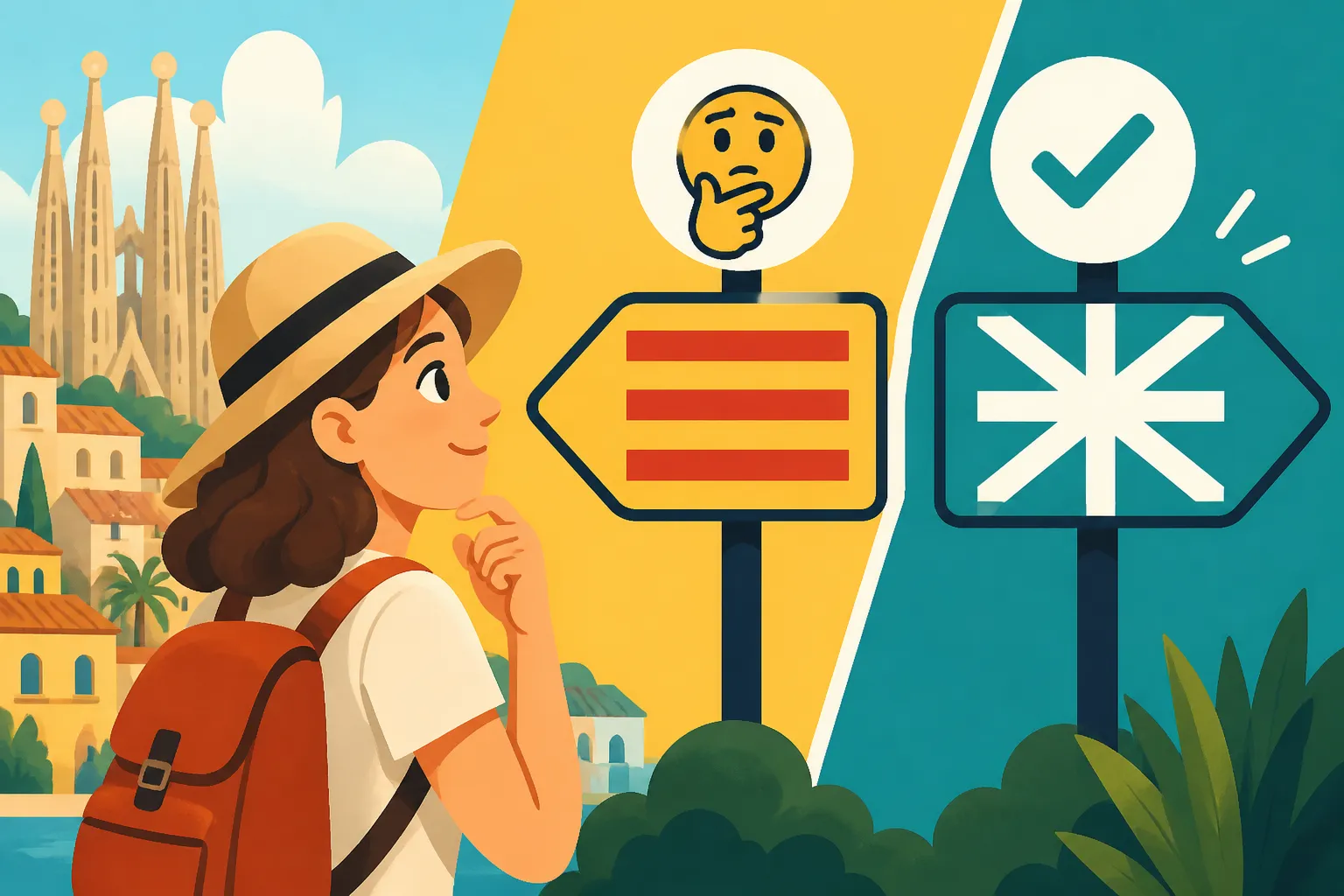
How to Handle Catalan or Basque Signs as a Visitor
Stepping off the plane or train in Spain, you might assume you’re ready to navigate with your trusty Spanish phrasebook, only to be met by signs that look… different. Suddenly, the street names, metro stations, and even shop fronts are in Catalan or Basque, and your carefully practiced Castilian Spanish feels about as useful as a chocolate teapot. It’s a common, and frankly, a bit disorienting, experience for many visitors. This guide is here to walk you through exactly what those non-Spanish signs mean, why they're there, and how you can confidently navigate the rich linguistic landscapes of Catalonia and the Basque Country without missing a beat.
Disclosure: This post may contain affiliate links. We may earn a commission at no extra cost to you if you make a purchase through these links. Read full disclosure.
The Linguistic Tapestry of Spain: More Than Just Castilian Spanish
When you first arrive, it’s easy to assume “Spanish” is one monolithic language across the entire country. But oh, my friend, Spain is a beautiful mosaic of cultures and languages, and understanding this is key to appreciating your visit, especially in certain regions. It's perfectly normal to feel a little thrown off when you see words like Carrer instead of Calle, or Kale instead of Calle, but it's all part of the local identity.
Spain has several co-official languages, each deeply rooted in the history and culture of its autonomous community. Beyond Castilian Spanish, which is spoken nationwide, you'll encounter Catalan (Català) in Catalonia, the Balearic Islands, and Valencia (where it’s known as Valencian), and Basque (Euskera) in the Basque Country and parts of Navarre. Then there's Galician (Galego) in Galicia, which has its own distinct charm, leaning closer to Portuguese. This linguistic diversity is a source of immense pride for the locals, representing centuries of distinct heritage and self-identity. It's not designed to confuse you; rather, it’s a living testament to the region's unique past. For a deeper dive, explore our guide on Regional Languages in Spain: Catalan, Basque, and Galician.
Understanding the Importance of Local Languages
For centuries, these languages faced suppression, especially during the Franco dictatorship, which attempted to impose Castilian Spanish as the sole language of the nation. Since the transition to democracy, there has been a significant effort to revive and promote these languages, making them central to education, public administration, and daily life. So, when you see a street sign in Catalan in Barcelona, or a menu in Basque in San Sebastián, it's not just a language; it’s a powerful symbol of cultural resilience and regional identity.
Embracing this linguistic reality, even as a temporary visitor, can significantly enhance your experience. It opens doors to understanding the local psyche and connects you more deeply with the people you meet. While Castilian Spanish will always get you by, a little awareness of the local tongue shows respect and often elicits a warmer response from residents.
Decoding the Signs: Practical Tips for Navigating in Catalonia and the Basque Country
Okay, so you’ve arrived, you know why the signs are different, but how do you actually get from point A to point B when your map says "Plaza de Cataluña" and the metro sign screams "Plaça de Catalunya"? Don't sweat it! There are very practical ways to navigate this linguistic maze. The good news is that most major cities in these regions, especially tourist-heavy ones like Barcelona, Girona, Bilbao, and San Sebastián, usually have bilingual signage in Castilian Spanish alongside the local language, at least in key areas.
However, once you venture off the main tourist drags or into smaller towns, the local language might become more dominant. This is where your smart strategies come into play. Always remember that while the words might look intimidating, many public symbols and pictograms are universally understood, so don't overlook those visual cues.
Public Transport and Street Names
Navigating public transport can feel like a game of linguistic bingo, especially with metro or bus maps. In Catalonia, for example, a "station" might be estació (Catalan) or estación (Castilian). A "street" is carrer (Catalan) or calle (Castilian). In the Basque Country, it's geltokia for "station" and kale for "street". These differences can initially be jarring.
When looking at maps or booking tickets, pay close attention to the city you're in. For example, when searching for transport on platforms like Omio, you might need to type in "Barcelona" but then see "Plaça de Catalunya" as a station option. Most major transport apps and websites integrate these local names, so they are generally reliable. Always cross-reference with numbers or colors on metro lines if available. For a detailed guide on moving around, check out Getting Around Spanish Cities: Metro, Bus, Tram, and Bikes.
Shops, Restaurants, and Tourist Information
When you’re hungry, the last thing you want is a language barrier getting between you and some delicious tapas. In many eateries, particularly in tourist-friendly areas, menus are often bilingual, featuring both the local language and Castilian Spanish, and sometimes even English. If not, don’t hesitate to ask for "la carta en castellano, por favor" or "the menu in Spanish, please." Most places are well-accustomed to international visitors.
Tourist information centers are your best friend. They are usually staffed by multilingual locals who can provide maps and advice in various languages, including English. They can clarify place names, suggest routes, and generally make your life much easier. Don't be shy about popping in for help; that's what they're there for! If you're looking to book experiences, platforms like GetYourGuide often list tours and activities with language options clearly stated, ensuring you get an English-speaking guide if needed.
Bridging the Language Gap: Essential Phrases and Tools
Even if you’re a pro at Castilian Spanish, having a few phrases in Catalan or Basque up your sleeve can make a world of difference. It shows respect and genuine interest in the local culture, and believe me, locals truly appreciate the effort! It’s like magic; even a simple "bon dia" (good day in Catalan) or "egun on" (good morning in Basque) can instantly warm up an interaction.
Beyond a few basic phrases, modern technology is your best ally. Your smartphone can be an invaluable tool in bridging the language gap, whether you're trying to understand a sign, order food, or simply have a quick chat with a local.
Your Pocket Translator: Apps and Dictionaries
Having a good translation app downloaded to your phone is practically mandatory for any traveler navigating a foreign language. Google Translate and DeepL are excellent choices, offering both text and voice translation. Many even have a camera function where you can point your phone at a sign, and it will instantly translate the text on your screen – absolute lifesavers for those tricky street names or museum descriptions.
Remember to download the offline language packs for Catalan, Basque, and Spanish before you leave your accommodation or have reliable Wi-Fi. This way, you won't be caught out if you lose signal, which can happen in remote areas or underground metro stations. Having a reliable offline translation tool will give you immense confidence, especially when facing a complex menu or a detailed information panel. You can find more tips in our guide on Using Translation Apps in Spain: What Works Best.
Basic Survival Phrases in Catalan and Basque
While you're not expected to become fluent overnight, learning a few courteous phrases goes a long way. Here’s a little cheat sheet to get you started:
| English | Castilian Spanish | Catalan | Basque (Euskera) |
|---|---|---|---|
| Hello / Good day | Hola / Buenos días | Bon dia | Egun on |
| Goodbye | Adiós | Adéu | Agur |
| Please | Por favor | Si us plau | Mesedez |
| Thank you | Gracias | Gràcies | Eskerrik asko |
| Excuse me | Perdón / Con permiso | Perdoni / Amb permís | Barkatu / Baimenarekin |
| Yes | Sí | Sí | Bai |
| No | No | No | Ez |
| Do you speak English? | ¿Habla inglés? | Parla anglès? | Ingelesez hitz egiten duzu? |
| I don't understand | No entiendo | No ho entenc | Ez dut ulertzen |
| How much? | ¿Cuánto cuesta? | Quant costa? | Zenbat da? |
Even attempting "Bon dia" or "Eskerrik asko" will often earn you a smile and a willingness from locals to switch to Castilian Spanish or even English if they can. It shows you respect their culture, and that gesture is always appreciated.
Regional Nuances: What to Expect in Each Autonomous Community
While the basic strategy of using translation apps and learning a few phrases applies across the board, there are subtle differences in the prevalence and impact of local languages depending on which region you’re visiting. Understanding these regional nuances will help you prepare and manage your expectations.
It’s worth noting that even within these communities, the linguistic landscape can vary. For example, in Catalonia, Catalan might be more dominant in rural areas or smaller towns, while in major cities like Barcelona, Castilian Spanish and English are more widely understood, especially in areas frequented by tourists. This isn’t a hard and fast rule, but a general observation to keep in mind.
Catalonia and the Balearics
In Catalonia, Catalan is the language of government, education, and often, daily life. You'll see it everywhere: public signs, shop names, newspapers, and television. Many locals, especially younger generations, speak Catalan as their first language, although virtually all are also fluent in Castilian Spanish. In the Balearic Islands (Mallorca, Menorca, Ibiza), a dialect of Catalan, known as Balear, is spoken, and the same principles apply.
Tourists in Barcelona will find that while Catalan signage is pervasive, communication in Castilian Spanish or English is generally easy in tourist zones. However, if you venture to towns like Girona or Tarragona, or even further into the Catalan countryside, Catalan becomes much more prominent. Don't be surprised if locals initially address you in Catalan – a simple "Lo siento, ¿habla castellano?" (I'm sorry, do you speak Castilian?) or "Habla inglés?" will usually prompt them to switch. Making an effort with "bon dia" or "gràcies" will be met with appreciation. For exploring beyond Barcelona, our guide Catalonia Beyond Barcelona: What to See offers great insights.
Basque Country (Euskadi)
The Basque Country, or Euskadi, presents a unique linguistic challenge because Euskera (Basque) is a language isolate, meaning it’s not related to Spanish, Catalan, or any other Romance language. This makes it particularly challenging for those relying on cognates (words that sound similar across languages). So, words like ongi etorri (welcome) or kaixo (hello) are completely distinct.
However, almost all official signs in the Basque Country are bilingual, displaying both Basque and Castilian Spanish. In major cities like Bilbao and San Sebastián, Castilian Spanish is widely spoken, and many people, especially those working in tourism, will also speak English. As you move into more rural, traditionally Basque-speaking areas, the local language becomes more prevalent. Again, a polite attempt at "kaixo" or "eskerrik asko" (thank you) can be a fantastic icebreaker. Even though it's a tricky language, the locals are often very proud of their linguistic heritage and appreciate any visitor who makes an effort. To learn more about this vibrant region, check out The Basque Country: Food, Coast, and Culture.
Embracing the Local Flavor: Beyond Just Reading Signs
Ultimately, encountering Catalan or Basque signs isn't a barrier; it's an invitation to immerse yourself deeper into the rich cultural tapestry of Spain. Think of it as an added layer of discovery, a unique puzzle to solve that reveals more about the place you're visiting.
Don't let the language differences deter you from exploring these incredible regions. In fact, many travelers find that navigating these linguistic quirks adds to the adventure. It’s part of what makes Spain such a fascinating and multifaceted country to explore. Take a deep breath, use your tools, embrace the challenge, and most importantly, enjoy the journey! You'll come away with not just memories of stunning sights and delicious food, but also a deeper appreciation for the diverse identities that make up Spain.
Disclaimer
The information provided in this guide is intended for general informational purposes only and may not be exhaustive or constitute professional advice. While we strive to provide accurate and up-to-date information, linguistic situations can evolve, and local customs or regulations may vary. Always verify critical information, such as transport schedules or specific local rules, with official sources.