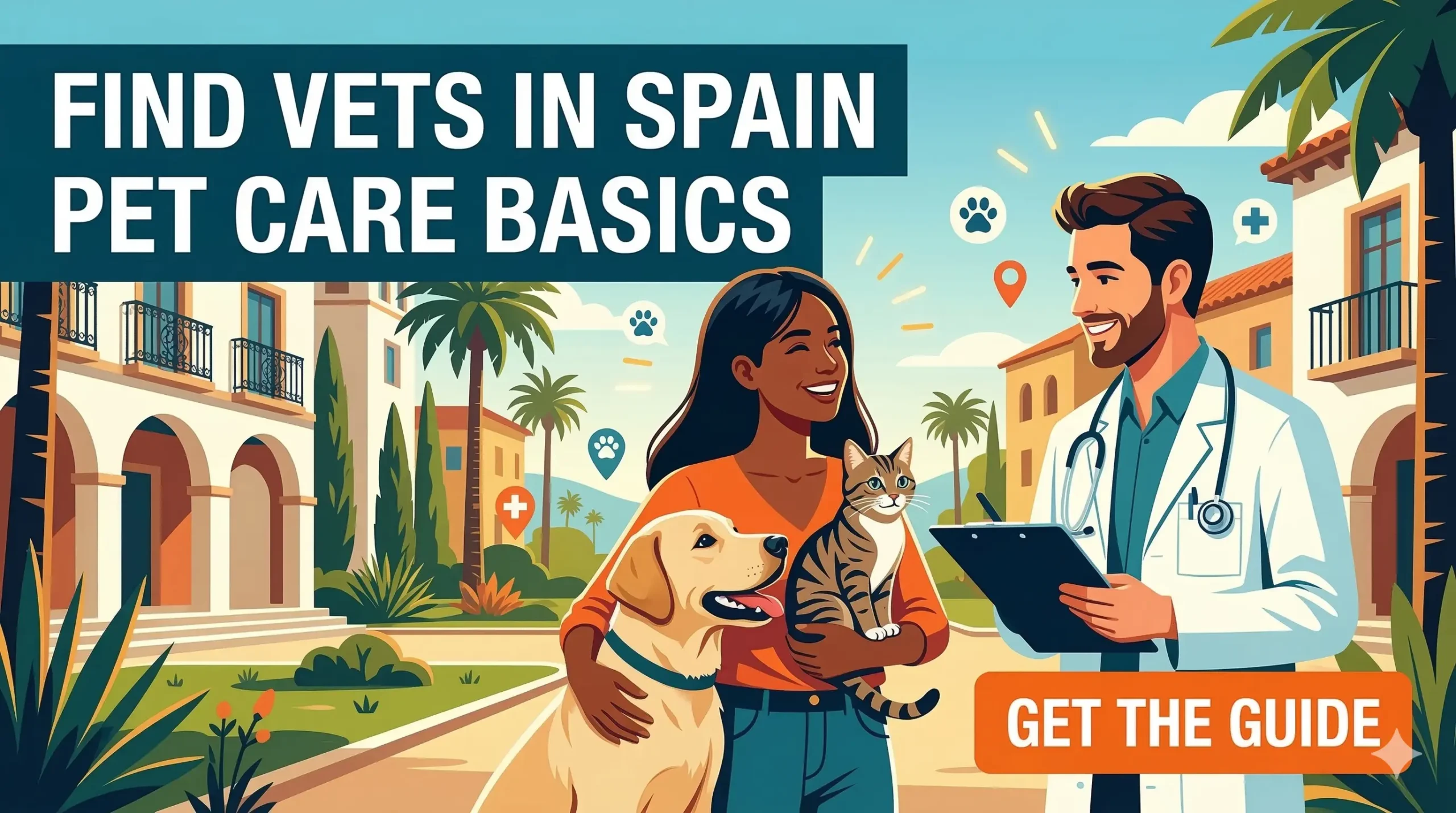
How to Find Veterinarians in Spain: Pet Healthcare Basics
You land in Valencia with a dog who suddenly won’t eat, or a cat who needs her yearly jabs, and you have no idea where to start. Spanish clinics, regional registries and late-night emergencies all work differently from home. This guide explains how to find a trustworthy vet in Spain, what the first visit involves, and how to avoid the mistakes most newcomers make.
Disclosure: This post may contain affiliate links. We may earn a commission at no extra cost to you if you make a purchase through these links. Read full disclosure.
How Veterinary Care Works in Spain
The first thing that surprises people is that Spain has no public veterinary system. There is no NHS-style safety net for animals, and no state clinic you can fall back on. Almost every vet in the country is a private business. Some are one-vet neighbourhood practices above a pet shop. Others are large referral hospitals with MRI scanners and specialist surgeons. You choose freely, you pay at the time of the visit, and you can move to another clinic whenever you like.
That freedom is useful, but it puts the research on your shoulders. When I first arrived, I assumed the nearest clinic to my flat would be fine. It was perfectly competent for routine vaccines. It was also closed every afternoon for the long lunch break and all of Sunday, and I only found that out at the worst possible moment. Learn from that.
Types of Veterinary Practices You Will Encounter
Spanish vet signage follows a fairly consistent vocabulary. Knowing it helps you decode Google Maps results quickly.
| Term on the Sign | What It Usually Means | Best For | Watch Out For |
|---|---|---|---|
| Clínica veterinaria | Standard neighbourhood practice, often one to three vets | Vaccines, check-ups, minor illness, microchipping | Limited hours, may close at lunch and on weekends |
| Centro veterinario | Similar to a clinic, sometimes with grooming or a shop attached | Routine care and convenience | Quality varies widely, check the vet team, not the shop |
| Hospital veterinario | Larger facility with hospitalisation, surgery and often 24-hour cover | Surgery, overnight stays, serious illness | Higher costs, possible waits for non-urgent cases |
| Urgencias veterinarias 24 horas | Round-the-clock emergency service | Night, weekend and holiday emergencies | Emergency surcharges, not a place for routine visits |
| Veterinario a domicilio | Mobile vet who visits your home | Anxious animals, elderly pets, multi-cat homes, euthanasia at home | Cannot do advanced diagnostics on the spot |
| Clínica de exóticos | Practice trained in rabbits, birds, reptiles and small mammals | Non-dog, non-cat pets | Fewer options outside big cities |
In practice, most expats end up with two relationships. They have a local clinic for everyday care and a 24-hour hospital saved in their phone for emergencies. The two often work together. Your regular vet refers you for scans or surgery, and the hospital sends reports back.
Regional Differences That Affect Your Pet
Spain’s seventeen autonomous communities each set their own animal identification and registration rules within a national framework. A Madrid resident and someone living in Andalusia might face slightly different requirements for rabies vaccination frequency, registration paperwork or dog licensing for certain breeds. Your vet is usually the most reliable local source here. Registering animals in the regional database is part of their daily work, and they know exactly what your comunidad expects.
For the bigger picture on the legal side, see Pet Ownership in Spain: Registration, Vet Visits, and Rules.
Why Your Own Health Insurance Will Not Help Here
This catches a surprising number of newcomers. Your personal health or travel policy covers you, not your animals. Global plans such as SafetyWing or Cigna Global are built around human medical care. Even the most comprehensive expat plan will not pay a vet bill. If you want help with vet costs, you need a separate pet insurance policy (seguro para mascotas), usually from a Spanish insurer.
There is one overlap worth knowing about. If your dog bites you during a stressful moment, or a stray cat scratches you badly, the treatment you receive at a human urgencias is a matter for your own medical cover. Check that your policy handles that kind of minor accident smoothly.
Finding the Right Vet for Your Pet
Finding a good vet in Spain is mostly about combining online research with old-fashioned word of mouth. Spanish neighbourhoods run on recommendations. The dog-walking crowd in your local park is a goldmine.
Step-by-Step: Building Your Shortlist
- Search in Spanish, not English. Type “clínica veterinaria” plus your barrio or town into Google Maps. English searches return fewer and often less relevant results.
- Filter by opening hours immediately. Look for clinics open on Saturday mornings and those that list continuous hours (horario continuo) rather than a split day.
- Read reviews for patterns, not stars. One angry review about a bill means little. Ten reviews praising how a vet explained a diagnosis clearly means a lot.
- Check the provincial Colegio Oficial de Veterinarios. Each province has an official college of veterinarians. These bodies regulate the profession and can confirm that a vet is registered to practise.
- Ask in local expat and pet groups. Facebook groups for your city, neighbourhood WhatsApp groups and breed clubs are full of honest opinions.
- Talk to people in the park. Spaniards are generally very happy to talk about their dogs. A simple “¿A qué veterinario vas?” usually gets a passionate recommendation.
- Identify a 24-hour hospital within reasonable driving or taxi distance. Do this before you need it, and save the number and address in your phone.
- Visit in person before an emergency. Pop in to buy food or ask a question. You learn a lot from the reception, the cleanliness and how staff treat animals in the waiting room.
Finding an English-Speaking Vet
In Madrid, Barcelona, Málaga, Alicante, Valencia, the Balearics and the Canary Islands, English-speaking vets are fairly easy to find. Many trained abroad or work with international clients. Clinics on the Costa del Sol and Costa Blanca often advertise English, German or Dutch on their websites because so many residents are foreign.
In inland towns and smaller cities, it gets harder. You may find a vet with basic English, or none at all. Here is my honest advice: a brilliant vet who speaks only Spanish is better than a mediocre one who speaks English. You can bridge the language gap. You cannot bridge a skills gap.
To make it work, prepare a short written summary of your pet’s history in Spanish before the visit. Use a translation app during the appointment for anything complex. See Using Translation Apps in Spain: What Works Best for which tools handle medical vocabulary reasonably well. Most vets are patient with this, especially if you show willingness.
Useful phrases to carry with you:
- “Mi perro no come desde ayer” – My dog hasn’t eaten since yesterday
- “Mi gato vomita” – My cat is vomiting
- “Tiene diarrea” – He or she has diarrhoea
- “Cojea de la pata trasera” – He or she is limping on a back leg
- “¿Es urgente?” – Is it urgent?
- “¿Me puede dar un presupuesto?” – Can you give me a cost estimate?
- “¿Tiene seguro?” – Do you have insurance? You will often be asked this.
Questions to Ask Before You Commit
When you phone or visit a clinic, a few questions quickly separate the good from the merely convenient:
- Do you have someone on call outside opening hours, or do you refer to a specific emergency hospital?
- Can you do blood tests and X-rays on site, or do you send them out?
- Do you see exotic animals? Ask this if you have a rabbit, bird or reptile.
- Can you issue or update an EU pet passport? Not every vet is authorised to issue them.
- Will you give me a written estimate before any procedure?
- Do you send vaccination reminders by SMS, email or WhatsApp?
Many Spanish clinics run on WhatsApp for appointments, reminders and even quick photo consultations. If that suits you, ask about it.
Scenario: Moving to a Rural Village
Imagine you relocate with two dogs to a white village in the Serranía de Ronda. The nearest clinic is twenty minutes away by car. It opens mornings and a few afternoons a week. The closest 24-hour hospital is in Málaga or along the coast, close to an hour’s drive.
In this situation, I would register with the local clinic for routine care straight away. Ask the vet directly what happens if your dog is hit by a car at night. Rural vets often give out a personal mobile number for genuine emergencies. They know the reality of their patch. Also, keep a basic pet first-aid kit at home and learn how to take your dog’s temperature. When help is far away, those first thirty minutes matter enormously.
Your First Vet Visit and Routine Care
Once you have chosen a clinic, book a “first visit” or “consulta general” to get your pet registered as a patient. Bring everything you have. Spanish clinics take documentation seriously, partly because they are legally responsible for updating official records.
What to Bring to the First Appointment
- Your pet’s EU pet passport, or your home-country vaccination records if you have not yet obtained one
- Any recent blood work, X-rays or specialist reports, ideally translated or at least summarised
- Your NIE or passport, because the clinic needs owner details for the regional registry
- Your Spanish address, which the microchip registration must reflect
- A list of current medications and doses
- Your pet insurance details, if you have a policy
If you are still in the middle of an international move, see Bringing Pets to Spain: EU Pet Passport and Entry Requirements for the documents needed at the border. Then hand them all to your new vet.
Vaccinations and Microchipping
These two sit together because, in Spain, the vet who vaccinates your animal is also the person who links that vaccine to your pet’s identity in the official system.
Microchipping is the foundation of everything. Dogs must carry an identification microchip everywhere in Spain. Cats and ferrets are increasingly covered by the same identification obligation under national animal welfare rules, and several regions already required it. Practically speaking, treat a microchip as mandatory for any cat or dog.
The chip is a tiny transponder about the size of a grain of rice. It is injected under the skin, usually between the shoulder blades. It feels very much like a normal vaccination, and most animals barely react. The vet scans it to confirm it reads correctly. Then they register the number in your autonomous community’s official pet database. Andalusia uses RAIA, for example, and the regional databases connect through the national REIAC network so a lost animal can be identified across regions.
If your pet arrives already chipped from abroad, your vet will scan the existing chip. If it meets the international ISO standard, they will usually register it in the regional system rather than implant a new one. Older non-standard chips sometimes cannot be read by Spanish scanners. In that case, a second chip may be recommended.
The step people forget is keeping the registration updated. When you move flat, change phone number, or move between regions, the details attached to the chip need changing too. A microchip with an old phone number is almost useless if your dog slips out of the door during a thunderstorm. Ask your vet how to update details in your region. Some regions allow online changes; others need the vet to do it.
Vaccinations follow a core-plus-lifestyle approach. For dogs, rabies is the vaccine with legal weight. Most regions require it, and the required frequency varies by community. The other core vaccines, often given as a combined shot, protect against distemper, parvovirus, hepatitis and leptospirosis. Kennel cough is usually recommended if your dog goes to daycare, kennels or training classes. For cats, the core combination covers panleukopenia and the cat flu viruses. Rabies is required if they travel. Feline leukaemia is often advised for cats that go outdoors.
Every vaccine should be recorded in the pet passport or cartilla sanitaria, with the vaccine sticker, date and vet’s stamp. Keep this booklet safe. It is your proof for travel, boarding kennels, groomers and, in some regions, inspections by local police.
For a dog-specific look at the paperwork, see Spanish Dog Registration: Microchip, Vaccines, and Local Rules.
Parasites and Spain-Specific Health Risks
This is where your Spanish vet earns their fee. The parasites and hazards here differ from those in northern Europe, North America or the UK, and many newcomers underestimate them.
Leishmaniasis is the big one. It is a serious disease spread by sandflies, especially around the Mediterranean, in central Spain and in the south. Infected dogs can develop skin problems, weight loss and kidney damage. Prevention usually combines repellent collars or spot-on treatments, avoiding evening walks in high-risk months, and in some cases a vaccine. Your vet will likely recommend an annual blood test. Do not skip this conversation.
Pine processionary caterpillars (procesionaria) appear in late winter and spring. They march in long lines under pine trees in parks and on beaches. Their hairs cause severe reactions if a curious dog sniffs or licks them, including swelling of the tongue and tissue death. If your dog touches one, rinse the mouth gently with water without rubbing, and go to a vet immediately.
Grass awns (espigas) are dry, arrow-shaped seed heads common in summer fields. They work their way into ears, noses, eyes and between toes. Sudden head shaking, violent sneezing or constant paw licking after a countryside walk often means an awn. Vets in Spain remove these constantly.
Heat is another serious risk, especially for flat-faced breeds such as pugs and French bulldogs. Pavements in Seville or Córdoba in July can burn paw pads. Walk early and late, carry water, and never leave a pet in a car. See Heatwave Safety in Spain: Practical Tips for Expats for wider precautions that apply to the whole household.
Ticks and heartworm are also present in many areas. Ask your vet to put together a year-round parasite plan that suits your region and your pet’s lifestyle.
Understanding Costs and Pet Insurance
Vet prices in Spain are set by each clinic, and they vary between cities, neighbourhoods and practice types. Routine consultations and vaccines in a small town clinic are generally more affordable than the same services at a large hospital in central Barcelona. Emergency visits, night fees, hospitalisation and advanced imaging cost considerably more. Always ask for a written estimate (presupuesto) before surgery or any procedure beyond a simple check. Spanish vets are used to this request.
For a realistic look at what visits involve, see Vet Visits in Spain: Typical Prices and What to Expect.
Pet insurance is widely available from Spanish insurers. Policies come in two broad shapes:
- Liability-only cover (responsabilidad civil) pays if your dog injures someone or damages property. Spanish law requires it for dogs designated as potentially dangerous breeds, and national rules have been moving towards wider liability obligations for dog owners. Check what currently applies to you.
- Veterinary cover contributes to treatment costs after an excess or within annual limits, and sometimes includes routine care.
When comparing policies, check the age limits for new pets, waiting periods, exclusions for hereditary conditions, and whether you can use any vet or must choose from a network. If you already use a broker such as Innoinsure for your own cover, it is worth asking whether they can also compare pet policies. Read every exclusion yourself either way, and confirm current figures on each insurer’s own pages.
Emergencies, Out-of-Hours Care and Settling In
Emergencies are where poor preparation hurts most. Spain’s split working day, long weekends (puentes) and August holidays mean your regular clinic may simply not be there when you need it.
What Counts as a Veterinary Emergency
Go straight to a 24-hour vet if your pet shows any of these signs:
- Difficulty breathing, choking, or blue or very pale gums
- A swollen, hard abdomen with unproductive retching, which can mean bloat in large dogs and is life-threatening
- Collapse, seizures, or sudden inability to stand
- Contact with processionary caterpillars, or swelling of the face or tongue
- Suspected poisoning, including rat bait, antifreeze, chocolate, grapes, or human medication
- Heatstroke signs: heavy panting, drooling, confusion or vomiting after heat exposure
- Being hit by a car, even if your pet seems fine afterwards
- A male cat straining to urinate and producing nothing
- Bleeding that will not stop
Remember that 112 is the emergency number for people, not animals. It will not dispatch a vet. If you are injured yourself in the same incident, see Emergency Numbers in Spain: 112 and When to Use It.
Steps to Take in a Night-Time Emergency
- Stay calm and keep your pet still and warm, unless the problem is heatstroke. In that case, cool them gradually with tepid water, never ice.
- Call the 24-hour hospital before you leave. Tell them what is happening so they can prepare. Simple Spanish works: “Vengo con un perro que no respira bien.”
- Grab the pet passport, any packaging if poisoning is suspected, and your phone with a translation app ready.
- Transport safely. Small animals should travel in a carrier. Large injured dogs can be moved on a blanket used as a stretcher.
- Expect to pay a deposit or pay on the spot. Most emergency hospitals require payment at the time of treatment, and insurance claims are usually settled afterwards.
- Ask for a written report (informe) to take back to your regular vet.
Human pharmacies cannot replace a vet in an emergency, and you should never give your pet human painkillers. Common ones such as ibuprofen and paracetamol can be deadly to cats and dogs. A late-night pharmacy can be useful for things like sterile saline or bandages for your first-aid kit. See How to Find a ‘Farmacia de Guardia’ Near You in Spain for how to locate one.
Scenario: Sunday Evening in Madrid
Picture this. It is Sunday evening in Madrid. Your Labrador has eaten something from under a park bench and is now vomiting repeatedly. Your clinic in Chamberí closed on Saturday afternoon.
The well-prepared expat opens their phone, finds the 24-hour hospital they saved weeks ago, calls ahead and takes a taxi. Many Madrid taxi drivers will take a dog in a carrier or on a lead if you ask politely and mention the emergency, though some may refuse. Within the hour, the dog is assessed, given fluids and kept under observation. On Monday, the report goes to the regular vet, who takes over follow-up care.
The unprepared expat spends forty minutes searching online, calls three closed clinics and arrives much later. With poisoning, that delay can be the difference between a quick recovery and serious illness. The single most valuable thing you can do this week is find and save your nearest 24-hour vet.
Housing, Moving and Long-Term Pet Life in Spain
Your choice of home affects your pet’s health more than you might expect. A ground-floor flat with a patio suits a large dog in a way that a fifth-floor walk-up does not. Building rules (normas de la comunidad) sometimes restrict pets in shared areas. When house hunting, ask landlords about pets in writing and get permission recorded in the contract. See How to Find Pet-Friendly Rentals in Spain and What to Ask for practical questions to raise.
If you are still in the planning stage, coordinating your pet’s flight or road journey with your household shipment saves a lot of stress. See Relocating to Spain With Pets: Coordinating Pet Transport and Household Shipping for how to time it all.
Once you are settled, build a rhythm. Plan an annual check-up with vaccines and a leishmaniasis test. Keep year-round parasite protection going. Update the microchip whenever your details change. Keep your vet’s WhatsApp number and the 24-hour hospital address in your phone. Spain is a wonderful place to live with animals. There are dog-friendly terraces, beaches with designated dog areas, and endless countryside walks. With the right vet beside you, your pet can enjoy all of it safely.
Disclaimer
This article is for general informational purposes only and does not constitute professional advice. Laws, prices and regulations vary by location and change over time. Consult a qualified professional for guidance on your specific situation.